Loading page, please wait…
Vaidra Logo
Vaidra

Top 4 items + smart groups

UPSC GPT
New
Current Affairs
Daily Solutions
Daily Puzzle
Mains Evaluator

Version 2.0.0 • Built with ❤️ for UPSC aspirants

Loading...
Loading...
Loading...
Loading...
Loading...
Loading...
Loading...
Loading...
Loading...
Loading...
Loading...
Loading...
Loading...

Historical Context - UPSC International Relations

What is Historical Context in UPSC International Relations?

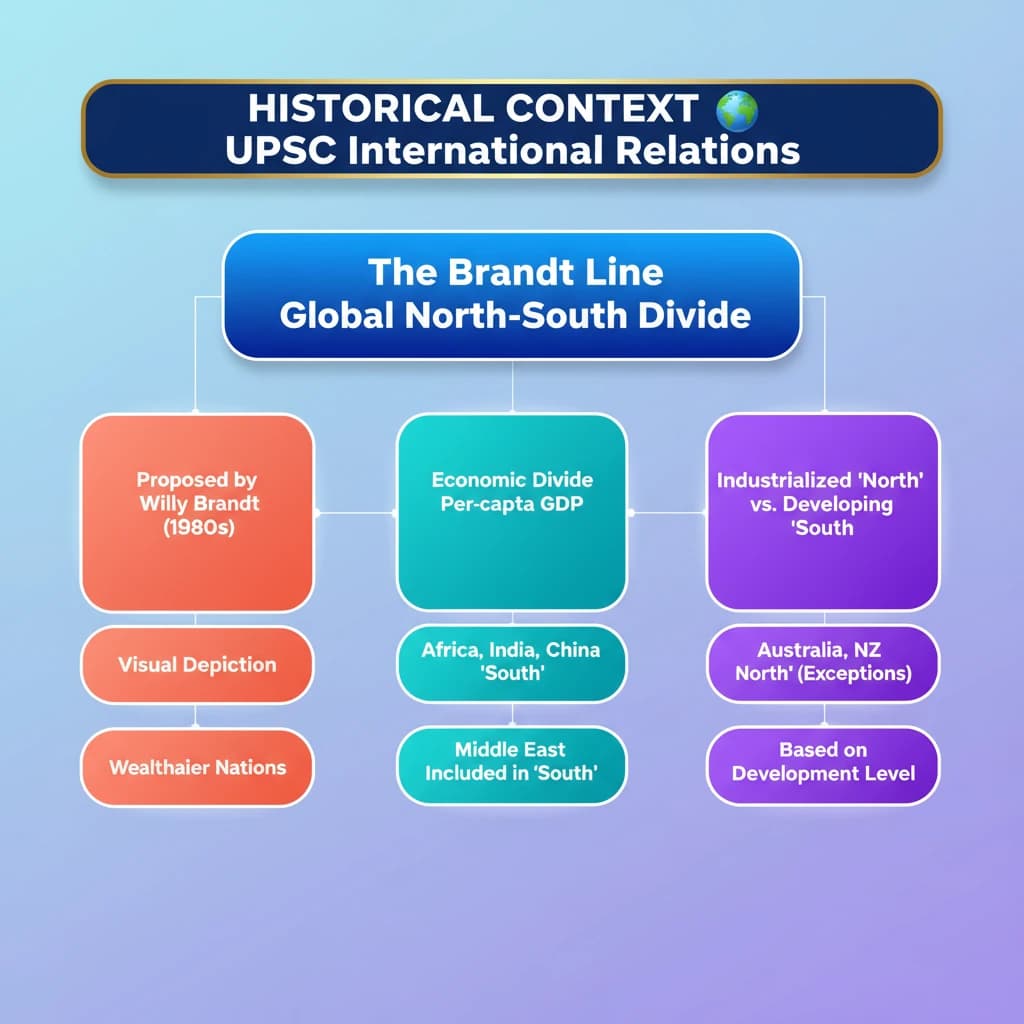
Historical Context is a key topic under International Relations for UPSC Civil Services Examination. Key points include: The Brandt Line was proposed by Willy Brandt in the 1980s.. It visually depicted the global North-South economic divide based on per-capita GDP.. The line separated wealthier industrialized nations from less developed countries.. Understanding this topic is essential for both UPSC Prelims and Mains preparation.

Why is Historical Context important for UPSC exam?

Historical Context is a Medium-level topic in UPSC International Relations. It is tested in both Prelims (factual MCQs) and Mains (analytical answer writing). Previous year UPSC questions have frequently covered aspects of Historical Context, making it essential for comprehensive IAS preparation.

How to prepare Historical Context for UPSC?

To prepare Historical Context for UPSC: (1) Study the comprehensive notes covering all key concepts on Vaidra. (2) Practice previous year questions on this topic. (3) Connect it with current affairs using daily updates. (4) Revise using key takeaways and mind maps available for International Relations. (5) Write practice answers linking Historical Context to related GS Paper topics.

Key takeaways of Historical Context for UPSC

  • The Brandt Line was proposed by Willy Brandt in the 1980s.
  • It visually depicted the global North-South economic divide based on per-capita GDP.
  • The line separated wealthier industrialized nations from less developed countries.
  • It included parts of Africa, Middle East, India, and China in the 'South'.
  • Australia and New Zealand were exceptions, placed in the 'North' due to high development.
  • While a historical concept, it highlights enduring global economic disparities.
Historical Context

Historical Context

Medium⏱️ 6 min read✓ 95% Verified
international relations

📖 Introduction

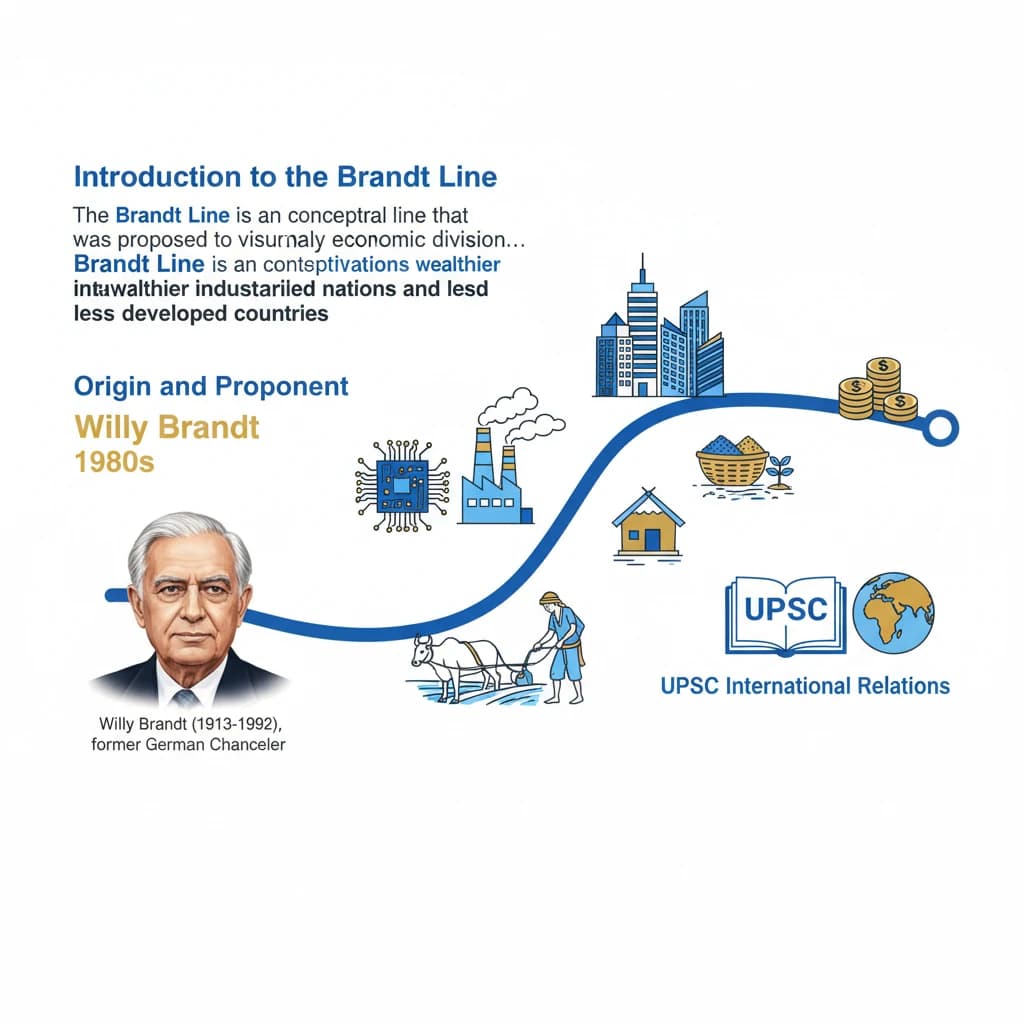
<h4>Introduction to the Brandt Line</h4><p>The <strong>Brandt Line</strong> is a conceptual line that was proposed to visually represent the global economic division between the wealthier industrialized nations and the less developed countries. It serves as a powerful symbol of the economic disparities prevalent worldwide.</p><h4>Origin and Proponent</h4><p>This significant concept was introduced by former German Chancellor <strong>Willy Brandt</strong>. He proposed the line in the <strong>1980s</strong>, aiming to highlight the stark economic contrast between the global North and South.</p><div class='info-box'><p><strong>Key Proponent:</strong> Willy Brandt, former German Chancellor</p><p><strong>Year Proposed:</strong> 1980s</p><p><strong>Purpose:</strong> To visually depict the global North-South divide based on economic indicators.</p></div><h4>Symbolism of the Divide</h4><p>The <strong>Brandt Line</strong> primarily symbolizes the profound <strong>global economic divide</strong>. This division is largely based upon <strong>per-capita GDP</strong>, with countries above the line generally having higher incomes and industrialization, and those below having lower incomes and being more agrarian or developing.</p><div class='key-point-box'><p>The Brandt Line illustrates the <strong>North-South divide</strong>, a term describing the socio-economic and political differences between developed countries (often in the Northern Hemisphere) and developing countries (often in the Southern Hemisphere).</p></div><h4>Geographical Representation</h4><p>Geographically, the line is depicted as a zigzagging boundary across continents. It encompasses a significant portion of the Southern Hemisphere and parts of the Northern Hemisphere that are economically less developed.</p><ul><li><strong>Countries Included (South):</strong> Parts of <strong>Africa</strong>, the <strong>Middle East</strong>, <strong>India</strong>, and <strong>China</strong>. These regions generally fell below the line due to lower per-capita GDPs at the time.</li><li><strong>Countries Excluded (North):</strong> Notably, <strong>Australia</strong> and <strong>New Zealand</strong>, despite being geographically in the Southern Hemisphere, are considered part of the 'Global North' due to their high economic development and are thus positioned above the Brandt Line.</li></ul><div class='exam-tip-box'><p>For UPSC, understanding the <strong>Brandt Line</strong> helps in conceptualizing historical global economic inequalities and can be used to introduce discussions on development, globalization, and international relations in <strong>GS Paper 2</strong> and <strong>GS Paper 3</strong>.</p></div>
Concept Diagram

💡 Key Takeaways

  • •The Brandt Line was proposed by Willy Brandt in the 1980s.
  • •It visually depicted the global North-South economic divide based on per-capita GDP.
  • •The line separated wealthier industrialized nations from less developed countries.
  • •It included parts of Africa, Middle East, India, and China in the 'South'.
  • •Australia and New Zealand were exceptions, placed in the 'North' due to high development.
  • •While a historical concept, it highlights enduring global economic disparities.

🧠 Memory Techniques

Memory Aid
95% Verified Content

📚 Reference Sources

•United Nations Development Programme (UNDP) reports on global development
•Academic texts on International Political Economy and Development Studies
•Drishti IAS Summary (provided source)

Related Topics

Loading related topics...
Explore:International Relations Topics·All Subjects·Daily Current Affairs·Editorial Analysis·Previous Year Questions·UPSC GPT
Back
All Subjects

Topics

0 topics • 0 completed

Loading topics...
Loading...
Loading...
Loading...
Loading...
Loading...
Overall Progress0%
Historical Context - UPSC International Relations