Loading page, please wait…
Vaidra Logo
Vaidra

Top 4 items + smart groups

UPSC GPT
New
Current Affairs
Daily Solutions
Daily Puzzle
Mains Evaluator

Version 2.0.0 • Built with ❤️ for UPSC aspirants

Loading...
Loading...
Loading...
Loading...
Loading...
Loading...
Loading...
Loading...
Loading...
Loading...
Loading...
Loading...
Loading...
Back
All Subjects

Topics

0 topics • 0 completed

Loading topics...
Loading...
Loading...
Loading...
Loading...
Loading...
Overall Progress0%

New Non-Permanent Members of UNSC - UPSC International Relations

What is New Non-Permanent Members of UNSC in UPSC International Relations?

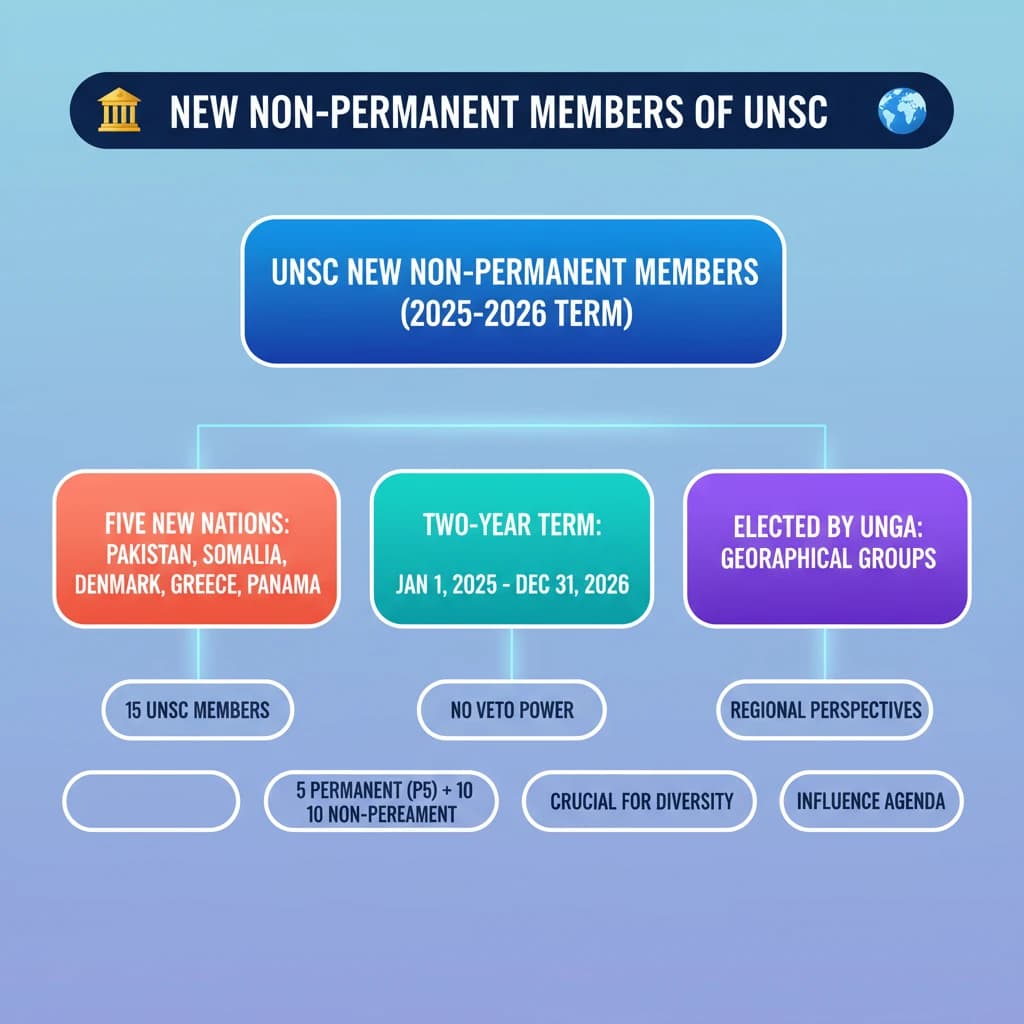
New Non-Permanent Members of UNSC is a key topic under International Relations for UPSC Civil Services Examination. Key points include: <strong>Pakistan, Somalia, Denmark, Greece, and Panama</strong> are the new non-permanent members of the UNSC.. They will serve a <strong>two-year term</strong> from <strong>January 1, 2025, to December 31, 2026</strong>.. The <strong>UNSC</strong> has <strong>15 members</strong>: 5 permanent (P5) with veto power and 10 non-permanent.. Understanding this topic is essential for both UPSC Prelims and Mains preparation.

Why is New Non-Permanent Members of UNSC important for UPSC exam?

New Non-Permanent Members of UNSC is a Medium-level topic in UPSC International Relations. It is tested in both Prelims (factual MCQs) and Mains (analytical answer writing). Previous year UPSC questions have frequently covered aspects of New Non-Permanent Members of UNSC, making it essential for comprehensive IAS preparation.

How to prepare New Non-Permanent Members of UNSC for UPSC?

To prepare New Non-Permanent Members of UNSC for UPSC: (1) Study the comprehensive notes covering all key concepts on Vaidra. (2) Practice previous year questions on this topic. (3) Connect it with current affairs using daily updates. (4) Revise using key takeaways and mind maps available for International Relations. (5) Write practice answers linking New Non-Permanent Members of UNSC to related GS Paper topics.

Key takeaways of New Non-Permanent Members of UNSC for UPSC

  • <strong>Pakistan, Somalia, Denmark, Greece, and Panama</strong> are the new non-permanent members of the UNSC.
  • They will serve a <strong>two-year term</strong> from <strong>January 1, 2025, to December 31, 2026</strong>.
  • The <strong>UNSC</strong> has <strong>15 members</strong>: 5 permanent (P5) with veto power and 10 non-permanent.
  • Non-permanent members are elected by the <strong>UN General Assembly</strong> based on <strong>geographical distribution</strong>.
  • Their role is crucial for bringing <strong>diverse regional perspectives</strong> and influencing the council's agenda, despite lacking veto power.
New Non-Permanent Members of UNSC

New Non-Permanent Members of UNSC

Medium⏱️ 8 min read✓ 95% Verified
international relations

📖 Introduction

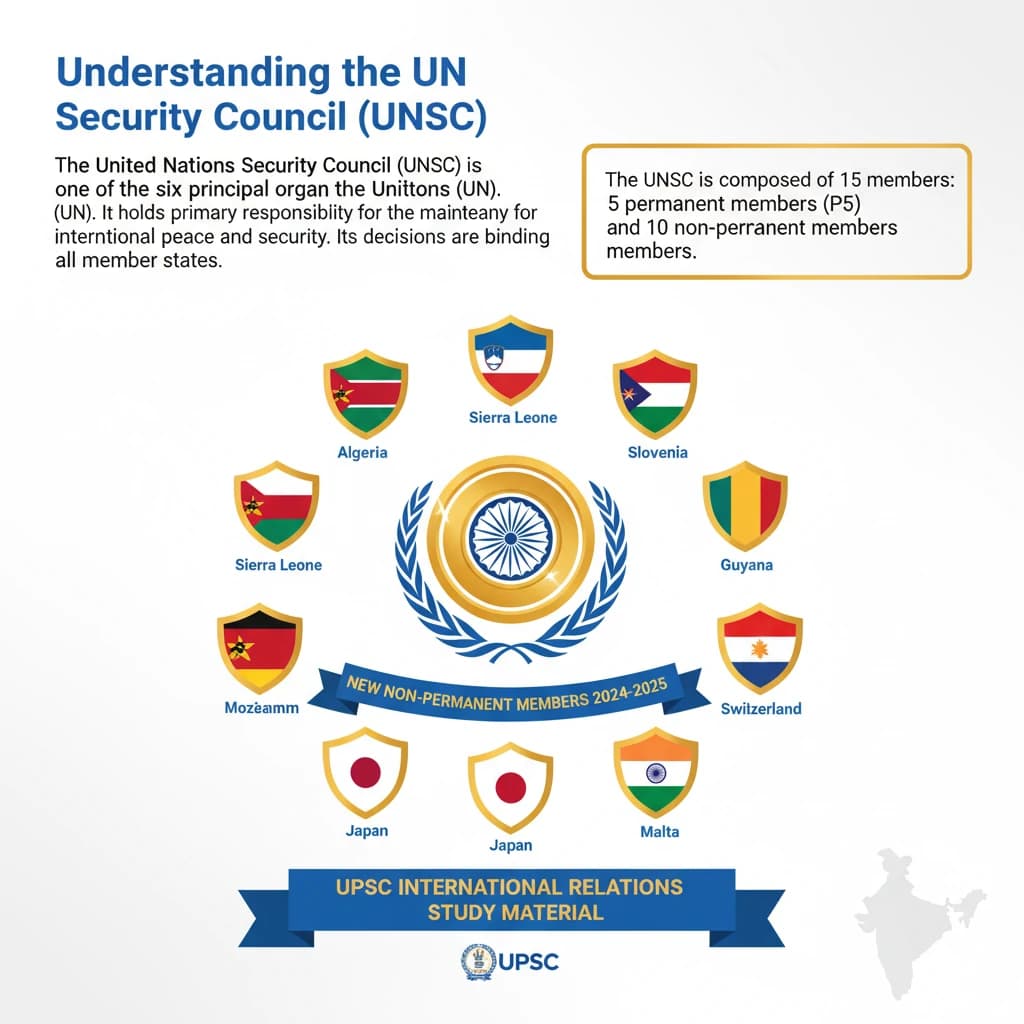
<h4>Understanding the UN Security Council (UNSC)</h4><p>The <strong>United Nations Security Council (UNSC)</strong> is one of the six principal organs of the <strong>United Nations (UN)</strong>. It holds the primary responsibility for the maintenance of <strong>international peace and security</strong>. Its decisions are binding on all member states.</p><div class='info-box'><p>The <strong>UNSC</strong> is composed of <strong>15 members</strong>: <strong>5 permanent members (P5)</strong> and <strong>10 non-permanent members</strong>. The <strong>P5</strong> are <strong>China, France, Russia, the United Kingdom, and the United States</strong>, each holding <strong>veto power</strong>.</p></div><h4>Election of New Non-Permanent Members for 2025-2026</h4><p>Recently, five nations were elected to serve as <strong>non-permanent members</strong> of the <strong>UN Security Council</strong>. These countries will commence their two-year term on <strong>January 1, 2025</strong>, and conclude on <strong>December 31, 2026</strong>.</p><div class='info-box'><p>The newly elected <strong>non-permanent members</strong> for the <strong>2025-2026 term</strong> are:</p><ul><li><strong>Pakistan</strong></li><li><strong>Somalia</strong></li><li><strong>Denmark</strong></li><li><strong>Greece</strong></li><li><strong>Panama</strong></li></ul></div><p>These nations were chosen through a vote in the <strong>UN General Assembly</strong>, securing the required two-thirds majority of votes from member states present and voting.</p><h4>Role and Responsibilities of Non-Permanent Members</h4><p><strong>Non-permanent members</strong> play a crucial role in the <strong>UNSC's decision-making process</strong>. They participate in discussions, vote on resolutions, and contribute to the council's agenda on matters of peace and security.</p><div class='key-point-box'><p>Unlike the <strong>P5</strong>, non-permanent members <strong>do not possess veto power</strong>. However, their votes are essential, as resolutions require <strong>9 affirmative votes</strong> to pass, including the concurring votes of the <strong>P5</strong>.</p></div><p>Their presence ensures a broader representation of global perspectives and interests within the council, reflecting the diverse membership of the United Nations.</p><h4>Geographical Representation in the UNSC</h4><p>The <strong>10 non-permanent seats</strong> are allocated based on <strong>geographical distribution</strong> to ensure equitable representation across different regions of the world. This system aims to provide a voice to various regional blocs.</p><div class='info-box'><p>The distribution of non-permanent seats is as follows:</p><ul><li><strong>African States: 3 seats</strong></li><li><strong>Asia-Pacific States: 2 seats</strong></li><li><strong>Latin American and Caribbean States: 2 seats</strong></li><li><strong>Eastern European States: 1 seat</strong></li><li><strong>Western European and Other States: 2 seats</strong></li></ul></div><p>The recent elections saw countries from various regional groups successfully securing their positions, highlighting the ongoing cycle of regional representation.</p><h4>Significance for Global Diplomacy</h4><p>The election of new non-permanent members is a significant event in <strong>international relations</strong>. It allows more nations to directly influence global security policies and bring their regional concerns to the forefront.</p><div class='exam-tip-box'><p><strong>UPSC Mains (GS-II)</strong>: Understanding the election process and the role of non-permanent members is vital for questions on <strong>international institutions</strong> and <strong>India's foreign policy</strong>, especially regarding <strong>UNSC reform</strong>.</p></div><p>For the elected countries, it provides an opportunity to enhance their diplomatic standing, advocate for their national interests, and contribute to resolving global conflicts and challenges.</p>
Concept Diagram

💡 Key Takeaways

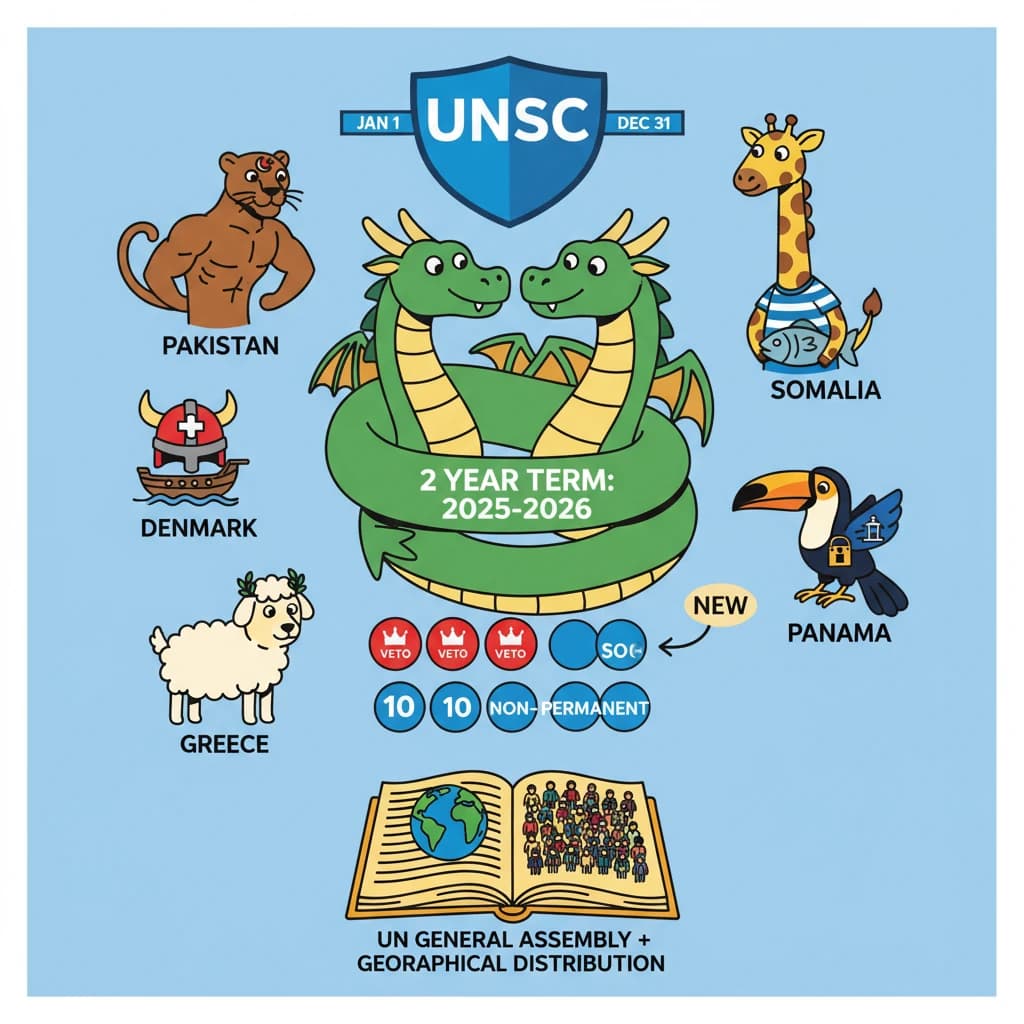
  • •<strong>Pakistan, Somalia, Denmark, Greece, and Panama</strong> are the new non-permanent members of the UNSC.
  • •They will serve a <strong>two-year term</strong> from <strong>January 1, 2025, to December 31, 2026</strong>.
  • •The <strong>UNSC</strong> has <strong>15 members</strong>: 5 permanent (P5) with veto power and 10 non-permanent.
  • •Non-permanent members are elected by the <strong>UN General Assembly</strong> based on <strong>geographical distribution</strong>.
  • •Their role is crucial for bringing <strong>diverse regional perspectives</strong> and influencing the council's agenda, despite lacking veto power.

🧠 Memory Techniques
Memory Aid
95% Verified Content

📚 Reference Sources

•UN Security Council Handbook
•Drishti IAS Current Affairs

Related Topics

Loading related topics...
Explore:International Relations Topics·All Subjects·Daily Current Affairs·Editorial Analysis·Previous Year Questions·UPSC GPT
New Non-Permanent Members of UNSC - UPSC International Relations