Loading page, please wait…
Vaidra Logo
Vaidra

Top 4 items + smart groups

UPSC GPT
New
Current Affairs
Daily Solutions
Daily Puzzle
Mains Evaluator

Version 2.0.0 • Built with ❤️ for UPSC aspirants

Loading...
Loading...
Loading...
Loading...
Loading...
Loading...
Loading...
Loading...
Loading...
Loading...
Loading...
Loading...
Loading...
Back
All Subjects

Topics

0 topics • 0 completed

Loading topics...
Loading...
Loading...
Loading...
Loading...
Loading...
Overall Progress0%

Deepening India-Brazil Relations - UPSC International Relations

What is Deepening India-Brazil Relations in UPSC International Relations?

Deepening India-Brazil Relations is a key topic under International Relations for UPSC Civil Services Examination. Key points include: India-Brazil strategic partnership is deepening across defence, space, security, technology, and economy.. The recent resolution of the WTO sugar subsidies dispute highlights mature bilateral engagement and commitment to trade rules.. Both nations are key players in global sugar production and are collaborating on ethanol technology.. Understanding this topic is essential for both UPSC Prelims and Mains preparation.

Why is Deepening India-Brazil Relations important for UPSC exam?

Deepening India-Brazil Relations is a Medium-level topic in UPSC International Relations. It is tested in both Prelims (factual MCQs) and Mains (analytical answer writing). Previous year UPSC questions have frequently covered aspects of Deepening India-Brazil Relations, making it essential for comprehensive IAS preparation.

How to prepare Deepening India-Brazil Relations for UPSC?

To prepare Deepening India-Brazil Relations for UPSC: (1) Study the comprehensive notes covering all key concepts on Vaidra. (2) Practice previous year questions on this topic. (3) Connect it with current affairs using daily updates. (4) Revise using key takeaways and mind maps available for International Relations. (5) Write practice answers linking Deepening India-Brazil Relations to related GS Paper topics.

Key takeaways of Deepening India-Brazil Relations for UPSC

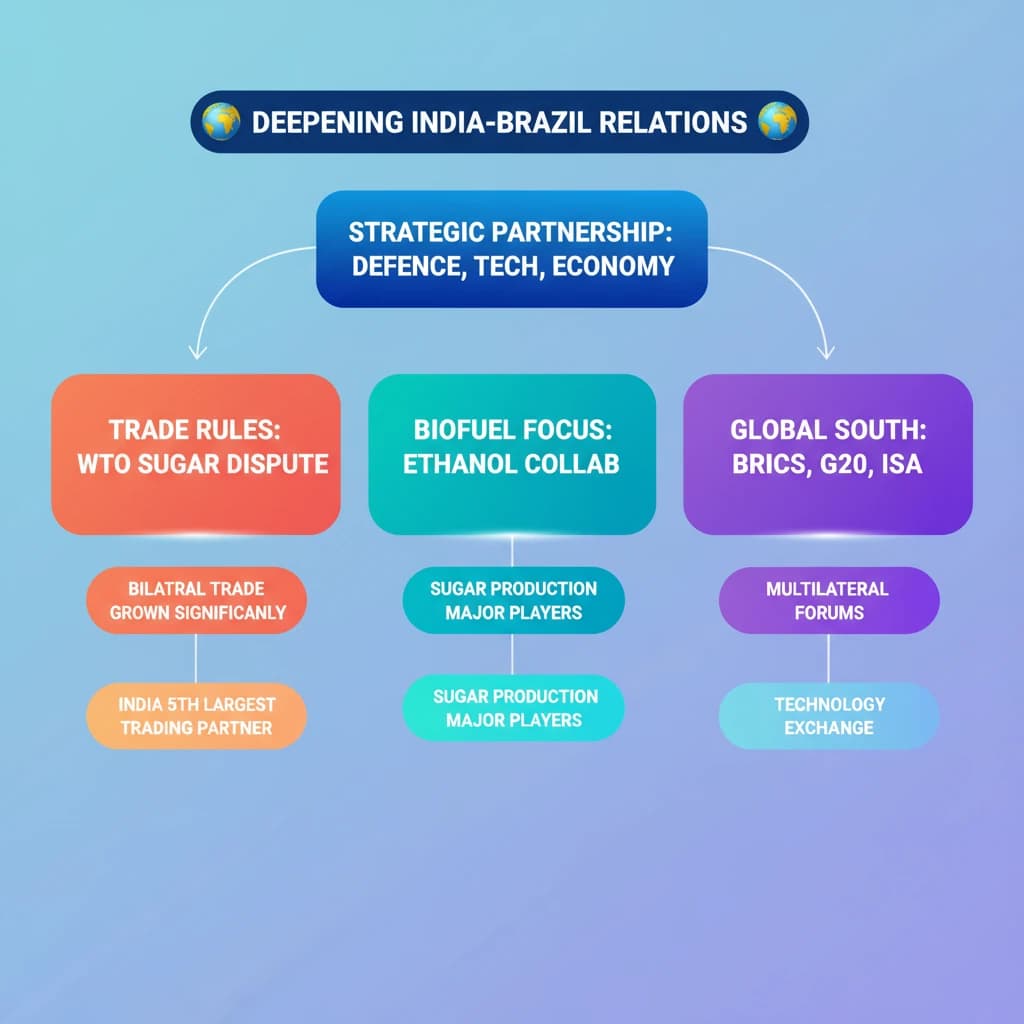
  • India-Brazil strategic partnership is deepening across defence, space, security, technology, and economy.
  • The recent resolution of the WTO sugar subsidies dispute highlights mature bilateral engagement and commitment to trade rules.
  • Both nations are key players in global sugar production and are collaborating on ethanol technology.
  • Bilateral trade has significantly grown, with India becoming Brazil's 5th largest trading partner in 2021.
  • India and Brazil are crucial members of multilateral forums like BRICS, IBSA, G20, and ISA, amplifying the Global South's voice.
  • Cooperation spans diverse sectors including agrochemicals, auto components, crude oil, gold, and investments in IT, energy, and biofuels.
Deepening India-Brazil Relations

Deepening India-Brazil Relations

Medium⏱️ 9 min read✓ 95% Verified
international relations

📖 Introduction

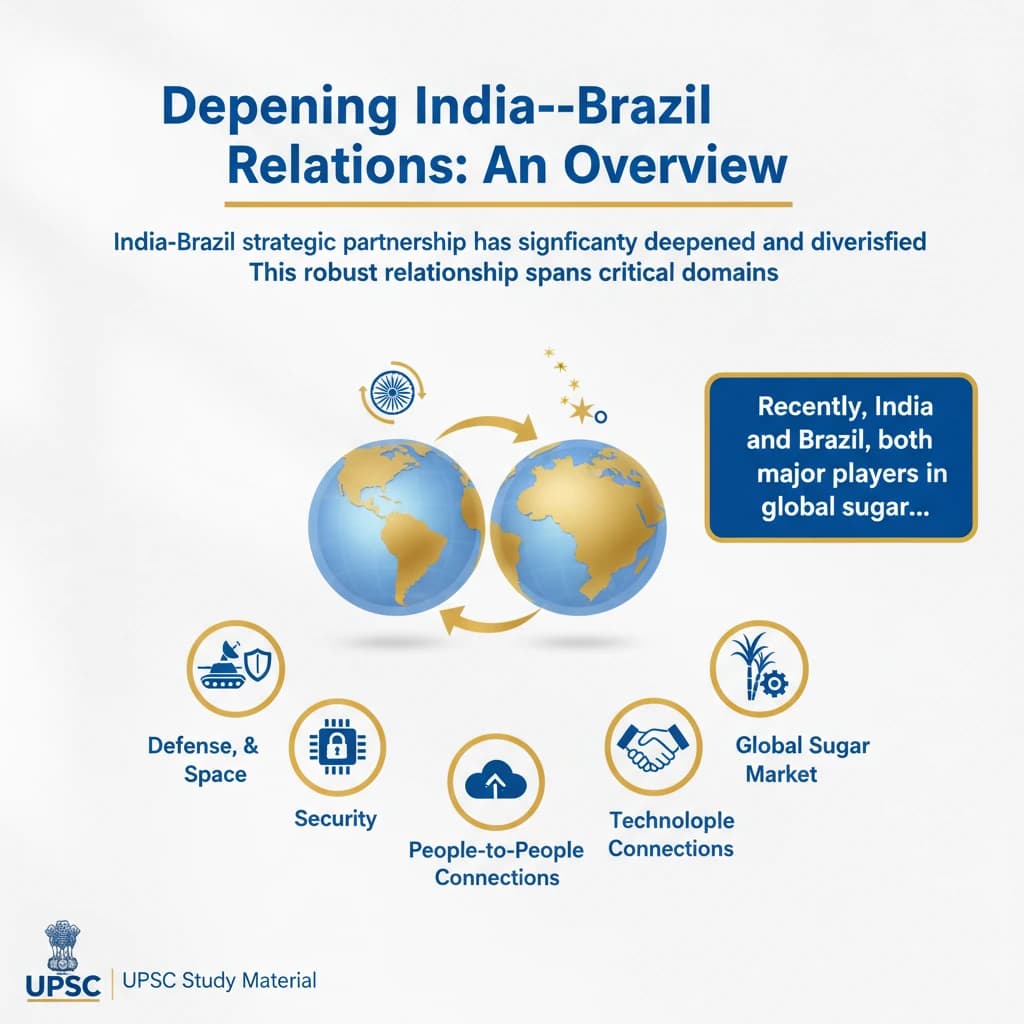
<h4>Deepening India-Brazil Relations: An Overview</h4><p>The <strong>India-Brazil strategic partnership</strong> has significantly <strong>deepened and diversified</strong> over recent years.</p><p>This robust relationship spans critical domains including <strong>defence, space, security, technology</strong>, and strong <strong>people-to-people connections</strong>.</p><div class='info-box'><p>Recently, <strong>India</strong> and <strong>Brazil</strong>, both major players in <strong>global sugar production</strong>, successfully resolved their long-standing <strong>WTO trade dispute</strong> concerning <strong>sugar subsidies</strong>.</p></div><div class='key-point-box'><p>This resolution aligns with their expanding collaboration in <strong>ethanol technology</strong> and addresses broader issues impacting <strong>global sugar supply and prices</strong>.</p></div><h4>The India-Brazil WTO Sugar Subsidies Dispute</h4><h5>Background of the Dispute</h5><p>In <strong>2019</strong>, <strong>Brazil</strong>, alongside <strong>Australia</strong> and <strong>Guatemala</strong>, initiated a challenge against <strong>India’s sugar subsidy measures</strong> at the <strong>World Trade Organization (WTO)</strong>.</p><p>They contended that these subsidies were inconsistent with various articles of the <strong>WTO’s Agreement on Agriculture</strong>.</p><div class='info-box'><p>The <strong>US</strong> and <strong>Australia</strong> also highlighted a significant reporting gap, claiming <strong>India</strong> had not included <strong>sugarcane or its derivatives</strong> in domestic support notifications since the <strong>marketing year 1995-96</strong>.</p></div><h5>India's Defence and Resolution</h5><p><strong>India</strong> defended its policies, asserting that <strong>sugarcane procurement</strong> is managed by <strong>private mills</strong>, not the government, which aligns with <strong>fair trade practices</strong>.</p><p><strong>India</strong> also pointed out an error in the <strong>US-Australia analysis</strong>, which used the entire <strong>sugarcane production</strong> in a given year for subsidy calculations, irrespective of whether it was delivered to mills under the <strong>Sugarcane (Control) Order</strong>.</p><div class='exam-tip-box'><p>The resolution of this dispute demonstrates the commitment of both nations to multilateral trade rules and can set a precedent for resolving similar trade disagreements through dialogue.</p></div><h4>Major Areas of Cooperation</h4><h5>Institutional Level Engagements</h5><p><strong>India</strong> and <strong>Brazil</strong> share a deeply <strong>multifaceted relationship</strong>, engaging closely both bilaterally and within numerous <strong>multilateral forums</strong>.</p><p>Key multilateral platforms include <strong>BRICS, IBSA, G4, G20, BASIC, International Solar Alliance (ISA), WTO, UNESCO</strong>, and <strong>WIPO</strong>.</p><p>Bilateral engagements are structured through various high-level dialogues and committees:</p><ul><li><strong>Strategic Dialogue</strong>: Led by the <strong>National Security Advisor (NSA)</strong>, addressing mutual regional and global issues.</li><li><strong>India-Brazil Business Leaders Forum</strong>: Focuses on enhancing <strong>trade, investment</strong>, and broader <strong>economic cooperation</strong>.</li><li><strong>Trade Monitoring Mechanism (TMM)</strong>: Designed to track and resolve specific issues in <strong>bilateral trade</strong>.</li><li><strong>Economic and Financial Dialogue</strong>: Covers cooperation across <strong>investment, trade</strong>, and <strong>monetary policy</strong>.</li><li><strong>Joint Defence Commission</strong>: Facilitates robust <strong>defence cooperation</strong>, including <strong>joint exercises, equipment procurement</strong>, and <strong>intelligence sharing</strong>.</li><li><strong>Joint Committee on Science & Technology</strong>: Fosters collaboration in <strong>research, development</strong>, and <strong>knowledge exchange</strong>.</li></ul><h5>Trade and Investment Landscape</h5><p><strong>India</strong> has emerged as <strong>Brazil’s 5th largest trading partner</strong> in <strong>2021</strong>, reflecting significant growth in bilateral commerce.</p><div class='info-box'><p>Bilateral trade figures:</p><ul><li><strong>2020</strong>: <strong>USD 7.05 billion</strong></li><li><strong>2021</strong>: Increased to <strong>USD 11.53 billion</strong></li><li><strong>2022</strong>: Further grew to <strong>USD 15.15 billion</strong></li><li><strong>2023</strong>: <strong>India’s exports</strong> to Brazil stood at <strong>USD 6.08 billion</strong>, with <strong>imports</strong> at <strong>USD 4.17 billion</strong>.</li></ul></div><p><strong>Major Indian exports</strong> to Brazil include <strong>agrochemicals, synthetic yarns, auto components and parts</strong>.</p><p>Conversely, <strong>India’s imports</strong> from Brazil primarily consist of <strong>crude oil, gold, vegetable oil, sugar</strong>, and various <strong>bulk minerals and ores</strong>.</p><p>Both nations have attracted substantial investments across diverse sectors such as <strong>automobiles, IT, mining, energy, biofuels</strong>, and <strong>footwear</strong>.</p>
Concept Diagram

💡 Key Takeaways

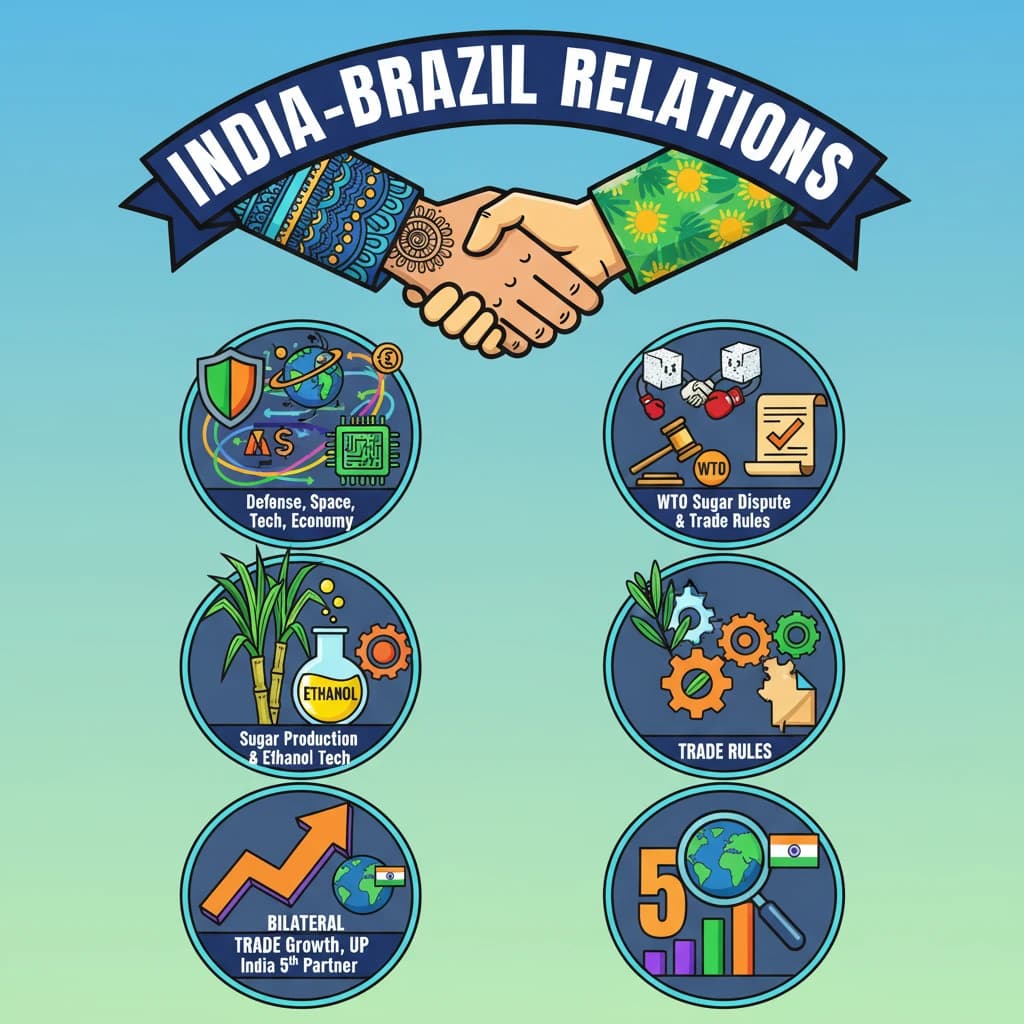
  • •India-Brazil strategic partnership is deepening across defence, space, security, technology, and economy.
  • •The recent resolution of the WTO sugar subsidies dispute highlights mature bilateral engagement and commitment to trade rules.
  • •Both nations are key players in global sugar production and are collaborating on ethanol technology.
  • •Bilateral trade has significantly grown, with India becoming Brazil's 5th largest trading partner in 2021.
  • •India and Brazil are crucial members of multilateral forums like BRICS, IBSA, G20, and ISA, amplifying the Global South's voice.
  • •Cooperation spans diverse sectors including agrochemicals, auto components, crude oil, gold, and investments in IT, energy, and biofuels.

🧠 Memory Techniques
Memory Aid
95% Verified Content

Related Topics

Loading related topics...
Explore:International Relations Topics·All Subjects·Daily Current Affairs·Editorial Analysis·Previous Year Questions·UPSC GPT
Deepening India-Brazil Relations - UPSC International Relations