Loading page, please wait…
Vaidra Logo
Vaidra

Top 4 items + smart groups

UPSC GPT
New
Current Affairs
Daily Solutions
Daily Puzzle
Mains Evaluator

Version 2.0.0 • Built with ❤️ for UPSC aspirants

Loading...
Loading...
Loading...
Loading...
Loading...
Loading...
Loading...
Loading...
Loading...
Loading...
Loading...
Loading...
Loading...

Myanmar Crisis: Conflict, Displacement, and Humanitarian Concerns - UPSC International Relations

What is Myanmar Crisis: Conflict, Displacement, and Humanitarian Concerns in UPSC International Relations?

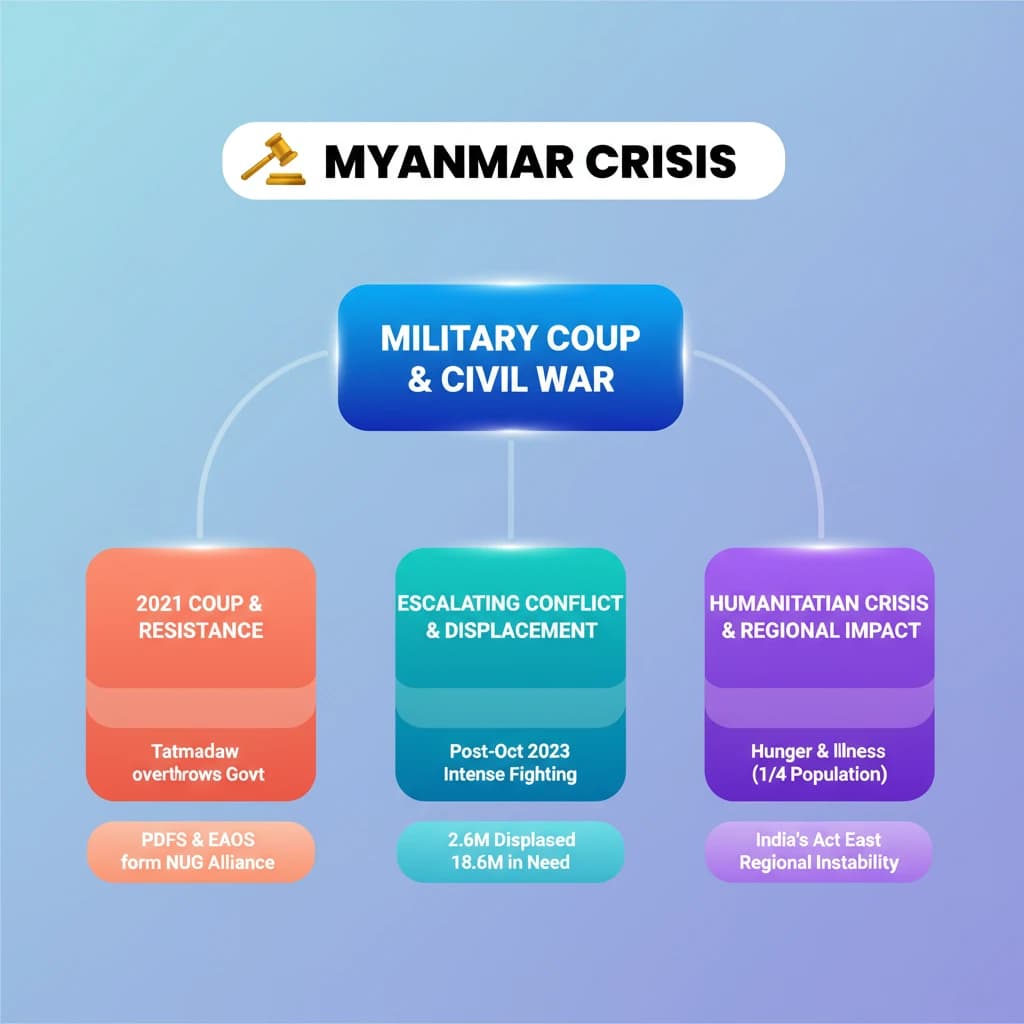
Myanmar Crisis: Conflict, Displacement, and Humanitarian Concerns is a key topic under International Relations for UPSC Civil Services Examination. Key points include: Myanmar's military (Tatmadaw) overthrew the democratically elected government in February 2021.. The coup led to widespread protests, a Civil Disobedience Movement, and the formation of armed resistance groups like PDFs and EAOs aligned with the NUG.. Intensified fighting since October 2023 has caused a severe humanitarian crisis, displacing 2.6 million people and leaving 18.6 million in need of aid.. Understanding this topic is essential for both UPSC Prelims and Mains preparation.

Why is Myanmar Crisis: Conflict, Displacement, and Humanitarian Concerns important for UPSC exam?

Myanmar Crisis: Conflict, Displacement, and Humanitarian Concerns is a Medium-level topic in UPSC International Relations. It is tested in both Prelims (factual MCQs) and Mains (analytical answer writing). Previous year UPSC questions have frequently covered aspects of Myanmar Crisis: Conflict, Displacement, and Humanitarian Concerns, making it essential for comprehensive IAS preparation.

How to prepare Myanmar Crisis: Conflict, Displacement, and Humanitarian Concerns for UPSC?

To prepare Myanmar Crisis: Conflict, Displacement, and Humanitarian Concerns for UPSC: (1) Study the comprehensive notes covering all key concepts on Vaidra. (2) Practice previous year questions on this topic. (3) Connect it with current affairs using daily updates. (4) Revise using key takeaways and mind maps available for International Relations. (5) Write practice answers linking Myanmar Crisis: Conflict, Displacement, and Humanitarian Concerns to related GS Paper topics.

Key takeaways of Myanmar Crisis: Conflict, Displacement, and Humanitarian Concerns for UPSC

  • Myanmar's military (Tatmadaw) overthrew the democratically elected government in February 2021.
  • The coup led to widespread protests, a Civil Disobedience Movement, and the formation of armed resistance groups like PDFs and EAOs aligned with the NUG.
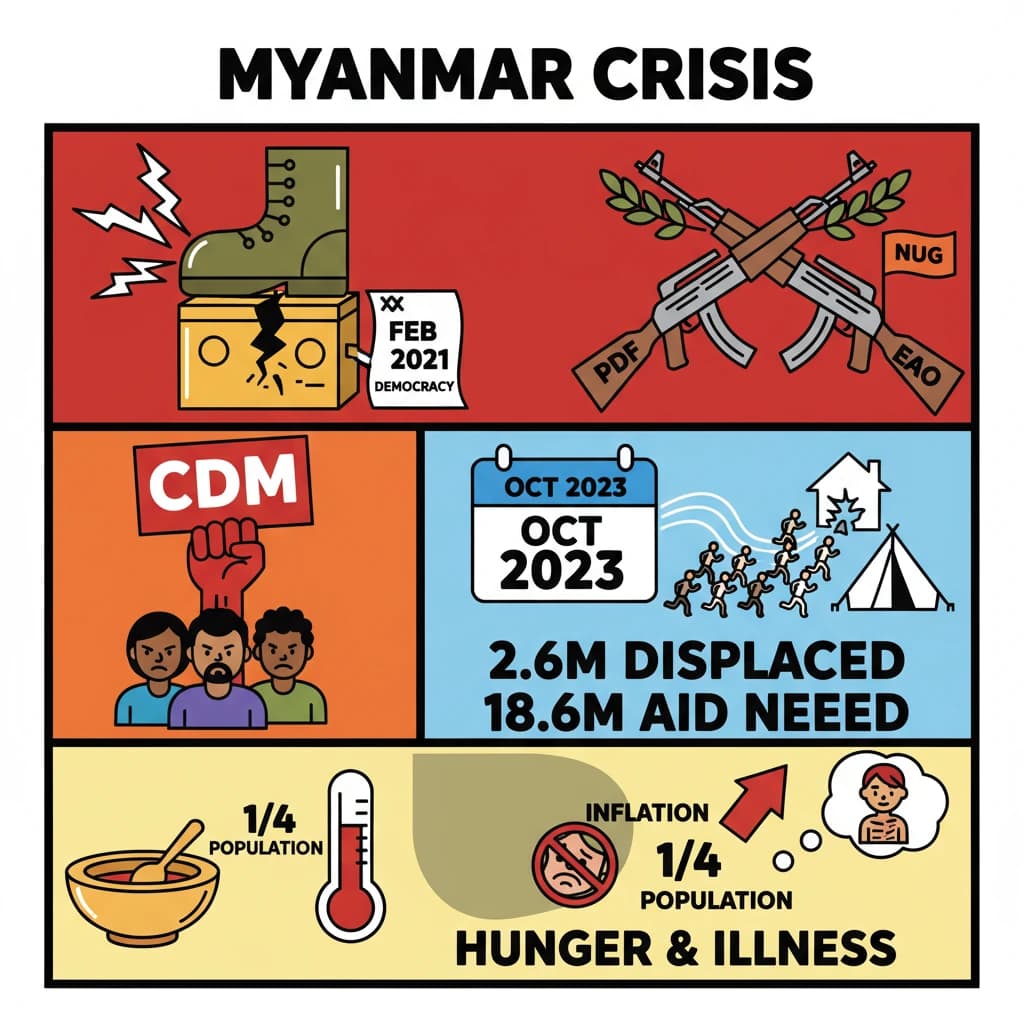
  • Intensified fighting since October 2023 has caused a severe humanitarian crisis, displacing 2.6 million people and leaving 18.6 million in need of aid.
  • Inflation and conflict have led to widespread hunger and illness for a quarter of the population.
  • The crisis impacts regional stability, India's Act East Policy, and poses significant humanitarian and security challenges.
Myanmar Crisis: Conflict, Displacement, and Humanitarian Concerns

Myanmar Crisis: Conflict, Displacement, and Humanitarian Concerns

Medium⏱️ 7 min read✓ 95% Verified
international relations

📖 Introduction

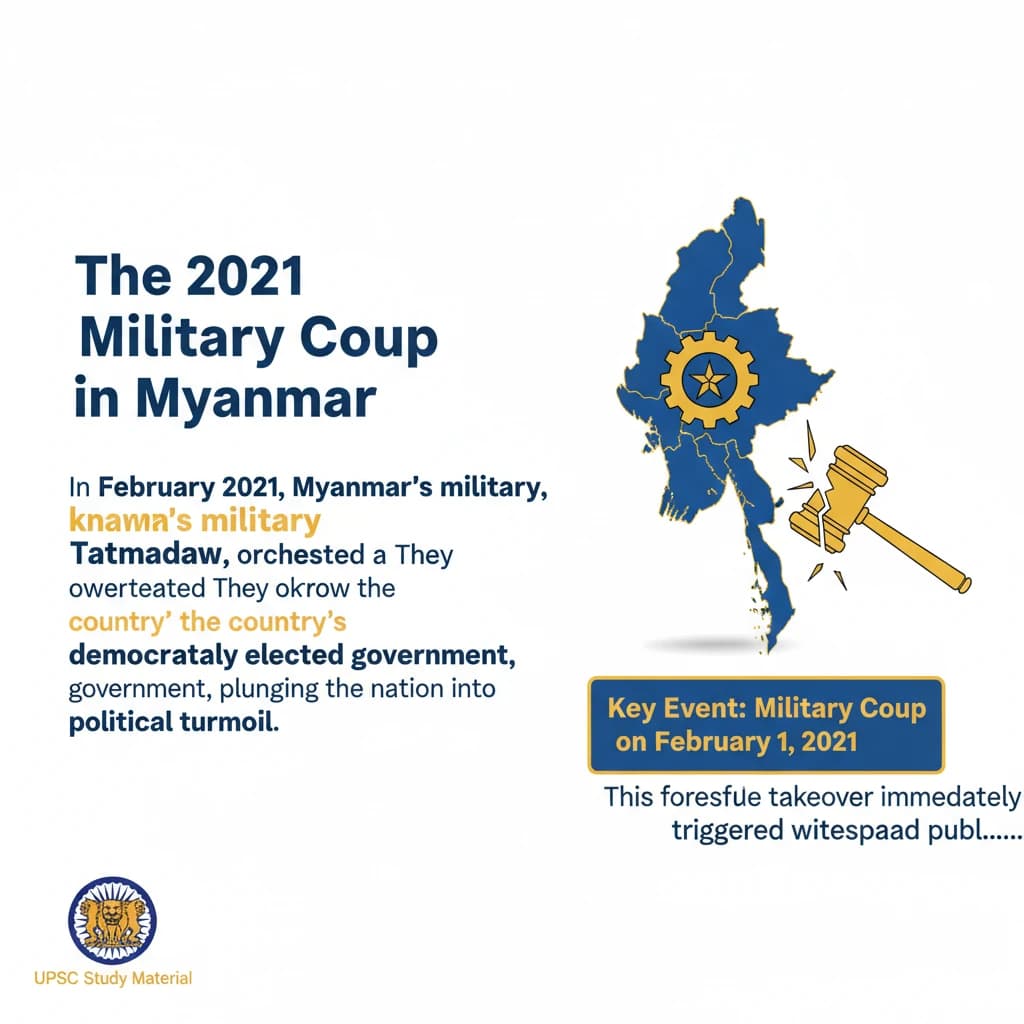
<h4>The 2021 Military Coup in Myanmar</h4><p>In <strong>February 2021</strong>, <strong>Myanmar's military</strong>, known as the <strong>Tatmadaw</strong>, orchestrated a coup. They overthrew the country's <strong>democratically elected government</strong>, plunging the nation into political turmoil.</p><div class='info-box'><p><strong>Key Event:</strong> <strong>Military Coup</strong> on <strong>February 1, 2021</strong>.</p></div><p>This forceful takeover immediately triggered widespread public outrage. Citizens initiated extensive <strong>protests</strong> and a robust <strong>civil disobedience movement</strong> across the country.</p><p>The primary demand of these movements was the swift <strong>restoration of democracy</strong> and the return of the elected civilian leadership.</p><h4>Emergence of Resistance Movements</h4><p>The <strong>junta's crackdown</strong> on dissent was severe, leading to the formation of organized opposition. Various groups, including established <strong>Ethnic Armed Organizations (EAOs)</strong>, united to resist military rule.</p><p>These groups collectively formed the <strong>People's Defence Forces (PDFs)</strong>. The <strong>PDFs</strong> operate as the armed wing of the resistance, challenging the <strong>Tatmadaw's</strong> authority.</p><div class='key-point-box'><p><strong>Key Players:</strong> <ul><li><strong>Tatmadaw:</strong> Myanmar's military junta.</li><li><strong>EAOs:</strong> Ethnic Armed Organizations.</li><li><strong>PDFs:</strong> People's Defence Forces, resistance fighters.</li><li><strong>NUG:</strong> National Unity Government, formed by ousted lawmakers.</li></ul></p></div><p>The <strong>National Unity Government (NUG)</strong>, comprising ousted lawmakers, provides a political umbrella for these resistance efforts. It seeks international recognition as Myanmar's legitimate government.</p><h4>Escalation of Conflict and Humanitarian Crisis</h4><p>Since <strong>October 2023</strong>, the conflict between the <strong>military</strong> and various <strong>armed opposition groups</strong> has dramatically intensified. This escalation has had devastating consequences for the civilian population.</p><p>The fighting has resulted in massive <strong>displacement</strong> of people from their homes and a severe, ongoing <strong>humanitarian crisis</strong> throughout the country.</p><div class='info-box'><p><strong>Humanitarian Impact:</strong></p><ul><li>Approximately <strong>2.6 million people</strong> have been displaced.</li><li><strong>18.6 million people</strong> (roughly <strong>one-third</strong> of the population) require humanitarian assistance.</li></ul></div><p>The combined effects of <strong>inflation</strong> and the persistent <strong>conflict</strong> have significantly driven up the cost of essential goods. This includes food and other basic necessities.</p><p>Consequently, an estimated <strong>one-quarter</strong> of Myanmar's population faces severe <strong>hunger</strong> and increased risks of <strong>illness</strong> due to lack of resources and ongoing instability.</p>
Concept Diagram

💡 Key Takeaways

  • •Myanmar's military (Tatmadaw) overthrew the democratically elected government in February 2021.
  • •The coup led to widespread protests, a Civil Disobedience Movement, and the formation of armed resistance groups like PDFs and EAOs aligned with the NUG.
  • •Intensified fighting since October 2023 has caused a severe humanitarian crisis, displacing 2.6 million people and leaving 18.6 million in need of aid.
  • •Inflation and conflict have led to widespread hunger and illness for a quarter of the population.
  • •The crisis impacts regional stability, India's Act East Policy, and poses significant humanitarian and security challenges.

🧠 Memory Techniques
Memory Aid
95% Verified Content

📚 Reference Sources

•UNOCHA reports on Myanmar Humanitarian Situation
•Council on Foreign Relations (CFR) analyses on Myanmar

Related Topics

Loading related topics...
Explore:International Relations Topics·All Subjects·Daily Current Affairs·Editorial Analysis·Previous Year Questions·UPSC GPT
Back
All Subjects

Topics

0 topics • 0 completed

Loading topics...
Loading...
Loading...
Loading...
Loading...
Loading...
Overall Progress0%
Myanmar Crisis: Conflict, Displacement, and Humanitarian Concerns - UPSC International Relations