Loading page, please wait…
Vaidra Logo
Vaidra

Top 4 items + smart groups

UPSC GPT
New
Current Affairs
Daily Solutions
Daily Puzzle
Mains Evaluator

Version 2.0.0 • Built with ❤️ for UPSC aspirants

Loading...
Loading...
Loading...
Loading...
Loading...
Loading...
Loading...
Loading...
Loading...
Loading...
Loading...
Loading...
Loading...
Back
All Subjects

Topics

0 topics • 0 completed

Loading topics...
Loading...
Loading...
Loading...
Loading...
Loading...
Overall Progress0%

India to Ratify Cape Town Convention - UPSC International Relations

What is India to Ratify Cape Town Convention in UPSC International Relations?

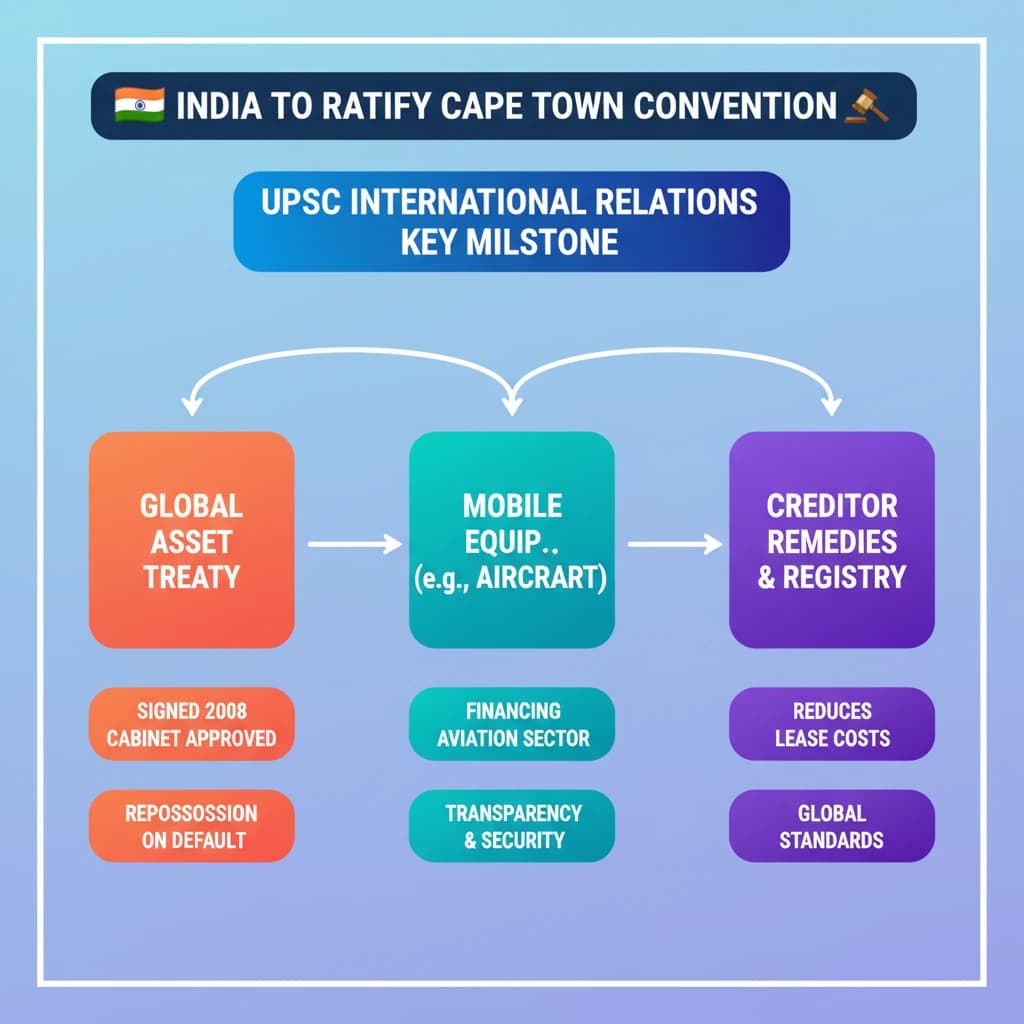
India to Ratify Cape Town Convention is a key topic under International Relations for UPSC Civil Services Examination. Key points include: India's Union Cabinet approved a Bill to ratify the Cape Town Convention (CTC) and its Protocol.. The CTC is an international treaty allowing creditors to repossess high-value mobile assets like aircraft upon lease payment defaults.. Key features include a global registry for transparency and clear remedies for creditors (deregistration, export).. Understanding this topic is essential for both UPSC Prelims and Mains preparation.

Why is India to Ratify Cape Town Convention important for UPSC exam?

India to Ratify Cape Town Convention is a Medium-level topic in UPSC International Relations. It is tested in both Prelims (factual MCQs) and Mains (analytical answer writing). Previous year UPSC questions have frequently covered aspects of India to Ratify Cape Town Convention, making it essential for comprehensive IAS preparation.

How to prepare India to Ratify Cape Town Convention for UPSC?

To prepare India to Ratify Cape Town Convention for UPSC: (1) Study the comprehensive notes covering all key concepts on Vaidra. (2) Practice previous year questions on this topic. (3) Connect it with current affairs using daily updates. (4) Revise using key takeaways and mind maps available for International Relations. (5) Write practice answers linking India to Ratify Cape Town Convention to related GS Paper topics.

Key takeaways of India to Ratify Cape Town Convention for UPSC

  • India's Union Cabinet approved a Bill to ratify the Cape Town Convention (CTC) and its Protocol.
  • The CTC is an international treaty allowing creditors to repossess high-value mobile assets like aircraft upon lease payment defaults.
  • Key features include a global registry for transparency and clear remedies for creditors (deregistration, export).
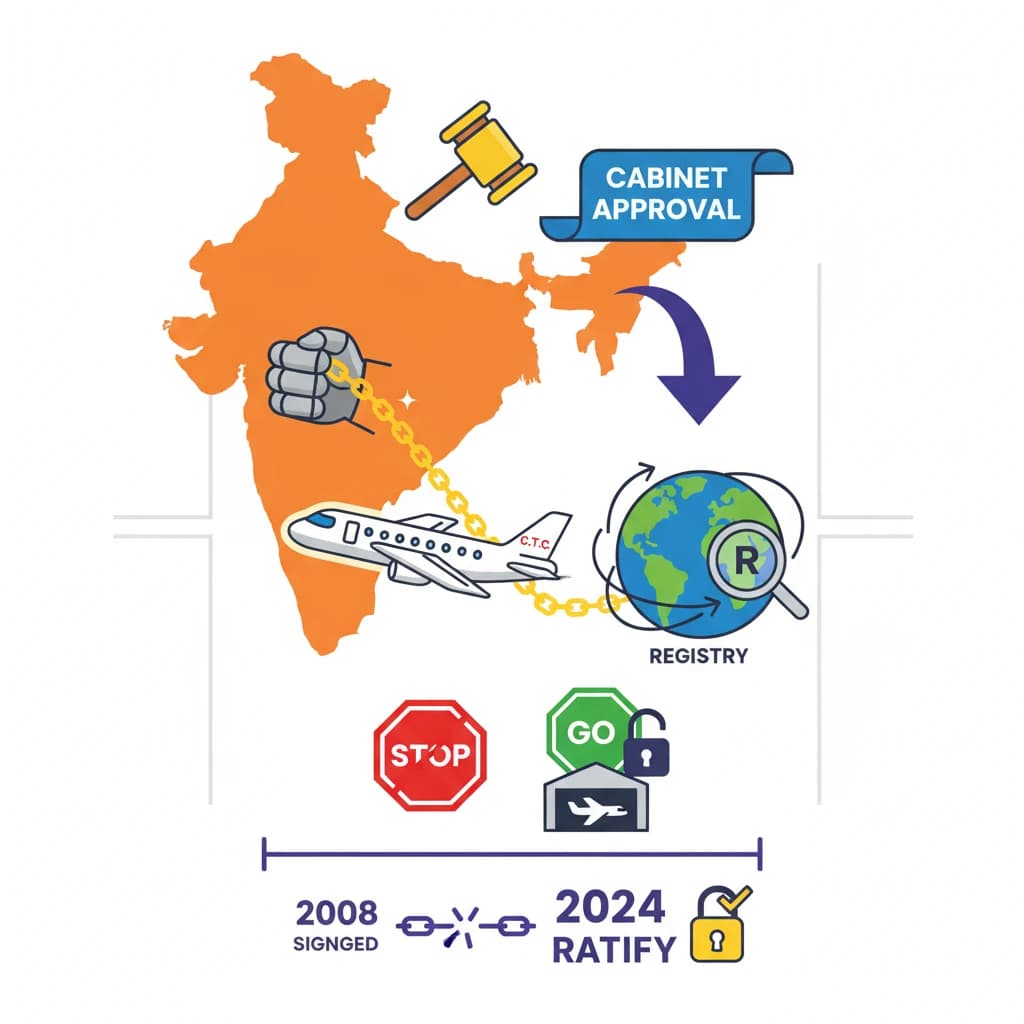
  • India signed CTC in 2008 but is now moving towards full ratification after cabinet approval.
  • Ratification aims to strengthen India's aviation framework, align with global standards, and reduce financing costs for airlines.
  • India is the world's third-largest domestic aviation market, making this step crucial for its growth and investment attraction.
India to Ratify Cape Town Convention

India to Ratify Cape Town Convention

Medium⏱️ 5 min read✓ 95% Verified
international relations

📖 Introduction

<h4>India to Ratify Cape Town Convention: Strengthening Aviation Framework</h4><p>The <strong>Union Cabinet</strong> has recently given its approval to the <strong>Protection and Enforcement of Interests in Aircraft Objects Bill</strong>. This move is a significant step towards bolstering <strong>India's aviation framework</strong> and aligning it with international standards.</p><div class='exam-tip-box'>This decision highlights India's commitment to global aviation norms, a crucial point for <strong>GS-II (International Relations)</strong> and <strong>GS-III (Economy)</strong>.</div><h4>Primary Objective of the Bill</h4><p>The primary aim of this Bill is to facilitate <strong>India's ratification</strong> and effective enforcement of the provisions laid out in two key international instruments: the <strong>Convention on International Interests in Mobile Equipment (Cape Town Convention)</strong> and its associated <strong>Protocol on Matters Specific to Aircraft Equipment (Cape Town Protocol)</strong>.</p><h4>Understanding the Cape Town Convention (CTC)</h4><p>The <strong>Cape Town Convention (CTC)</strong> is a landmark <strong>international treaty</strong> designed to simplify and secure the financing of high-value mobile assets.</p><div class='info-box'><p><strong>About CTC:</strong></p><ul><li>It enables <strong>creditors</strong>, such as <strong>lessors</strong>, <strong>lenders</strong>, and <strong>financiers</strong>, to efficiently <strong>repossess</strong> high-value mobile assets like <strong>aircraft</strong>, <strong>aircraft engines</strong>, and <strong>helicopters</strong>.</li><li>This right of repossession becomes critical if an airline or debtor defaults on its <strong>lease payments</strong> or other financial obligations.</li></ul></div><div class='info-box'><p><strong>Origin:</strong> The <strong>CTC</strong> was adopted in <strong>Cape Town, South Africa</strong>, in <strong>2001</strong>.</p></div><h4>Key Features of CTC</h4><div class='key-point-box'><p>The <strong>Cape Town Convention</strong> introduces several mechanisms to enhance security and predictability in asset financing:</p><ul><li><strong>Global Registry:</strong> It establishes a <strong>global electronic registry</strong> for recording international interests in mobile equipment. This ensures transparency and provides a clear priority system for registered creditor claims.</li><li><strong>Clear Remedies:</strong> The Convention provides clear and streamlined remedies for creditors. These include the right to facilitate the <strong>deregistration</strong> and <strong>export of aircraft</strong> without facing lengthy and complex legal procedures in the event of a default.</li></ul></div><h4>Role of the Cape Town Protocol</h4><p>The <strong>Cape Town Protocol</strong> acts as a complementary instrument to the main Convention. It specifically sets out detailed rules and procedures tailored for <strong>aircraft financing</strong> and <strong>leasing transactions</strong>, addressing the unique complexities of the aviation industry.</p><h4>India's Current Status Regarding CTC</h4><p><strong>India</strong> initially signed the <strong>Cape Town Convention</strong> in <strong>2008</strong>. However, despite signing, the nation had not yet proceeded with its full <strong>ratification</strong>, meaning its provisions were not legally binding within India's domestic framework until now.</p><div class='info-box'><p><strong>India's Aviation Market:</strong> India holds the position of the <strong>world’s third-largest domestic aviation market</strong>, trailing only the <strong>United States</strong> and <strong>China</strong>. This substantial market size underscores the importance of a robust and internationally compliant legal framework for aviation assets.</p></div>
Concept Diagram

💡 Key Takeaways

  • •India's Union Cabinet approved a Bill to ratify the Cape Town Convention (CTC) and its Protocol.
  • •The CTC is an international treaty allowing creditors to repossess high-value mobile assets like aircraft upon lease payment defaults.
  • •Key features include a global registry for transparency and clear remedies for creditors (deregistration, export).
  • •India signed CTC in 2008 but is now moving towards full ratification after cabinet approval.
  • •Ratification aims to strengthen India's aviation framework, align with global standards, and reduce financing costs for airlines.
  • •India is the world's third-largest domestic aviation market, making this step crucial for its growth and investment attraction.

🧠 Memory Techniques
Memory Aid
95% Verified Content

Related Topics

Loading related topics...
Explore:International Relations Topics·All Subjects·Daily Current Affairs·Editorial Analysis·Previous Year Questions·UPSC GPT
India to Ratify Cape Town Convention - UPSC International Relations