Loading page, please wait…
Vaidra Logo
Vaidra

Top 4 items + smart groups

UPSC GPT
New
Current Affairs
Daily Solutions
Daily Puzzle
Mains Evaluator

Version 2.0.0 • Built with ❤️ for UPSC aspirants

Loading...
Loading...
Loading...
Loading...
Loading...
Loading...
Loading...
Loading...
Loading...
Loading...
Loading...
Loading...
Loading...
Back
All Subjects

Topics

0 topics • 0 completed

Loading topics...
Loading...
Loading...
Loading...
Loading...
Loading...
Overall Progress0%

India-Indonesia Relations: 'Look East' to 'Act East' Policy & Trade - UPSC International Relations

What is India-Indonesia Relations: 'Look East' to 'Act East' Policy & Trade in UPSC International Relations?

India-Indonesia Relations: 'Look East' to 'Act East' Policy & Trade is a key topic under International Relations for UPSC Civil Services Examination. Key points include: India's 'Look East' Policy (1991) shifted focus to Southeast Asia for economic, security, cultural ties.. It evolved into the more proactive 'Act East' Policy (2014) for deeper, action-oriented engagement.. Indonesia is India's 2nd largest ASEAN trading partner, with trade reaching $38.84 billion in 2022-23.. Understanding this topic is essential for both UPSC Prelims and Mains preparation.

Why is India-Indonesia Relations: 'Look East' to 'Act East' Policy & Trade important for UPSC exam?

India-Indonesia Relations: 'Look East' to 'Act East' Policy & Trade is a Medium-level topic in UPSC International Relations. It is tested in both Prelims (factual MCQs) and Mains (analytical answer writing). Previous year UPSC questions have frequently covered aspects of India-Indonesia Relations: 'Look East' to 'Act East' Policy & Trade, making it essential for comprehensive IAS preparation.

How to prepare India-Indonesia Relations: 'Look East' to 'Act East' Policy & Trade for UPSC?

To prepare India-Indonesia Relations: 'Look East' to 'Act East' Policy & Trade for UPSC: (1) Study the comprehensive notes covering all key concepts on Vaidra. (2) Practice previous year questions on this topic. (3) Connect it with current affairs using daily updates. (4) Revise using key takeaways and mind maps available for International Relations. (5) Write practice answers linking India-Indonesia Relations: 'Look East' to 'Act East' Policy & Trade to related GS Paper topics.

Key takeaways of India-Indonesia Relations: 'Look East' to 'Act East' Policy & Trade for UPSC

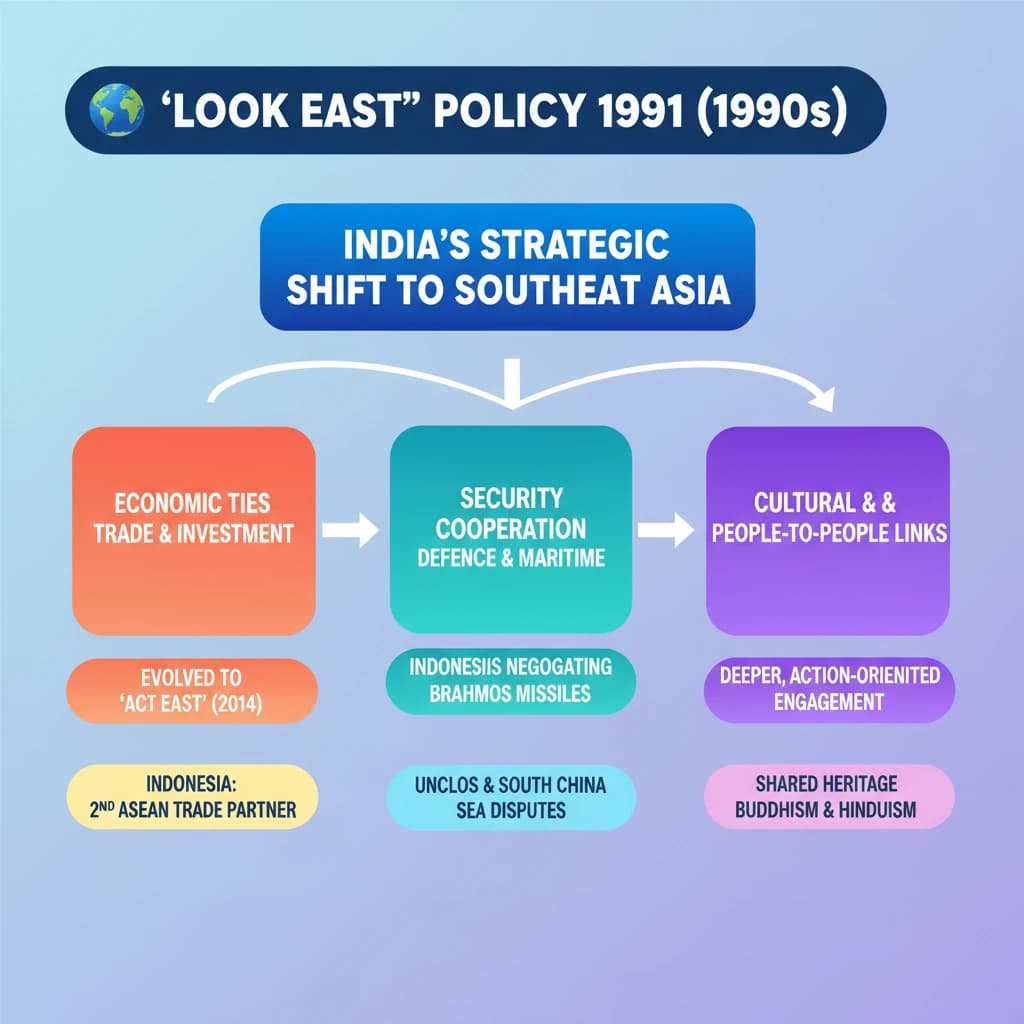
  • India's 'Look East' Policy (1991) shifted focus to Southeast Asia for economic, security, cultural ties.
  • It evolved into the more proactive 'Act East' Policy (2014) for deeper, action-oriented engagement.
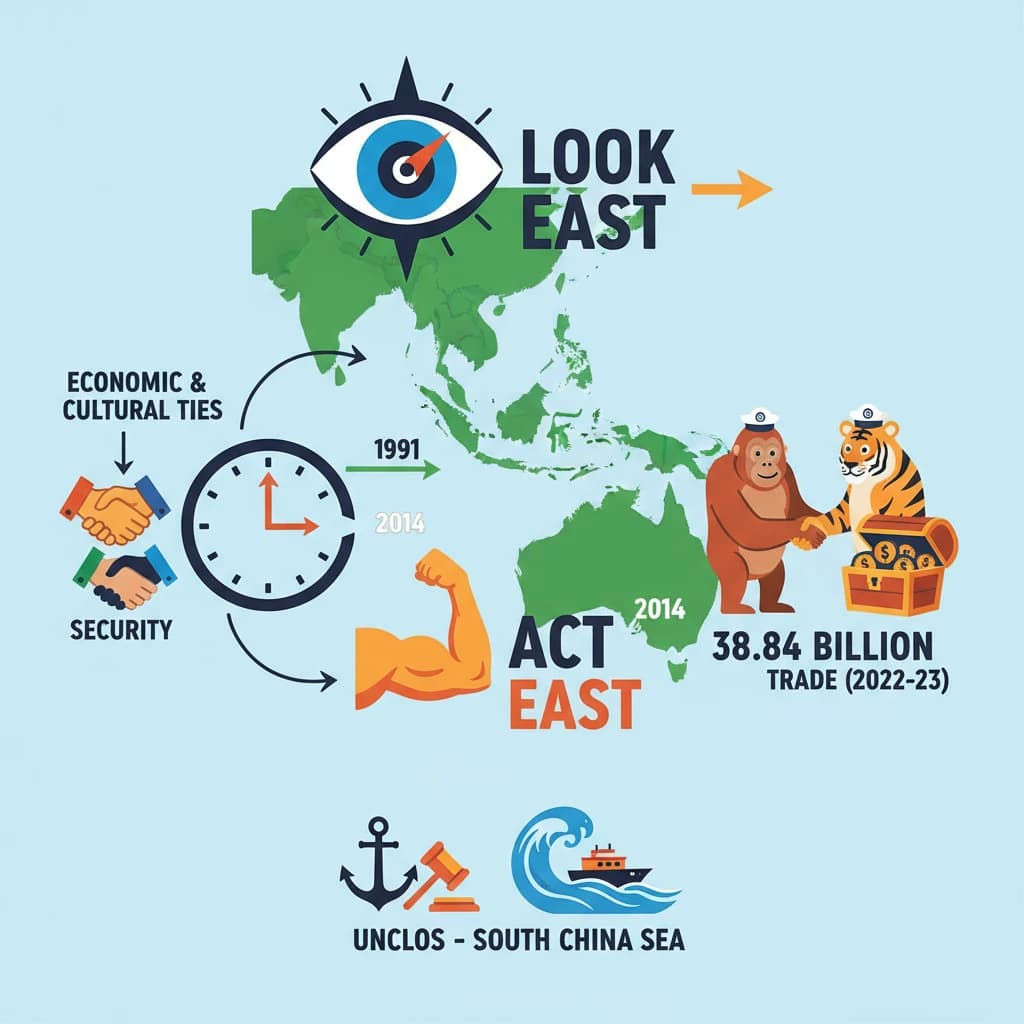
  • Indonesia is India's 2nd largest ASEAN trading partner, with trade reaching $38.84 billion in 2022-23.
  • Both nations advocate for resolving South China Sea disputes per UNCLOS.
  • Indonesia is negotiating to acquire India's BrahMos missile system, highlighting defence cooperation.
India-Indonesia Relations: 'Look East' to 'Act East' Policy & Trade

India-Indonesia Relations: 'Look East' to 'Act East' Policy & Trade

Medium⏱️ 4 min read✓ 95% Verified
international relations

📖 Introduction

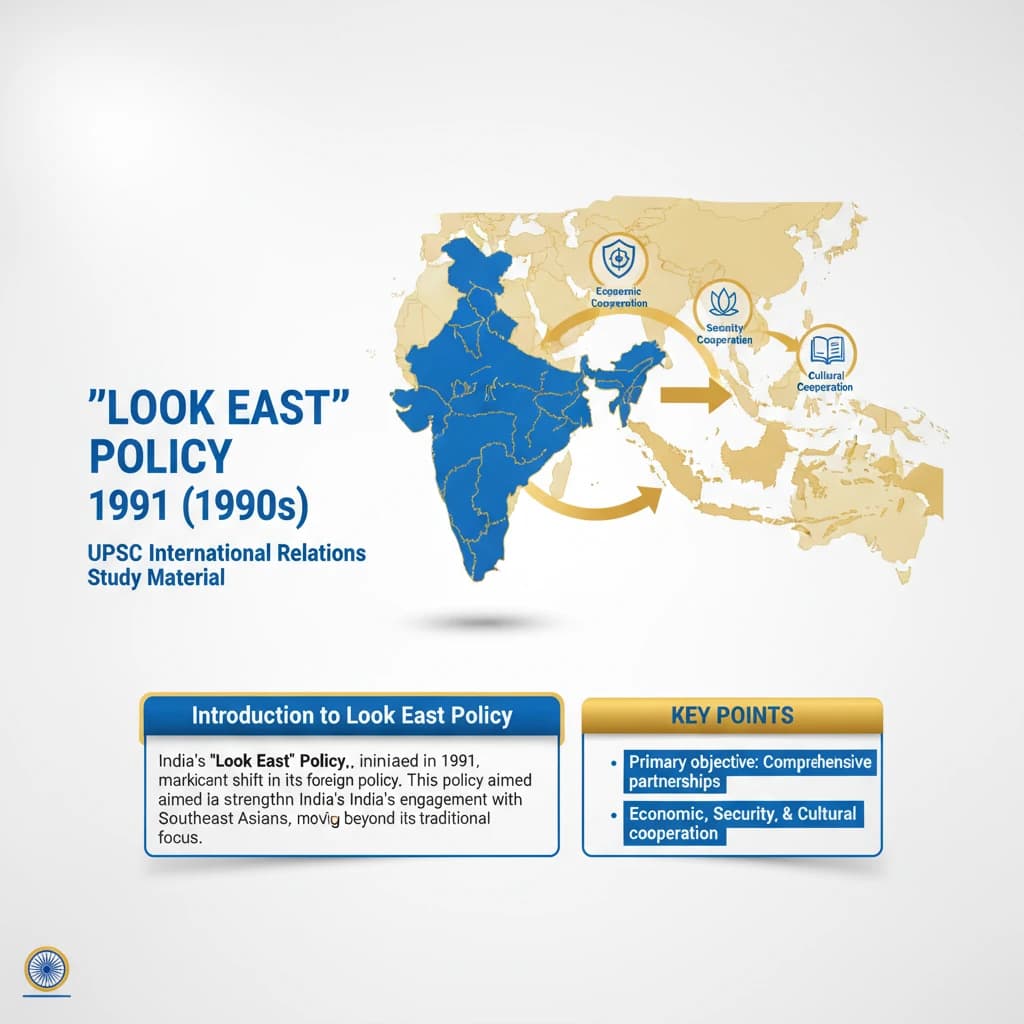
<h4>Introduction to Look East Policy</h4><p>India's <strong>'Look East' Policy</strong>, initiated in <strong>1991</strong>, marked a significant shift in its foreign policy. This policy aimed to strengthen India's engagement with Southeast Asian nations, moving beyond its traditional focus.</p><div class='key-point-box'><p>The primary objective was to foster comprehensive partnerships covering <strong>economic</strong>, <strong>security</strong>, and <strong>cultural cooperation</strong>, leading to substantial growth in trade between India and the region.</p></div><h4>Evolution to Act East Policy</h4><p>The <strong>'Look East' Policy</strong> was further invigorated and upgraded to the <strong>'Act East' Policy</strong> in <strong>2014</strong> by the new government. This evolution signified a more proactive and action-oriented approach towards strengthening ties with the extended neighborhood in the Indo-Pacific.</p><p>Under the <strong>'Act East' Policy</strong>, countries like <strong>Indonesia</strong> have emerged as pivotal regional partners for India, reflecting a deeper strategic alignment and increased bilateral engagement.</p><h4>India-Indonesia Economic Partnership</h4><p>Since the <strong>2000s</strong>, the economic relationship between India and Indonesia has witnessed remarkable growth. <strong>Indonesia</strong> is now India's <strong>second largest trading partner</strong> within the <strong>ASEAN</strong> region.</p><div class='info-box'><p><strong>Key Economic Data:</strong><ul><li><strong>Trade Volume (2005-06):</strong> <strong>USD 4.3 billion</strong></li><li><strong>Trade Volume (2022-23):</strong> <strong>USD 38.84 billion</strong> (a significant increase)</li><li><strong>Indonesian Investments in India:</strong> Approximately <strong>USD 30 billion</strong></li></ul></p></div><p>This substantial increase in trade and investment underscores the robust and expanding economic collaboration between the two nations.</p><h4>Strategic and Security Cooperation</h4><p>Beyond economic ties, India and Indonesia also share common strategic interests, particularly concerning maritime security and regional stability. Both nations have jointly emphasized the importance of resolving <strong>maritime disputes</strong> peacefully.</p><p>They advocate for the finalization of the <strong>South China Sea Code of Conduct</strong> in strict adherence to <strong>international law</strong>, including the <strong>United Nations Convention on the Law of the Sea (UNCLOS)</strong>.</p><div class='exam-tip-box'><p><strong>UPSC Insight:</strong> The joint stance on <strong>South China Sea</strong> disputes highlights India's growing role in regional security architecture and its commitment to a rules-based international order, relevant for <strong>GS-II International Relations</strong>.</p></div><p>In a significant development, <strong>Indonesia</strong> is actively negotiating with India for the acquisition of the advanced <strong>BrahMos missile system</strong>. A broad agreement on pricing, estimated at <strong>USD 450 million</strong>, has been reached, signaling deepening defence cooperation.</p>
Concept Diagram

💡 Key Takeaways

  • •India's 'Look East' Policy (1991) shifted focus to Southeast Asia for economic, security, cultural ties.
  • •It evolved into the more proactive 'Act East' Policy (2014) for deeper, action-oriented engagement.
  • •Indonesia is India's 2nd largest ASEAN trading partner, with trade reaching $38.84 billion in 2022-23.
  • •Both nations advocate for resolving South China Sea disputes per UNCLOS.
  • •Indonesia is negotiating to acquire India's BrahMos missile system, highlighting defence cooperation.

🧠 Memory Techniques
Memory Aid
95% Verified Content

📚 Reference Sources

•Government of India official reports (implied for trade and policy details)

Related Topics

Loading related topics...
Explore:International Relations Topics·All Subjects·Daily Current Affairs·Editorial Analysis·Previous Year Questions·UPSC GPT
India-Indonesia Relations: 'Look East' to 'Act East' Policy & Trade - UPSC International Relations