Loading page, please wait…
Vaidra Logo
Vaidra

Top 4 items + smart groups

UPSC GPT
New
Current Affairs
Daily Solutions
Daily Puzzle
Mains Evaluator

Version 2.0.0 • Built with ❤️ for UPSC aspirants

Loading...
Loading...
Loading...
Loading...
Loading...
Loading...
Loading...
Loading...
Loading...
Loading...
Loading...
Loading...
Loading...
Back
All Subjects

Topics

0 topics • 0 completed

Loading topics...
Loading...
Loading...
Loading...
Loading...
Loading...
Overall Progress0%

China’s ‘Xiaokang’ Border Defence Villages along the LAC - UPSC International Relations

What is China’s ‘Xiaokang’ Border Defence Villages along the LAC in UPSC International Relations?

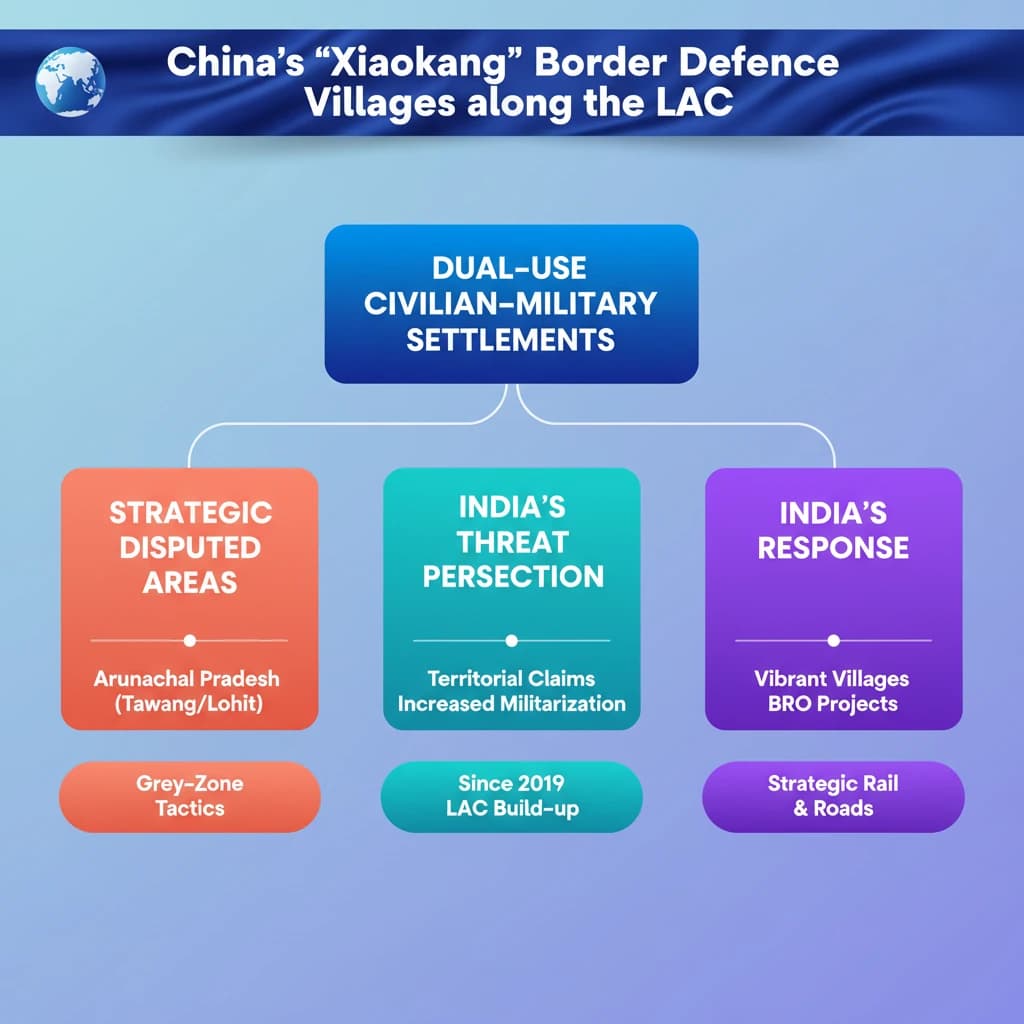
China’s ‘Xiaokang’ Border Defence Villages along the LAC is a key topic under International Relations for UPSC Civil Services Examination. Key points include: Xiaokang villages are China's 'well-off' border defence settlements constructed since 2019.. They are 'dual-use infrastructure', serving both civilian settlement and potential military presence.. Located along the LAC, particularly in contested areas like Arunachal Pradesh's Lohit Valley and Tawang sector.. Understanding this topic is essential for both UPSC Prelims and Mains preparation.

Why is China’s ‘Xiaokang’ Border Defence Villages along the LAC important for UPSC exam?

China’s ‘Xiaokang’ Border Defence Villages along the LAC is a Medium-level topic in UPSC International Relations. It is tested in both Prelims (factual MCQs) and Mains (analytical answer writing). Previous year UPSC questions have frequently covered aspects of China’s ‘Xiaokang’ Border Defence Villages along the LAC, making it essential for comprehensive IAS preparation.

How to prepare China’s ‘Xiaokang’ Border Defence Villages along the LAC for UPSC?

To prepare China’s ‘Xiaokang’ Border Defence Villages along the LAC for UPSC: (1) Study the comprehensive notes covering all key concepts on Vaidra. (2) Practice previous year questions on this topic. (3) Connect it with current affairs using daily updates. (4) Revise using key takeaways and mind maps available for International Relations. (5) Write practice answers linking China’s ‘Xiaokang’ Border Defence Villages along the LAC to related GS Paper topics.

Key takeaways of China’s ‘Xiaokang’ Border Defence Villages along the LAC for UPSC

  • Xiaokang villages are China's 'well-off' border defence settlements constructed since 2019.
  • They are 'dual-use infrastructure', serving both civilian settlement and potential military presence.
  • Located along the LAC, particularly in contested areas like Arunachal Pradesh's Lohit Valley and Tawang sector.
  • China has built 628 such villages, aiming to assert territorial claims and reinforce sovereignty.
  • Raise significant concerns for India regarding increased militarisation and uncertain Chinese intentions.
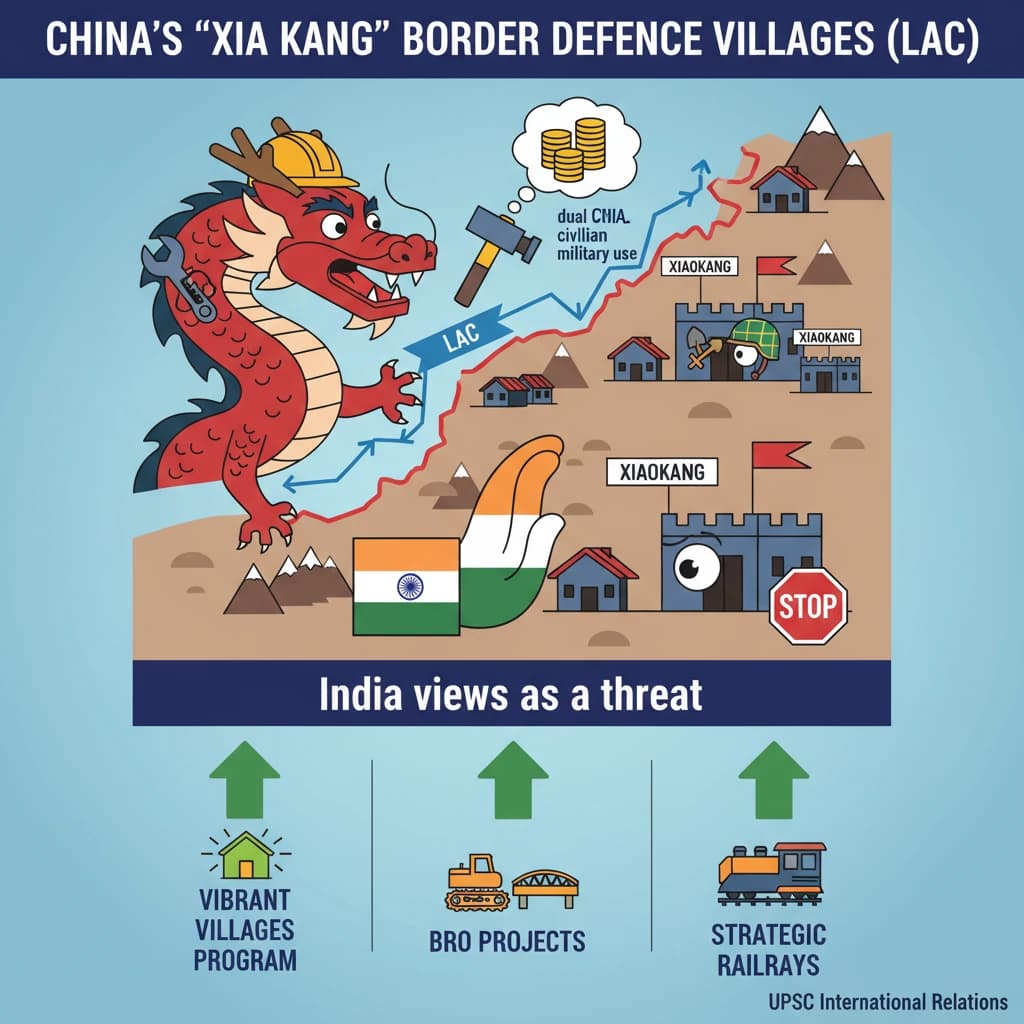
  • Compel India to enhance vigilance and accelerate its own border infrastructure development.
China’s ‘Xiaokang’ Border Defence Villages along the LAC

China’s ‘Xiaokang’ Border Defence Villages along the LAC

Medium⏱️ 6 min read✓ 95% Verified
international relations

📖 Introduction

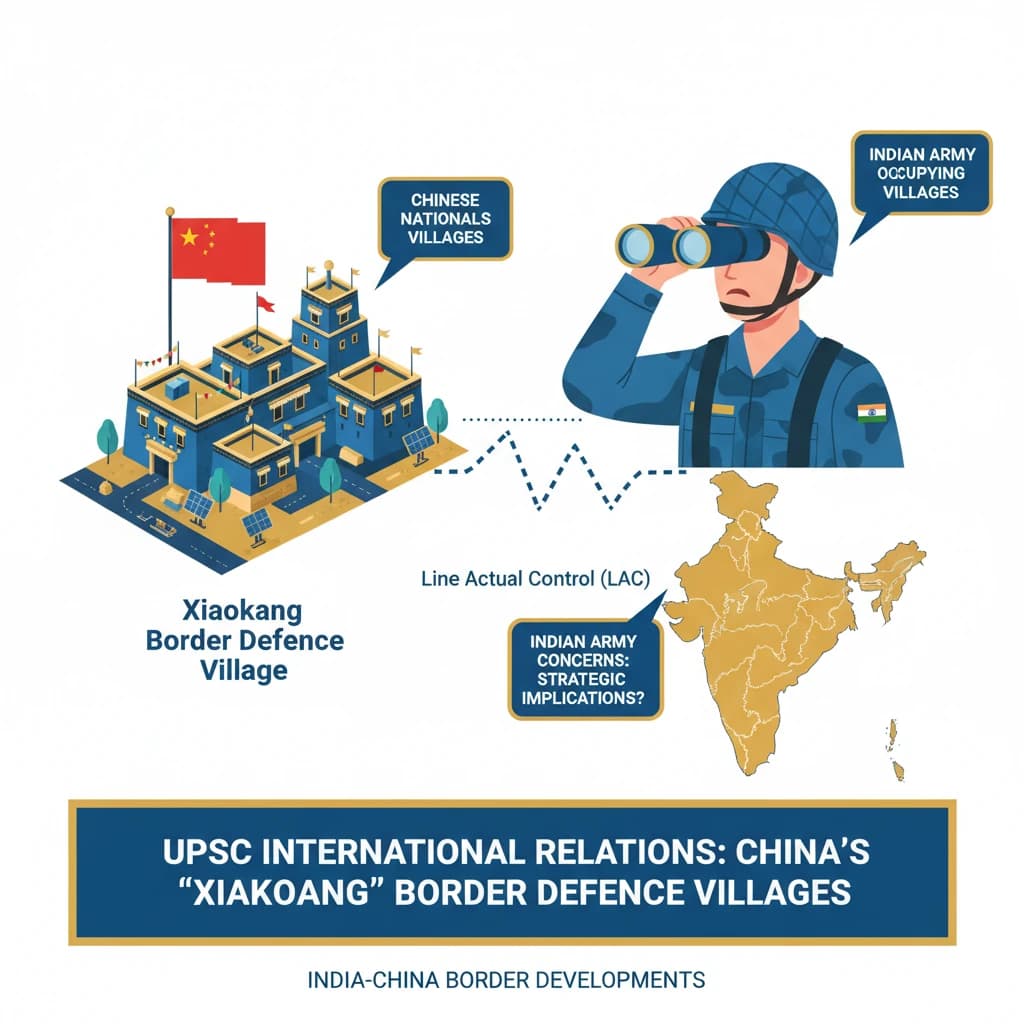
<h4>Recent Developments along the LAC</h4><p>In recent times, significant developments have been observed along the <strong>Line of Actual Control (LAC)</strong> between <strong>India</strong> and <strong>China</strong>.</p><p>Specifically, <strong>Chinese nationals</strong> have commenced occupying previously vacant <strong>“Xiaokang” border defence villages</strong>, drawing attention and concern from the <strong>Indian Army</strong>.</p><div class='info-box'><p>These strategic villages were initially constructed by <strong>China</strong> in <strong>2019</strong>. The nature of their occupants and their broader strategic implications are key areas of concern for <strong>India</strong>.</p></div><h4>Understanding Xiaokang Border Defence Villages</h4><p>The <strong>Xiaokang</strong>, also known as <strong>“well-off villages”</strong>, are a crucial component of <strong>China's strategic infrastructure development initiative</strong>.</p><p>This initiative is specifically focused on strengthening its borders, particularly along the <strong>Line of Actual Control (LAC)</strong> shared with <strong>India</strong>.</p><div class='info-box'><ul><li><strong>Notable Occupation Areas</strong>: These villages have been observed across from <strong>Lohit Valley</strong> and the <strong>Tawang sector</strong> in <strong>Arunachal Pradesh</strong>.</li></ul></div><h4>Dual-Use Infrastructure</h4><p>A defining characteristic of these <strong>Xiaokang villages</strong> is their design as <strong>“dual-use infrastructure”</strong>.</p><p>This means they are engineered to serve a dual purpose: accommodating <strong>civilian settlements</strong> while also facilitating a potential <strong>military presence</strong>.</p><div class='key-point-box'><p>These villages are strategically located in regions where <strong>territorial claims are contested</strong> or where <strong>China</strong> perceives a need to <strong>reinforce its sovereignty</strong>.</p></div><h4>Associated Concerns for India</h4><p>The establishment and occupation of <strong>Xiaokang border defence villages</strong> raise several critical concerns for <strong>India's security</strong> and strategic posture.</p><h5>1. Asserting Territorial Claims</h5><p><strong>China's construction</strong> of an estimated <strong>628 such villages</strong> along <strong>India's borders</strong> with the <strong>Tibet Autonomous Region</strong> is viewed as a concerted effort.</p><p>This initiative aims to unilaterally <strong>assert territorial claims</strong> along the disputed <strong>LAC</strong>, necessitating heightened vigilance from <strong>Indian military strategists</strong>.</p><h5>2. Military Implications</h5><p>The inherent <strong>dual-use nature</strong> of these villages raises significant concerns about potential <strong>increased militarisation</strong> in sensitive border areas.</p><p>This development could further escalate tensions along the already volatile <strong>Line of Actual Control (LAC)</strong>.</p><h5>3. Uncertain Intentions</h5><p>The lack of <strong>transparency</strong> surrounding the specific purpose and the actual scale of the <strong>civilian population</strong> within these villages creates deep suspicion.</p><p>This opacity actively hinders efforts towards <strong>trust-building</strong> between the two nations and complicates regional stability.
Concept Diagram

💡 Key Takeaways

  • •Xiaokang villages are China's 'well-off' border defence settlements constructed since 2019.
  • •They are 'dual-use infrastructure', serving both civilian settlement and potential military presence.
  • •Located along the LAC, particularly in contested areas like Arunachal Pradesh's Lohit Valley and Tawang sector.
  • •China has built 628 such villages, aiming to assert territorial claims and reinforce sovereignty.
  • •Raise significant concerns for India regarding increased militarisation and uncertain Chinese intentions.
  • •Compel India to enhance vigilance and accelerate its own border infrastructure development.

🧠 Memory Techniques
Memory Aid
95% Verified Content

Related Topics

Loading related topics...
Explore:International Relations Topics·All Subjects·Daily Current Affairs·Editorial Analysis·Previous Year Questions·UPSC GPT
China’s ‘Xiaokang’ Border Defence Villages along the LAC - UPSC International Relations