Loading page, please wait…
Vaidra Logo
Vaidra

Top 4 items + smart groups

UPSC GPT
New
Current Affairs
Daily Solutions
Daily Puzzle
Mains Evaluator

Version 2.0.0 • Built with ❤️ for UPSC aspirants

Loading...
Loading...
Loading...
Loading...
Loading...
Loading...
Loading...
Loading...
Loading...
Loading...
Loading...
Loading...
Loading...
Back
All Subjects

Topics

0 topics • 0 completed

Loading topics...
Loading...
Loading...
Loading...
Loading...
Loading...
Overall Progress0%

Kailash Mansarovar Yatra - UPSC International Relations

What is Kailash Mansarovar Yatra in UPSC International Relations?

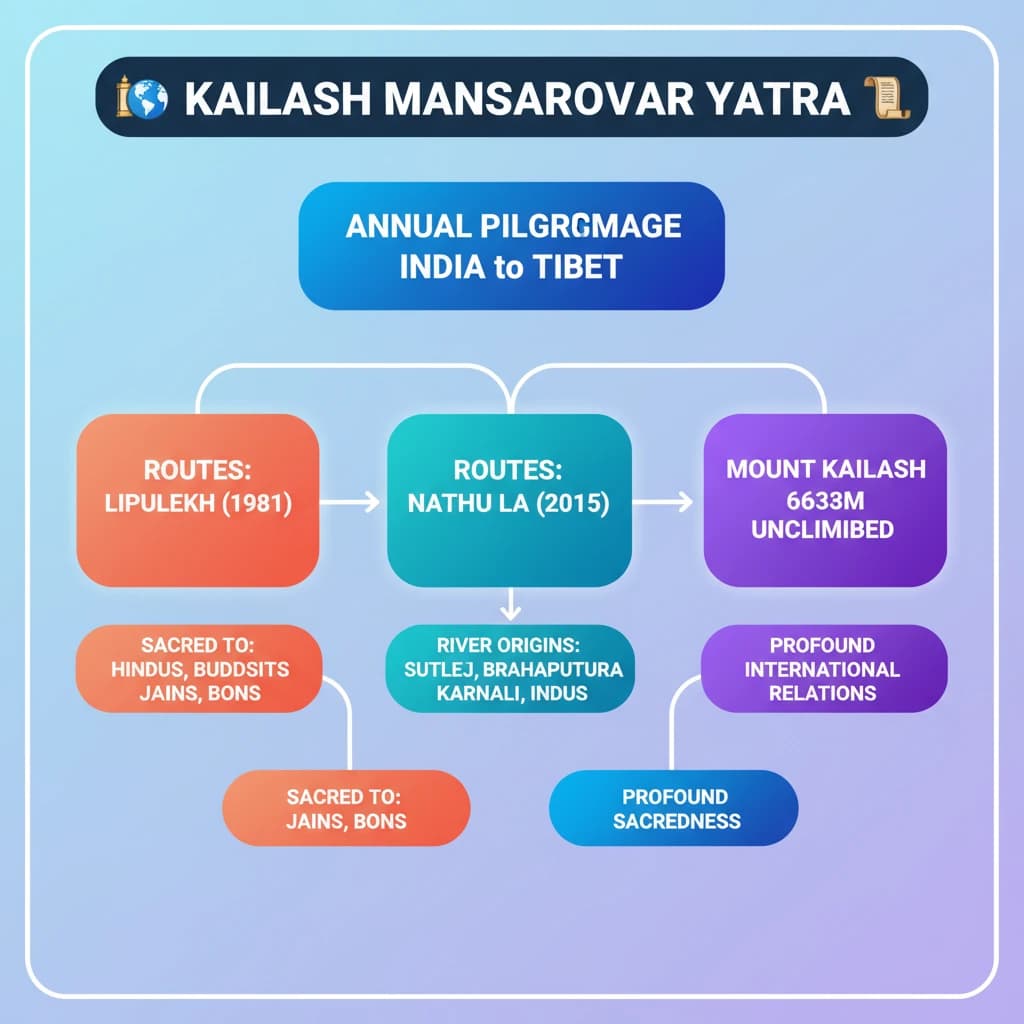
Kailash Mansarovar Yatra is a key topic under International Relations for UPSC Civil Services Examination. Key points include: KMY is an annual pilgrimage to Mount Kailash and Lake Mansarovar in Tibet, organized by India.. Routes are Lipulekh Pass (Uttarakhand, 1981) and Nathu La Pass (Sikkim, 2015).. Mount Kailash (6,638m) is sacred to Hindus, Buddhists, Jains, and Bons.. Understanding this topic is essential for both UPSC Prelims and Mains preparation.

Why is Kailash Mansarovar Yatra important for UPSC exam?

Kailash Mansarovar Yatra is a Medium-level topic in UPSC International Relations. It is tested in both Prelims (factual MCQs) and Mains (analytical answer writing). Previous year UPSC questions have frequently covered aspects of Kailash Mansarovar Yatra, making it essential for comprehensive IAS preparation.

How to prepare Kailash Mansarovar Yatra for UPSC?

To prepare Kailash Mansarovar Yatra for UPSC: (1) Study the comprehensive notes covering all key concepts on Vaidra. (2) Practice previous year questions on this topic. (3) Connect it with current affairs using daily updates. (4) Revise using key takeaways and mind maps available for International Relations. (5) Write practice answers linking Kailash Mansarovar Yatra to related GS Paper topics.

Key takeaways of Kailash Mansarovar Yatra for UPSC

  • KMY is an annual pilgrimage to Mount Kailash and Lake Mansarovar in Tibet, organized by India.
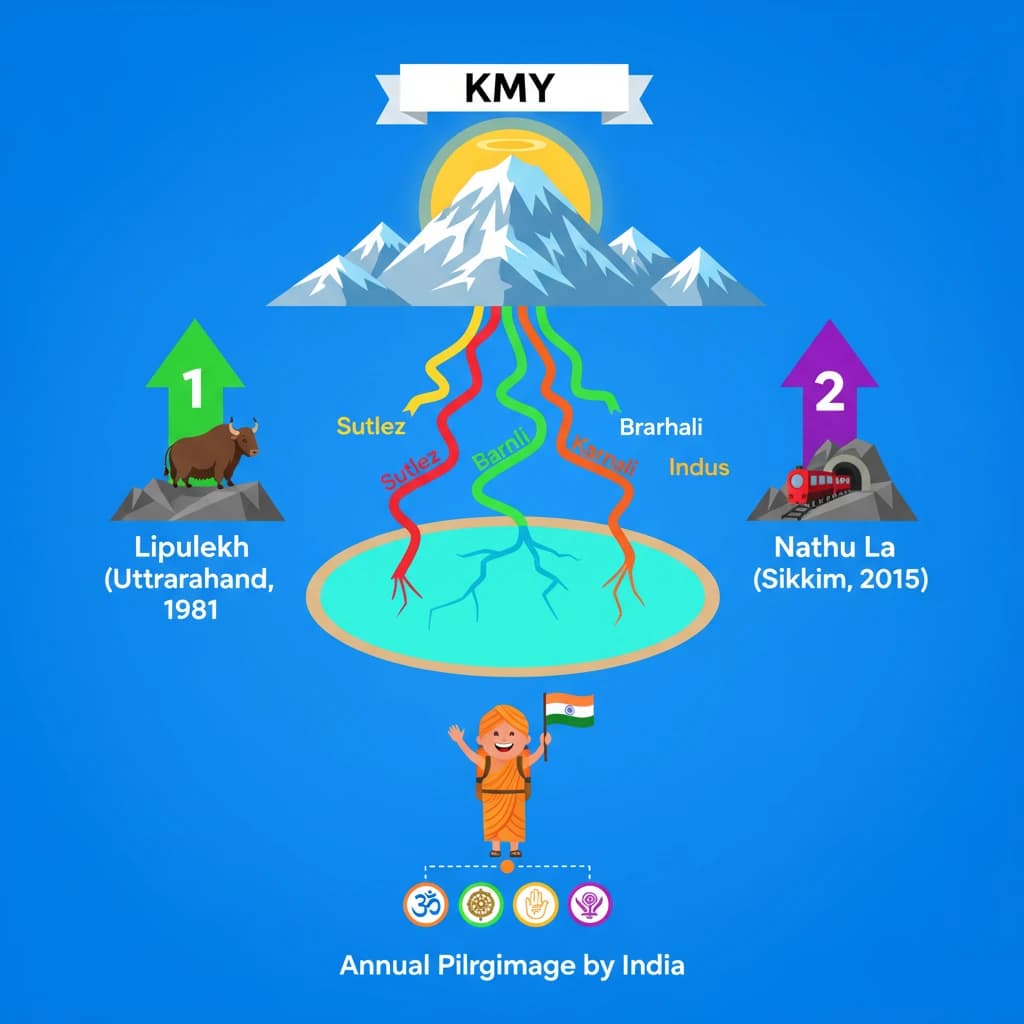
  • Routes are Lipulekh Pass (Uttarakhand, 1981) and Nathu La Pass (Sikkim, 2015).
  • Mount Kailash (6,638m) is sacred to Hindus, Buddhists, Jains, and Bons.
  • It is the origin of major rivers: Sutlej, Brahmaputra, Karnali, and Indus.
  • Mount Kailash remains unclimbed due to its profound sacred significance.
Kailash Mansarovar Yatra

Kailash Mansarovar Yatra

Medium⏱️ 6 min read✓ 95% Verified
international relations

📖 Introduction

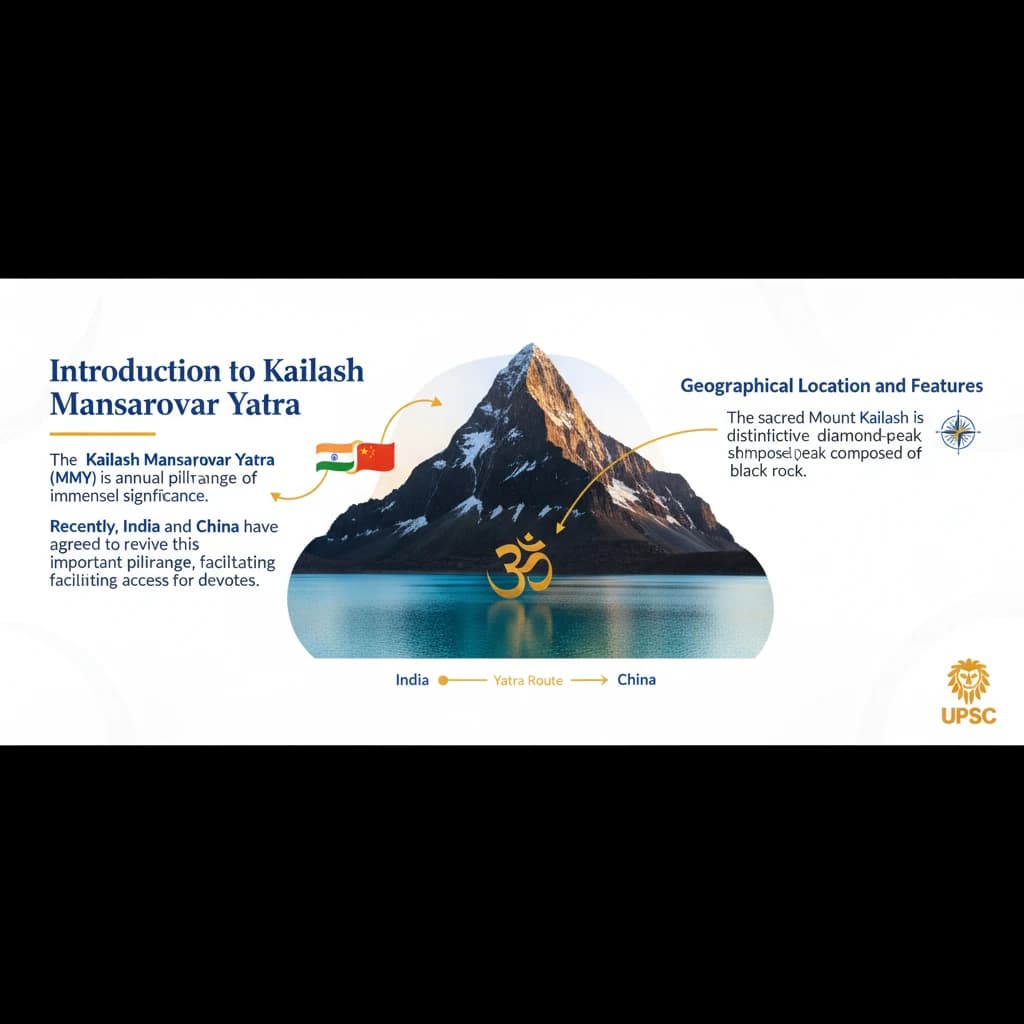
<h4>Introduction to Kailash Mansarovar Yatra</h4><p>The <strong>Kailash Mansarovar Yatra (KMY)</strong> is an annual pilgrimage of immense spiritual significance.</p><p>Recently, <strong>India</strong> and <strong>China</strong> have agreed to revive this important pilgrimage, facilitating access for devotees.</p><h4>Geographical Location and Features</h4><p>The sacred <strong>Mount Kailash</strong> is a distinctive <strong>diamond-shaped peak</strong> composed of <strong>black rock</strong>.</p><p>It is strategically located in the <strong>Tibet Autonomous Region</strong> of <strong>China</strong>.</p><div class='info-box'><p><strong>Mount Kailash</strong> stands at an elevation of <strong>6,638 meters</strong>.</p></div><p>At the base of <strong>Mount Kailash</strong> lies the revered <strong>Lake Mansarovar</strong>, an integral part of the pilgrimage.</p><h4>Pilgrimage Routes and Organization</h4><p>The <strong>KMY</strong> is organized annually by <strong>India</strong>, typically between the months of <strong>June</strong> and <strong>September</strong>.</p><p>Two primary routes are utilized for this spiritual journey:</p><ul><li>The <strong>Lipulekh Pass</strong> in <strong>Uttarakhand</strong>, operational since <strong>1981</strong>.</li><li>The <strong>Nathu La Pass</strong> in <strong>Sikkim</strong>, which opened for pilgrims in <strong>2015</strong>.</li></ul><h4>Prohibition on Ascent</h4><p>Despite being lower in height than <strong>Mount Everest</strong> (8,849 meters), <strong>Mount Kailash</strong> remains <strong>unclimbed</strong>.</p><div class='key-point-box'><p>Its ascent is strictly prohibited due to its profound <strong>sacred significance</strong> to multiple religions.</p></div><h4>Origin of Major Rivers</h4><p><strong>Mount Kailash</strong> is considered a spiritual center, notably as the origin point for several major rivers.</p><ul><li>The <strong>Sutlej River</strong></li><li>The <strong>Brahmaputra River</strong></li><li>The <strong>Karnali River</strong> (a major tributary of the Ganga)</li><li>The <strong>Indus River</strong></li></ul>
Concept Diagram

💡 Key Takeaways

  • •KMY is an annual pilgrimage to Mount Kailash and Lake Mansarovar in Tibet, organized by India.
  • •Routes are Lipulekh Pass (Uttarakhand, 1981) and Nathu La Pass (Sikkim, 2015).
  • •Mount Kailash (6,638m) is sacred to Hindus, Buddhists, Jains, and Bons.
  • •It is the origin of major rivers: Sutlej, Brahmaputra, Karnali, and Indus.
  • •Mount Kailash remains unclimbed due to its profound sacred significance.

🧠 Memory Techniques
Memory Aid
95% Verified Content

📚 Reference Sources

•Ministry of External Affairs (India) official reports
•Academic texts on Himalayan geography and religious studies

Related Topics

Loading related topics...
Explore:International Relations Topics·All Subjects·Daily Current Affairs·Editorial Analysis·Previous Year Questions·UPSC GPT
Kailash Mansarovar Yatra - UPSC International Relations