Loading page, please wait…
Vaidra Logo
Vaidra

Top 4 items + smart groups

UPSC GPT
New
Current Affairs
Daily Solutions
Daily Puzzle
Mains Evaluator

Version 2.0.0 • Built with ❤️ for UPSC aspirants

Loading...
Loading...
Loading...
Loading...
Loading...
Loading...
Loading...
Loading...
Loading...
Loading...
Loading...
Loading...
Loading...

India’s Engagement at ASEAN Meet - UPSC International Relations

What is India’s Engagement at ASEAN Meet in UPSC International Relations?

India’s Engagement at ASEAN Meet is a key topic under International Relations for UPSC Civil Services Examination. Key points include: EAM's visit to Vientiane for ASEAN meetings highlights India's strong engagement.. ASEAN, founded in 1967, is a regional intergovernmental organization with 10 member states.. The ASEAN Charter (2008) provided legal status and institutional framework.. Understanding this topic is essential for both UPSC Prelims and Mains preparation.

Why is India’s Engagement at ASEAN Meet important for UPSC exam?

India’s Engagement at ASEAN Meet is a Medium-level topic in UPSC International Relations. It is tested in both Prelims (factual MCQs) and Mains (analytical answer writing). Previous year UPSC questions have frequently covered aspects of India’s Engagement at ASEAN Meet, making it essential for comprehensive IAS preparation.

How to prepare India’s Engagement at ASEAN Meet for UPSC?

To prepare India’s Engagement at ASEAN Meet for UPSC: (1) Study the comprehensive notes covering all key concepts on Vaidra. (2) Practice previous year questions on this topic. (3) Connect it with current affairs using daily updates. (4) Revise using key takeaways and mind maps available for International Relations. (5) Write practice answers linking India’s Engagement at ASEAN Meet to related GS Paper topics.

Key takeaways of India’s Engagement at ASEAN Meet for UPSC

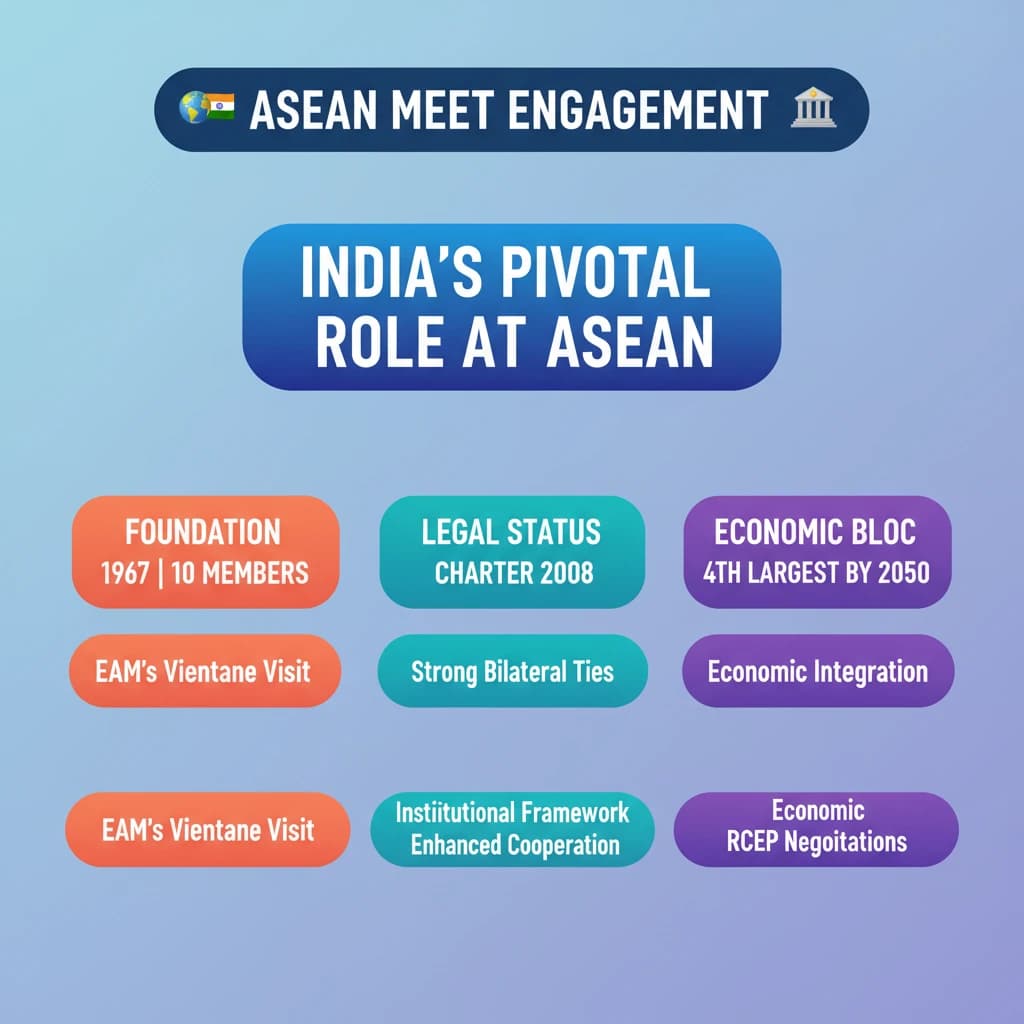
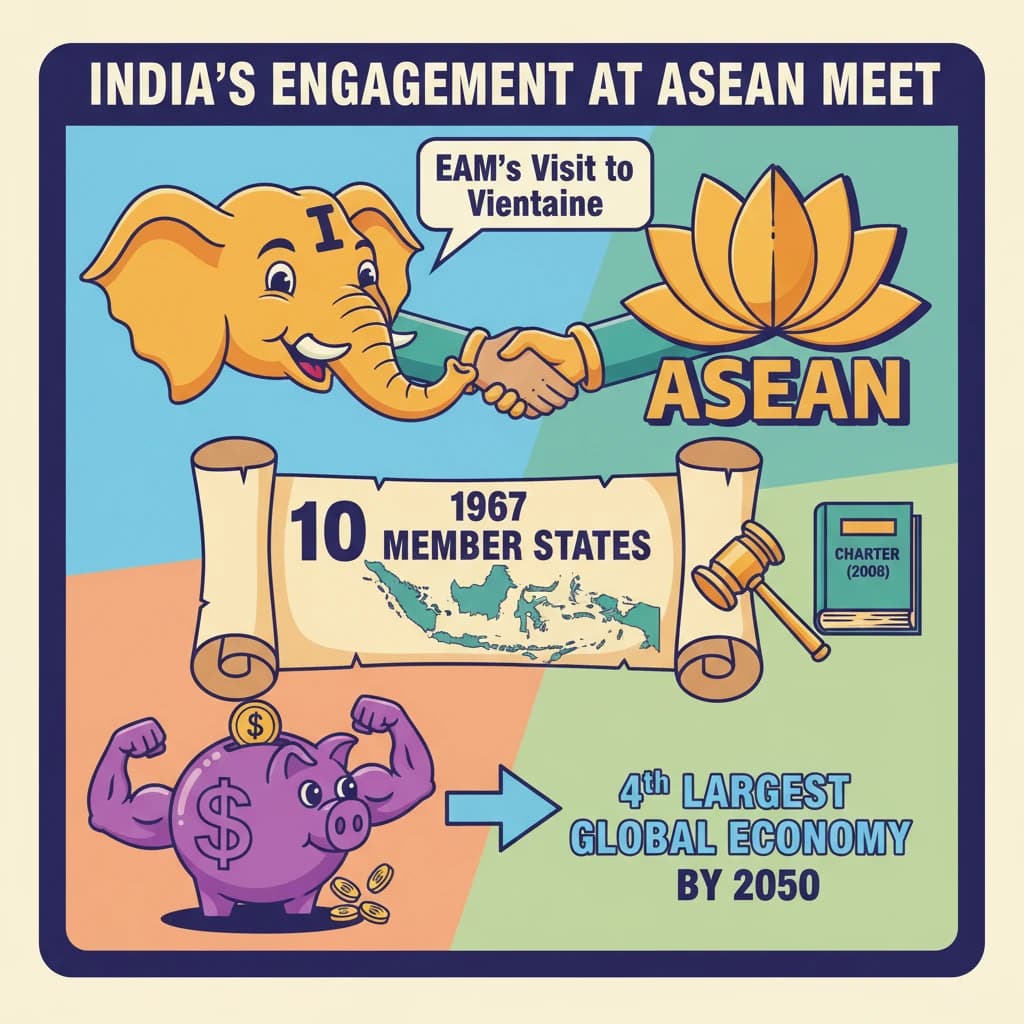
  • EAM's visit to Vientiane for ASEAN meetings highlights India's strong engagement.
  • ASEAN, founded in 1967, is a regional intergovernmental organization with 10 member states.
  • The ASEAN Charter (2008) provided legal status and institutional framework.
  • ASEAN is a major economic bloc, projected to be the 4th largest global economy by 2050.
  • ASEAN's key achievements include economic integration and negotiating RCEP.
  • India's Act East Policy places ASEAN at its core for strategic and economic partnerships.
India’s Engagement at ASEAN Meet

India’s Engagement at ASEAN Meet

Medium⏱️ 7 min read✓ 95% Verified
international relations

📖 Introduction

<h4>Introduction to India's ASEAN Engagement</h4><p>India's External Affairs Minister (<strong>EAM</strong>) recently undertook a significant visit to <strong>Vientiane, Laos</strong>. This visit was primarily for the <strong>Association of Southeast Asian Nations (ASEAN)</strong> meetings, underscoring India's commitment to regional partnerships.</p><p>The visit served as a crucial platform for high-level dialogues with various global leaders. These interactions aimed at further strengthening <strong>bilateral relations</strong> and fostering deeper cooperation across multiple sectors.</p><h4>Understanding ASEAN: A Regional Powerhouse</h4><p>The <strong>Association of Southeast Asian Nations (ASEAN)</strong> is a prominent regional intergovernmental organization. It plays a pivotal role in promoting economic, political, security, educational, and socio-cultural cooperation among its ten member states.</p><div class='info-box'><p><strong>Founded:</strong> 8th August 1967</p><p><strong>Location:</strong> Bangkok, Thailand</p><p><strong>Formalized by:</strong> The ASEAN Declaration</p></div><p>ASEAN has emerged as one of the world's largest economic blocs. Projections suggest that the region could potentially become the <strong>4th-largest economy globally by 2050</strong>, highlighting its growing influence.</p><h4>Evolution of ASEAN Membership</h4><p>ASEAN was initially established by five founding member states. Over the years, it has progressively expanded to include more nations from Southeast Asia, strengthening its regional representation.</p><ul><li><strong>Initial Signatories:</strong> <ul><li><strong>Indonesia</strong></li><li><strong>Malaysia</strong></li><li><strong>the Philippines</strong></li><li><strong>Singapore</strong></li><li><strong>Thailand</strong></li></ul></li><li><strong>Later Additions:</strong> <ul><li><strong>Brunei Darussalam</strong> (1984)</li><li><strong>Vietnam</strong> (1995)</li><li><strong>Laos PDR</strong> (1997)</li><li><strong>Myanmar</strong> (1997)</li><li><strong>Cambodia</strong> (1999)</li></ul></li></ul><h4>ASEAN's Institutional Framework and Achievements</h4><p>A significant milestone for ASEAN was the adoption of the <strong>ASEAN Charter in 2008</strong>. This charter provided the organization with a robust legal status and a comprehensive institutional framework.</p><div class='key-point-box'><p>The <strong>ASEAN Charter (2008)</strong> codified norms, rules, and values for the bloc. This enhancement has significantly improved <strong>accountability</strong> and <strong>compliance</strong> among member states, solidifying its operational structure.</p></div><p>One of ASEAN's biggest successes has been its remarkable achievement in promoting <strong>economic integration</strong> among its members. This has led to increased trade, investment, and regional prosperity.</p><div class='exam-tip-box'><p>ASEAN played a crucial role in negotiating the <strong>Regional Comprehensive Economic Partnership (RCEP)</strong>. Although India is not a member, understanding ASEAN's role in the <strong>world's largest free trade agreement</strong> is vital for UPSC, especially for questions on regional economic blocs and India's trade policy.</p></div>
Concept Diagram

💡 Key Takeaways

  • •EAM's visit to Vientiane for ASEAN meetings highlights India's strong engagement.
  • •ASEAN, founded in 1967, is a regional intergovernmental organization with 10 member states.
  • •The ASEAN Charter (2008) provided legal status and institutional framework.
  • •ASEAN is a major economic bloc, projected to be the 4th largest global economy by 2050.
  • •ASEAN's key achievements include economic integration and negotiating RCEP.
  • •India's Act East Policy places ASEAN at its core for strategic and economic partnerships.

🧠 Memory Techniques
Memory Aid
95% Verified Content

Related Topics

Loading related topics...
Explore:International Relations Topics·All Subjects·Daily Current Affairs·Editorial Analysis·Previous Year Questions·UPSC GPT
Back
All Subjects

Topics

0 topics • 0 completed

Loading topics...
Loading...
Loading...
Loading...
Loading...
Loading...
Overall Progress0%
India’s Engagement at ASEAN Meet - UPSC International Relations