Loading page, please wait…
Vaidra Logo
Vaidra

Top 4 items + smart groups

UPSC GPT
New
Current Affairs
Daily Solutions
Daily Puzzle
Mains Evaluator

Version 2.0.0 • Built with ❤️ for UPSC aspirants

Loading...
Loading...
Loading...
Loading...
Loading...
Loading...
Loading...
Loading...
Loading...
Loading...
Loading...
Loading...
Loading...
India-EU Trade Conundrum - UPSC International Relations
Back
All Subjects

Topics

0 topics • 0 completed

Loading topics...
Loading...
Loading...
Loading...
Loading...
Loading...
Overall Progress0%

India-EU Trade Conundrum - UPSC International Relations

What is India-EU Trade Conundrum in UPSC International Relations?

India-EU Trade Conundrum is a key topic under International Relations for UPSC Civil Services Examination. Key points include: EU extended safeguard duties on steel until 2026, impacting Indian exports.. India's merchandise exports to EU were USD 44 billion (2021-22), imports USD 51.4 billion.. Indian steel exports to EU grew to USD 6.64 billion in 2023-24 despite duties.. Understanding this topic is essential for both UPSC Prelims and Mains preparation.

Why is India-EU Trade Conundrum important for UPSC exam?

India-EU Trade Conundrum is a Medium-level topic in UPSC International Relations. It is tested in both Prelims (factual MCQs) and Mains (analytical answer writing). Previous year UPSC questions have frequently covered aspects of India-EU Trade Conundrum, making it essential for comprehensive IAS preparation.

How to prepare India-EU Trade Conundrum for UPSC?

To prepare India-EU Trade Conundrum for UPSC: (1) Study the comprehensive notes covering all key concepts on Vaidra. (2) Practice previous year questions on this topic. (3) Connect it with current affairs using daily updates. (4) Revise using key takeaways and mind maps available for International Relations. (5) Write practice answers linking India-EU Trade Conundrum to related GS Paper topics.

Key takeaways of India-EU Trade Conundrum for UPSC

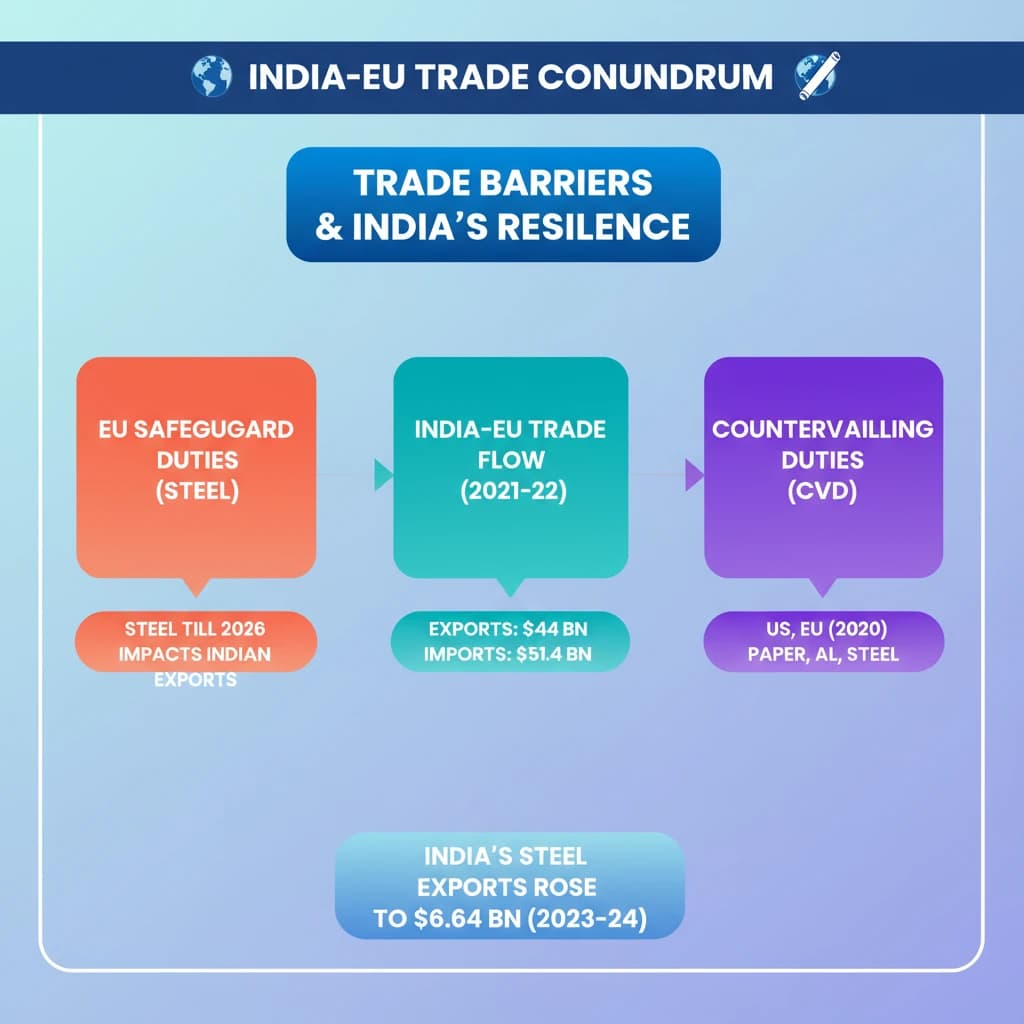
  • EU extended safeguard duties on steel until 2026, impacting Indian exports.
  • India's merchandise exports to EU were USD 44 billion (2021-22), imports USD 51.4 billion.
  • Indian steel exports to EU grew to USD 6.64 billion in 2023-24 despite duties.
  • US and EU imposed countervailing duties (CVDs) on Indian paper, aluminium, and steel products in 2020.
  • Safeguard duties protect domestic industries from import surges; CVDs offset foreign government subsidies.
  • These measures pose challenges for India-EU trade relations and FTA negotiations.
India-EU Trade Conundrum

India-EU Trade Conundrum

Medium⏱️ 7 min read✓ 95% Verified
international relations

📖 Introduction

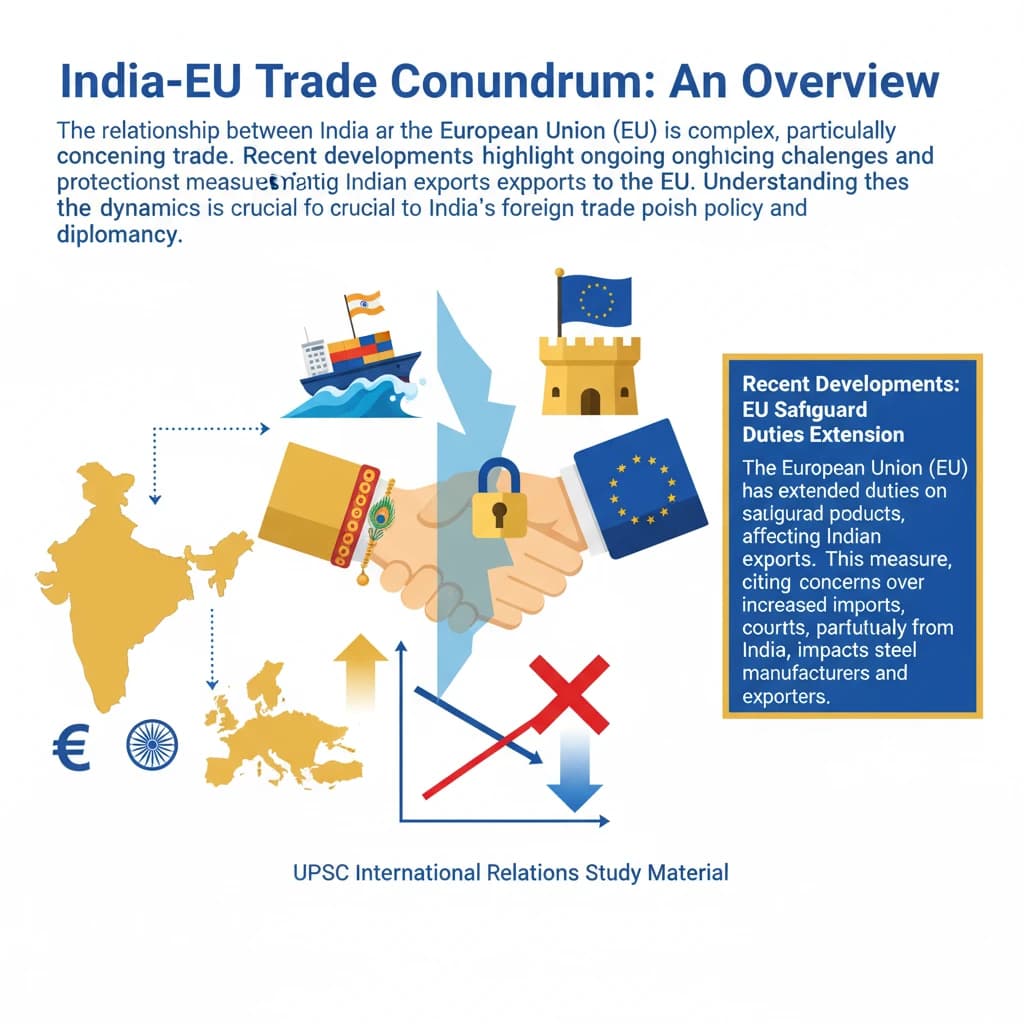
<h4>India-EU Trade Conundrum: An Overview</h4><p>The relationship between <strong>India</strong> and the <strong>European Union (EU)</strong> is complex, particularly concerning trade. Recent developments highlight ongoing challenges and protectionist measures impacting Indian exports to the EU.</p><p>Understanding these dynamics is crucial for comprehending India's foreign trade policy and economic diplomacy.</p><h4>Recent Developments: EU Safeguard Duties Extension</h4><p>The <strong>European Union (EU)</strong> has recently decided to extend its existing <strong>safeguard duties</strong>. These duties, initially set to expire, will now remain in effect until <strong>2026</strong>.</p><div class='info-box'><p><strong>Safeguard duties</strong> are temporary restrictions on imports of certain products, imposed to protect a domestic industry from serious injury caused by a surge in imports.</p></div><p>This extension directly impacts Indian exporters, especially in sectors subject to these duties, creating a significant trade conundrum.</p><h4>Key Highlights in India-EU Trade Relations</h4><p>Trade between <strong>India</strong> and the <strong>EU</strong> involves substantial volumes, with specific sectors showing notable growth and challenges.</p><ul><li><p><strong>Overall Exports:</strong> India's exports to Europe reached approximately <strong>USD 16 billion</strong> in <strong>FY24</strong>. Merchandise exports to EU member countries stood at about <strong>USD 44 billion</strong> in <strong>2021-22</strong>.</p></li><li><p><strong>Overall Imports:</strong> Imports from the EU aggregated at <strong>USD 51.4 billion</strong> in <strong>2021-22</strong>.</p></li><li><p><strong>Recent Growth:</strong> In <strong>2022-23</strong>, India's total exports aggregated at <strong>USD 67 billion</strong>, indicating a growing trade relationship despite challenges.</p></li></ul><h4>Significant Interest in Steel Exports</h4><p>The <strong>iron and steel sector</strong> is a major component of India's exports to the EU, but it is also a sector frequently affected by trade protectionist measures.</p><ul><li><p><strong>Growth in Steel Exports:</strong> India’s iron and steel product exports to the <strong>EU</strong> increased to <strong>USD 6.64 billion</strong> in <strong>2023-2024</strong>, up from <strong>USD 6.1 billion</strong> in <strong>2022-23</strong>.</p></li></ul><div class='key-point-box'><p>The continued growth in steel exports, despite safeguard duties, highlights the competitiveness of Indian steel products and the importance of the EU market.</p></div><h4>Imposition of Countervailing Duties (CVDs)</h4><p>Beyond safeguard duties, <strong>Indian exports</strong> have also faced the imposition of <strong>Countervailing Duties (CVDs)</strong> from major trading partners like the <strong>US</strong> and the <strong>EU</strong>.</p><ul><li><p><strong>CVD Imposition:</strong> In <strong>2020</strong>, the <strong>US</strong> and <strong>EU</strong> imposed <strong>CVDs</strong> on certain Indian exports.</p></li><li><p><strong>Affected Products:</strong> These included <strong>paper file folders</strong>, <strong>common alloy aluminium sheets</strong>, and <strong>forged steel fluid</strong>.</p></li></ul><div class='info-box'><p><strong>Countervailing duties (CVDs)</strong> are tariffs imposed on imported goods. Their purpose is to offset the impact of subsidies provided by the exporting country’s government, thereby protecting the domestic industry of the importing country.</p></div><div class='exam-tip-box'><p>For <strong>UPSC Mains (GS Paper II/III)</strong>, understanding the distinction between <strong>safeguard duties</strong> and <strong>countervailing duties</strong>, along with their implications for India's trade policy, is critical. Be prepared to discuss the economic rationale and diplomatic challenges.</p></div>
Concept Diagram

💡 Key Takeaways

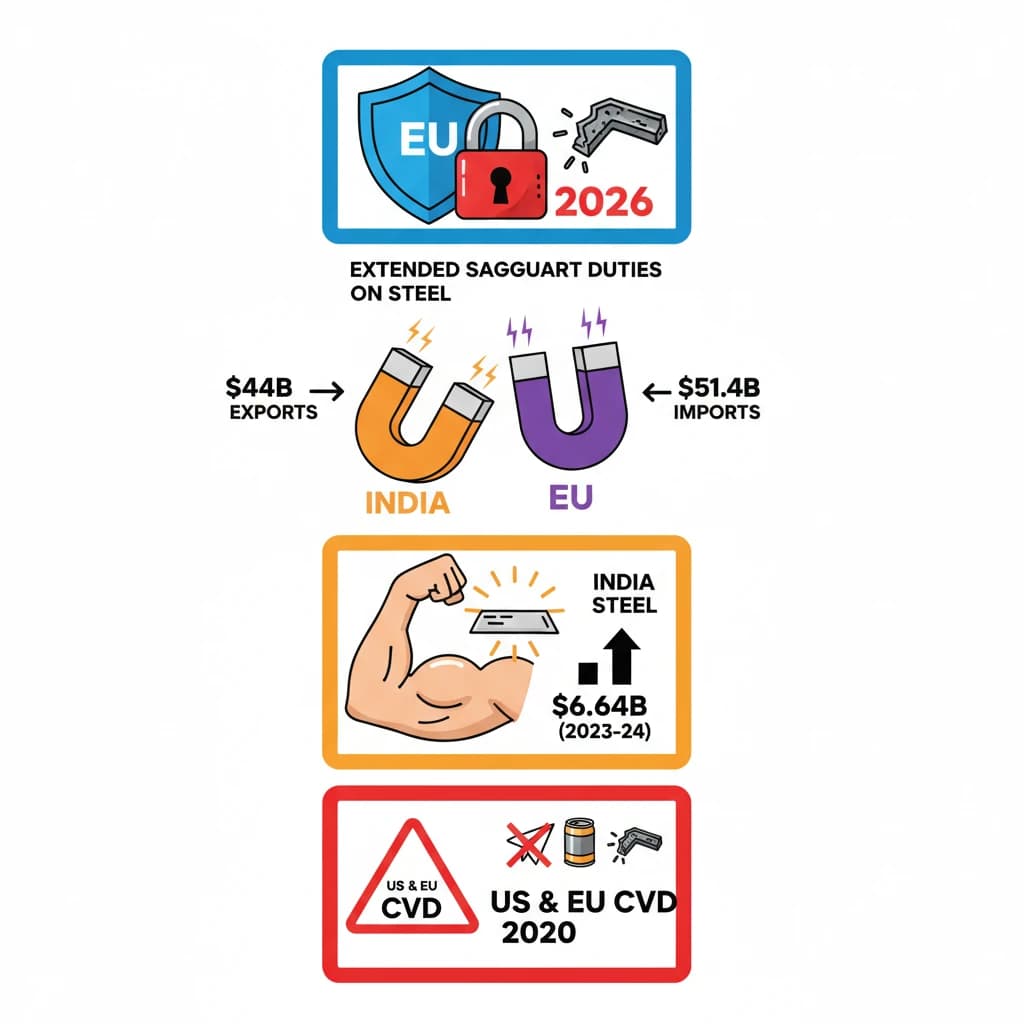
  • •EU extended safeguard duties on steel until 2026, impacting Indian exports.
  • •India's merchandise exports to EU were USD 44 billion (2021-22), imports USD 51.4 billion.
  • •Indian steel exports to EU grew to USD 6.64 billion in 2023-24 despite duties.
  • •US and EU imposed countervailing duties (CVDs) on Indian paper, aluminium, and steel products in 2020.
  • •Safeguard duties protect domestic industries from import surges; CVDs offset foreign government subsidies.
  • •These measures pose challenges for India-EU trade relations and FTA negotiations.

🧠 Memory Techniques
Memory Aid
95% Verified Content

📚 Reference Sources

•World Trade Organization (WTO) Agreements on Safeguards and Subsidies
•Ministry of Commerce & Industry, Government of India reports (general knowledge)

Related Topics

Loading related topics...
Explore:International Relations Topics·All Subjects·Daily Current Affairs·Editorial Analysis·Previous Year Questions·UPSC GPT