Loading page, please wait…
Vaidra Logo
Vaidra

Top 4 items + smart groups

UPSC GPT
New
Current Affairs
Daily Solutions
Daily Puzzle
Mains Evaluator

Version 2.0.0 • Built with ❤️ for UPSC aspirants

Loading...
Loading...
Loading...
Loading...
Loading...
Loading...
Loading...
Loading...
Loading...
Loading...
Loading...
Loading...
Loading...
India-Middle East-Europe Corridor (IMEC) - UPSC International Relations
Back
All Subjects

Topics

0 topics • 0 completed

Loading topics...
Loading...
Loading...
Loading...
Loading...
Loading...
Overall Progress0%

India-Middle East-Europe Corridor (IMEC) - UPSC International Relations

What is India-Middle East-Europe Corridor (IMEC) in UPSC International Relations?

India-Middle East-Europe Corridor (IMEC) is a key topic under International Relations for UPSC Civil Services Examination. Key points include: IMEC aims to connect India, Middle East, and Europe for enhanced trade and connectivity.. Global corridors like Lobito and Middle Corridor are vital for regional development and supply chain diversification.. The Great Green Wall Initiative is a major environmental project combating desertification in Africa.. Understanding this topic is essential for both UPSC Prelims and Mains preparation.

Why is India-Middle East-Europe Corridor (IMEC) important for UPSC exam?

India-Middle East-Europe Corridor (IMEC) is a Medium-level topic in UPSC International Relations. It is tested in both Prelims (factual MCQs) and Mains (analytical answer writing). Previous year UPSC questions have frequently covered aspects of India-Middle East-Europe Corridor (IMEC), making it essential for comprehensive IAS preparation.

How to prepare India-Middle East-Europe Corridor (IMEC) for UPSC?

To prepare India-Middle East-Europe Corridor (IMEC) for UPSC: (1) Study the comprehensive notes covering all key concepts on Vaidra. (2) Practice previous year questions on this topic. (3) Connect it with current affairs using daily updates. (4) Revise using key takeaways and mind maps available for International Relations. (5) Write practice answers linking India-Middle East-Europe Corridor (IMEC) to related GS Paper topics.

Key takeaways of India-Middle East-Europe Corridor (IMEC) for UPSC

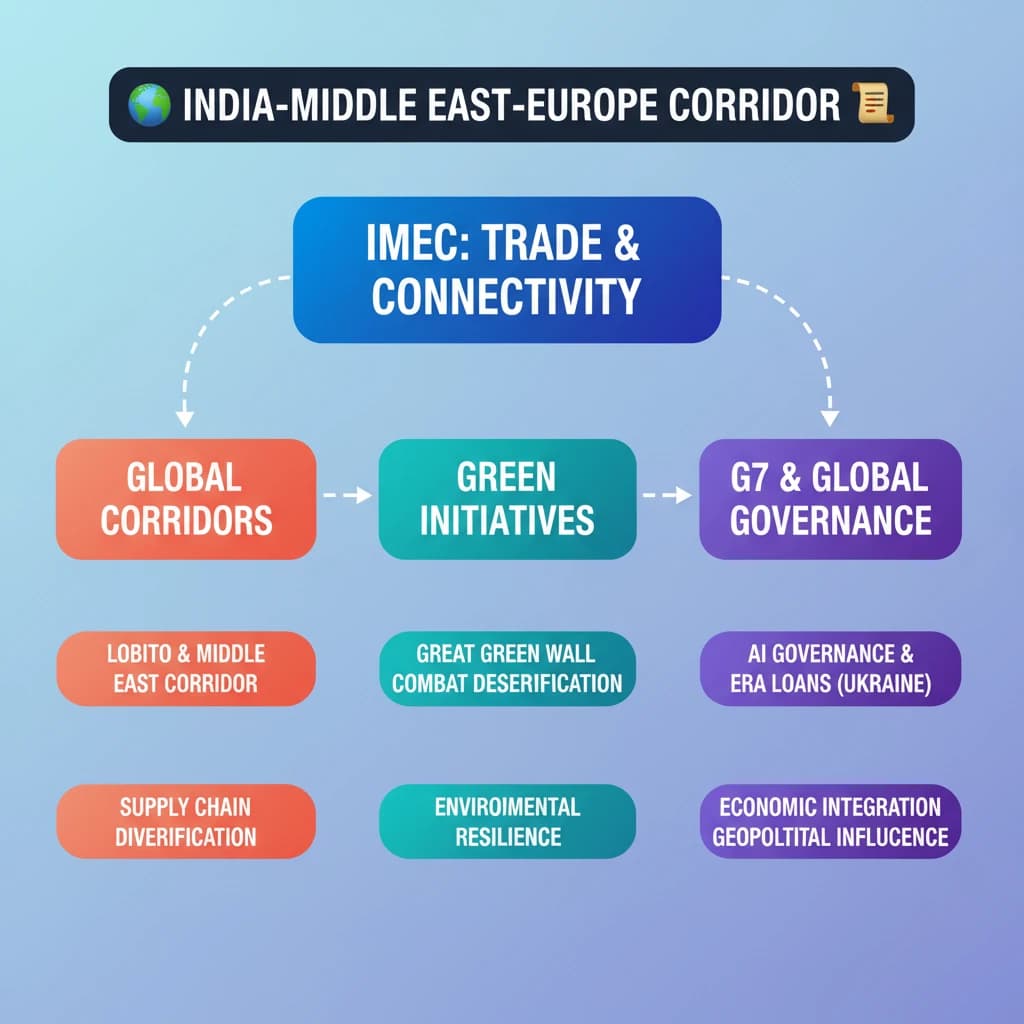
  • IMEC aims to connect India, Middle East, and Europe for enhanced trade and connectivity.
  • Global corridors like Lobito and Middle Corridor are vital for regional development and supply chain diversification.
  • The Great Green Wall Initiative is a major environmental project combating desertification in Africa.
  • G7 leaders are committed to interoperable AI governance and significant financial aid for Ukraine (ERA Loans).
  • These initiatives reflect a strategic focus on economic integration, geopolitical influence, and addressing global challenges.
India-Middle East-Europe Corridor (IMEC)

India-Middle East-Europe Corridor (IMEC)

Medium⏱️ 8 min read✓ 95% Verified
international relations

📖 Introduction

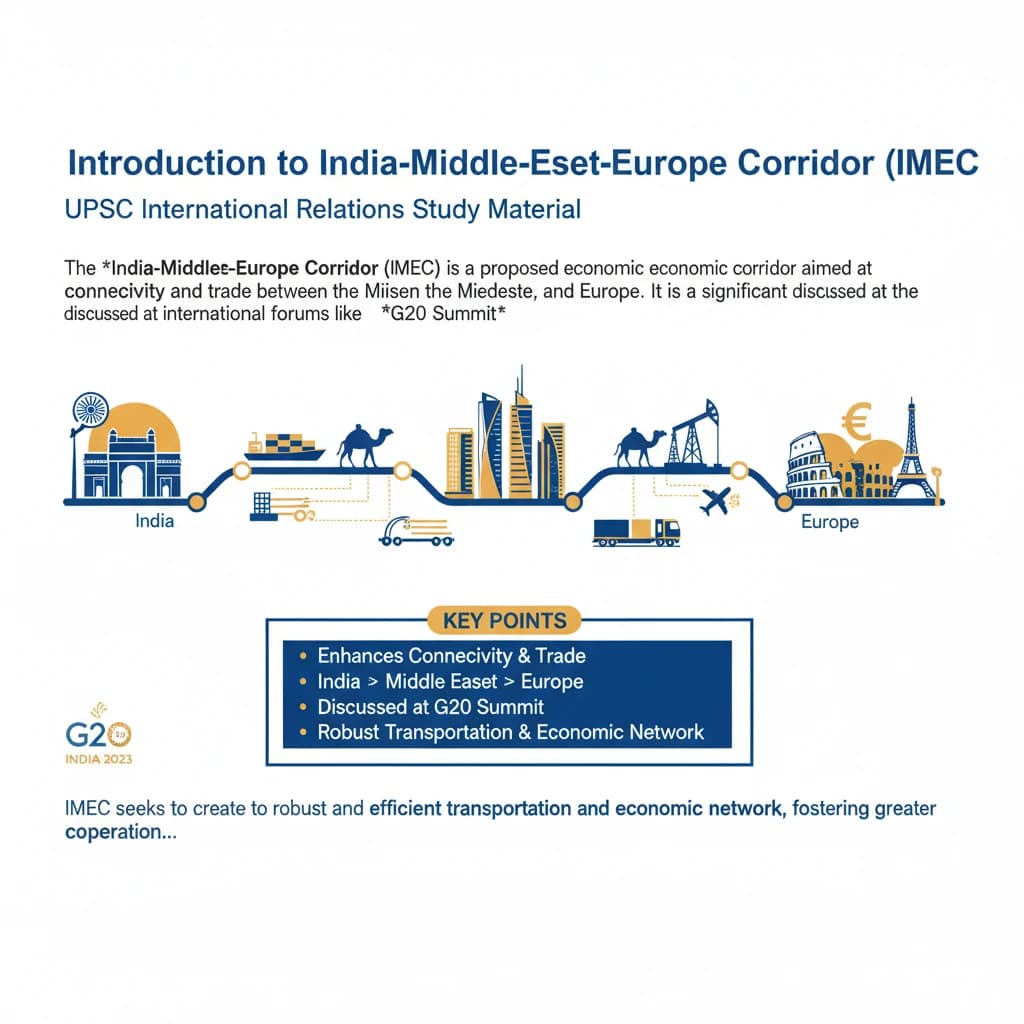
<h4>Introduction to India-Middle East-Europe Corridor (IMEC)</h4><p>The <strong>India-Middle East-Europe Corridor (IMEC)</strong> is a proposed economic corridor aimed at enhancing connectivity and trade between India, the Middle East, and Europe. It is a significant initiative discussed at international forums like the <strong>G20 Summit</strong>.</p><div class='key-point-box'><p>IMEC seeks to create a robust and efficient transportation and economic network, fostering greater cooperation and reducing transit times for goods and services.</p></div><h4>Other Significant Global Corridors</h4><p>Beyond IMEC, several other corridors are shaping global trade and connectivity. These initiatives highlight a growing focus on integrated infrastructure development to facilitate economic growth and geopolitical influence.</p><h4>Lobito Corridor</h4><p>The <strong>Lobito Corridor</strong> is a crucial infrastructure project in Africa. It originates from the port city of <strong>Lobito</strong> on the Atlantic coast of <strong>Angola</strong>.</p><div class='info-box'><ul><li><strong>Route:</strong> Extends through the <strong>Democratic Republic of the Congo (DRC)</strong> and into <strong>Zambia</strong>.</li><li><strong>Purpose:</strong> Aims to provide a vital trade route for minerals and other goods from landlocked central African countries to global markets.</li></ul></div><h4>Luzon Corridor</h4><p>The <strong>Luzon Corridor</strong> is a strategic economic and infrastructure corridor located on the island of <strong>Luzon</strong> in the <strong>Philippines</strong>.</p><div class='info-box'><ul><li><strong>Location:</strong> <strong>Luzon</strong> is recognized as the largest and most populous island in the Philippines.</li><li><strong>Significance:</strong> It plays a key role in the economic development and connectivity within the archipelago.</li></ul></div><h4>Middle Corridor (Trans-Caspian International Transport Route)</h4><p>Also known as the <strong>Trans-Caspian International Transport Route (TITR)</strong>, the <strong>Middle Corridor</strong> is a vital logistics and transportation network. It effectively connects <strong>Europe</strong> and <strong>Asia</strong>.</p><div class='info-box'><ul><li><strong>Alternative Route:</strong> This route serves as a significant alternative to traditional Northern and Southern corridors.</li><li><strong>Objective:</strong> It aims to enhance trade and economic cooperation between the regions it traverses, offering resilience in global supply chains.</li></ul></div><h4>The Great Green Wall Initiative</h4><p>The <strong>Great Green Wall Initiative</strong> is an ambitious environmental project focused on combating <strong>desertification</strong> and <strong>land degradation</strong> in the <strong>Sahel region of Africa</strong>.</p><div class='info-box'><ul><li><strong>Goal:</strong> To create a "wall" of trees stretching across Africa from west to east.</li><li><strong>Benefits:</strong> It helps prevent the spread of the <strong>Sahara Desert</strong>, improves <strong>biodiversity</strong>, and provides economic opportunities for local communities.</li></ul></div><h4>Enhancing Interoperability of AI Governance</h4><p><strong>G7 leaders</strong> have committed to actions aimed at enhancing the <strong>interoperability</strong> among their various <strong>AI governance approaches</strong>.</p><div class='key-point-box'><p>This commitment seeks to promote greater <strong>certainty, transparency</strong>, and <strong>accountability</strong> in AI development and deployment.</p></div><p>The focus is on managing potential risks associated with AI in a manner that actively supports <strong>innovation</strong>. This approach also promotes healthy, inclusive, and long-lasting <strong>economic growth</strong>.</p><h4>Extraordinary Revenue Acceleration (ERA) Loans for Ukraine</h4><p>The <strong>G7 nations</strong> have reached an agreement to provide substantial financial support to <strong>Ukraine</strong>. This initiative is known as <strong>Extraordinary Revenue Acceleration (ERA) Loans</strong>.</p><div class='info-box'><p><strong>Funding:</strong> Approximately <strong>USD 50 billion</strong> in additional funding is slated to be provided to Ukraine by the end of <strong>2024</strong>.</p></div><p>This financial aid underscores the G7's commitment to supporting Ukraine amidst ongoing challenges.</p>
Concept Diagram

💡 Key Takeaways

  • •IMEC aims to connect India, Middle East, and Europe for enhanced trade and connectivity.
  • •Global corridors like Lobito and Middle Corridor are vital for regional development and supply chain diversification.
  • •The Great Green Wall Initiative is a major environmental project combating desertification in Africa.
  • •G7 leaders are committed to interoperable AI governance and significant financial aid for Ukraine (ERA Loans).
  • •These initiatives reflect a strategic focus on economic integration, geopolitical influence, and addressing global challenges.

🧠 Memory Techniques

Memory Aid
95% Verified Content

Related Topics

Loading related topics...
Explore:International Relations Topics·All Subjects·Daily Current Affairs·Editorial Analysis·Previous Year Questions·UPSC GPT