Loading page, please wait…
Vaidra Logo
Vaidra

Top 4 items + smart groups

UPSC GPT
New
Current Affairs
Daily Solutions
Daily Puzzle
Mains Evaluator

Version 2.0.0 • Built with ❤️ for UPSC aspirants

Loading...
Loading...
Loading...
Loading...
Loading...
Loading...
Loading...
Loading...
Loading...
Loading...
Loading...
Loading...
Loading...
Back
All Subjects

Topics

0 topics • 0 completed

Loading topics...
Loading...
Loading...
Loading...
Loading...
Loading...
Overall Progress0%

What is Salami Slicing Technique in Maritime Disputes? - UPSC International Relations

What is What is Salami Slicing Technique in Maritime Disputes? in UPSC International Relations?

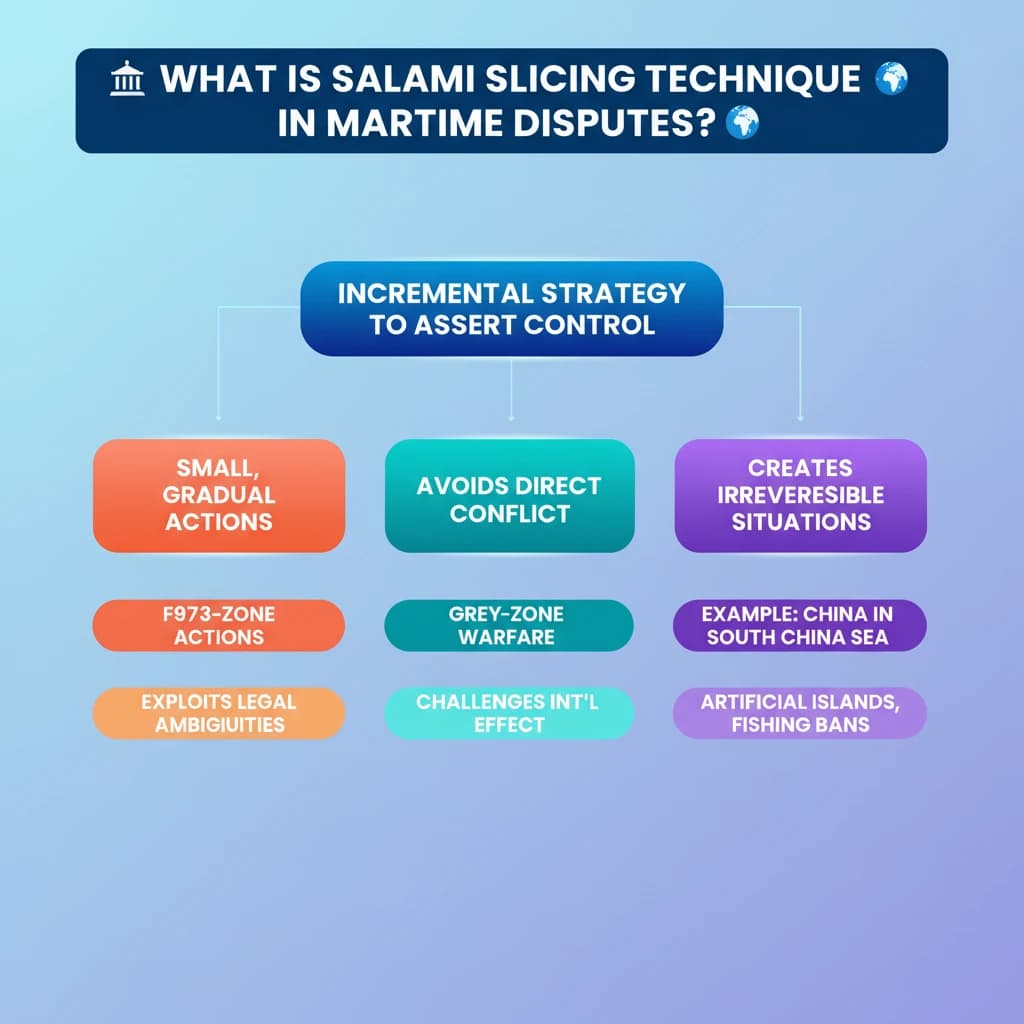
What is Salami Slicing Technique in Maritime Disputes? is a key topic under International Relations for UPSC Civil Services Examination. Key points include: Salami Slicing is an incremental strategy to assert control over disputed areas.. It involves small, gradual actions to avoid direct confrontation and exploit legal ambiguities.. The cumulative effect creates irreversible situations, challenging the status quo.. Understanding this topic is essential for both UPSC Prelims and Mains preparation.

Why is What is Salami Slicing Technique in Maritime Disputes? important for UPSC exam?

What is Salami Slicing Technique in Maritime Disputes? is a Medium-level topic in UPSC International Relations. It is tested in both Prelims (factual MCQs) and Mains (analytical answer writing). Previous year UPSC questions have frequently covered aspects of What is Salami Slicing Technique in Maritime Disputes?, making it essential for comprehensive IAS preparation.

How to prepare What is Salami Slicing Technique in Maritime Disputes? for UPSC?

To prepare What is Salami Slicing Technique in Maritime Disputes? for UPSC: (1) Study the comprehensive notes covering all key concepts on Vaidra. (2) Practice previous year questions on this topic. (3) Connect it with current affairs using daily updates. (4) Revise using key takeaways and mind maps available for International Relations. (5) Write practice answers linking What is Salami Slicing Technique in Maritime Disputes? to related GS Paper topics.

Key takeaways of What is Salami Slicing Technique in Maritime Disputes? for UPSC

  • Salami Slicing is an incremental strategy to assert control over disputed areas.
  • It involves small, gradual actions to avoid direct confrontation and exploit legal ambiguities.
  • The cumulative effect creates irreversible situations, challenging the status quo.
  • China's actions in the South China Sea (artificial islands, fishing bans) are prime examples.
  • It's a form of grey-zone warfare, posing significant challenges to international law and regional stability.
What is Salami Slicing Technique in Maritime Disputes?

What is Salami Slicing Technique in Maritime Disputes?

Medium⏱️ 8 min read✓ 95% Verified
international relations

📖 Introduction

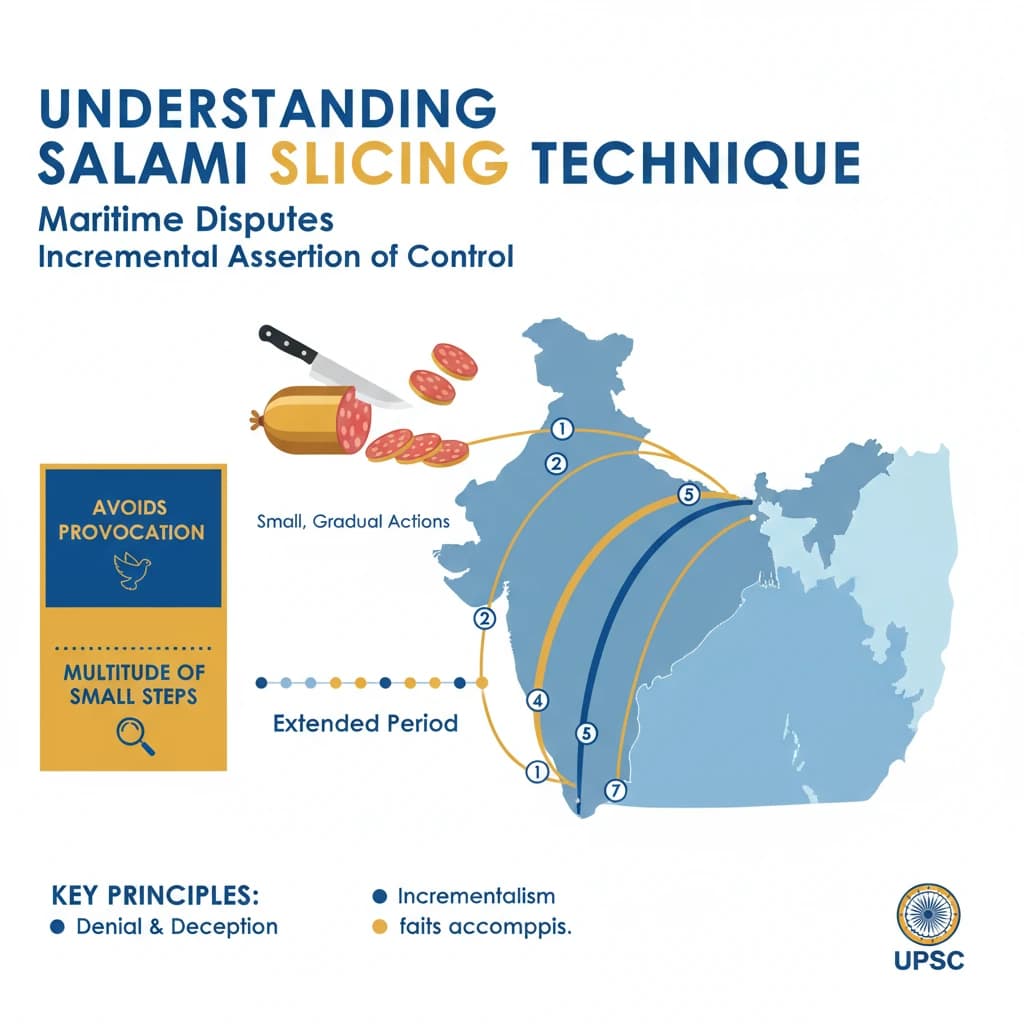
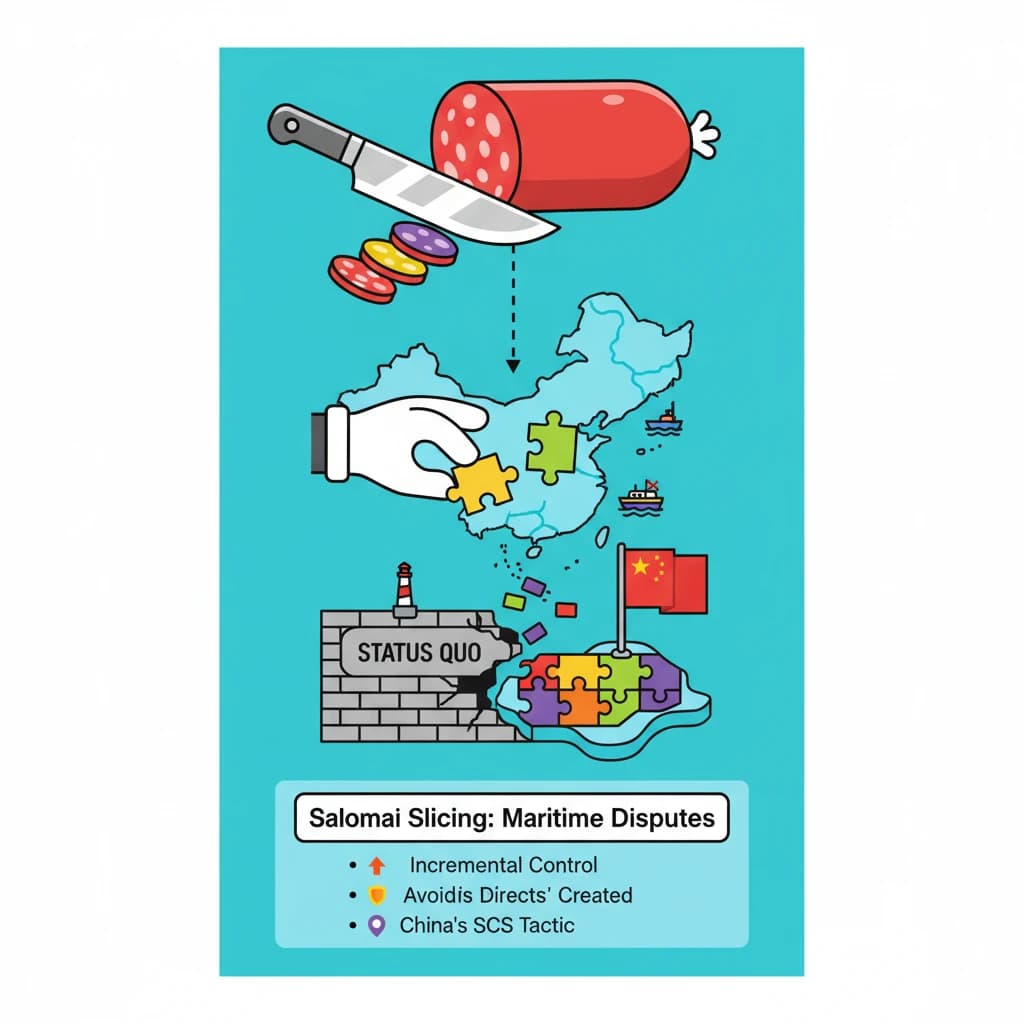
<h4>Understanding Salami Slicing Technique</h4><p>The <strong>Salami Slicing Technique</strong> in <strong>maritime disputes</strong> refers to a strategic approach where a country incrementally asserts control over disputed maritime areas. This is achieved through a series of small, gradual actions over an extended period.</p><p>The essence of this technique lies in avoiding any single, large action that might provoke a strong international or military response. Instead, it involves a multitude of minor infringements or assertions that, individually, seem insignificant.</p><div class='key-point-box'><p><strong>Key Principle:</strong> Each 'slice' is small enough to avoid direct confrontation but contributes to a cumulative gain, eventually leading to a significant shift in control or influence over the disputed territory.</p></div><h4>Characteristics of the Technique</h4><p>This method is characterized by its subtlety and long-term vision. It aims to alter the status quo without triggering an immediate, forceful reaction from other claimants or the international community.</p><ul><li><strong>Avoids Direct Confrontation:</strong> Actions are calibrated to stay below the threshold that would necessitate a military response or severe diplomatic backlash.</li><li><strong>Exploits Legal Ambiguities:</strong> Nations often leverage vague interpretations of international law, such as the <strong>United Nations Convention on the Law of the Sea (UNCLOS)</strong>, to justify their incremental steps.</li><li><strong>Creates Irreversible Situations:</strong> Over time, the cumulative effect of these small actions can create new facts on the ground (or sea) that are difficult to reverse, effectively cementing control.</li></ul><h4>Example: China in the South China Sea</h4><p><strong>China</strong> has frequently been accused of employing the <strong>salami slicing technique</strong> in the <strong>South China Sea</strong>. This strategic waterway is subject to overlapping claims by several countries, including the Philippines, Vietnam, Malaysia, Brunei, and Taiwan.</p><p>China's actions demonstrate a systematic approach to asserting its claims, particularly over features like reefs and shoals. These actions have gradually expanded its influence and limited access for other nations.</p><div class='info-box'><p><strong>Specific Actions by China:</strong><ul><li><strong>Building Artificial Islands:</strong> Transforming submerged reefs into fortified military outposts and civilian facilities.</li><li><strong>Conducting Resource Exploration:</strong> Asserting exclusive rights over oil, gas, and fishing resources within the disputed zones.</li><li><strong>Imposing Fishing Bans:</strong> Declaring unilateral fishing moratoriums that cover areas claimed by other nations.</li></ul></p></div><p>A recent instance involved <strong>Chinese coast guard ships</strong> blocking <strong>Philippine vessels</strong> at <strong>Second Thomas Shoal</strong>. This incident, while seemingly minor, is part of a larger pattern of asserting control and has led to escalated tensions in the region.</p><div class='exam-tip-box'><p><strong>UPSC Insight:</strong> Understanding <strong>Salami Slicing</strong> is crucial for analyzing <strong>geopolitical strategies</strong> and <strong>maritime security issues</strong> in the <strong>Indo-Pacific region</strong>. It often appears in questions related to <strong>international relations</strong> and <strong>India's neighbourhood policy</strong> (<strong>GS Paper 2</strong>).</p></div>
Concept Diagram

💡 Key Takeaways

  • •Salami Slicing is an incremental strategy to assert control over disputed areas.
  • •It involves small, gradual actions to avoid direct confrontation and exploit legal ambiguities.
  • •The cumulative effect creates irreversible situations, challenging the status quo.
  • •China's actions in the South China Sea (artificial islands, fishing bans) are prime examples.
  • •It's a form of grey-zone warfare, posing significant challenges to international law and regional stability.

🧠 Memory Techniques
Memory Aid
95% Verified Content

📚 Reference Sources

•General knowledge on South China Sea disputes and international relations

Related Topics

Loading related topics...
Explore:International Relations Topics·All Subjects·Daily Current Affairs·Editorial Analysis·Previous Year Questions·UPSC GPT
What is Salami Slicing Technique in Maritime Disputes? - UPSC International Relations