Loading page, please wait…
Vaidra Logo
Vaidra

Top 4 items + smart groups

UPSC GPT
New
Current Affairs
Daily Solutions
Daily Puzzle
Mains Evaluator

Version 2.0.0 • Built with ❤️ for UPSC aspirants

Loading...
Loading...
Loading...
Loading...
Loading...
Loading...
Loading...
Loading...
Loading...
Loading...
Loading...
Loading...
Loading...
Free Movement Regime - UPSC International Relations
Back
All Subjects

Topics

0 topics • 0 completed

Loading topics...
Loading...
Loading...
Loading...
Loading...
Loading...
Overall Progress0%

Free Movement Regime - UPSC International Relations

What is Free Movement Regime in UPSC International Relations?

Free Movement Regime is a key topic under International Relations for UPSC Civil Services Examination. Key points include: The Free Movement Regime (FMR) allows residents within 16 km of the India-Myanmar border to cross without a visa for up to two weeks.. Established in 2018 under India's Act East policy to facilitate local trade, education, healthcare, and diplomatic ties.. The India-Myanmar border (1,643 km) was established by the Treaty of Yandaboo in 1826, dividing ethnic communities.. Understanding this topic is essential for both UPSC Prelims and Mains preparation.

Why is Free Movement Regime important for UPSC exam?

Free Movement Regime is a Medium-level topic in UPSC International Relations. It is tested in both Prelims (factual MCQs) and Mains (analytical answer writing). Previous year UPSC questions have frequently covered aspects of Free Movement Regime, making it essential for comprehensive IAS preparation.

How to prepare Free Movement Regime for UPSC?

To prepare Free Movement Regime for UPSC: (1) Study the comprehensive notes covering all key concepts on Vaidra. (2) Practice previous year questions on this topic. (3) Connect it with current affairs using daily updates. (4) Revise using key takeaways and mind maps available for International Relations. (5) Write practice answers linking Free Movement Regime to related GS Paper topics.

Key takeaways of Free Movement Regime for UPSC

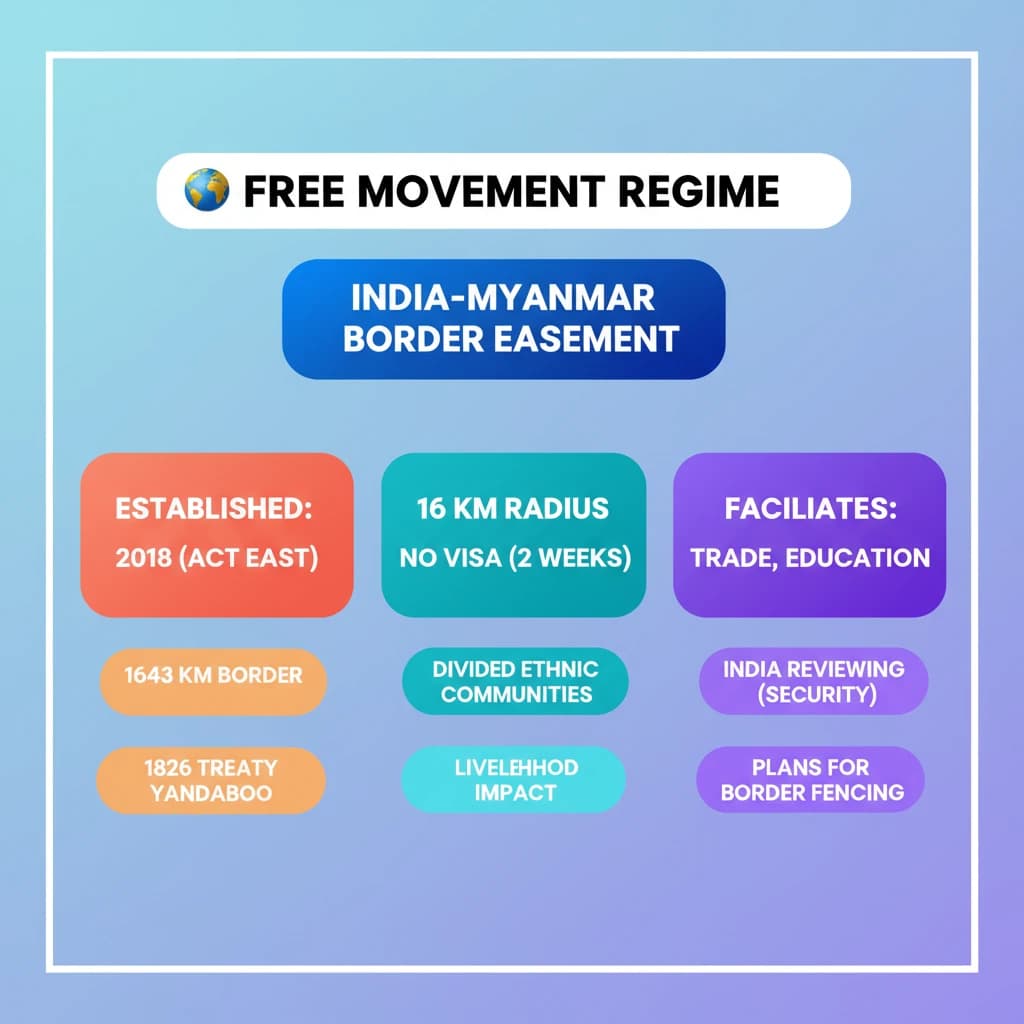
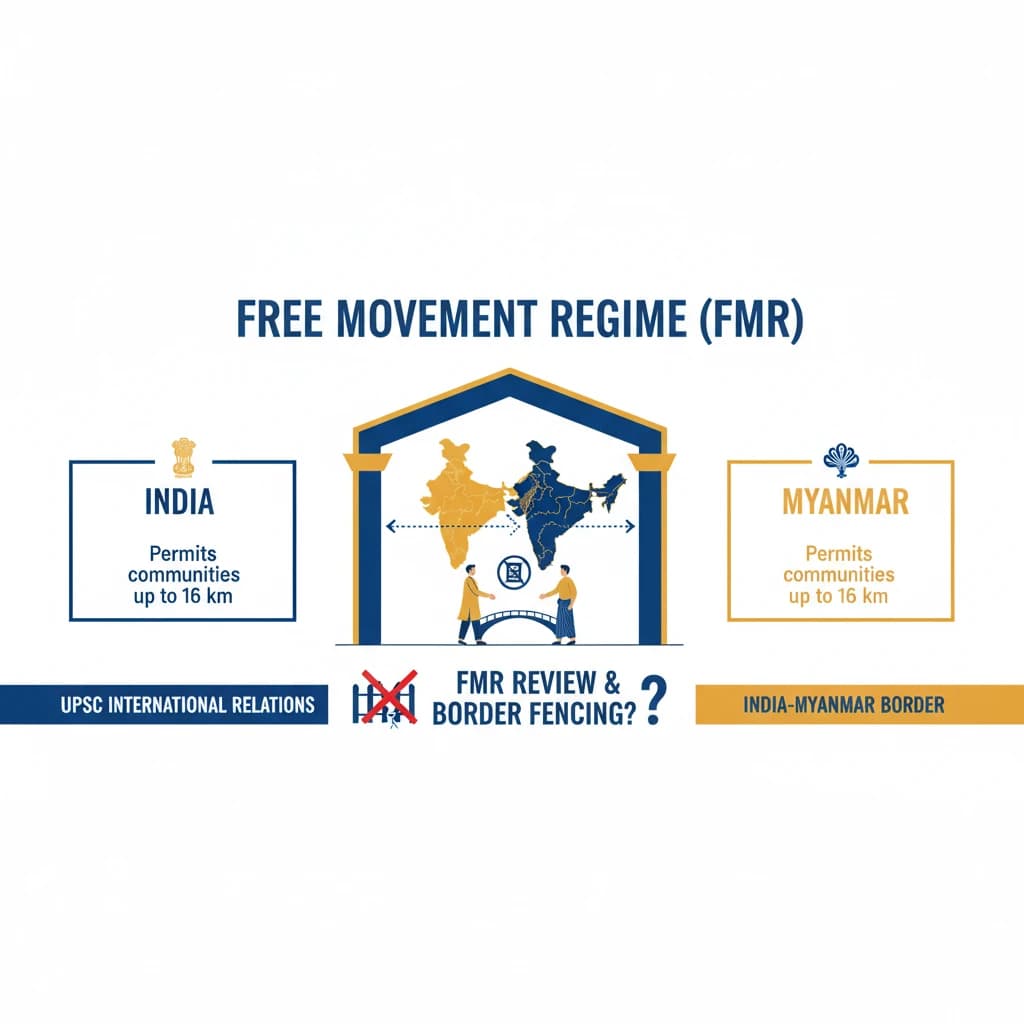
  • The Free Movement Regime (FMR) allows residents within 16 km of the India-Myanmar border to cross without a visa for up to two weeks.
  • Established in 2018 under India's Act East policy to facilitate local trade, education, healthcare, and diplomatic ties.
  • The India-Myanmar border (1,643 km) was established by the Treaty of Yandaboo in 1826, dividing ethnic communities.
  • India is reviewing the FMR and plans to fence the border due to security, cultural, and historical considerations.
  • The decision has significant implications for internal security, India-Myanmar relations, and the livelihoods of border communities.
Free Movement Regime

Free Movement Regime

Medium⏱️ 8 min read✓ 98% Verified
international relations

📖 Introduction

<h4>Introduction to Free Movement Regime (FMR)</h4><p>The <strong>Free Movement Regime (FMR)</strong> is a unique arrangement between <strong>India</strong> and <strong>Myanmar</strong>. It permits communities residing along the shared border to travel up to <strong>16 km</strong> into the neighbouring country without a visa.</p><p>Recently, <strong>India’s</strong> decision to review the <strong>FMR agreement</strong> and fence the <strong>India-Myanmar border</strong> has sparked significant discussions, particularly within the <strong>northeastern states</strong>.</p><div class='key-point-box'><p>This review aims to address a complex interplay of <strong>historical, cultural, and security considerations</strong> along the sensitive border region.</p></div><h4>Historical Context of the India-Myanmar Border</h4><p>Historically, a significant portion of <strong>India’s northeast region</strong> was under <strong>Burmese occupation</strong> for an extended period.</p><p>The current <strong>India-Myanmar boundary</strong> was formally established by the <strong>Treaty of Yandaboo</strong> in <strong>1826</strong>. This treaty marked a pivotal moment in the region's geopolitical landscape.</p><div class='info-box'><ul><li><strong>Treaty of Yandaboo (1826)</strong>: Signed by <strong>General Sir Archibald Campbell</strong> (representing the British) and <strong>Governor of Legaing Maha Min Hla Kyaw Htin</strong> (representing the Burmese).</li><li>It officially concluded the <strong>First Anglo-Burmese War (1824-1826)</strong>.</li></ul></div><p>Despite the treaty, the newly drawn border inadvertently separated various ethnic communities with shared heritage. This included the <strong>Nagas</strong> in <strong>Nagaland</strong> and <strong>Manipur</strong>, and the <strong>Kuki-Chin-Mizo</strong> communities across <strong>Manipur</strong> and <strong>Mizoram</strong>, often without their direct consent.</p><h4>Understanding the Free Movement Regime (FMR)</h4><p>The <strong>FMR</strong> was officially established in <strong>2018</strong>. It was conceptualized as a key component of <strong>India’s Act East policy</strong>, aiming to foster closer ties and facilitate cross-border interactions.</p><div class='info-box'><p>Under the <strong>FMR</strong>, individuals residing within the border areas are allowed to move up to <strong>16 km</strong> into the adjacent country. They are required to possess a <strong>one-year border pass</strong>, which permits stays of up to <strong>two weeks</strong>.</p></div><p>The primary objectives behind implementing the <strong>FMR</strong> were multifaceted, focusing on enhancing the well-being and connectivity of border populations.</p><ul><li>Facilitate <strong>local border trade</strong>, supporting economic activities for communities.</li><li>Improve access to essential services like <strong>education</strong> and <strong>healthcare</strong> for border residents.</li><li>Strengthen <strong>diplomatic ties</strong> and people-to-people connectivity between <strong>India</strong> and <strong>Myanmar</strong>.</li></ul><h4>India-Myanmar Border: Current Scenario</h4><p><strong>India</strong> and <strong>Myanmar</strong> share an extensive land border stretching approximately <strong>1,643 km</strong>. This border traverses four <strong>Indian northeastern states</strong>.</p><div class='info-box'><ul><li><strong>Indian States Sharing Border</strong>: <strong>Manipur</strong>, <strong>Mizoram</strong>, <strong>Nagaland</strong>, and <strong>Arunachal Pradesh</strong>.</li><li><strong>Fencing Status</strong>: Currently, only about <strong>10 km</strong> of this long border is fenced, specifically in parts of <strong>Manipur</strong>.</li></ul></div><div class='exam-tip-box'><p><strong>UPSC Insight</strong>: The FMR's review highlights the delicate balance between <strong>security imperatives</strong> and <strong>people-to-people connectivity</strong>, a recurring theme in India's border management and foreign policy discussions (e.g., <strong>GS Paper 2: International Relations</strong>, <strong>GS Paper 3: Internal Security</strong>).</p></div><h4>Neighbourhood First Policy and FMR</h4><p>The <strong>Neighbourhood First policy</strong> is a cornerstone of <strong>India's foreign policy</strong>, prioritizing friendly relations with its immediate neighbours.</p><p>This policy aims to enhance various forms of connectivity across the region. This includes <strong>physical, digital, and people-to-people linkages</strong>, alongside boosting <strong>trade and commerce</strong>.</p><p>The <strong>FMR</strong>, while initially a tool for connectivity, is now being re-evaluated under the broader framework of this policy, considering its evolving challenges and benefits.
Concept Diagram

💡 Key Takeaways

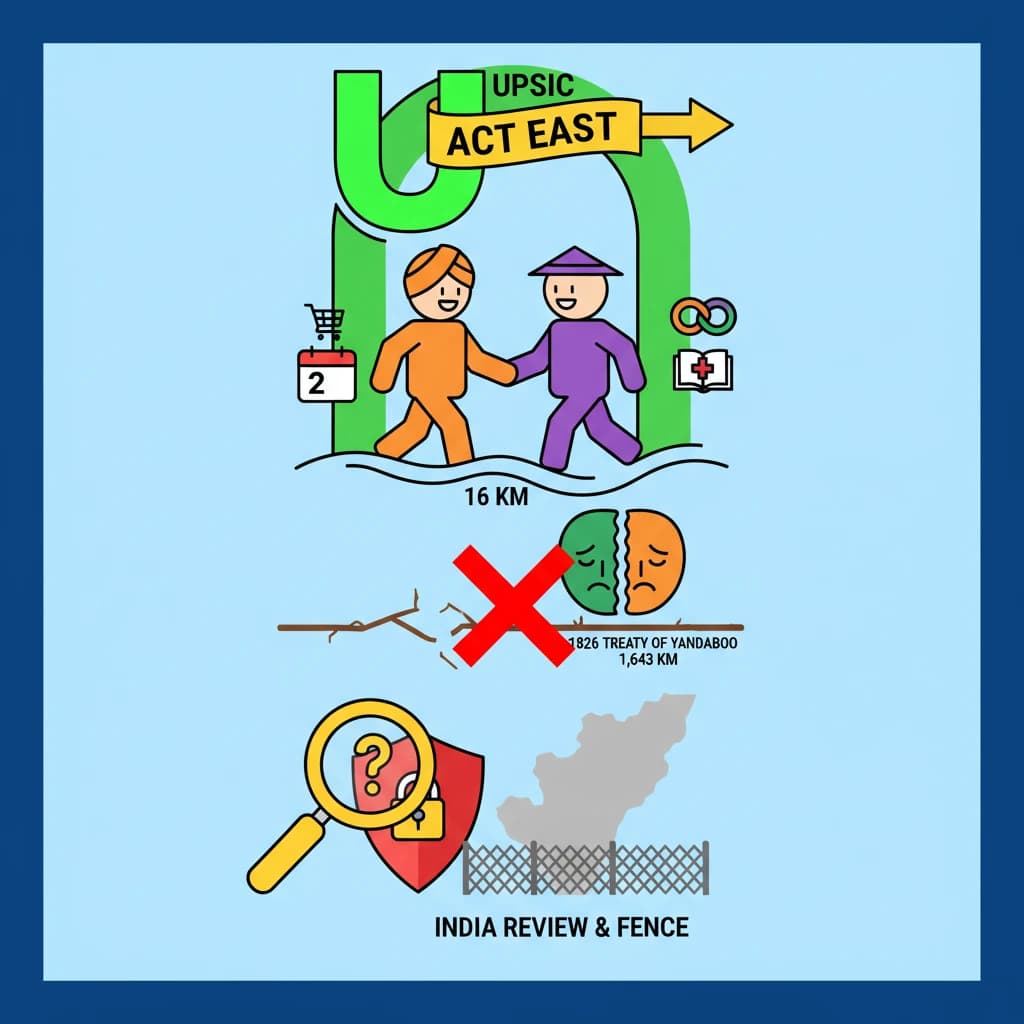
  • •The Free Movement Regime (FMR) allows residents within 16 km of the India-Myanmar border to cross without a visa for up to two weeks.
  • •Established in 2018 under India's Act East policy to facilitate local trade, education, healthcare, and diplomatic ties.
  • •The India-Myanmar border (1,643 km) was established by the Treaty of Yandaboo in 1826, dividing ethnic communities.
  • •India is reviewing the FMR and plans to fence the border due to security, cultural, and historical considerations.
  • •The decision has significant implications for internal security, India-Myanmar relations, and the livelihoods of border communities.

🧠 Memory Techniques
Memory Aid
98% Verified Content

Related Topics

Loading related topics...
Explore:International Relations Topics·All Subjects·Daily Current Affairs·Editorial Analysis·Previous Year Questions·UPSC GPT