Loading page, please wait…
Vaidra Logo
Vaidra

Top 4 items + smart groups

UPSC GPT
New
Current Affairs
Daily Solutions
Daily Puzzle
Mains Evaluator

Version 2.0.0 • Built with ❤️ for UPSC aspirants

Loading...
Loading...
Loading...
Loading...
Loading...
Loading...
Loading...
Loading...
Loading...
Loading...
Loading...
Loading...
Loading...
Back
All Subjects

Topics

0 topics • 0 completed

Loading topics...
Loading...
Loading...
Loading...
Loading...
Loading...
Overall Progress0%

What are Key Highlights of the 6th AITIGA Joint Committee Meetings? - UPSC International Relations

What is What are Key Highlights of the 6th AITIGA Joint Committee Meetings? in UPSC International Relations?

What are Key Highlights of the 6th AITIGA Joint Committee Meetings? is a key topic under International Relations for UPSC Civil Services Examination. Key points include: India initiated a review of the 2010 AITIGA due to disproportionate trade benefits favoring ASEAN.. India's trade deficit with ASEAN widened significantly from USD 4.98 billion (FY 2010-11) to USD 38.4 billion (FY 2023-24).. Key Indian objectives include enhanced market access for its goods and stricter Rules of Origin (ROO) to prevent circumvention by third-country goods (e.g., China).. Understanding this topic is essential for both UPSC Prelims and Mains preparation.

Why is What are Key Highlights of the 6th AITIGA Joint Committee Meetings? important for UPSC exam?

What are Key Highlights of the 6th AITIGA Joint Committee Meetings? is a Medium-level topic in UPSC International Relations. It is tested in both Prelims (factual MCQs) and Mains (analytical answer writing). Previous year UPSC questions have frequently covered aspects of What are Key Highlights of the 6th AITIGA Joint Committee Meetings?, making it essential for comprehensive IAS preparation.

How to prepare What are Key Highlights of the 6th AITIGA Joint Committee Meetings? for UPSC?

To prepare What are Key Highlights of the 6th AITIGA Joint Committee Meetings? for UPSC: (1) Study the comprehensive notes covering all key concepts on Vaidra. (2) Practice previous year questions on this topic. (3) Connect it with current affairs using daily updates. (4) Revise using key takeaways and mind maps available for International Relations. (5) Write practice answers linking What are Key Highlights of the 6th AITIGA Joint Committee Meetings? to related GS Paper topics.

Key takeaways of What are Key Highlights of the 6th AITIGA Joint Committee Meetings? for UPSC

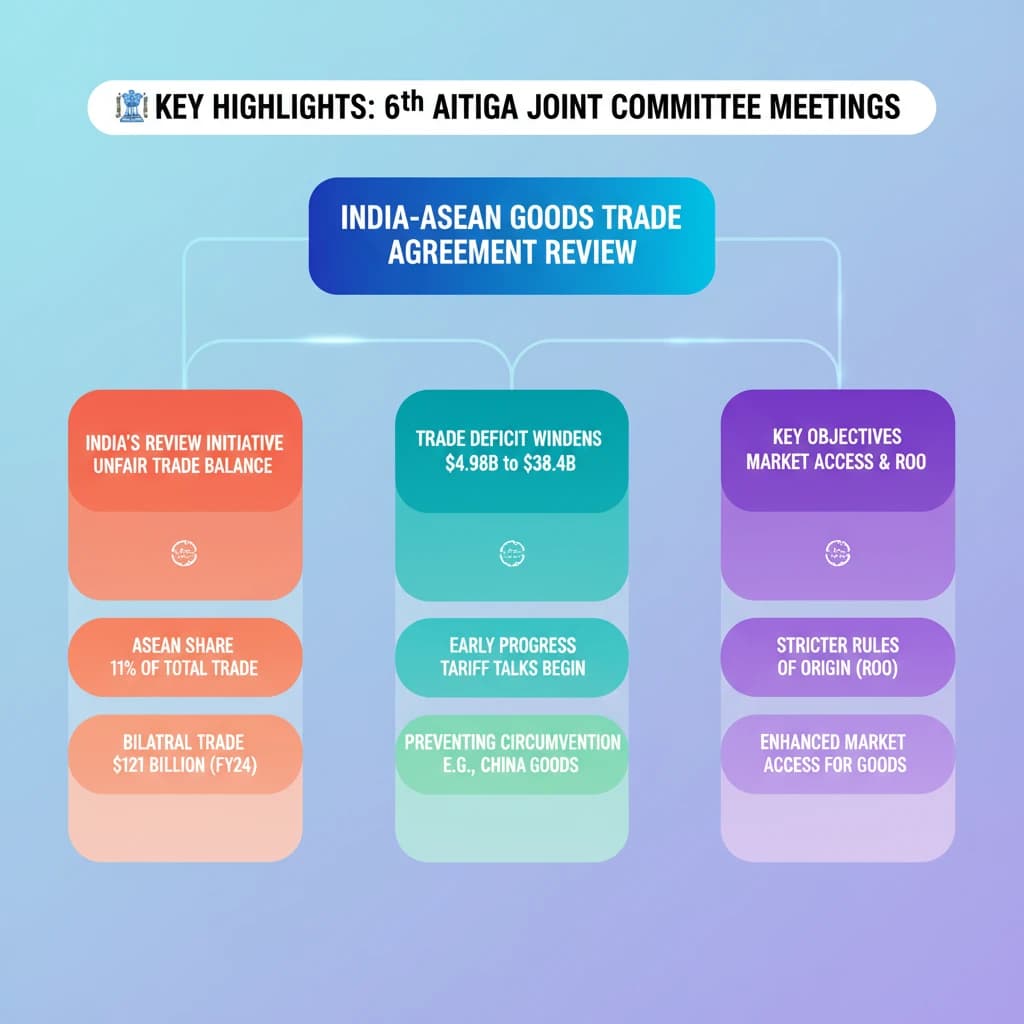
  • India initiated a review of the 2010 AITIGA due to disproportionate trade benefits favoring ASEAN.
  • India's trade deficit with ASEAN widened significantly from USD 4.98 billion (FY 2010-11) to USD 38.4 billion (FY 2023-24).
  • Key Indian objectives include enhanced market access for its goods and stricter Rules of Origin (ROO) to prevent circumvention by third-country goods (e.g., China).
  • Initial progress has been made towards initiating tariff negotiations during the 6th AITIGA Joint Committee Meetings.
  • ASEAN accounts for approximately 11% of India's global trade, with bilateral trade reaching USD 121 billion in FY 2023-24.
What are Key Highlights of the 6th AITIGA Joint Committee Meetings?

What are Key Highlights of the 6th AITIGA Joint Committee Meetings?

Medium⏱️ 6 min read✓ 95% Verified
international relations

📖 Introduction

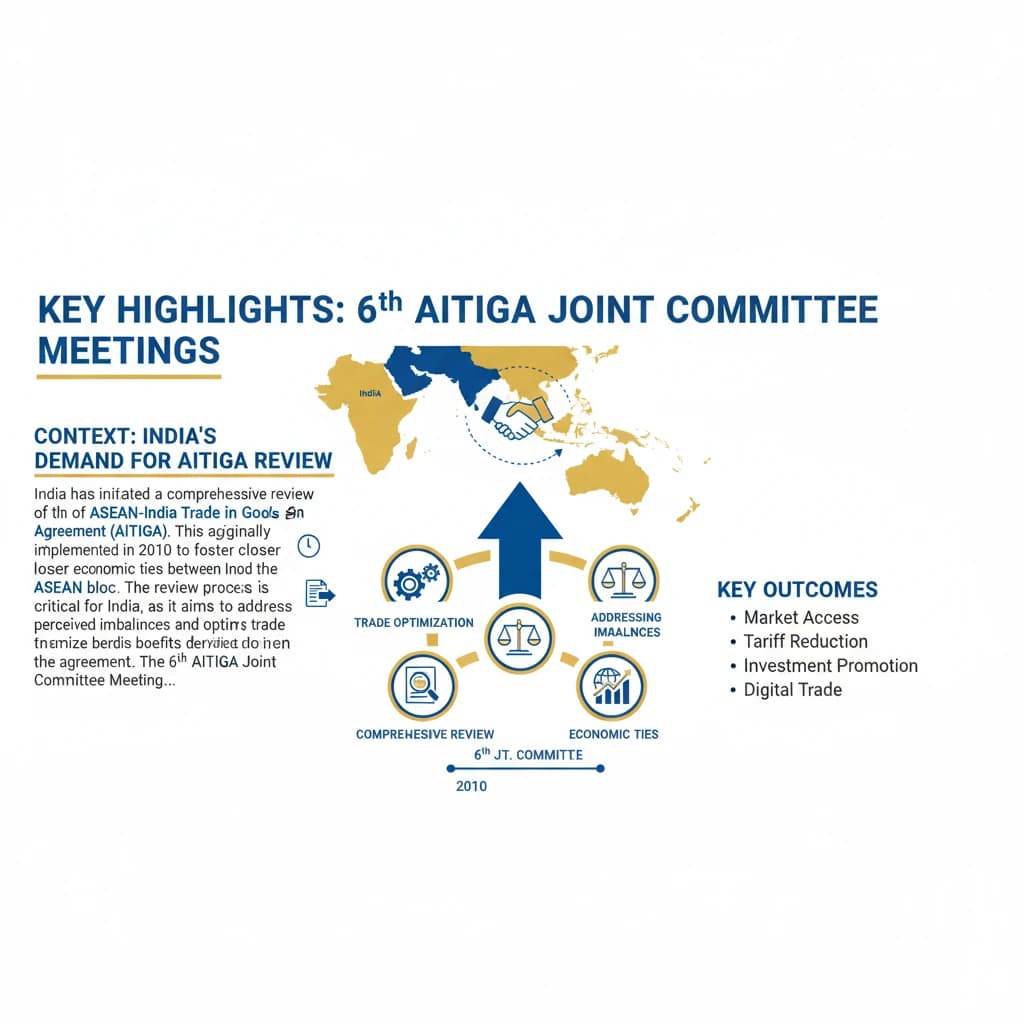
<h4>Context: India's Demand for AITIGA Review</h4><p>India has initiated a comprehensive review of the <strong>ASEAN-India Trade in Goods Agreement (AITIGA)</strong>. This agreement was originally implemented in <strong>2010</strong> to foster closer economic ties between India and the <strong>ASEAN</strong> bloc.</p><p>The review process is critical for India, as it aims to address perceived imbalances and optimize the trade benefits derived from the agreement. The <strong>6th AITIGA Joint Committee Meetings</strong> served as a crucial platform for these discussions.</p><h4>Reasons for India's Review Demand</h4><p>India sought a review of <strong>AITIGA</strong> primarily due to concerns over <strong>disproportionate trade benefits</strong> favoring <strong>ASEAN countries</strong>. Data indicates a significant widening of India's trade deficit with the bloc since the agreement's inception.</p><div class='info-box'><p><strong>Trade Data Comparison (FY 2010-11 vs. FY 2023-24):</strong></p><ul><li><strong>India’s Exports to ASEAN:</strong> Increased from <strong>USD 25.62 billion</strong> to <strong>USD 41.2 billion</strong>.</li><li><strong>India’s Imports from ASEAN:</strong> Surged from <strong>USD 30.8 billion</strong> to <strong>USD 87.36 billion</strong>.</li></ul></div><p>This substantial increase in imports compared to exports has led to a growing trade imbalance, prompting India to seek a re-evaluation of the agreement's terms.</p><h4>India's Key Objectives in the Review</h4><p>India's primary goals in the <strong>AITIGA</strong> review are multifaceted, focusing on improving market access and strengthening trade regulations.</p><ul><li><strong>Enhanced Market Access:</strong> India is pushing for greater market-opening commitments from <strong>ASEAN countries</strong>, particularly <strong>Vietnam</strong>. This aims to facilitate easier entry for Indian goods into these markets.</li><li><strong>Stricter Rules of Origin (ROO):</strong> A key objective is to implement more stringent <strong>Rules of Origin</strong> provisions. This is designed to prevent goods from third countries, notably <strong>China</strong>, from being re-routed through <strong>ASEAN nations</strong> to avail preferential tariff rates under <strong>AITIGA</strong>.</li></ul><div class='key-point-box'><p>The stricter <strong>ROO</strong> are crucial to ensure that only goods genuinely originating from <strong>ASEAN</strong> or <strong>India</strong> benefit from the agreement, preventing misuse and protecting domestic industries.</p></div><h4>Progress in Negotiations</h4><p>During the <strong>6th AITIGA Joint Committee Meetings</strong>, significant initial progress was made. Both sides advanced towards initiating <strong>tariff negotiations</strong>.</p><p>This step is considered crucial in the overall review process, as it directly addresses the tariff structures and concessions that dictate the flow of goods between India and <strong>ASEAN</strong>.</p><h4>Key Trade Statistics with ASEAN</h4><p><strong>ASEAN</strong> remains a vital trading partner for India, accounting for a significant portion of its global trade.</p><div class='info-box'><p><strong>Snapshot of India-ASEAN Trade:</strong></p><ul><li><strong>Share of India’s Global Trade:</strong> Approximately <strong>11%</strong>.</li><li><strong>Bilateral Trade (FY 2023-24):</strong> Reached <strong>USD 121 billion</strong>.</li><li><strong>Bilateral Trade (April-October 2024):</strong> Stood at <strong>USD 73 billion</strong>, marking a <strong>5.2% growth</strong> over the same period in the previous year.</li></ul></div><p>Despite the overall growth in bilateral trade, India's trade deficit with <strong>ASEAN</strong> has widened considerably. It grew from <strong>USD 4.98 billion</strong> in <strong>2010-11</strong> (the first full year of <strong>AITIGA</strong> operation) to <strong>USD 38.4 billion</strong> in <strong>2023-24</strong>.</p><div class='exam-tip-box'><p>Understanding the dynamics of <strong>trade deficits</strong> and the role of <strong>Rules of Origin</strong> is vital for <strong>UPSC Mains GS Paper 3 (Economy)</strong>. Candidates should be able to analyze the implications of such agreements on India's economic interests.</p></div>
Concept Diagram

💡 Key Takeaways

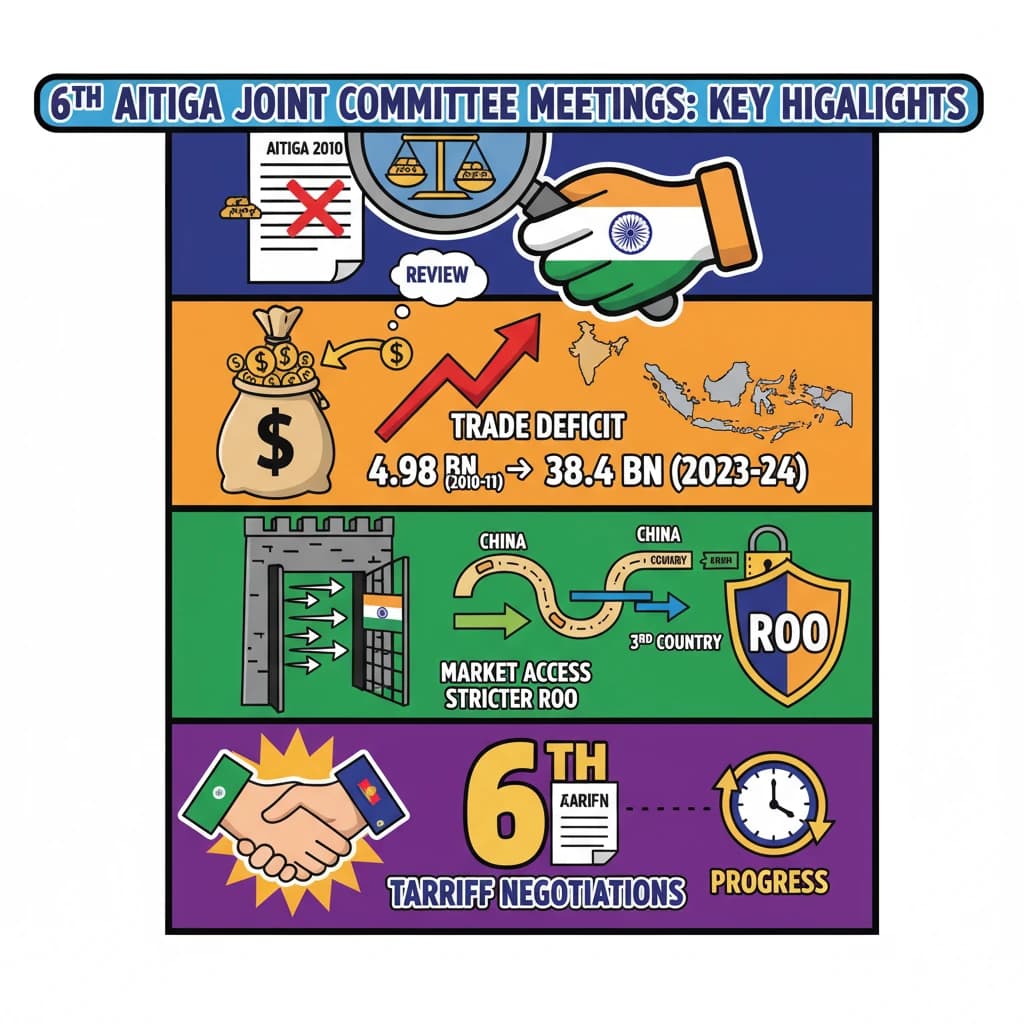
  • •India initiated a review of the 2010 AITIGA due to disproportionate trade benefits favoring ASEAN.
  • •India's trade deficit with ASEAN widened significantly from USD 4.98 billion (FY 2010-11) to USD 38.4 billion (FY 2023-24).
  • •Key Indian objectives include enhanced market access for its goods and stricter Rules of Origin (ROO) to prevent circumvention by third-country goods (e.g., China).
  • •Initial progress has been made towards initiating tariff negotiations during the 6th AITIGA Joint Committee Meetings.
  • •ASEAN accounts for approximately 11% of India's global trade, with bilateral trade reaching USD 121 billion in FY 2023-24.

🧠 Memory Techniques
Memory Aid
95% Verified Content

Related Topics

Loading related topics...
Explore:International Relations Topics·All Subjects·Daily Current Affairs·Editorial Analysis·Previous Year Questions·UPSC GPT
What are Key Highlights of the 6th AITIGA Joint Committee Meetings? - UPSC International Relations