📖 Introduction
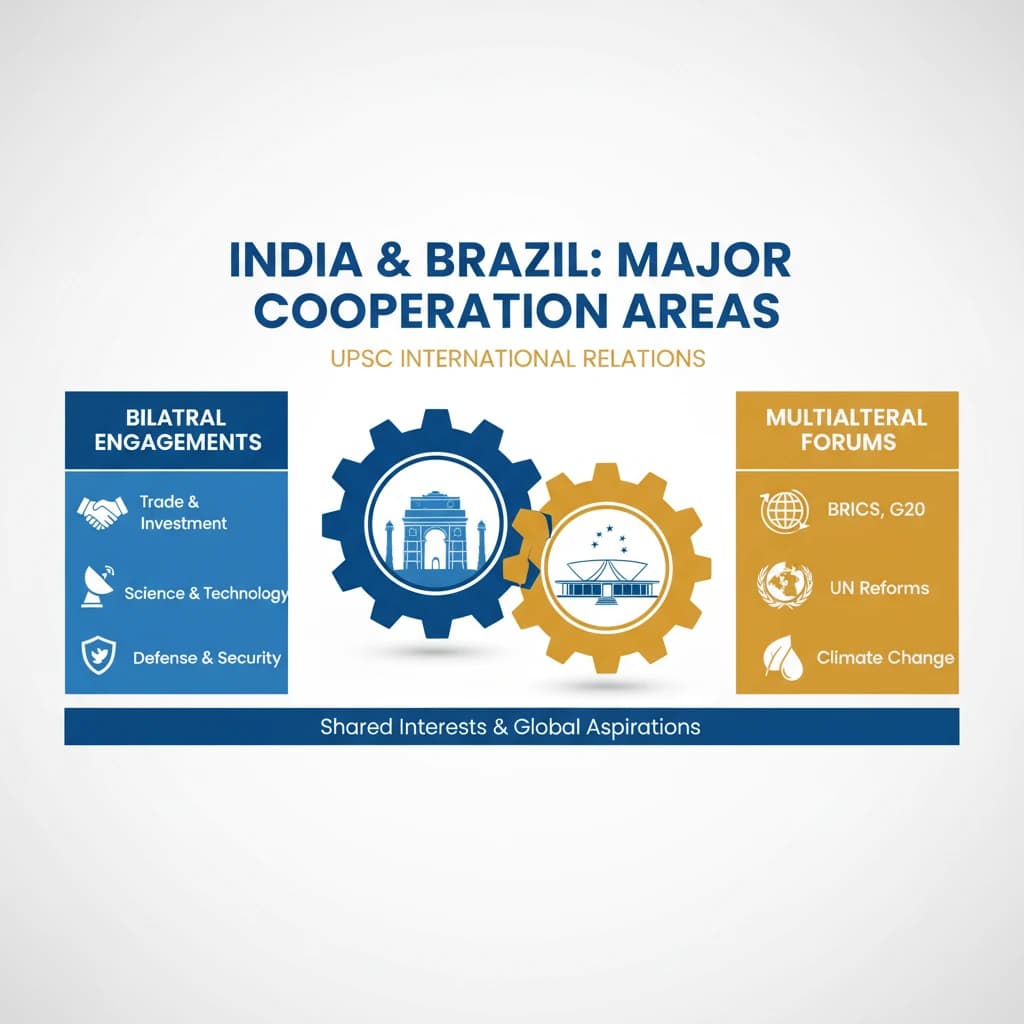
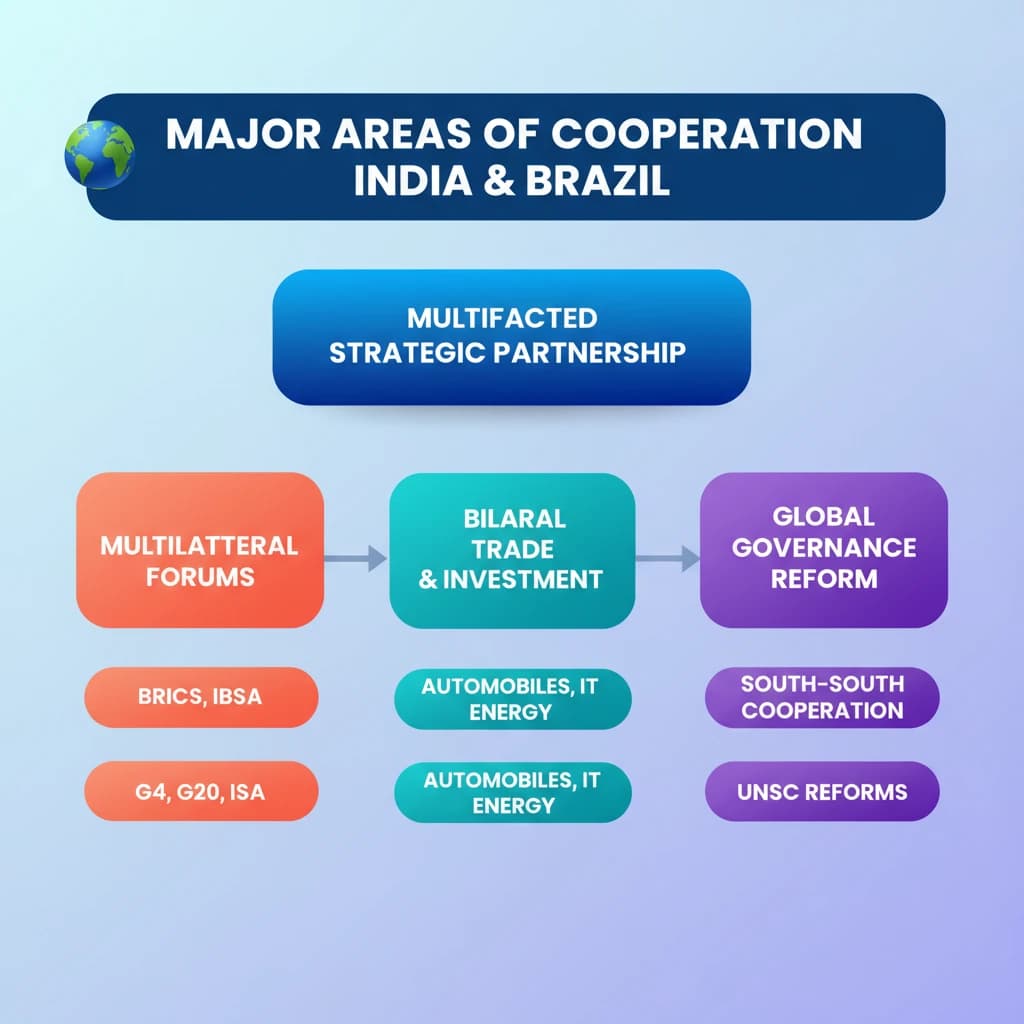
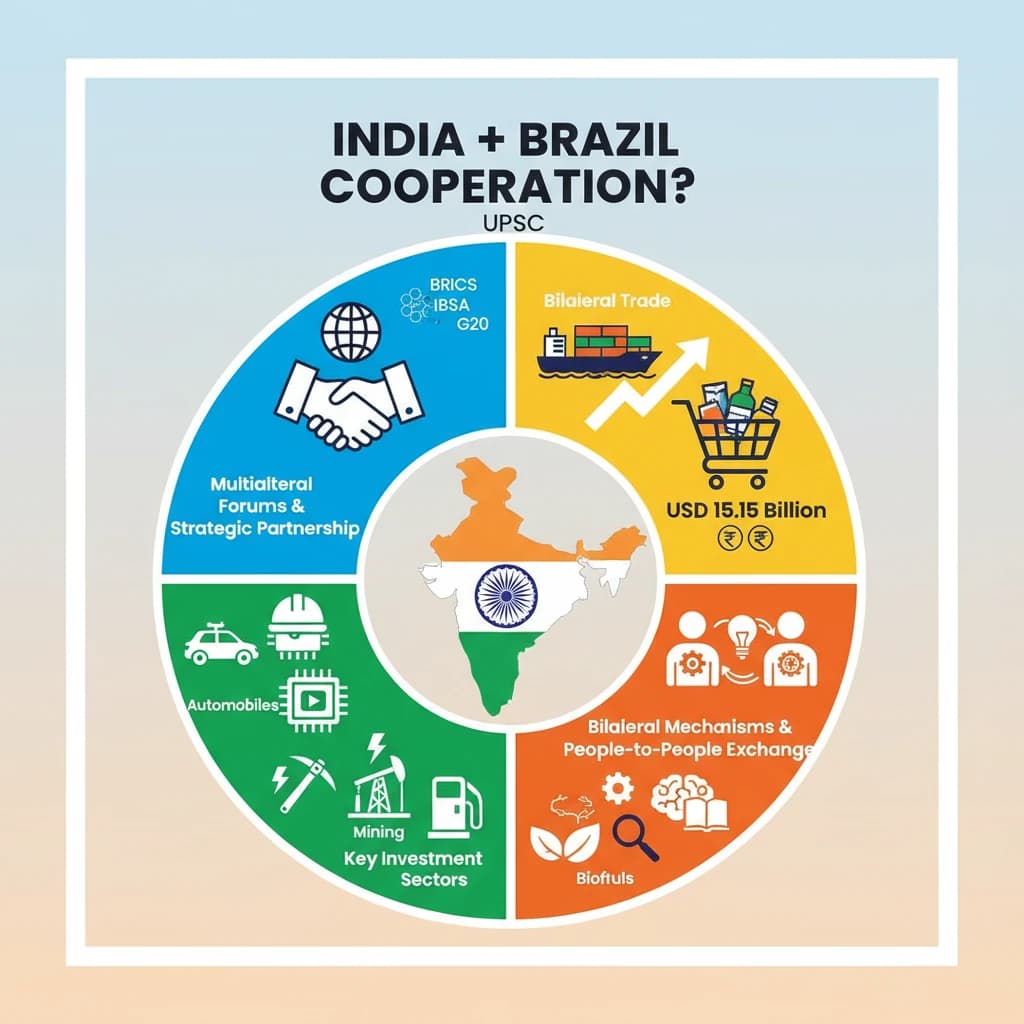
<h4>Introduction to India-Brazil Cooperation</h4><p>The relationship between <strong>India</strong> and <strong>Brazil</strong> is characterized by its <strong>diverse</strong> and <strong>multifaceted nature</strong>. This cooperation spans both <strong>bilateral engagements</strong> and participation in various <strong>multilateral forums</strong>, reflecting shared interests and global aspirations.</p><p>Both nations are significant emerging economies, playing crucial roles in shaping the global order. Their partnership is built on common values such as <strong>democracy</strong>, <strong>multilateralism</strong>, and <strong>sustainable development</strong>.</p><div class='key-point-box'><p><strong>Key Concept:</strong> The <strong>India-Brazil relationship</strong> is a prime example of <strong>South-South Cooperation</strong>, where developing nations collaborate to address shared challenges and promote mutual growth.</p></div><h4>Institutional Level Engagements</h4><p><strong>India</strong> and <strong>Brazil</strong> engage extensively through a robust framework of institutional mechanisms. These platforms facilitate dialogue and cooperation across a wide spectrum of areas, from security to science and technology.</p><p>Beyond bilateral ties, both countries are active members in several prominent <strong>multilateral forums</strong>, amplifying their collective voice on the global stage.</p><div class='info-box'><p><strong>Major Multilateral Forums:</strong></p><ul><li><strong>BRICS:</strong> A group of five major emerging economies (Brazil, Russia, India, China, South Africa) focused on economic cooperation.</li><li><strong>IBSA (India, Brazil, South Africa):</strong> A trilateral developmental initiative promoting South-South cooperation.</li><li><strong>G4:</strong> Group of countries (Brazil, Germany, India, Japan) advocating for permanent seats on the <strong>UN Security Council</strong>.</li><li><strong>G20:</strong> An international forum for the governments and central bank governors from 19 countries and the European Union.</li><li><strong>BASIC:</strong> A bloc of four large newly industrialized countries (Brazil, South Africa, India, China) formed to fight climate change.</li><li><strong>International Solar Alliance (ISA):</strong> An India-led initiative of 121 sun-rich countries to promote solar energy.</li><li><strong>WTO (World Trade Organization):</strong> Global organization dealing with the rules of trade between nations.</li><li><strong>UNESCO (United Nations Educational, Scientific and Cultural Organization):</strong> Promotes international cooperation in education, science, culture, and communication.</li><li><strong>WIPO (World Intellectual Property Organization):</strong> A UN agency promoting the protection of intellectual property worldwide.</li></ul></div><p><strong>Bilateral Engagement Mechanisms:</strong></p><ul><li><strong>Strategic Dialogue:</strong> Led by the <strong>National Security Advisor (NSA)</strong>, this dialogue addresses critical <strong>regional</strong> and <strong>global issues</strong> of mutual interest, enhancing strategic convergence.</li><li><strong>India-Brazil Business Leaders Forum:</strong> This forum focuses on exploring and maximizing opportunities in <strong>trade</strong>, <strong>investment</strong>, and broader <strong>economic cooperation</strong> between the two nations.</li><li><strong>Trade Monitoring Mechanism (TMM):</strong> Designed to track bilateral trade flows and proactively resolve any emerging issues, ensuring smooth commercial exchanges.</li><li><strong>Economic and Financial Dialogue:</strong> Covers extensive cooperation in areas such as <strong>investment</strong>, <strong>trade policy</strong>, and coordination on <strong>monetary policy</strong> matters.</li><li><strong>Joint Defence Commission:</strong> Facilitates robust <strong>defence cooperation</strong>, including activities like <strong>joint military exercises</strong>, strategic <strong>equipment procurement</strong>, and vital <strong>intelligence sharing</strong>.</li><li><strong>Joint Committee on Science & Technology:</strong> Promotes collaboration in <strong>research</strong>, <strong>development</strong>, and the crucial <strong>exchange of knowledge</strong> and expertise in scientific fields.</li></ul><div class='exam-tip-box'><p><strong>UPSC Insight:</strong> When discussing <strong>India's foreign policy</strong>, mentioning institutional frameworks like these demonstrates a deep understanding of diplomatic engagement. Highlight how these mechanisms contribute to <strong>multilateralism</strong> and <strong>South-South cooperation</strong>.</p></div><h4>Trade and Investment Dynamics</h4><p>Economic ties form a cornerstone of the <strong>India-Brazil relationship</strong>, with significant growth observed in <strong>bilateral trade</strong> and <strong>cross-country investments</strong>. This robust economic partnership underscores the complementary nature of their economies.</p><p><strong>India's position</strong> as a key trading partner for <strong>Brazil</strong> has steadily strengthened, reflecting increasing commercial integration and mutual economic reliance.</p><div class='info-box'><p><strong>Bilateral Trade Growth:</strong></p><ul><li>In <strong>2021</strong>, <strong>India</strong> became <strong>Brazil’s 5th largest trading partner</strong>.</li><li><strong>2020:</strong> Bilateral trade stood at <strong>USD 7.05 billion</strong>.</li><li><strong>2021:</strong> Increased significantly to <strong>USD 11.53 billion</strong>.</li><li><strong>2022:</strong> Further grew to <strong>USD 15.15 billion</strong>.</li><li><strong>2023:</strong> Total trade reached <strong>USD 15.15 billion</strong>, with <strong>India’s exports to Brazil</strong> at <strong>USD 6.85 billion</strong> and <strong>imports from Brazil</strong> at <strong>USD 8.3 billion</strong>.</li></ul></div><p><strong>Key Trade Commodities:</strong></p><ul><li><strong>Major Indian exports to Brazil:</strong> Include <strong>agrochemicals</strong>, <strong>synthetic yarns</strong>, and <strong>auto components and parts</strong>, showcasing India's industrial capabilities.</li><li><strong>Major Indian imports from Brazil:</strong> Consist of essential resources such as <strong>crude oil</strong>, <strong>gold</strong>, <strong>vegetable oil</strong>, <strong>sugar</strong>, and various <strong>bulk minerals and ores</strong>, addressing India's resource needs.</li></ul><p><strong>Investment Landscape:</strong></p><p>Both nations have attracted substantial investments across diverse sectors, fostering economic growth and technological exchange. This mutual investment highlights confidence in each other's markets.</p><ul><li><strong>Key Investment Sectors:</strong> Notable investments have been made in <strong>automobiles</strong>, <strong>Information Technology (IT)</strong>, <strong>mining</strong>, <strong>energy</strong>, <strong>biofuels</strong>, and <strong>footwear</strong>, indicating a broad spectrum of economic engagement.</li></ul><div class='exam-tip-box'><p><strong>UPSC Tip:</strong> When answering questions on <strong>economic diplomacy</strong> or <strong>India's trade relations</strong>, use specific figures and sectors like these to substantiate your points. Emphasize the shift towards a more diversified trade basket.</p></div>