Loading page, please wait…
Vaidra Logo
Vaidra

Top 4 items + smart groups

UPSC GPT
New
Current Affairs
Daily Solutions
Daily Puzzle
Mains Evaluator

Version 2.0.0 • Built with ❤️ for UPSC aspirants

Loading...
Loading...
Loading...
Loading...
Loading...
Loading...
Loading...
Loading...
Loading...
Loading...
Loading...
Loading...
Loading...
Back
All Subjects

Topics

0 topics • 0 completed

Loading topics...
Loading...
Loading...
Loading...
Loading...
Loading...
Overall Progress0%

Bilateral Groupings and Agreements - UPSC International Relations

What is Bilateral Groupings and Agreements in UPSC International Relations?

Bilateral Groupings and Agreements is a key topic under International Relations for UPSC Civil Services Examination. Key points include: PM's visits to Brunei and Singapore signify India's enhanced diplomatic engagement in Southeast Asia.. These visits are crucial for India's Act East Policy, strengthening economic, strategic, and cultural ties.. Singapore is a key strategic partner and economic gateway for India in ASEAN.. Understanding this topic is essential for both UPSC Prelims and Mains preparation.

Why is Bilateral Groupings and Agreements important for UPSC exam?

Bilateral Groupings and Agreements is a Medium-level topic in UPSC International Relations. It is tested in both Prelims (factual MCQs) and Mains (analytical answer writing). Previous year UPSC questions have frequently covered aspects of Bilateral Groupings and Agreements, making it essential for comprehensive IAS preparation.

How to prepare Bilateral Groupings and Agreements for UPSC?

To prepare Bilateral Groupings and Agreements for UPSC: (1) Study the comprehensive notes covering all key concepts on Vaidra. (2) Practice previous year questions on this topic. (3) Connect it with current affairs using daily updates. (4) Revise using key takeaways and mind maps available for International Relations. (5) Write practice answers linking Bilateral Groupings and Agreements to related GS Paper topics.

Key takeaways of Bilateral Groupings and Agreements for UPSC

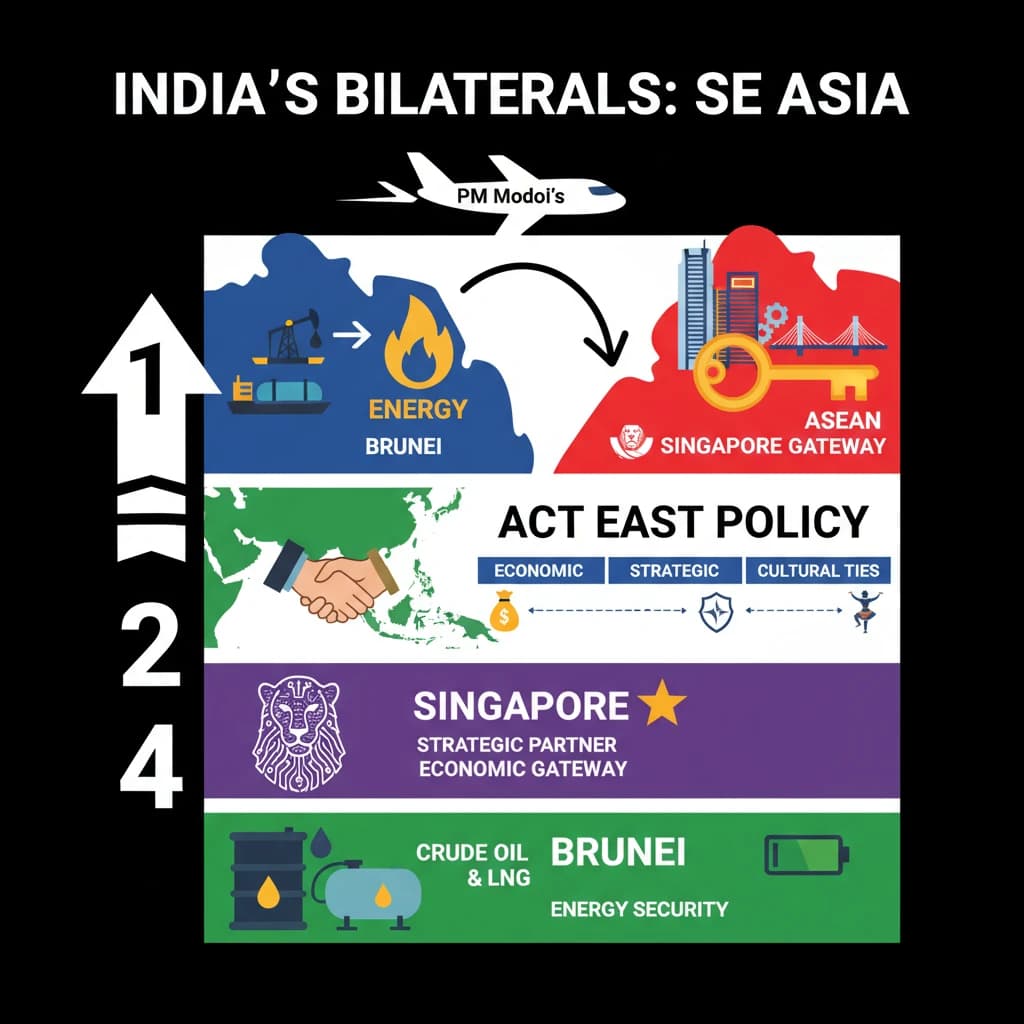
  • PM's visits to Brunei and Singapore signify India's enhanced diplomatic engagement in Southeast Asia.
  • These visits are crucial for India's Act East Policy, strengthening economic, strategic, and cultural ties.
  • Singapore is a key strategic partner and economic gateway for India in ASEAN.
  • Brunei is vital for India's energy security, providing crude oil and LNG.
  • Bilateral agreements are fundamental tools for advancing national interests and regional stability in the Indo-Pacific.
Bilateral Groupings and Agreements

Bilateral Groupings and Agreements

Medium⏱️ 7 min read✓ 95% Verified
international relations

📖 Introduction

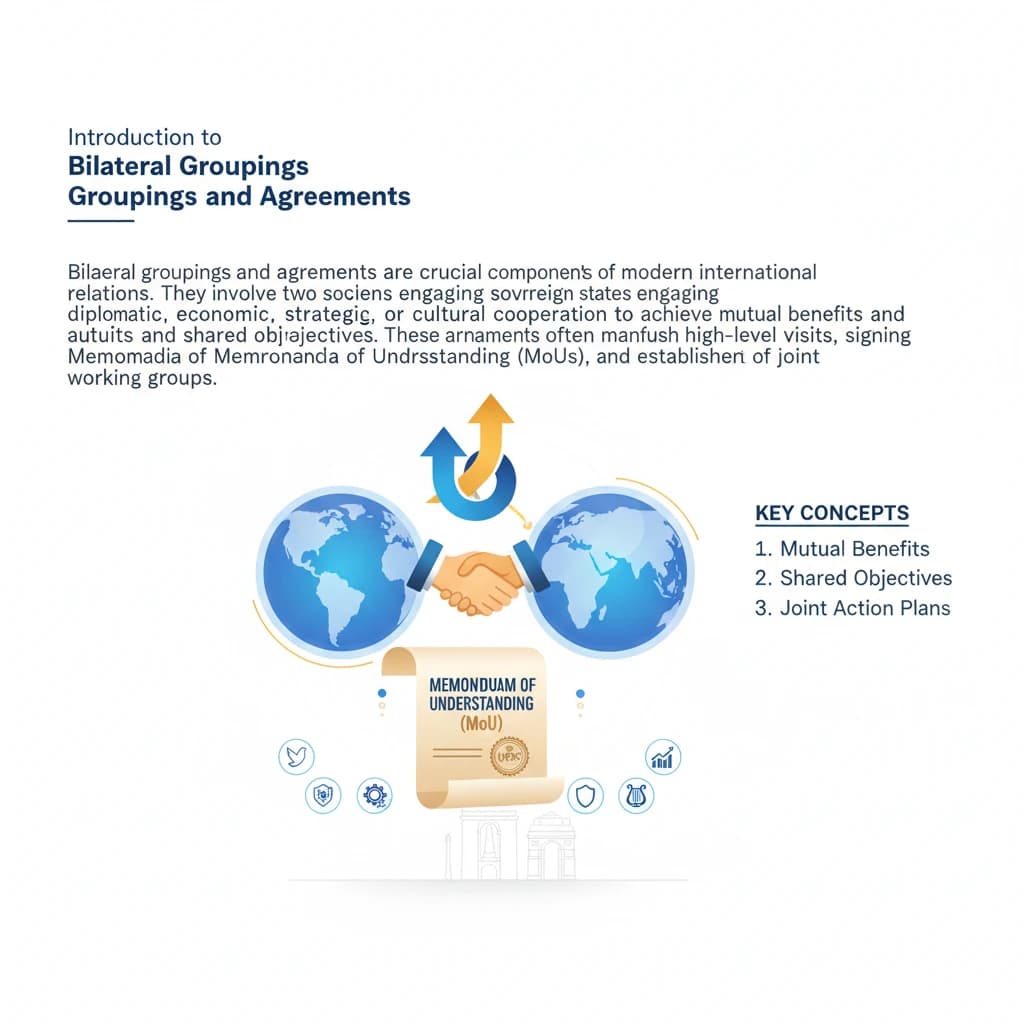
<h4>Introduction to Bilateral Groupings and Agreements</h4><p><strong>Bilateral groupings and agreements</strong> are crucial components of modern international relations. They involve two sovereign states engaging in diplomatic, economic, strategic, or cultural cooperation to achieve mutual benefits and shared objectives.</p><p>These arrangements often manifest through high-level visits, signing of Memoranda of Understanding (MoUs), and establishment of joint working groups.</p><div class='key-point-box'><p><strong>Key Point:</strong> Bilateral ties allow for focused engagement on specific issues, fostering deeper trust and understanding between nations compared to multilateral platforms.</p></div><h4>Significance of PM's Visits to Brunei and Singapore</h4><p>The recent visits by the <strong>Prime Minister of India</strong> to <strong>Brunei Darussalam</strong> and <strong>Singapore</strong> signify India's enhanced diplomatic and strategic outreach in <strong>Southeast Asia</strong>. These visits are integral to India's broader <strong>Act East Policy</strong>.</p><p>Such high-level engagements underscore India's commitment to strengthening ties with key partners in the region, promoting stability, and expanding economic opportunities.</p><div class='info-box'><p><strong>Why in News:</strong> Prime Minister of India’s visits to <strong>Brunei Darussalam</strong> and <strong>Singapore</strong> have marked significant advancements in India’s diplomatic and strategic engagements in Southeast Asia.</p></div><h4>India's Act East Policy Context</h4><p>The <strong>Act East Policy</strong>, launched in <strong>2014</strong>, is a successor to the <strong>Look East Policy</strong> of <strong>1991</strong>. It aims to promote economic cooperation, cultural ties, and strategic relationships with countries in the <strong>Asia-Pacific region</strong>.</p><p>These visits reinforce the policy's objectives, emphasizing India's role as a reliable partner and a growing power in the <strong>Indo-Pacific</strong>.</p><div class='exam-tip-box'><p><strong>UPSC Insight:</strong> Understanding the evolution from 'Look East' to 'Act East' is vital for Mains answers on India's foreign policy and regional diplomacy (<strong>GS Paper 2</strong>).</p></div><h4>Key Areas of Cooperation with Singapore</h4><p>India's relationship with <strong>Singapore</strong> is a comprehensive <strong>Strategic Partnership</strong>. Cooperation spans defence, trade, investment, technology, and skill development.</p><ul><li><strong>Defence:</strong> Joint military exercises, training, and defence technology collaboration.</li><li><strong>Economic:</strong> Significant trade volume, Singapore as a major source of FDI for India.</li><li><strong>Technology & Innovation:</strong> Collaboration in smart cities, fintech, and digital economy.</li></ul><h4>Key Areas of Cooperation with Brunei Darussalam</h4><p>India's ties with <strong>Brunei Darussalam</strong> focus primarily on energy security, defence, and cultural exchanges.</p><ul><li><strong>Energy Security:</strong> Brunei is a significant source of crude oil and LNG.</li><li><strong>Defence:</strong> Cooperation in maritime security and naval exchanges.</li><li><strong>People-to-People:</strong> Cultural exchange programs and tourism promotion.</li></ul>
Concept Diagram

💡 Key Takeaways

  • •PM's visits to Brunei and Singapore signify India's enhanced diplomatic engagement in Southeast Asia.
  • •These visits are crucial for India's Act East Policy, strengthening economic, strategic, and cultural ties.
  • •Singapore is a key strategic partner and economic gateway for India in ASEAN.
  • •Brunei is vital for India's energy security, providing crude oil and LNG.
  • •Bilateral agreements are fundamental tools for advancing national interests and regional stability in the Indo-Pacific.

🧠 Memory Techniques
Memory Aid
95% Verified Content

📚 Reference Sources

•Drishti IAS current affairs summaries.
•Observer Research Foundation (ORF) analyses on India's foreign policy.
•ASEAN-India Summit joint statements.

Related Topics

Loading related topics...
Explore:International Relations Topics·All Subjects·Daily Current Affairs·Editorial Analysis·Previous Year Questions·UPSC GPT
Bilateral Groupings and Agreements - UPSC International Relations