Loading page, please wait…
Vaidra Logo
Vaidra

Top 4 items + smart groups

UPSC GPT
New
Current Affairs
Daily Solutions
Daily Puzzle
Mains Evaluator

Version 2.0.0 • Built with ❤️ for UPSC aspirants

Loading...
Loading...
Loading...
Loading...
Loading...
Loading...
Loading...
Loading...
Loading...
Loading...
Loading...
Loading...
Loading...
Back
All Subjects

Topics

0 topics • 0 completed

Loading topics...
Loading...
Loading...
Loading...
Loading...
Loading...
Overall Progress0%

How is BIMSTEC Different from SAARC? - UPSC International Relations

What is How is BIMSTEC Different from SAARC? in UPSC International Relations?

How is BIMSTEC Different from SAARC? is a key topic under International Relations for UPSC Civil Services Examination. Key points include: BIMSTEC (1997) is interregional (South Asia + Southeast Asia); SAARC (1985) is purely South Asian.. BIMSTEC members: Bangladesh, Bhutan, India, Myanmar, Nepal, Sri Lanka, Thailand. SAARC members: Afghanistan, Bangladesh, Bhutan, India, Maldives, Nepal, Pakistan, Sri Lanka.. BIMSTEC has better intra-regional trade growth (6%) and smoother cooperation due to fewer bilateral tensions.. Understanding this topic is essential for both UPSC Prelims and Mains preparation.

Why is How is BIMSTEC Different from SAARC? important for UPSC exam?

How is BIMSTEC Different from SAARC? is a Medium-level topic in UPSC International Relations. It is tested in both Prelims (factual MCQs) and Mains (analytical answer writing). Previous year UPSC questions have frequently covered aspects of How is BIMSTEC Different from SAARC?, making it essential for comprehensive IAS preparation.

How to prepare How is BIMSTEC Different from SAARC? for UPSC?

To prepare How is BIMSTEC Different from SAARC? for UPSC: (1) Study the comprehensive notes covering all key concepts on Vaidra. (2) Practice previous year questions on this topic. (3) Connect it with current affairs using daily updates. (4) Revise using key takeaways and mind maps available for International Relations. (5) Write practice answers linking How is BIMSTEC Different from SAARC? to related GS Paper topics.

Key takeaways of How is BIMSTEC Different from SAARC? for UPSC

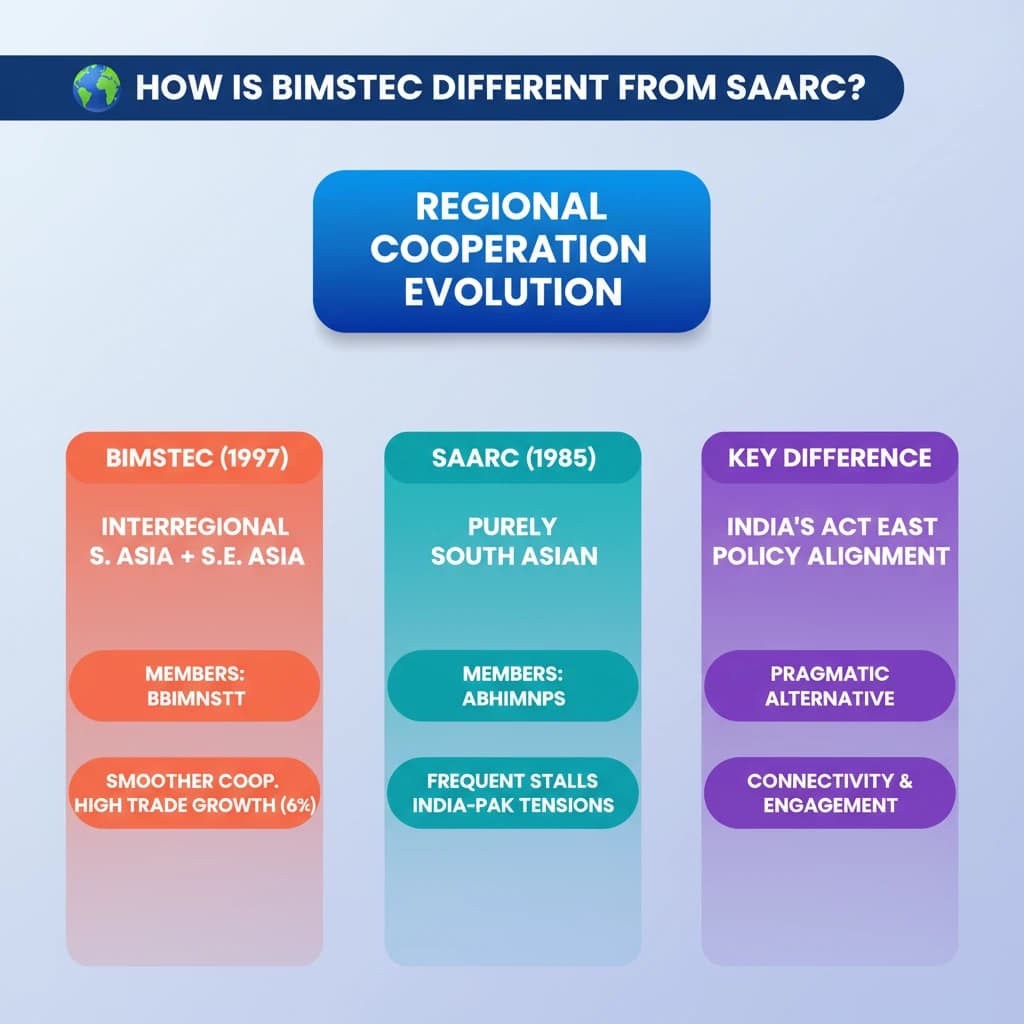
  • BIMSTEC (1997) is interregional (South Asia + Southeast Asia); SAARC (1985) is purely South Asian.
  • BIMSTEC members: Bangladesh, Bhutan, India, Myanmar, Nepal, Sri Lanka, Thailand. SAARC members: Afghanistan, Bangladesh, Bhutan, India, Maldives, Nepal, Pakistan, Sri Lanka.
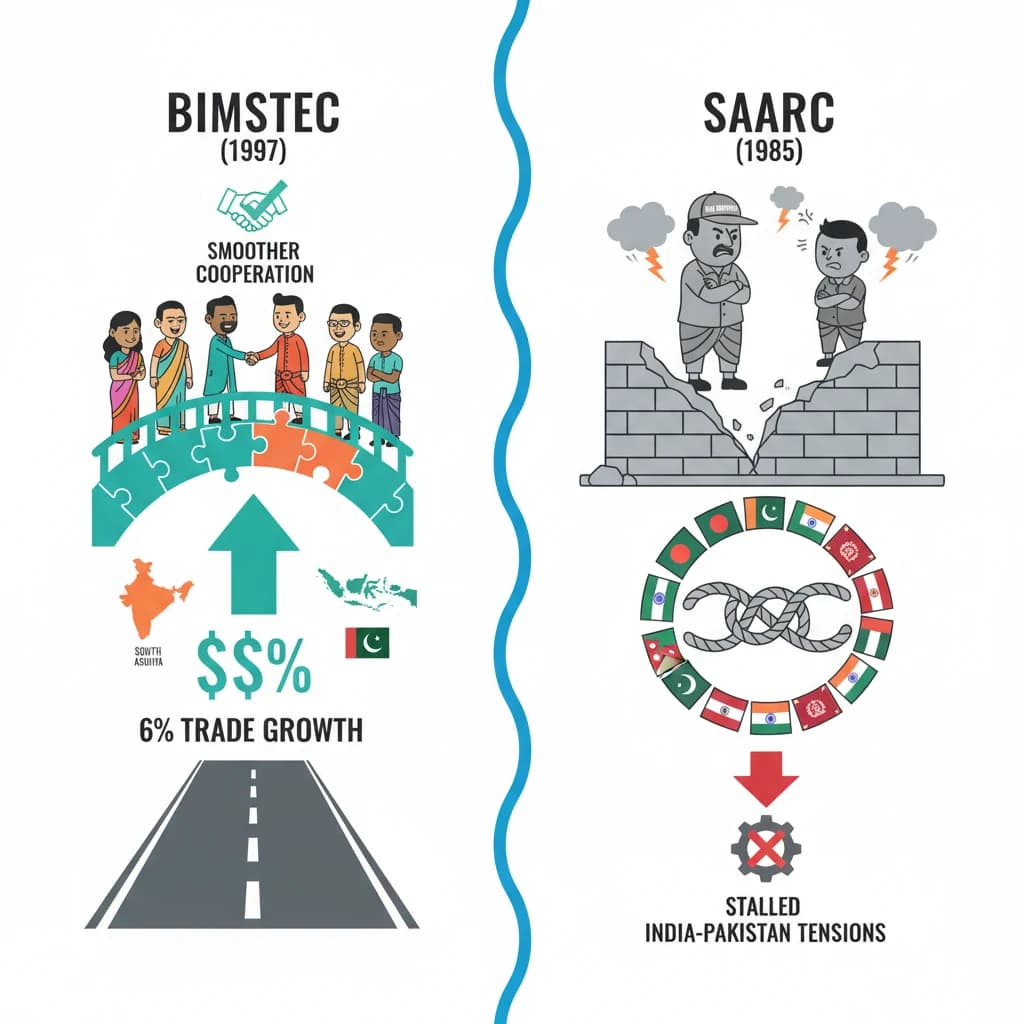
  • BIMSTEC has better intra-regional trade growth (6%) and smoother cooperation due to fewer bilateral tensions.
  • SAARC is often stalled by India-Pakistan tensions and the 'Big Brother' perception of India by smaller members.
  • BIMSTEC aligns with India's Act East Policy, offering a pragmatic alternative for regional engagement and connectivity.
How is BIMSTEC Different from SAARC?

How is BIMSTEC Different from SAARC?

Medium⏱️ 8 min read✓ 95% Verified
international relations

📖 Introduction

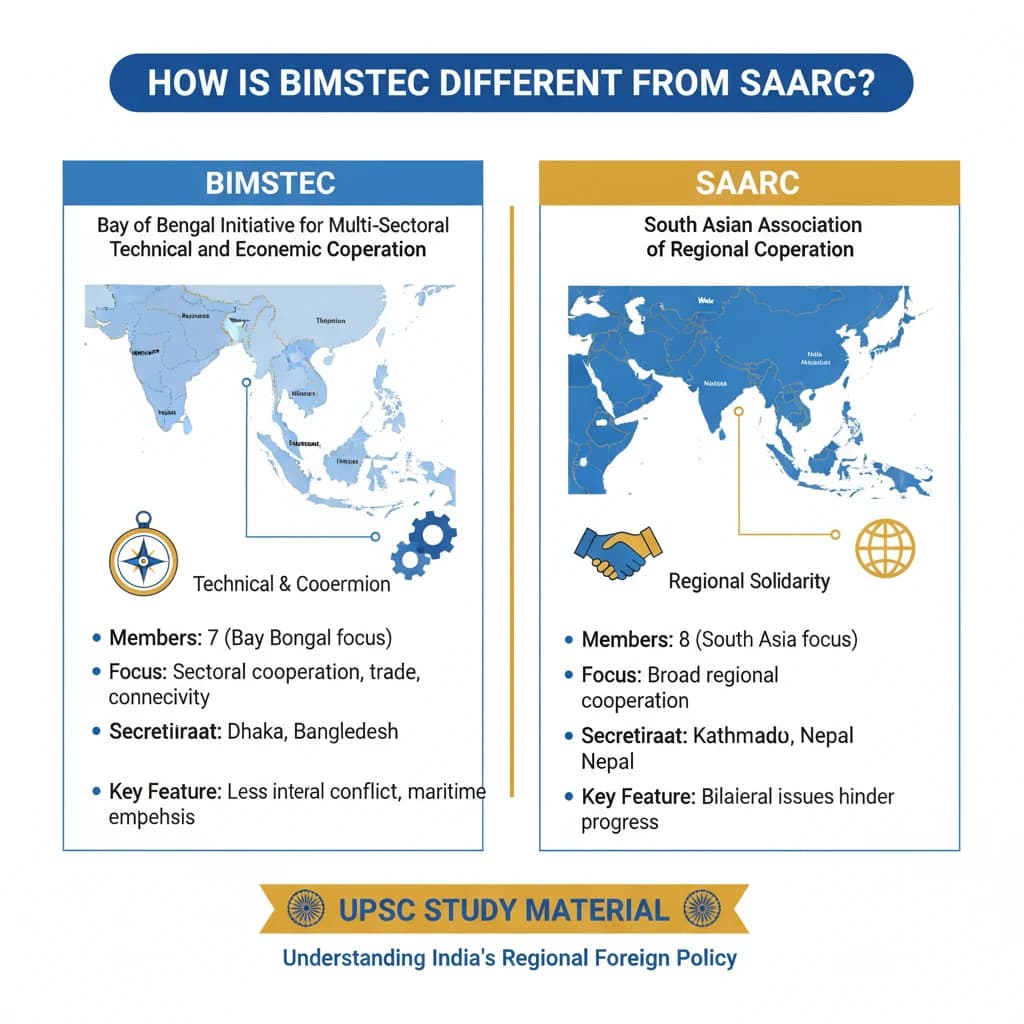
<h4>Introduction to Regional Groupings: BIMSTEC and SAARC</h4><p>Understanding the distinctions between <strong>BIMSTEC</strong> (Bay of Bengal Initiative for Multi-Sectoral Technical and Economic Cooperation) and <strong>SAARC</strong> (South Asian Association for Regional Cooperation) is crucial for comprehending India's regional foreign policy. Both organizations aim for regional cooperation but differ significantly in their scope, membership, and operational effectiveness.</p><div class='key-point-box'><p>While <strong>SAARC</strong> represents purely <strong>South Asian regionalism</strong>, <strong>BIMSTEC</strong> embodies an <strong>interregional approach</strong>, bridging South Asia with Southeast Asia.</p></div><h4>Key Differentiating Factors: BIMSTEC vs. SAARC</h4><p>The table below provides a structured comparison of <strong>BIMSTEC</strong> and <strong>SAARC</strong> across several critical parameters, highlighting their unique characteristics and operational frameworks.</p><table class='info-table'><tr><th>Criteria</th><th>BIMSTEC</th><th>SAARC</th></tr><tr><td><strong>Established</strong></td><td>Originated by <strong>Bangkok Declaration</strong> in <strong>1997</strong></td><td>Originated by Adoption of <strong>Charter by Members</strong> in <strong>1985</strong> in <strong>Dhaka</strong></td></tr><tr><td><strong>Member Countries</strong></td><td><strong>Bangladesh, Bhutan, India, Myanmar, Nepal, Sri Lanka, Thailand</strong></td><td><strong>Afghanistan, Bangladesh, Bhutan, India, Maldives, Nepal, Pakistan, Sri Lanka</strong></td></tr><tr><td><strong>Geographical Focus</strong></td><td><strong>Interregional</strong> (South Asia and South East Asia)</td><td><strong>Regional</strong> (South Asia)</td></tr><tr><td><strong>Intra-Regional Trade</strong></td><td>Increased around <strong>6%</strong> in a decade</td><td>Around <strong>5%</strong> since inception</td></tr><tr><td><strong>Key Strengths</strong></td><td>Connects <strong>SAARC</strong> countries with <strong>ASEAN</strong>, reasonably friendly relations among members, practical cooperation in <strong>14 sectors</strong></td><td>Long-standing regional forum, numerous agreements signed</td></tr><tr><td><strong>Secretariat Location</strong></td><td><strong>Dhaka, Bangladesh</strong></td><td><strong>Kathmandu, Nepal</strong></td></tr><tr><td><strong>Leadership Dynamics</strong></td><td>Balancing of power with the presence of <strong>Thailand</strong> and <strong>India</strong> on the bloc</td><td><strong>India</strong> perceived as <strong>‘Big Brother’</strong> by smaller members, often leading to trust deficits</td></tr></table><h4>Geographical Scope and Membership</h4><p>A primary distinction lies in their geographical reach. <strong>SAARC</strong> is exclusively a <strong>South Asian</strong> grouping, comprising eight nations. In contrast, <strong>BIMSTEC</strong> extends its membership to include two <strong>Southeast Asian</strong> nations, <strong>Myanmar</strong> and <strong>Thailand</strong>, giving it an interregional character.</p><div class='info-box'><p><strong>BIMSTEC Members:</strong> <strong>Bangladesh, Bhutan, India, Myanmar, Nepal, Sri Lanka, Thailand</strong>.</p><p><strong>SAARC Members:</strong> <strong>Afghanistan, Bangladesh, Bhutan, India, Maldives, Nepal, Pakistan, Sri Lanka</strong>.</p></div><h4>Trade and Economic Cooperation</h4><p>While both aim to boost regional trade, their success rates differ. <strong>BIMSTEC</strong> has shown a relatively higher growth in <strong>intra-regional trade</strong>, increasing by approximately <strong>6%</strong> in a decade. <strong>SAARC's intra-regional trade</strong> has remained stagnant at around <strong>5%</strong> since its inception.</p><div class='exam-tip-box'><p>The performance of <strong>intra-regional trade</strong> is a key metric for evaluating the effectiveness of regional groupings. UPSC often asks about economic integration challenges.</p></div><h4>Operational Effectiveness and Leadership</h4><p><strong>BIMSTEC</strong> benefits from more congenial relations among its members, facilitating practical cooperation across <strong>14 identified sectors</strong>. The presence of <strong>Thailand</strong> alongside <strong>India</strong> helps in balancing power dynamics within the bloc.</p><p>Conversely, <strong>SAARC</strong> has been plagued by geopolitical tensions, primarily between <strong>India</strong> and <strong>Pakistan</strong>. This often leads to stalemates, with smaller members sometimes perceiving <strong>India</strong> as a <strong>‘Big Brother’</strong>, hindering consensus-building and effective implementation of agreements.</p>
Concept Diagram

💡 Key Takeaways

  • •BIMSTEC (1997) is interregional (South Asia + Southeast Asia); SAARC (1985) is purely South Asian.
  • •BIMSTEC members: Bangladesh, Bhutan, India, Myanmar, Nepal, Sri Lanka, Thailand. SAARC members: Afghanistan, Bangladesh, Bhutan, India, Maldives, Nepal, Pakistan, Sri Lanka.
  • •BIMSTEC has better intra-regional trade growth (6%) and smoother cooperation due to fewer bilateral tensions.
  • •SAARC is often stalled by India-Pakistan tensions and the 'Big Brother' perception of India by smaller members.
  • •BIMSTEC aligns with India's Act East Policy, offering a pragmatic alternative for regional engagement and connectivity.

🧠 Memory Techniques
Memory Aid
95% Verified Content

Related Topics

Loading related topics...
Explore:International Relations Topics·All Subjects·Daily Current Affairs·Editorial Analysis·Previous Year Questions·UPSC GPT
How is BIMSTEC Different from SAARC? - UPSC International Relations