Loading page, please wait…
Vaidra Logo
Vaidra

Top 4 items + smart groups

UPSC GPT
New
Current Affairs
Daily Solutions
Daily Puzzle
Mains Evaluator

Version 2.0.0 • Built with ❤️ for UPSC aspirants

Loading...
Loading...
Loading...
Loading...
Loading...
Loading...
Loading...
Loading...
Loading...
Loading...
Loading...
Loading...
Loading...
Back
All Subjects

Topics

0 topics • 0 completed

Loading topics...
Loading...
Loading...
Loading...
Loading...
Loading...
Overall Progress0%

What are the Key Highlights of the 2nd India-CARICOM Summit - UPSC International Relations

What is What are the Key Highlights of the 2nd India-CARICOM Summit in UPSC International Relations?

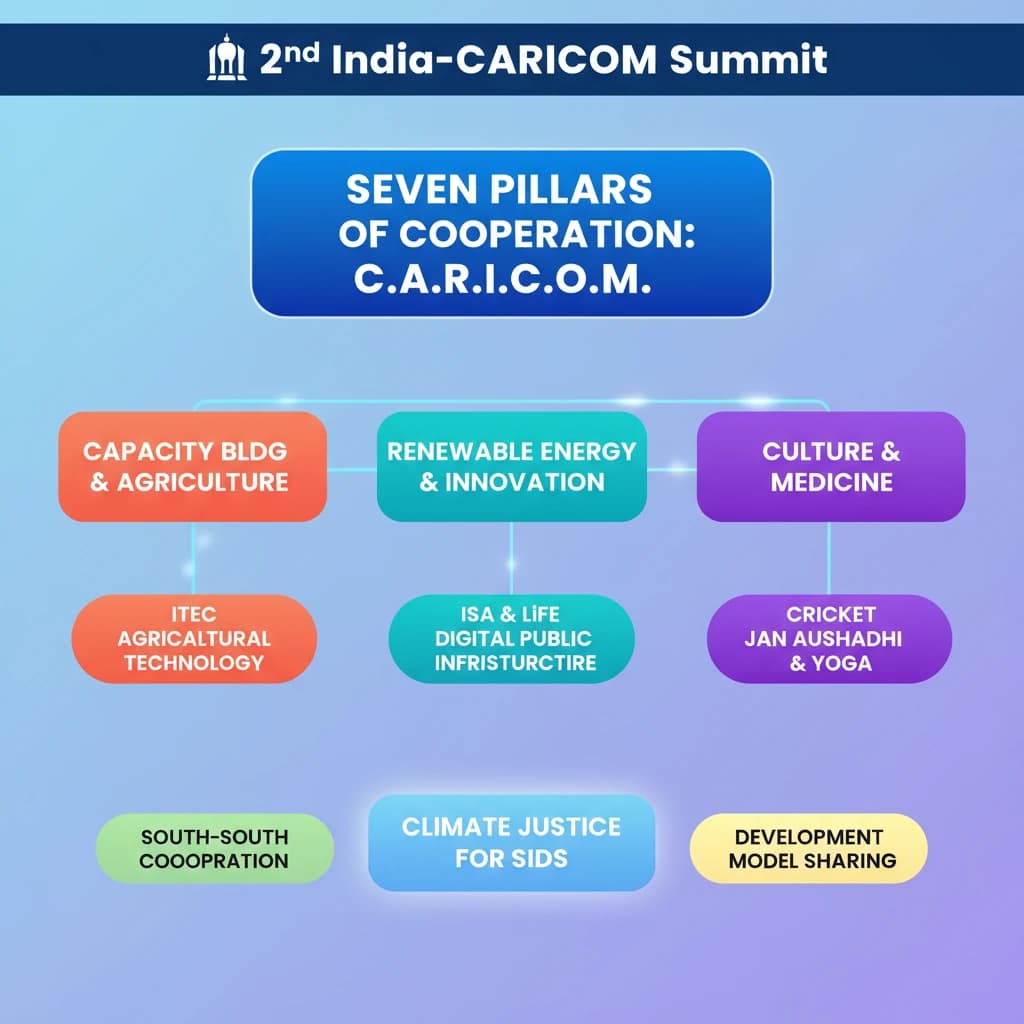
What are the Key Highlights of the 2nd India-CARICOM Summit is a key topic under International Relations for UPSC Civil Services Examination. Key points include: The 2nd India-CARICOM Summit focused on seven pillars of cooperation, encapsulated by the C.A.R.I.C.O.M. acronym.. Key areas include Capacity Building (ITEC), Agriculture (tech), Renewable Energy (ISA, LiFE), Innovation (DPI), Culture (Cricket), Ocean Economy, and Medicine (Jan Aushadhi, Yoga).. India demonstrated strong leadership in advocating for Climate Justice for Small Island Developing States (SIDS).. Understanding this topic is essential for both UPSC Prelims and Mains preparation.

Why is What are the Key Highlights of the 2nd India-CARICOM Summit important for UPSC exam?

What are the Key Highlights of the 2nd India-CARICOM Summit is a Medium-level topic in UPSC International Relations. It is tested in both Prelims (factual MCQs) and Mains (analytical answer writing). Previous year UPSC questions have frequently covered aspects of What are the Key Highlights of the 2nd India-CARICOM Summit, making it essential for comprehensive IAS preparation.

How to prepare What are the Key Highlights of the 2nd India-CARICOM Summit for UPSC?

To prepare What are the Key Highlights of the 2nd India-CARICOM Summit for UPSC: (1) Study the comprehensive notes covering all key concepts on Vaidra. (2) Practice previous year questions on this topic. (3) Connect it with current affairs using daily updates. (4) Revise using key takeaways and mind maps available for International Relations. (5) Write practice answers linking What are the Key Highlights of the 2nd India-CARICOM Summit to related GS Paper topics.

Key takeaways of What are the Key Highlights of the 2nd India-CARICOM Summit for UPSC

  • The 2nd India-CARICOM Summit focused on seven pillars of cooperation, encapsulated by the C.A.R.I.C.O.M. acronym.
  • Key areas include Capacity Building (ITEC), Agriculture (tech), Renewable Energy (ISA, LiFE), Innovation (DPI), Culture (Cricket), Ocean Economy, and Medicine (Jan Aushadhi, Yoga).
  • India demonstrated strong leadership in advocating for Climate Justice for Small Island Developing States (SIDS).
  • The summit reinforced India's commitment to South-South cooperation and sharing its development models.
  • The partnership aims to enhance public service delivery, economic growth, and climate resilience in CARICOM nations.
What are the Key Highlights of the 2nd India-CARICOM Summit

What are the Key Highlights of the 2nd India-CARICOM Summit

Medium⏱️ 7 min read✓ 95% Verified
international relations

📖 Introduction

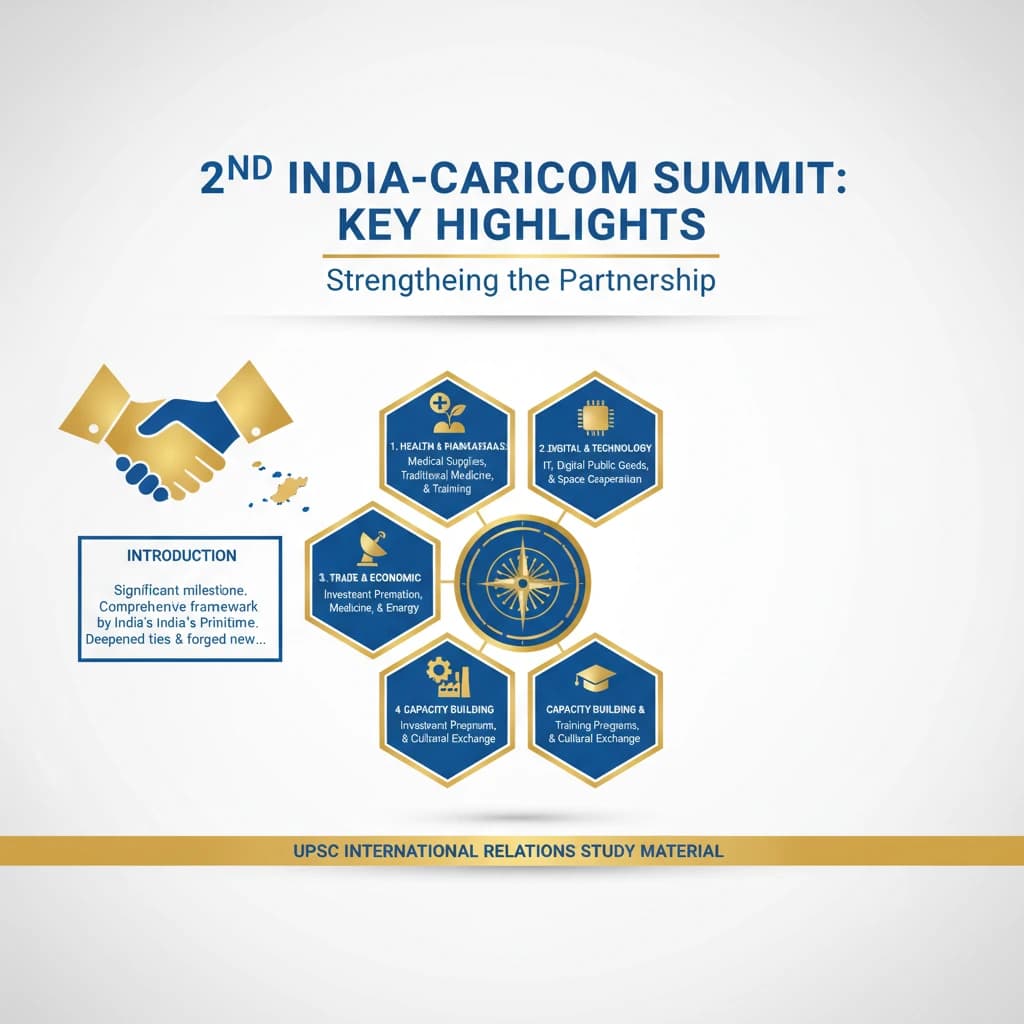
<h4>Introduction to the 2nd India-CARICOM Summit</h4><p>The <strong>2nd India-CARICOM Summit</strong> marked a significant milestone in strengthening the partnership between <strong>India</strong> and the <strong>Caribbean Community (CARICOM)</strong>.</p><p>During this summit, <strong>India's Prime Minister</strong> outlined a comprehensive framework for enhanced cooperation across various crucial sectors.</p><div class='key-point-box'><p>The summit aimed to deepen existing ties and forge new avenues for collaboration, reflecting <strong>India's commitment</strong> to its partners in the <strong>Global South</strong>.</p></div><h4>The Seven Pillars of Cooperation: The C.A.R.I.C.O.M. Framework</h4><p>Prime Minister Modi proposed <strong>seven key pillars</strong> to bolster the relationship between <strong>India</strong> and <strong>CARICOM nations</strong>. These pillars are structured around the acronym <strong>C.A.R.I.C.O.M.</strong> for easy recall.</p><p>This framework provides a clear roadmap for focused engagement, addressing the specific needs and shared priorities of the region.</p><h4>C: Capacity Building</h4><p><strong>Capacity building</strong> is a cornerstone of India's development partnership approach, focusing on human resource development.</p><div class='info-box'><p>India announced an additional <strong>1000 ITEC (Indian Technical and Economic Cooperation) slots</strong> for <strong>CARICOM countries</strong> over the next <strong>five years</strong>.</p></div><p>These slots facilitate training and skill development across diverse fields, empowering individuals and institutions in the Caribbean.</p><h4>A: Agriculture and Food Security</h4><p>Addressing <strong>agriculture</strong> and <strong>food security</strong> is vital for the sustainable development of CARICOM nations.</p><p>India shared its extensive experience in modern agricultural practices, emphasizing the integration of advanced <strong>technology</strong>.</p><ul><li>Key areas of shared expertise include the use of <strong>drones</strong> for precision farming, advancements in <strong>digital farming techniques</strong>, and the promotion of <strong>farm mechanization</strong>.</li></ul><h4>R: Renewable Energy and Climate Change</h4><p>Collaboration on <strong>renewable energy</strong> and combating <strong>climate change</strong> is a critical aspect, given the vulnerability of island nations.</p><p>India urged greater cooperation on global initiatives where it plays a leading role.</p><ul><li>These initiatives include the <strong>International Solar Alliance (ISA)</strong>, promoting solar energy adoption globally, and <strong>Mission LiFE (Lifestyle for Environment)</strong>, advocating for sustainable lifestyles.</li></ul><h4>I: Innovation, Technology and Trade</h4><p>Fostering <strong>innovation</strong>, facilitating <strong>technology transfer</strong>, and expanding <strong>trade</strong> are crucial for economic growth.</p><p>Prime Minister Modi offered India’s successful models in <strong>Digital Public Infrastructure (DPI)</strong> to CARICOM countries.</p><p>These technological solutions aim to enhance <strong>public service delivery</strong> and drive digital transformation in the region.</p><h4>C: Cricket and Culture</h4><p><strong>Cricket</strong> and <strong>cultural exchanges</strong> serve as powerful bridges between India and the Caribbean, reflecting shared passions.</p><p>India proposed organizing <strong>“Days of Indian Culture”</strong> in CARICOM countries to promote mutual understanding and appreciation.</p><p>Furthermore, an initiative was offered to provide specialized <strong>cricket training</strong> for <strong>young women cricketers</strong> from the CARICOM region, fostering sports development.</p><h4>O: Ocean Economy and Maritime Security</h4><p>Given the geographical nature of CARICOM nations, the <strong>ocean economy</strong> and <strong>maritime security</strong> are of paramount importance.</p><p>India expressed its readiness to collaborate on vital areas related to marine resources and safety.</p><ul><li>Specific proposals include cooperation on <strong>maritime domain mapping</strong> and conducting <strong>hydrography</strong> studies in the <strong>Caribbean Sea</strong>, enhancing regional security and resource management.</li></ul><h4>M: Medicine and Healthcare</h4><p>Ensuring accessible and affordable <strong>medicine</strong> and <strong>healthcare</strong> is a universal priority.</p><p>India offered its proven model for delivering <strong>affordable healthcare solutions</strong>.</p><ul><li>This includes the provision of <strong>generic medicines</strong> through the successful <strong>Jan Aushadhi Kendras</strong> program and the promotion of <strong>Yoga</strong> for holistic well-being.</li></ul><h4>Emphasis on Climate Justice for Small Island Developing States (SIDS)</h4><p>A significant highlight of the summit was the focus on <strong>climate justice</strong>, particularly for <strong>Small Island Developing States (SIDS)</strong>.</p><p>CARICOM leaders conveyed their deep appreciation for <strong>India’s leadership</strong> in championing this critical cause on the global stage.</p><div class='key-point-box'><p>This recognition underscores India's growing influence as a voice for vulnerable nations in international climate negotiations.</p></div><h4>Vulnerability of SIDS to Climate Change</h4><p><strong>Small Island Developing States (SIDS)</strong> face disproportionate impacts from climate change despite their minimal contribution to global emissions.</p><div class='info-box'><p>SIDS are collectively responsible for <strong>less than 1%</strong> of global greenhouse gas emissions.</p></div><p>However, they are among the most severely affected by phenomena such as rising sea levels, extreme weather events, and ocean acidification.</p><h4>Defining Climate Justice</h4><p>The concept of <strong>climate justice</strong> is central to ensuring equitable responses to the climate crisis.</p><div class='info-box'><p><strong>Climate justice</strong> means addressing the <strong>unequal and disproportionate impacts</strong> of climate change on different communities.</p></div><p>It specifically focuses on protecting the rights and needs of <strong>poor, marginalized, and vulnerable groups</strong>, who often bear the brunt of environmental degradation.</p>
Concept Diagram

💡 Key Takeaways

  • •The 2nd India-CARICOM Summit focused on seven pillars of cooperation, encapsulated by the C.A.R.I.C.O.M. acronym.
  • •Key areas include Capacity Building (ITEC), Agriculture (tech), Renewable Energy (ISA, LiFE), Innovation (DPI), Culture (Cricket), Ocean Economy, and Medicine (Jan Aushadhi, Yoga).
  • •India demonstrated strong leadership in advocating for Climate Justice for Small Island Developing States (SIDS).
  • •The summit reinforced India's commitment to South-South cooperation and sharing its development models.
  • •The partnership aims to enhance public service delivery, economic growth, and climate resilience in CARICOM nations.

🧠 Memory Techniques

Memory Aid
95% Verified Content

Related Topics

Loading related topics...
Explore:International Relations Topics·All Subjects·Daily Current Affairs·Editorial Analysis·Previous Year Questions·UPSC GPT
What are the Key Highlights of the 2nd India-CARICOM Summit - UPSC International Relations