Loading page, please wait…
Vaidra Logo
Vaidra

Top 4 items + smart groups

UPSC GPT
New
Current Affairs
Daily Solutions
Daily Puzzle
Mains Evaluator

Version 2.0.0 • Built with ❤️ for UPSC aspirants

Loading...
Loading...
Loading...
Loading...
Loading...
Loading...
Loading...
Loading...
Loading...
Loading...
Loading...
Loading...
Loading...
Back
All Subjects

Topics

0 topics • 0 completed

Loading topics...
Loading...
Loading...
Loading...
Loading...
Loading...
Overall Progress0%

19th East Asia Summit (EAS) - UPSC International Relations

What is 19th East Asia Summit (EAS) in UPSC International Relations?

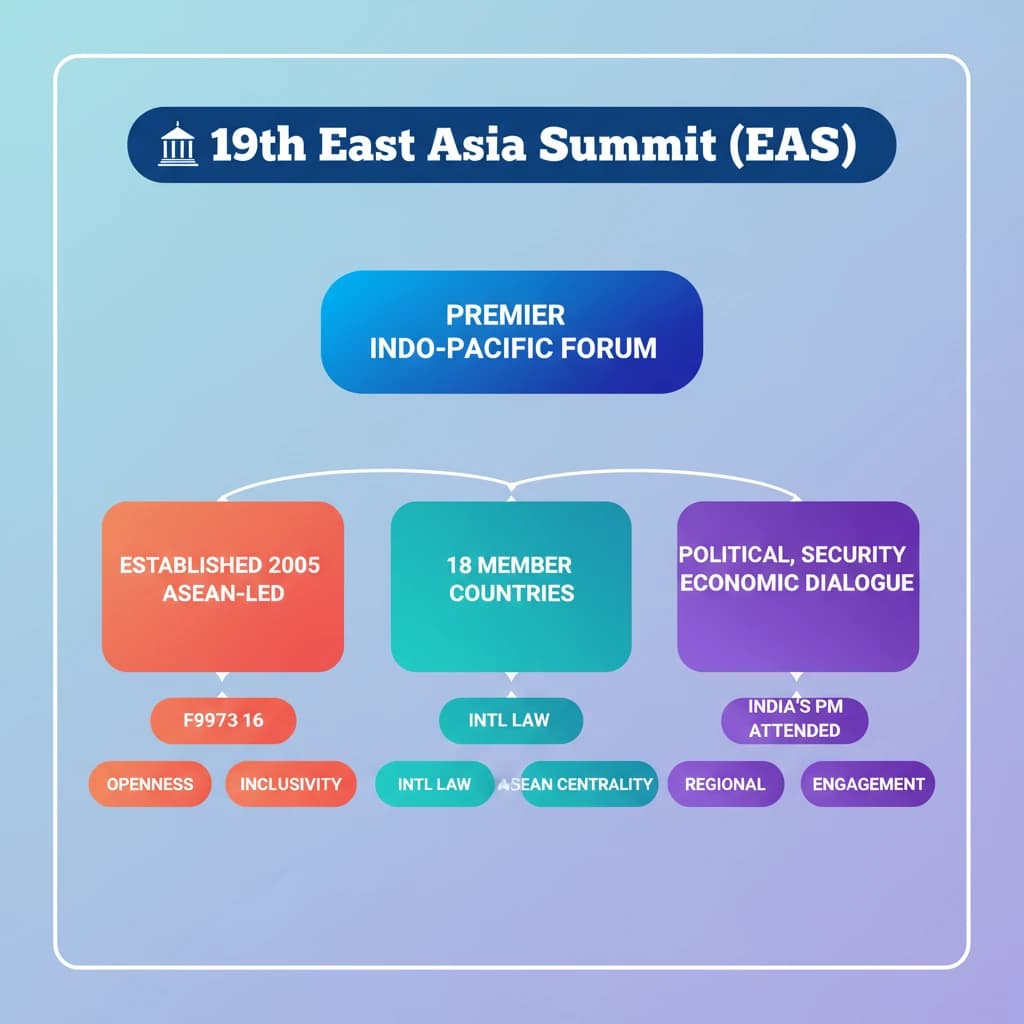
19th East Asia Summit (EAS) is a key topic under International Relations for UPSC Civil Services Examination. Key points include: The East Asia Summit (EAS) was established in 2005 as an ASEAN-led initiative.. It is the only leader-led forum in the Indo-Pacific, discussing political, security, and economic issues.. The EAS comprises 10 ASEAN countries and 8 dialogue partners (Australia, China, India, Japan, New Zealand, ROK, Russia, US).. Understanding this topic is essential for both UPSC Prelims and Mains preparation.

Why is 19th East Asia Summit (EAS) important for UPSC exam?

19th East Asia Summit (EAS) is a Medium-level topic in UPSC International Relations. It is tested in both Prelims (factual MCQs) and Mains (analytical answer writing). Previous year UPSC questions have frequently covered aspects of 19th East Asia Summit (EAS), making it essential for comprehensive IAS preparation.

How to prepare 19th East Asia Summit (EAS) for UPSC?

To prepare 19th East Asia Summit (EAS) for UPSC: (1) Study the comprehensive notes covering all key concepts on Vaidra. (2) Practice previous year questions on this topic. (3) Connect it with current affairs using daily updates. (4) Revise using key takeaways and mind maps available for International Relations. (5) Write practice answers linking 19th East Asia Summit (EAS) to related GS Paper topics.

Key takeaways of 19th East Asia Summit (EAS) for UPSC

  • The East Asia Summit (EAS) was established in 2005 as an ASEAN-led initiative.
  • It is the only leader-led forum in the Indo-Pacific, discussing political, security, and economic issues.
  • The EAS comprises 10 ASEAN countries and 8 dialogue partners (Australia, China, India, Japan, New Zealand, ROK, Russia, US).
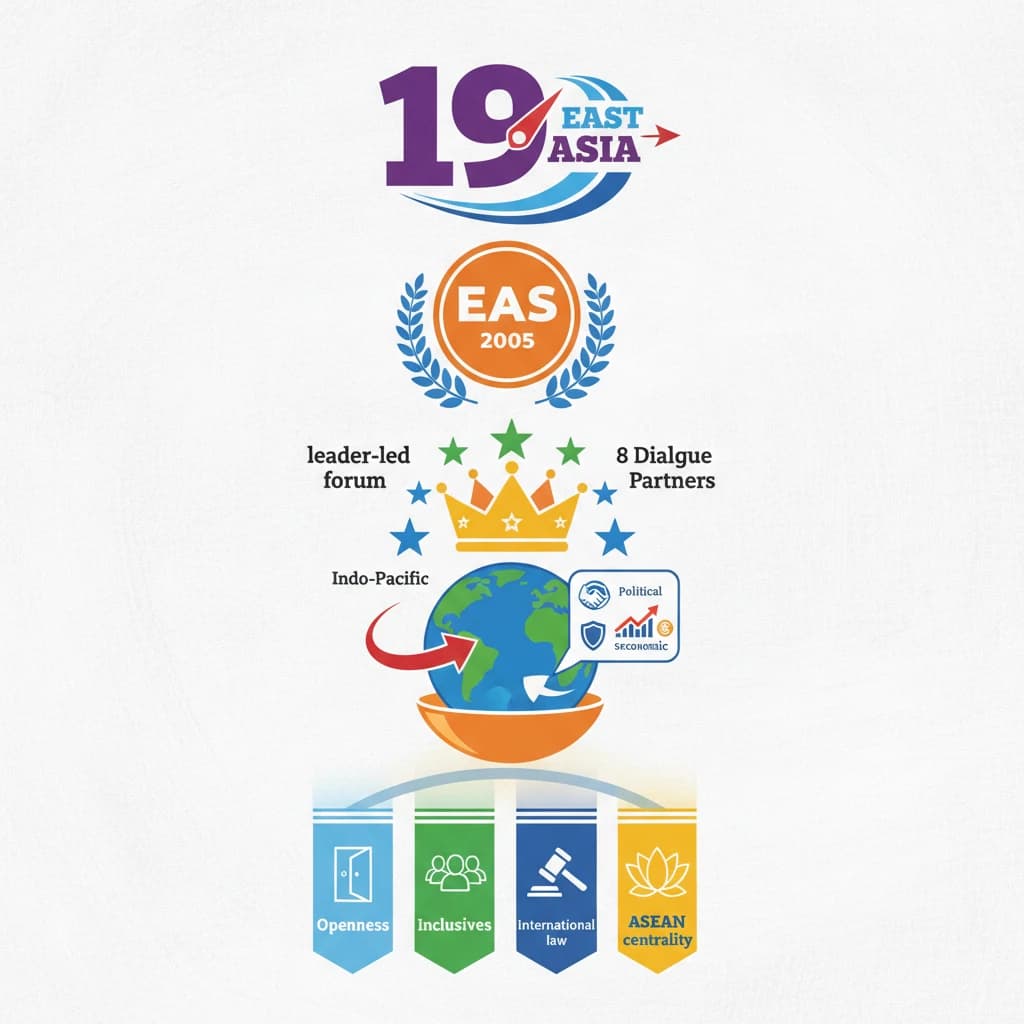
  • Its principles include openness, inclusiveness, respect for international law, and ASEAN centrality.
  • India's Prime Minister recently attended the 19th EAS, highlighting its importance for India's regional engagement.
19th East Asia Summit (EAS)

19th East Asia Summit (EAS)

Medium⏱️ 7 min read✓ 98% Verified
international relations

📖 Introduction

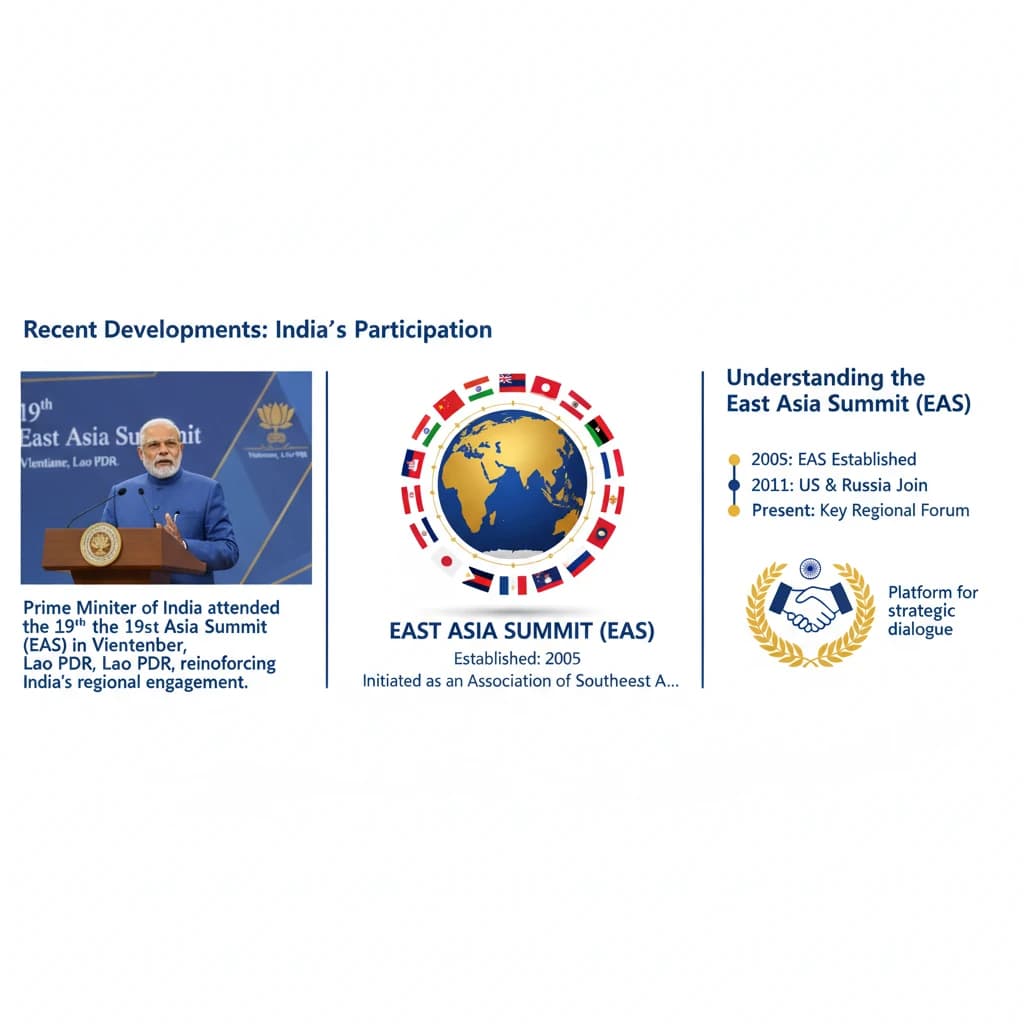
<h4>Recent Developments: India's Participation</h4><p>Recently, the <strong>Prime Minister of India</strong> attended the <strong>19th East Asia Summit (EAS)</strong> in <strong>Vientiane, Lao PDR</strong>. This participation underscores India's continued engagement with key regional forums.</p><h4>Understanding the East Asia Summit (EAS)</h4><p>The <strong>East Asia Summit (EAS)</strong> was formally established in <strong>2005</strong>. It was initiated as an <strong>Association of Southeast Asian Nations (ASEAN)-led initiative</strong>, highlighting ASEAN's central role in regional diplomacy.</p><div class='key-point-box'>The EAS stands out as the <strong>only leader-led forum</strong> in the <strong>Indo-Pacific</strong> region. It brings together all key partners to discuss a wide array of issues, including <strong>political, security, and economic matters</strong> of strategic importance.</div><p>The foundational idea of an <strong>East Asia Grouping</strong> was first proposed by then <strong>Malaysian Prime Minister Mahathir Mohamad</strong> in <strong>1991</strong>, setting the stage for its eventual formation.</p><p>The <strong>first summit</strong> was successfully held in <strong>Kuala Lumpur, Malaysia</strong>, on <strong>14th December 2005</strong>, officially launching the forum.</p><h4>Core Objectives and Principles of EAS</h4><p>The EAS operates on a set of fundamental principles that guide its discussions and collaborations:</p><ul><li><strong>Openness</strong>: Encouraging broad participation and transparency.</li><li><strong>Inclusiveness</strong>: Welcoming diverse perspectives from all member states.</li><li><strong>Respect for international law</strong>: Upholding global norms and regulations.</li><li><strong>ASEAN centrality</strong>: Recognizing ASEAN as the driving force and core of the forum.</li><li><strong>ASEAN’s role as the driving force</strong>: Affirming ASEAN's leadership in setting the agenda and direction.</li></ul><h4>EAS Membership: A Strategic Indo-Pacific Forum</h4><p>The EAS is a crucial forum for <strong>strategic dialogue</strong> within the expansive <strong>Indo-Pacific region</strong>. It comprises a total of <strong>18 countries</strong>, including all ASEAN members and key dialogue partners.</p><div class='info-box'><strong>EAS Member Countries:</strong><ul><li><strong>10 ASEAN Countries:</strong> Brunei, Cambodia, Indonesia, Laos, Malaysia, Myanmar, Philippines, Singapore, Thailand, and Vietnam.</li><li><strong>8 Dialogue Partners:</strong> Australia, China, India, Japan, New Zealand, Republic of Korea, Russia, and the United States.</li></ul></div>
Concept Diagram

💡 Key Takeaways

  • •The East Asia Summit (EAS) was established in 2005 as an ASEAN-led initiative.
  • •It is the only leader-led forum in the Indo-Pacific, discussing political, security, and economic issues.
  • •The EAS comprises 10 ASEAN countries and 8 dialogue partners (Australia, China, India, Japan, New Zealand, ROK, Russia, US).
  • •Its principles include openness, inclusiveness, respect for international law, and ASEAN centrality.
  • •India's Prime Minister recently attended the 19th EAS, highlighting its importance for India's regional engagement.

🧠 Memory Techniques
Memory Aid
98% Verified Content

Related Topics

Loading related topics...
Explore:International Relations Topics·All Subjects·Daily Current Affairs·Editorial Analysis·Previous Year Questions·UPSC GPT
19th East Asia Summit (EAS) - UPSC International Relations