Loading page, please wait…
Vaidra Logo
Vaidra

Top 4 items + smart groups

UPSC GPT
New
Current Affairs
Daily Solutions
Daily Puzzle
Mains Evaluator

Version 2.0.0 • Built with ❤️ for UPSC aspirants

Loading...
Loading...
Loading...
Loading...
Loading...
Loading...
Loading...
Loading...
Loading...
Loading...
Loading...
Loading...
Loading...
Jurisdiction and Working - UPSC International Relations
Back
All Subjects

Topics

0 topics • 0 completed

Loading topics...
Loading...
Loading...
Loading...
Loading...
Loading...
Overall Progress0%

Jurisdiction and Working - UPSC International Relations

What is Jurisdiction and Working in UPSC International Relations?

Jurisdiction and Working is a key topic under International Relations for UPSC Civil Services Examination. Key points include: The ICC prosecutes individuals for genocide, war crimes, crimes against humanity, and crimes of aggression.. Jurisdiction applies to State Party nationals, crimes in State Party territory, or situations referred by the UNSC.. It operates on the principle of complementarity, acting only when national courts are unwilling or unable.. Understanding this topic is essential for both UPSC Prelims and Mains preparation.

Why is Jurisdiction and Working important for UPSC exam?

Jurisdiction and Working is a Medium-level topic in UPSC International Relations. It is tested in both Prelims (factual MCQs) and Mains (analytical answer writing). Previous year UPSC questions have frequently covered aspects of Jurisdiction and Working, making it essential for comprehensive IAS preparation.

How to prepare Jurisdiction and Working for UPSC?

To prepare Jurisdiction and Working for UPSC: (1) Study the comprehensive notes covering all key concepts on Vaidra. (2) Practice previous year questions on this topic. (3) Connect it with current affairs using daily updates. (4) Revise using key takeaways and mind maps available for International Relations. (5) Write practice answers linking Jurisdiction and Working to related GS Paper topics.

Key takeaways of Jurisdiction and Working for UPSC

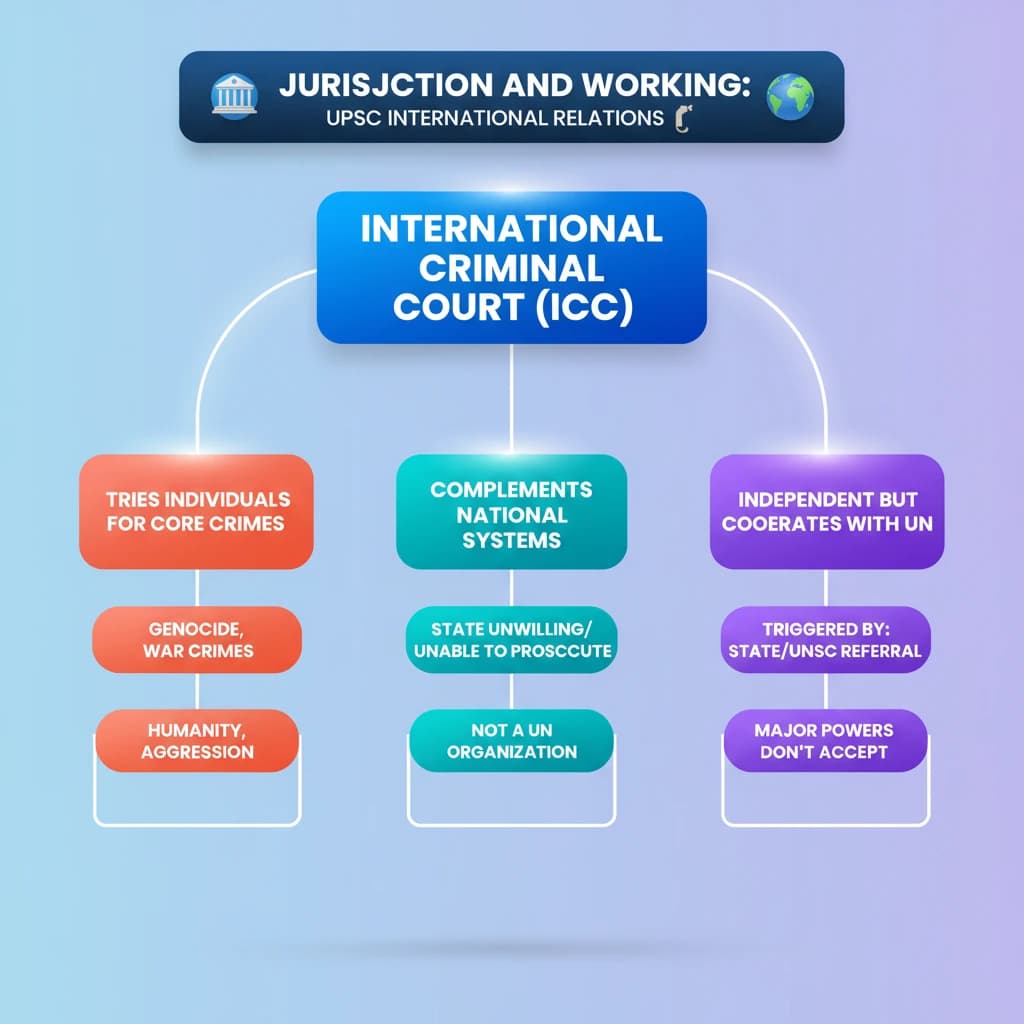
  • The ICC prosecutes individuals for genocide, war crimes, crimes against humanity, and crimes of aggression.
  • Jurisdiction applies to State Party nationals, crimes in State Party territory, or situations referred by the UNSC.
  • It operates on the principle of complementarity, acting only when national courts are unwilling or unable.
  • The ICC is independent of the UN but has a cooperation agreement; UNSC can grant it jurisdiction.
  • Major powers like the US, China, and Russia do not accept the ICC's jurisdiction, posing challenges to its universality.
Jurisdiction and Working

Jurisdiction and Working

Medium⏱️ 8 min read✓ 98% Verified
international relations

📖 Introduction

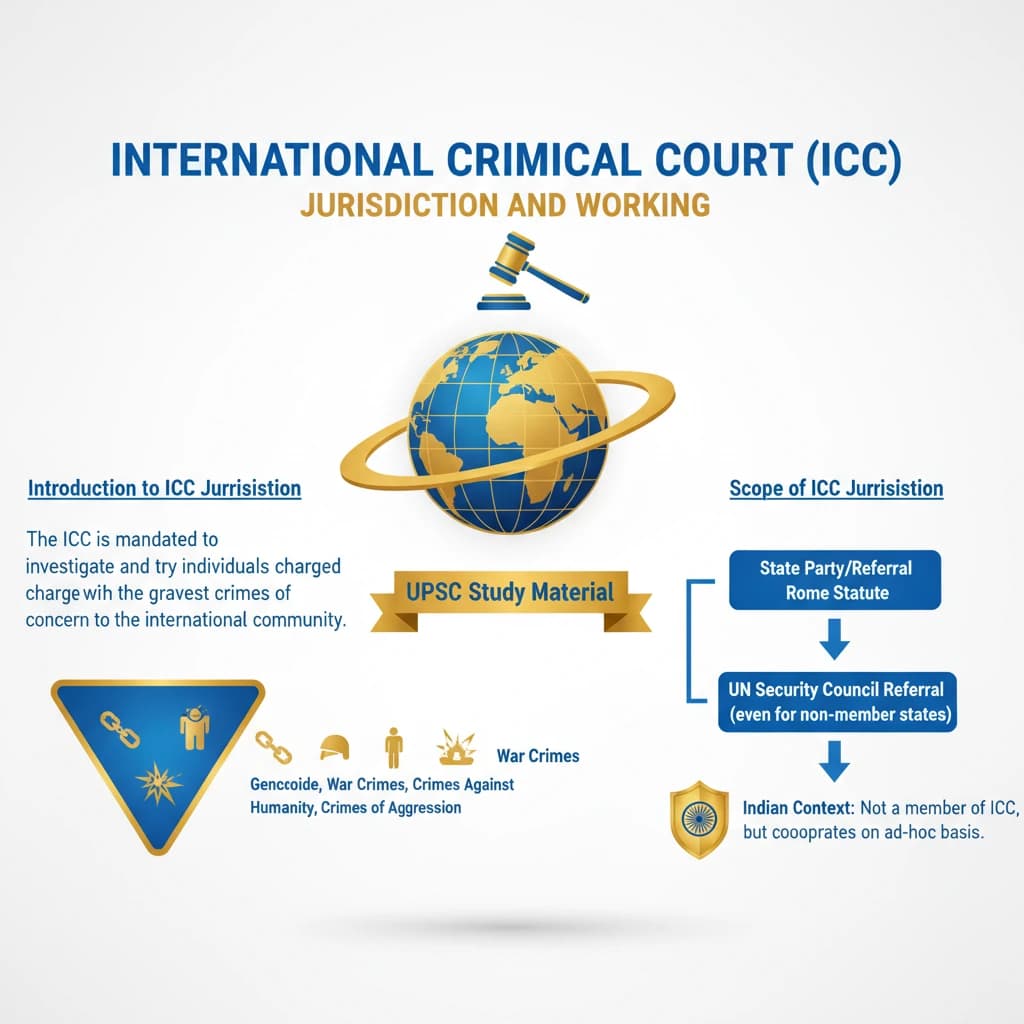
<h4>Introduction to ICC Jurisdiction</h4><p>The <strong>International Criminal Court (ICC)</strong> is a permanent international court that investigates and prosecutes individuals for the gravest crimes of concern to the international community. Its jurisdiction is specifically defined to ensure it acts as a court of last resort.</p><p>The ICC aims to hold individuals accountable for heinous acts, ensuring that justice is served where national systems fail.</p><h4>Crimes Under ICC Jurisdiction</h4><p>The ICC has jurisdiction over four core international crimes. These are considered the most serious offenses impacting global peace and security.</p><div class='info-box'><ul><li><strong>Genocide:</strong> Acts committed with intent to destroy, in whole or in part, a national, ethnical, racial or religious group.</li><li><strong>War Crimes:</strong> Grave breaches of the Geneva Conventions and other serious violations of the laws and customs applicable in international armed conflict and non-international armed conflict.</li><li><strong>Crimes Against Humanity:</strong> Widespread or systematic attacks directed against any civilian population, such as murder, extermination, enslavement, deportation, imprisonment, torture, rape, persecution, and other inhumane acts.</li><li><strong>Crimes of Aggression:</strong> The planning, preparation, initiation or execution of an act of aggression which, by its character, gravity and scale, constitutes a manifest violation of the UN Charter.</li></ul></div><h4>Conditions for Exercising Jurisdiction</h4><p>The ICC's ability to act is not universal and depends on specific conditions related to the accused or the location of the crime. This ensures respect for state sovereignty while addressing severe international crimes.</p><div class='key-point-box'><p>The ICC can exercise its jurisdiction if:</p><ul><li>The crimes are committed by a <strong>State Party national</strong> (a national of a country that has ratified the <strong>Rome Statute</strong>).</li><li>The crimes are committed in the <strong>territory of a State Party</strong>, regardless of the nationality of the perpetrator.</li><li>The crimes are committed in a <strong>State that has accepted the jurisdiction of the court</strong> through a special declaration, even if it is not a State Party.</li></ul></div><h4>Referral Mechanisms to the ICC</h4><p>Cases can be brought before the ICC through different avenues, highlighting the interplay between international political bodies and judicial processes.</p><ul><li>The <strong>United Nations Security Council (UNSC)</strong> can refer situations to the <strong>International Criminal Court Prosecutor</strong>. This is done pursuant to a resolution adopted under <strong>Chapter VII of the UN Charter</strong>, which deals with threats to peace, breaches of the peace, and acts of aggression.</li><li>A <strong>State Party</strong> can refer a situation to the Prosecutor.</li><li>The <strong>ICC Prosecutor</strong> can initiate an investigation <em>proprio motu</em> (on their own initiative) with the authorization of the Pre-Trial Chamber.</li></ul><h4>Complementary Role of the ICC</h4><p>The ICC operates on the principle of <strong>complementarity</strong>. This means it is not intended to replace national criminal justice systems but rather to support them.</p><p>The Court prosecutes cases only when national judicial systems are genuinely <strong>unwilling or unable</strong> to investigate or prosecute such crimes themselves. This ensures that states retain primary responsibility for prosecuting serious international crimes.</p><h4>ICC's Relationship with the United Nations</h4><p>While often associated with the UN, the ICC maintains an independent status. This separation ensures its judicial impartiality.</p><div class='info-box'><p>The <strong>ICC is not a UN organisation</strong>. It is an independent international organization with international legal personality.</p><p>However, it has a <strong>cooperation agreement with the UN</strong>, facilitating mutual assistance and information sharing, especially concerning UNSC referrals.</p></div><h4>UNSC's Power to Grant Jurisdiction</h4><p>The <strong>UN Security Council</strong> possesses a unique power to extend the ICC's reach. This can be crucial in situations where direct jurisdiction might otherwise be lacking.</p><p>When a situation is not initially within the Court’s jurisdiction based on the criteria of State Party nationality or territory, the <strong>UNSC can refer the situation to the International Criminal Court</strong>, thereby <strong>granting it jurisdiction</strong> over that specific situation.</p><h4>States Not Accepting ICC Jurisdiction</h4><p>Despite the ICC's mandate, several significant global powers do not accept its jurisdiction. This poses challenges to its universal applicability and effectiveness.</p><div class='exam-tip-box'><p>It is crucial to note that several prominent countries, including <strong>Israel</strong>, the <strong>United States (US)</strong>, <strong>Russia</strong>, and <strong>China</strong>, do not accept the Court’s jurisdiction over war crimes, genocide, and other crimes. Understanding their reasons (e.g., concerns over sovereignty, potential political weaponization) is important for UPSC answers.</p></div>
Concept Diagram

💡 Key Takeaways

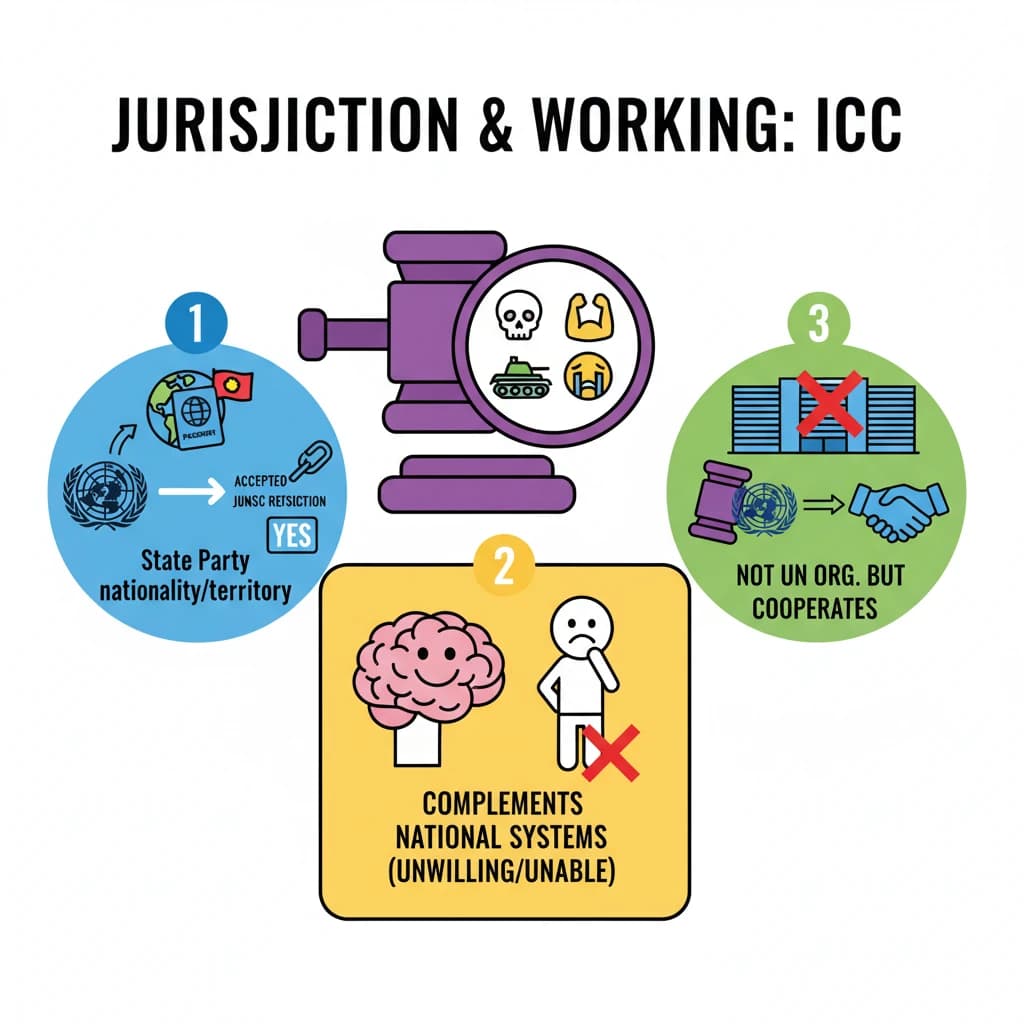
  • •The ICC prosecutes individuals for genocide, war crimes, crimes against humanity, and crimes of aggression.
  • •Jurisdiction applies to State Party nationals, crimes in State Party territory, or situations referred by the UNSC.
  • •It operates on the principle of complementarity, acting only when national courts are unwilling or unable.
  • •The ICC is independent of the UN but has a cooperation agreement; UNSC can grant it jurisdiction.
  • •Major powers like the US, China, and Russia do not accept the ICC's jurisdiction, posing challenges to its universality.

🧠 Memory Techniques
Memory Aid
98% Verified Content

📚 Reference Sources

•Rome Statute of the International Criminal Court
•Official website of the International Criminal Court (icc-cpi.int)
•United Nations Charter (Chapter VII)

Related Topics

Loading related topics...
Explore:International Relations Topics·All Subjects·Daily Current Affairs·Editorial Analysis·Previous Year Questions·UPSC GPT