Loading page, please wait…
Vaidra Logo
Vaidra

Top 4 items + smart groups

UPSC GPT
New
Current Affairs
Daily Solutions
Daily Puzzle
Mains Evaluator

Version 2.0.0 • Built with ❤️ for UPSC aspirants

Loading...
Loading...
Loading...
Loading...
Loading...
Loading...
Loading...
Loading...
Loading...
Loading...
Loading...
Loading...
Loading...
Back
All Subjects

Topics

0 topics • 0 completed

Loading topics...
Loading...
Loading...
Loading...
Loading...
Loading...
Overall Progress0%
FMR Review: Security Concerns - Infiltration, Drugs, Insurgency - UPSC International Relations

FMR Review: Security Concerns - Infiltration, Drugs, Insurgency - UPSC International Relations

What is FMR Review: Security Concerns - Infiltration, Drugs, Insurgency in UPSC International Relations?

FMR Review: Security Concerns - Infiltration, Drugs, Insurgency is a key topic under International Relations for UPSC Civil Services Examination. Key points include: Reconsideration of FMR driven by security, socio-economic, and regional concerns.. Increased infiltration of illegal immigrants (Chin, Naga, Rohingyas) strains resources and impacts demographics.. Porous border facilitates drug trafficking (e.g., Manipur NDPS cases) and arms smuggling, threatening internal security.. Understanding this topic is essential for both UPSC Prelims and Mains preparation.

Why is FMR Review: Security Concerns - Infiltration, Drugs, Insurgency important for UPSC exam?

FMR Review: Security Concerns - Infiltration, Drugs, Insurgency is a Medium-level topic in UPSC International Relations. It is tested in both Prelims (factual MCQs) and Mains (analytical answer writing). Previous year UPSC questions have frequently covered aspects of FMR Review: Security Concerns - Infiltration, Drugs, Insurgency, making it essential for comprehensive IAS preparation.

How to prepare FMR Review: Security Concerns - Infiltration, Drugs, Insurgency for UPSC?

To prepare FMR Review: Security Concerns - Infiltration, Drugs, Insurgency for UPSC: (1) Study the comprehensive notes covering all key concepts on Vaidra. (2) Practice previous year questions on this topic. (3) Connect it with current affairs using daily updates. (4) Revise using key takeaways and mind maps available for International Relations. (5) Write practice answers linking FMR Review: Security Concerns - Infiltration, Drugs, Insurgency to related GS Paper topics.

Key takeaways of FMR Review: Security Concerns - Infiltration, Drugs, Insurgency for UPSC

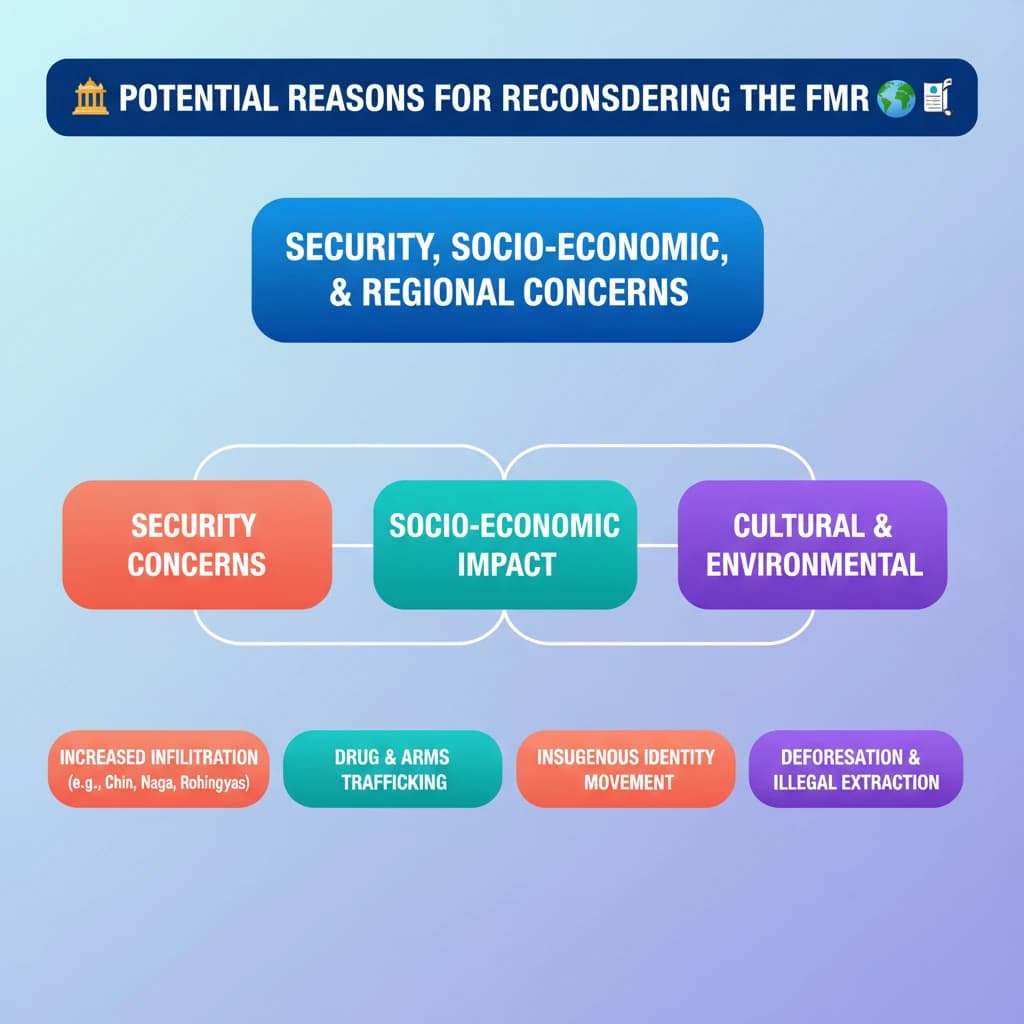
  • Reconsideration of FMR driven by security, socio-economic, and regional concerns.
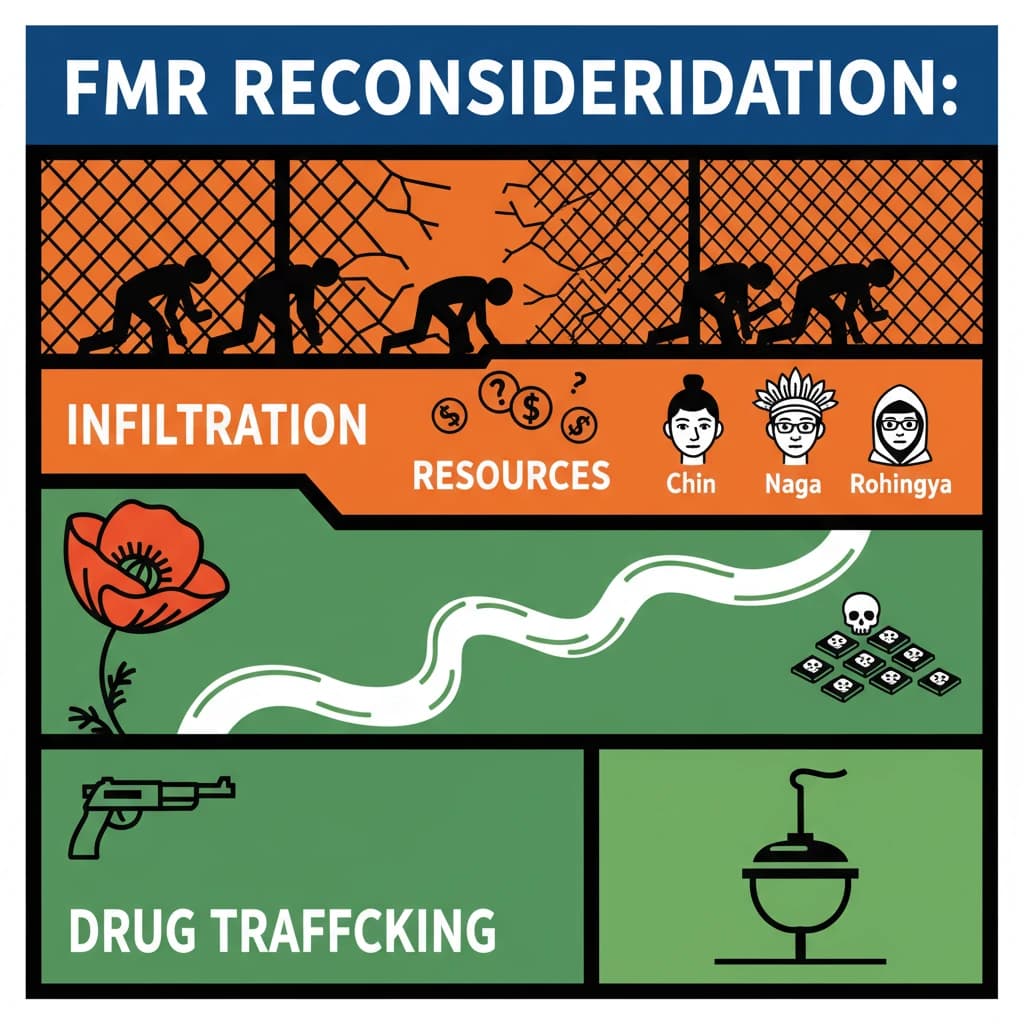
  • Increased infiltration of illegal immigrants (Chin, Naga, Rohingyas) strains resources and impacts demographics.
  • Porous border facilitates drug trafficking (e.g., Manipur NDPS cases) and arms smuggling, threatening internal security.
  • Insurgent groups (KNO, KCP-Lamphel) exploit FMR for cross-border movement and evasion.
  • Concerns exist over dilution of indigenous cultural identity and environmental degradation (deforestation, illegal extraction).
  • China's growing influence in Myanmar adds a geopolitical dimension to border security challenges.
FMR Review: Security Concerns - Infiltration, Drugs, Insurgency

FMR Review: Security Concerns - Infiltration, Drugs, Insurgency

Medium⏱️ 7 min read✓ 95% Verified
international relations

📖 Introduction

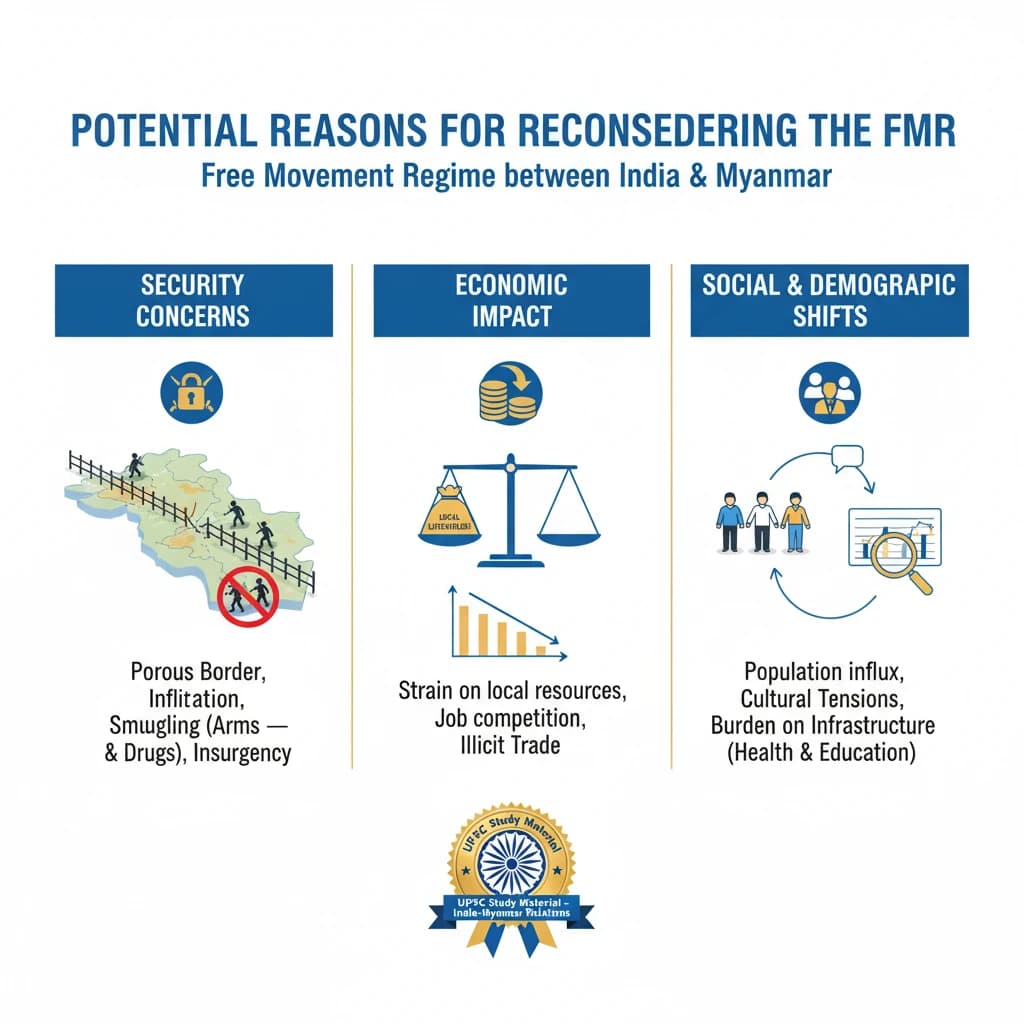
<h4>Potential Reasons for Reconsidering the Free Movement Regime (FMR)</h4><p>The <strong>Free Movement Regime (FMR)</strong>, a unique arrangement between <strong>India</strong> and <strong>Myanmar</strong>, is currently under scrutiny. Several pressing concerns necessitate a re-evaluation of its continued implementation along the shared border.</p><h4>Security Concerns</h4><p>The porous nature of the <strong>India-Myanmar border</strong>, facilitated by the FMR, has raised significant security challenges for India's northeastern states. These issues directly impact national security and regional stability.</p><h4>Increased Infiltration</h4><p>There are growing concerns regarding the influx of <strong>illegal immigrants</strong> into India. Communities such as the <strong>Chin</strong> and <strong>Naga</strong>, along with <strong>Rohingyas</strong>, are migrating from <strong>Myanmar</strong>.</p><p>This unchecked migration places a considerable strain on local resources and significantly impacts the demographic balance in border regions, leading to potential social unrest.</p><h4>Drug Trafficking and Arms Smuggling</h4><p>The open border is frequently exploited for the illegal movement of contraband. This includes widespread <strong>drug trafficking</strong> and the smuggling of <strong>weapons</strong>, which poses a severe threat to India's internal security.</p><p>These illicit activities fuel crime within the border states and destabilize the region. The flow of narcotics, in particular, has devastating social consequences.</p><div class='info-box'><p><strong>Factual Data: Drug Cases in Manipur</strong></p><ul><li>In <strong>2022</strong>, <strong>Manipur</strong> recorded <strong>500 cases</strong> filed under the <strong>Narcotic Drugs and Psychotropic Substances (NDPS) Act</strong>.</li><li>A total of <strong>625 individuals</strong> were arrested in connection with these drug-related offenses, according to data from the Chief Minister’s Office.</li></ul></div><h4>Insurgency Activities</h4><p>The FMR has been consistently misused by various <strong>insurgent groups</strong> operating in <strong>northeastern India</strong>. The ease of cross-border movement allows them to evade capture by Indian security forces.</p><p>These groups exploit the FMR to establish hideouts, procure arms, and conduct cross-border operations, complicating counter-insurgency efforts.</p><div class='info-box'><p><strong>Examples of Insurgent Groups Misusing FMR:</strong></p><ul><li><strong>Kuki National Organisation (KNO)</strong> in <strong>Manipur</strong>.</li><li><strong>Kangleipak Communist Party-Lamphel (KCP-Lamphel)</strong>, also active in <strong>Manipur</strong>.</li></ul></div><h4>Socio-economic and Regional Issues</h4><p>Beyond immediate security concerns, the FMR also presents significant socio-economic and regional challenges that affect the delicate balance of life in border communities.</p><h4>Impact on Cultural Identity</h4><p>Increased migration from <strong>Myanmar</strong> raises concerns about the preservation of <strong>indigenous culture</strong> and <strong>traditions</strong> in India's border areas. Local communities fear the dilution of their unique heritage.</p><p>The demographic changes brought about by migration can lead to social tensions and a loss of distinct cultural identities over time.</p><h4>Environmental Degradation</h4><p>Unregulated cross-border movements are often linked to environmental damage. This includes extensive <strong>deforestation</strong> along the border regions.</p><p>Illegal resource extraction, such as logging and poaching, is also attributed to the ease of movement, leading to significant ecological imbalances.</p><h4>Regional Dynamics</h4><p>The evolving geopolitical landscape adds another layer of complexity. <strong>China's growing influence</strong> in <strong>Myanmar</strong> is a critical factor.</p><p>This increasing influence has potential implications for <strong>India's border security</strong> and regional stability, necessitating a strategic re-evaluation of border policies like the FMR.</p><div class='exam-tip-box'><p><strong>UPSC Insight: Multidimensional Challenge</strong></p><p>When analyzing the FMR, remember it's not just a security issue. It's a complex challenge involving <strong>geopolitics</strong>, <strong>socio-cultural dynamics</strong>, and <strong>environmental concerns</strong>. A holistic approach is key for mains answers.</p></div>
Concept Diagram

💡 Key Takeaways

  • •Reconsideration of FMR driven by security, socio-economic, and regional concerns.
  • •Increased infiltration of illegal immigrants (Chin, Naga, Rohingyas) strains resources and impacts demographics.
  • •Porous border facilitates drug trafficking (e.g., Manipur NDPS cases) and arms smuggling, threatening internal security.
  • •Insurgent groups (KNO, KCP-Lamphel) exploit FMR for cross-border movement and evasion.
  • •Concerns exist over dilution of indigenous cultural identity and environmental degradation (deforestation, illegal extraction).
  • •China's growing influence in Myanmar adds a geopolitical dimension to border security challenges.

🧠 Memory Techniques
Memory Aid
95% Verified Content

📚 Reference Sources

•General knowledge on India-Myanmar Free Movement Regime and border dynamics
•Publicly available reports on NDPS cases in Manipur (as referenced in source)

Related Topics

Loading related topics...
Explore:International Relations Topics·All Subjects·Daily Current Affairs·Editorial Analysis·Previous Year Questions·UPSC GPT