Loading page, please wait…
Vaidra Logo
Vaidra

Top 4 items + smart groups

UPSC GPT
New
Current Affairs
Daily Solutions
Daily Puzzle
Mains Evaluator

Version 2.0.0 • Built with ❤️ for UPSC aspirants

Loading...
Loading...
Loading...
Loading...
Loading...
Loading...
Loading...
Loading...
Loading...
Loading...
Loading...
Loading...
Loading...
G7: Origin, Members, and Significance for International Relations - UPSC International Relations
Back
All Subjects

Topics

0 topics • 0 completed

Loading topics...
Loading...
Loading...
Loading...
Loading...
Loading...
Overall Progress0%

G7: Origin, Members, and Significance for International Relations - UPSC International Relations

What is G7: Origin, Members, and Significance for International Relations in UPSC International Relations?

G7: Origin, Members, and Significance for International Relations is a key topic under International Relations for UPSC Civil Services Examination. Key points include: G7 comprises 7 advanced economies: France, Germany, Italy, Japan, UK, USA, Canada.. It originated from the 1973 Oil Crisis, with the G6 forming in 1975 and Canada joining in 1976.. Russia joined in 1997 (G8) but was expelled in 2014 after annexing Crimea, reverting to G7.. Understanding this topic is essential for both UPSC Prelims and Mains preparation.

Why is G7: Origin, Members, and Significance for International Relations important for UPSC exam?

G7: Origin, Members, and Significance for International Relations is a Medium-level topic in UPSC International Relations. It is tested in both Prelims (factual MCQs) and Mains (analytical answer writing). Previous year UPSC questions have frequently covered aspects of G7: Origin, Members, and Significance for International Relations, making it essential for comprehensive IAS preparation.

How to prepare G7: Origin, Members, and Significance for International Relations for UPSC?

To prepare G7: Origin, Members, and Significance for International Relations for UPSC: (1) Study the comprehensive notes covering all key concepts on Vaidra. (2) Practice previous year questions on this topic. (3) Connect it with current affairs using daily updates. (4) Revise using key takeaways and mind maps available for International Relations. (5) Write practice answers linking G7: Origin, Members, and Significance for International Relations to related GS Paper topics.

Key takeaways of G7: Origin, Members, and Significance for International Relations for UPSC

  • G7 comprises 7 advanced economies: France, Germany, Italy, Japan, UK, USA, Canada.
  • It originated from the 1973 Oil Crisis, with the G6 forming in 1975 and Canada joining in 1976.
  • Russia joined in 1997 (G8) but was expelled in 2014 after annexing Crimea, reverting to G7.
  • It is an informal grouping, operating without treaties or permanent bureaucracy, making decisions by consensus.
  • G7 members collectively control 60% of global net wealth and drive 46% of global GDP, giving it significant global influence.
  • Despite its informal nature, G7 plays a crucial role in coordinating responses to global economic, health, and geopolitical challenges.
G7: Origin, Members, and Significance for International Relations

G7: Origin, Members, and Significance for International Relations

Medium⏱️ 7 min read✓ 95% Verified
international relations

📖 Introduction

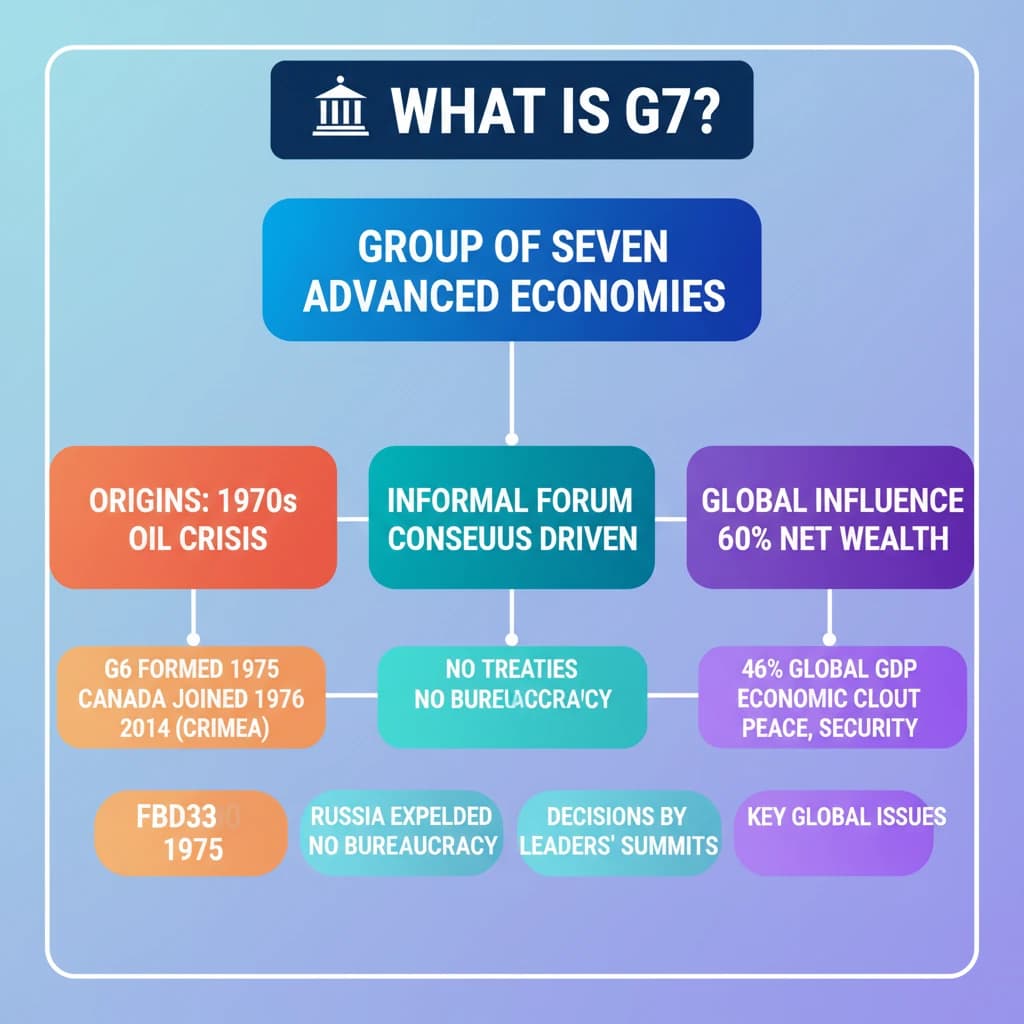
<h4>What is the G7?</h4><p>The <strong>Group of Seven (G7)</strong> is an informal forum comprising seven of the world's most advanced and developed economies. It serves as a platform for its member countries to discuss and coordinate solutions to global issues, particularly economic, security, and environmental challenges.</p><div class='info-box'><p><strong>Core Members:</strong></p><ul><li><strong>France</strong></li><li><strong>Germany</strong></li><li><strong>Italy</strong></li><li><strong>Japan</strong></li><li><strong>The United Kingdom</strong></li><li><strong>The United States</strong></li><li><strong>Canada</strong></li></ul></div><p>Beyond its core members, the G7 also extends invitations to the heads of significant <strong>international organizations</strong>. These invitees participate in discussions, contributing their expertise and perspectives on global governance.</p><div class='info-box'><p><strong>Key International Organizations Invited:</strong></p><ul><li>The <strong>European Union (EU)</strong></li><li>The <strong>International Monetary Fund (IMF)</strong></li><li>The <strong>World Bank</strong></li><li>The <strong>United Nations (UN)</strong></li></ul></div><p><strong>G7 summits</strong> are held annually, providing a regular opportunity for leaders to meet. The hosting responsibility rotates among the member countries, ensuring shared leadership and diverse perspectives on the agenda.</p><h4>Origin of the G7</h4><p>The G7's inception was a direct response to a major global economic upheaval. The <strong>Oil Crisis of 1973</strong>, coupled with a subsequent financial crisis, highlighted the need for major industrial nations to coordinate their economic policies.</p><div class='key-point-box'><p><strong>Foundational Event:</strong> The <strong>1973 Oil Crisis</strong> and subsequent financial instability prompted the creation of the G7.</p></div><p>In <strong>1975</strong>, the leaders of six major industrial nations convened for the first time. This initial grouping was known as the <strong>G6</strong>, laying the groundwork for future collaboration.</p><div class='info-box'><p><strong>Original G6 Members (1975):</strong></p><ul><li><strong>United States</strong></li><li><strong>United Kingdom</strong></li><li><strong>France</strong></li><li><strong>West Germany</strong></li><li><strong>Japan</strong></li><li><strong>Italy</strong></li></ul></div><p>The group expanded in <strong>1976</strong> when <strong>Canada</strong> joined, transforming the <strong>G6</strong> into the <strong>G7</strong>. This marked the stable composition of the group for many years.</p><p>Later, in <strong>1997</strong>, <strong>Russia</strong> was invited to join, leading to the formation of the <strong>G8</strong>. However, this expanded format was not permanent.</p><p>In <strong>2014</strong>, <strong>Russia</strong> was expelled from the group following its <strong>annexation of the Crimea region of Ukraine</strong>. This event led to the group reverting to its original <strong>G7</strong> format, which it maintains today.</p><h4>Nature of the G7 Grouping</h4><p>The <strong>G7</strong> is characterized by its informal structure. It operates without formal treaties or a permanent bureaucratic apparatus, distinguishing it from traditional international organizations.</p><div class='key-point-box'><p><strong>Informal Grouping:</strong> The G7 functions outside formal treaties and lacks a permanent bureaucracy. Each member nation takes turns leading discussions.</p></div><p>Decisions within the <strong>G7</strong> are reached through <strong>consensus</strong> among its members. While these decisions are not legally binding, they carry significant weight due to the economic and political influence of the member states.</p><p>Despite its lack of direct legislative power, the <strong>G7's pronouncements</strong> and coordinated actions can profoundly influence international policies. Their agreements often shape global agendas and set precedents for multilateral cooperation.</p><h4>Significance and Global Impact</h4><p>The collective economic strength of the <strong>G7 nations</strong> gives the group considerable influence on the global stage. Their combined resources and policy coordination efforts have far-reaching implications for international trade, finance, and development.</p><div class='info-box'><p><strong>G7's Global Economic Footprint:</strong></p><ul><li>Controls approximately <strong>60% of global net wealth</strong>.</li><li>Drives about <strong>46% of global GDP</strong>.</li><li>Represents roughly <strong>10% of the world’s population</strong>.</li></ul></div><div class='exam-tip-box'><p>For <strong>UPSC Mains (GS-II)</strong>, understanding the <strong>G7's informal nature</strong> and its <strong>influence through consensus</strong> is crucial. Be prepared to discuss how such groupings impact global governance without formal legal backing.</p></div>
Concept Diagram

💡 Key Takeaways

  • •G7 comprises 7 advanced economies: France, Germany, Italy, Japan, UK, USA, Canada.
  • •It originated from the 1973 Oil Crisis, with the G6 forming in 1975 and Canada joining in 1976.
  • •Russia joined in 1997 (G8) but was expelled in 2014 after annexing Crimea, reverting to G7.
  • •It is an informal grouping, operating without treaties or permanent bureaucracy, making decisions by consensus.
  • •G7 members collectively control 60% of global net wealth and drive 46% of global GDP, giving it significant global influence.
  • •Despite its informal nature, G7 plays a crucial role in coordinating responses to global economic, health, and geopolitical challenges.

🧠 Memory Techniques

Memory Aid
95% Verified Content

Related Topics

Loading related topics...
Explore:International Relations Topics·All Subjects·Daily Current Affairs·Editorial Analysis·Previous Year Questions·UPSC GPT