Loading page, please wait…
Vaidra Logo
Vaidra

Top 4 items + smart groups

UPSC GPT
New
Current Affairs
Daily Solutions
Daily Puzzle
Mains Evaluator

Version 2.0.0 • Built with ❤️ for UPSC aspirants

Loading...
Loading...
Loading...
Loading...
Loading...
Loading...
Loading...
Loading...
Loading...
Loading...
Loading...
Loading...
Loading...
Back
All Subjects

Topics

0 topics • 0 completed

Loading topics...
Loading...
Loading...
Loading...
Loading...
Loading...
Overall Progress0%

What are the Reasons for the Iran-Israel Conflict? - UPSC International Relations

What is What are the Reasons for the Iran-Israel Conflict? in UPSC International Relations?

What are the Reasons for the Iran-Israel Conflict? is a key topic under International Relations for UPSC Civil Services Examination. Key points include: The Iran-Israel conflict is a complex geopolitical rivalry rooted in historical, religious, and ideological differences.. The 1979 Iranian Revolution marked a pivotal shift from a covert alliance to open hostility.. Key drivers include Iran's support for Palestinian groups (Hamas, Hezbollah), geopolitical competition in Syria and Yemen, and Israel's concerns over Iran's nuclear program.. Understanding this topic is essential for both UPSC Prelims and Mains preparation.

Why is What are the Reasons for the Iran-Israel Conflict? important for UPSC exam?

What are the Reasons for the Iran-Israel Conflict? is a Medium-level topic in UPSC International Relations. It is tested in both Prelims (factual MCQs) and Mains (analytical answer writing). Previous year UPSC questions have frequently covered aspects of What are the Reasons for the Iran-Israel Conflict?, making it essential for comprehensive IAS preparation.

How to prepare What are the Reasons for the Iran-Israel Conflict? for UPSC?

To prepare What are the Reasons for the Iran-Israel Conflict? for UPSC: (1) Study the comprehensive notes covering all key concepts on Vaidra. (2) Practice previous year questions on this topic. (3) Connect it with current affairs using daily updates. (4) Revise using key takeaways and mind maps available for International Relations. (5) Write practice answers linking What are the Reasons for the Iran-Israel Conflict? to related GS Paper topics.

Key takeaways of What are the Reasons for the Iran-Israel Conflict? for UPSC

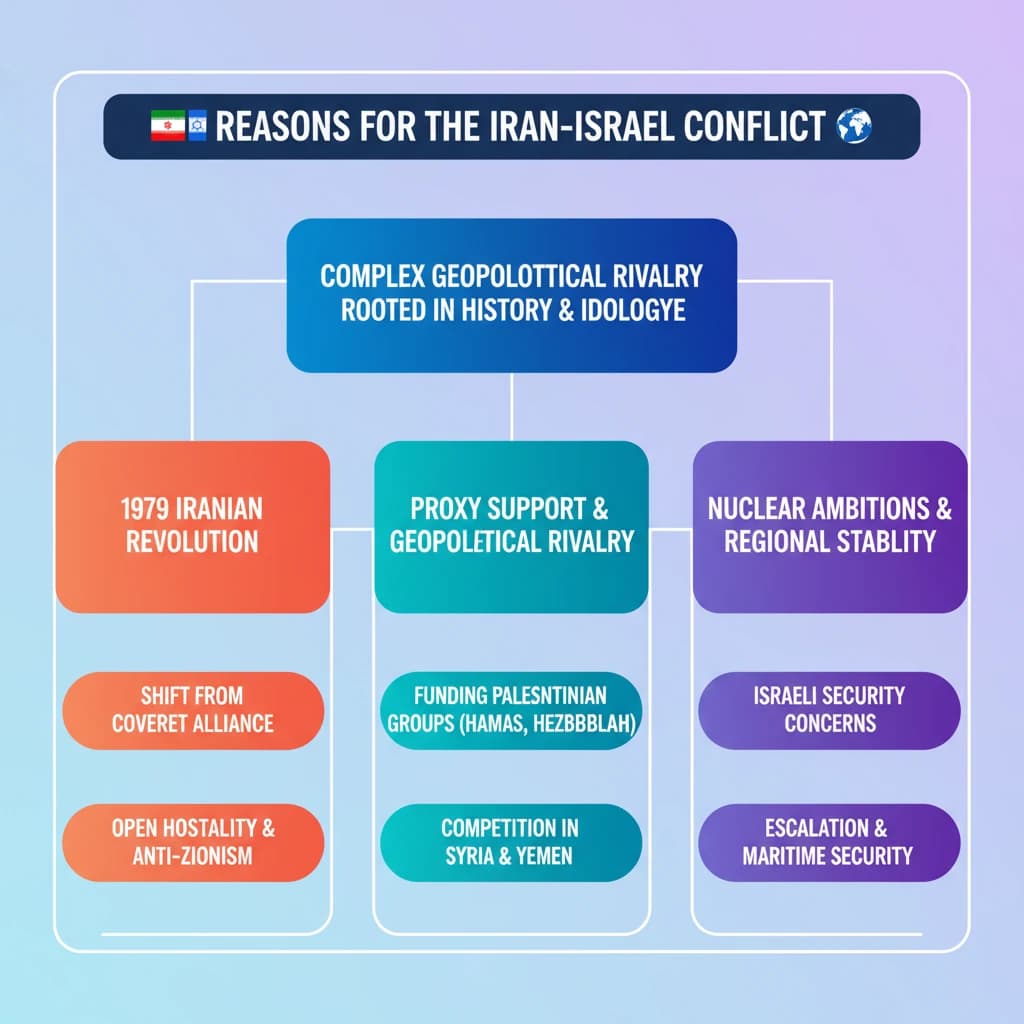
  • The Iran-Israel conflict is a complex geopolitical rivalry rooted in historical, religious, and ideological differences.
  • The 1979 Iranian Revolution marked a pivotal shift from a covert alliance to open hostility.
  • Key drivers include Iran's support for Palestinian groups (Hamas, Hezbollah), geopolitical competition in Syria and Yemen, and Israel's concerns over Iran's nuclear program.
  • Recent direct military exchanges, like Iran's April 2024 strikes, signify a dangerous escalation from traditional proxy warfare.
  • The conflict poses significant risks to regional stability, maritime security in the Gulf, and international efforts for nuclear non-proliferation.
What are the Reasons for the Iran-Israel Conflict?

What are the Reasons for the Iran-Israel Conflict?

Medium⏱️ 8 min read✓ 95% Verified
international relations

📖 Introduction

<h4>Recent Escalation: Iran's Attacks on Israel</h4><p>In a significant escalation, <strong>Iran</strong> launched over <strong>300 projectiles</strong> against <strong>Israel</strong>. These included a combination of <strong>drones, cruise missiles, and ballistic missiles</strong>, marking a direct military engagement between the two nations.</p><div class='info-box'><p>This large-scale attack by <strong>Iran</strong> was widely perceived as direct retaliation for a previous deadly strike. The strike targeted <strong>Iran’s consulate in Damascus, Syria</strong>, which resulted in significant casualties.</p></div><p>The immediate aftermath of this escalation has led to increased tensions. It has also created an additional risk of <strong>piracy and hostage-taking</strong> within the critical <strong>Gulf region</strong>, impacting global maritime security.</p><h4>Historical Roots of Hostility</h4><p>The relationship between <strong>Iran</strong> and <strong>Israel</strong> has been profoundly tumultuous for decades. A pivotal turning point was the <strong>Iranian Revolution of 1979</strong>, which fundamentally reshaped Iran's political and ideological landscape.</p><div class='info-box'><p>Before <strong>1979</strong>, <strong>Iran</strong>, under the rule of the <strong>Shah</strong>, maintained a relatively close alliance with <strong>Israel</strong>. The revolution transformed <strong>Iran</strong> into an <strong>Islamic Republic</strong>, adopting an openly hostile stance towards <strong>Israel</strong>.</p></div><h4>Religious and Ideological Divide</h4><p>At the core of the conflict lie deep-seated <strong>religious and ideological differences</strong>. <strong>Iran</strong> is constitutionally an <strong>Islamic Republic</strong>, primarily governed by the principles of <strong>Shia Islam</strong>.</p><p>Conversely, <strong>Israel</strong> defines itself as a <strong>predominantly Jewish state</strong>. These contrasting foundational identities contribute significantly to their mutual distrust and animosity.</p><h4>The Israeli-Palestinian Conflict Dimension</h4><p><strong>Iran's unwavering support</strong> for <strong>Palestinian causes</strong> is a major flashpoint. This includes substantial backing for various militant groups operating in the region.</p><ul><li><strong>Hamas:</strong> A Palestinian Sunni-Islamist fundamentalist organization.</li><li><strong>Hezbollah:</strong> A Shia Islamist political party and militant group based in Lebanon.</li></ul><div class='key-point-box'><p>Both <strong>Hamas</strong> and <strong>Hezbollah</strong> are designated as <strong>terrorist organizations</strong> by <strong>Israel</strong>, the <strong>United States</strong>, and several other Western nations. Iran's support for these groups directly challenges Israel's security interests.</p></div><h4>Geopolitical Rivalry and Regional Influence</h4><p><strong>Iran</strong> and <strong>Israel</strong> are formidable <strong>regional rivals</strong>, actively vying for influence across the <strong>Middle East</strong>. Their competing strategic interests fuel numerous proxy conflicts.</p><p>Key regional conflicts where their interests clash include the <strong>civil wars in Syria and Yemen</strong>. These theatres demonstrate their opposing objectives and alliances.</p><ul><li>In <strong>Syria</strong>, <strong>Iran</strong> strongly supports the <strong>Assad regime</strong>, providing military and financial aid.</li><li>In <strong>Yemen</strong>, <strong>Iran</strong> backs the <strong>Houthi rebels</strong>, who control significant parts of the country.</li></ul><div class='exam-tip-box'><p><strong>UPSC Insight:</strong> Understanding these proxy conflicts is crucial for analyzing the broader <strong>Middle East geopolitics</strong>, often appearing in <strong>GS Paper 2 (International Relations)</strong> questions.</p></div><p><strong>Israel</strong>, on the other hand, actively opposes <strong>Iranian influence</strong> in these countries. It views Iran's expansion as a direct threat to its national security and regional stability.</p><h4>Iran's Nuclear Program</h4><p><strong>Iran's nuclear program</strong> remains a significant point of contention. <strong>Israel</strong> has been an exceptionally vocal critic of the <strong>Iran nuclear deal</strong>, formally known as the <strong>Joint Comprehensive Plan of Action (JCPOA)</strong>.</p><div class='info-box'><p><strong>Israel</strong> views a nuclear-armed <strong>Iran</strong> as an existential threat. It has taken proactive measures, including alleged <strong>covert operations</strong>, to disrupt and delay <strong>Iran’s nuclear activities</strong>.</p></div>
Concept Diagram

💡 Key Takeaways

  • •The Iran-Israel conflict is a complex geopolitical rivalry rooted in historical, religious, and ideological differences.
  • •The 1979 Iranian Revolution marked a pivotal shift from a covert alliance to open hostility.
  • •Key drivers include Iran's support for Palestinian groups (Hamas, Hezbollah), geopolitical competition in Syria and Yemen, and Israel's concerns over Iran's nuclear program.
  • •Recent direct military exchanges, like Iran's April 2024 strikes, signify a dangerous escalation from traditional proxy warfare.
  • •The conflict poses significant risks to regional stability, maritime security in the Gulf, and international efforts for nuclear non-proliferation.

🧠 Memory Techniques
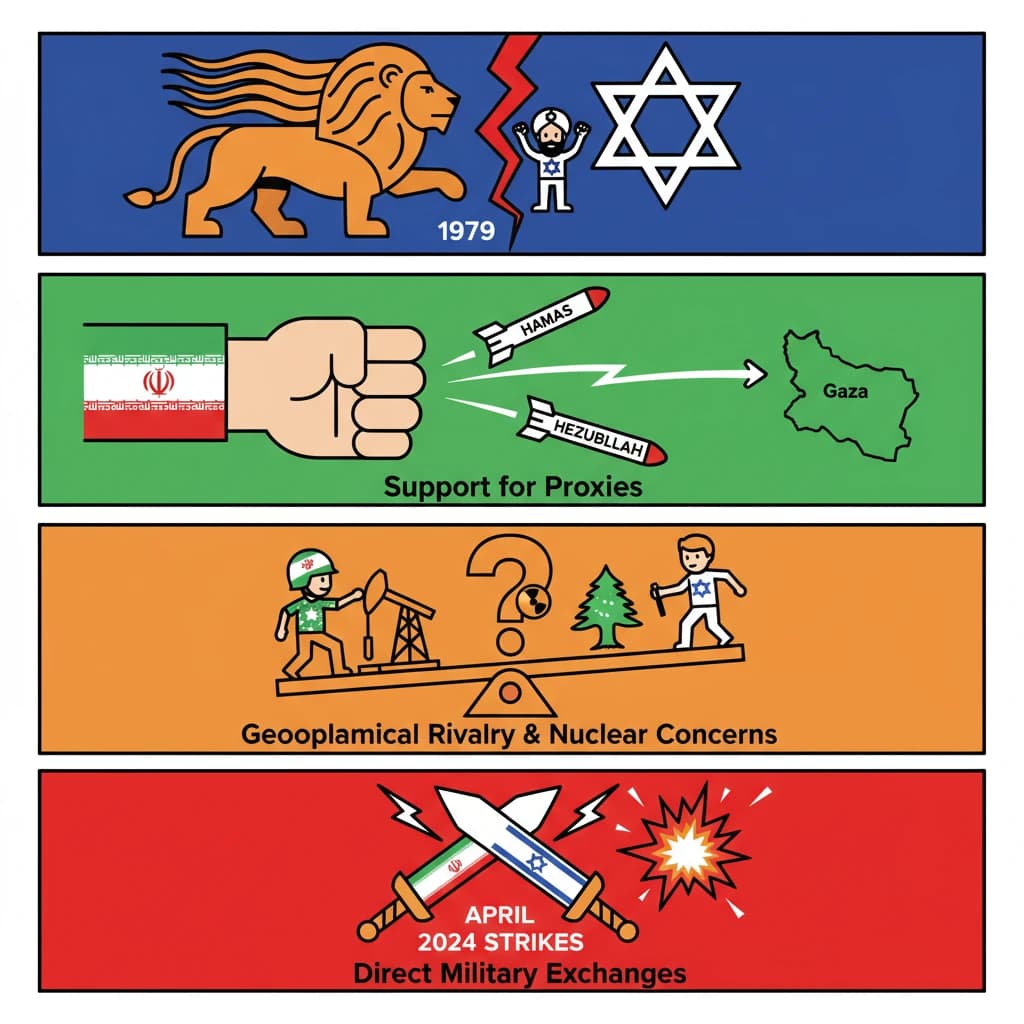
Memory Aid
95% Verified Content

📚 Reference Sources

•Council on Foreign Relations
•International Crisis Group reports
•UN Security Council resolutions (general context)

Related Topics

Loading related topics...
Explore:International Relations Topics·All Subjects·Daily Current Affairs·Editorial Analysis·Previous Year Questions·UPSC GPT
What are the Reasons for the Iran-Israel Conflict? - UPSC International Relations