Loading page, please wait…
Vaidra Logo
Vaidra

Top 4 items + smart groups

UPSC GPT
New
Current Affairs
Daily Solutions
Daily Puzzle
Mains Evaluator

Version 2.0.0 • Built with ❤️ for UPSC aspirants

Loading...
Loading...
Loading...
Loading...
Loading...
Loading...
Loading...
Loading...
Loading...
Loading...
Loading...
Loading...
Loading...
Other US Nonimmigrant Visa Categories - UPSC International Relations
Back
All Subjects

Topics

0 topics • 0 completed

Loading topics...
Loading...
Loading...
Loading...
Loading...
Loading...
Overall Progress0%

Other US Nonimmigrant Visa Categories - UPSC International Relations

What is Other US Nonimmigrant Visa Categories in UPSC International Relations?

Other US Nonimmigrant Visa Categories is a key topic under International Relations for UPSC Civil Services Examination. Key points include: US nonimmigrant visas allow temporary stay for specific purposes.. H-1B visas have cap exemptions for certain employment types (e.g., higher education, nonprofits).. Indians are the largest beneficiaries of H-1B visas (over 70% since 2015), followed by Chinese (12-13%).. Understanding this topic is essential for both UPSC Prelims and Mains preparation.

Why is Other US Nonimmigrant Visa Categories important for UPSC exam?

Other US Nonimmigrant Visa Categories is a Medium-level topic in UPSC International Relations. It is tested in both Prelims (factual MCQs) and Mains (analytical answer writing). Previous year UPSC questions have frequently covered aspects of Other US Nonimmigrant Visa Categories, making it essential for comprehensive IAS preparation.

How to prepare Other US Nonimmigrant Visa Categories for UPSC?

To prepare Other US Nonimmigrant Visa Categories for UPSC: (1) Study the comprehensive notes covering all key concepts on Vaidra. (2) Practice previous year questions on this topic. (3) Connect it with current affairs using daily updates. (4) Revise using key takeaways and mind maps available for International Relations. (5) Write practice answers linking Other US Nonimmigrant Visa Categories to related GS Paper topics.

Key takeaways of Other US Nonimmigrant Visa Categories for UPSC

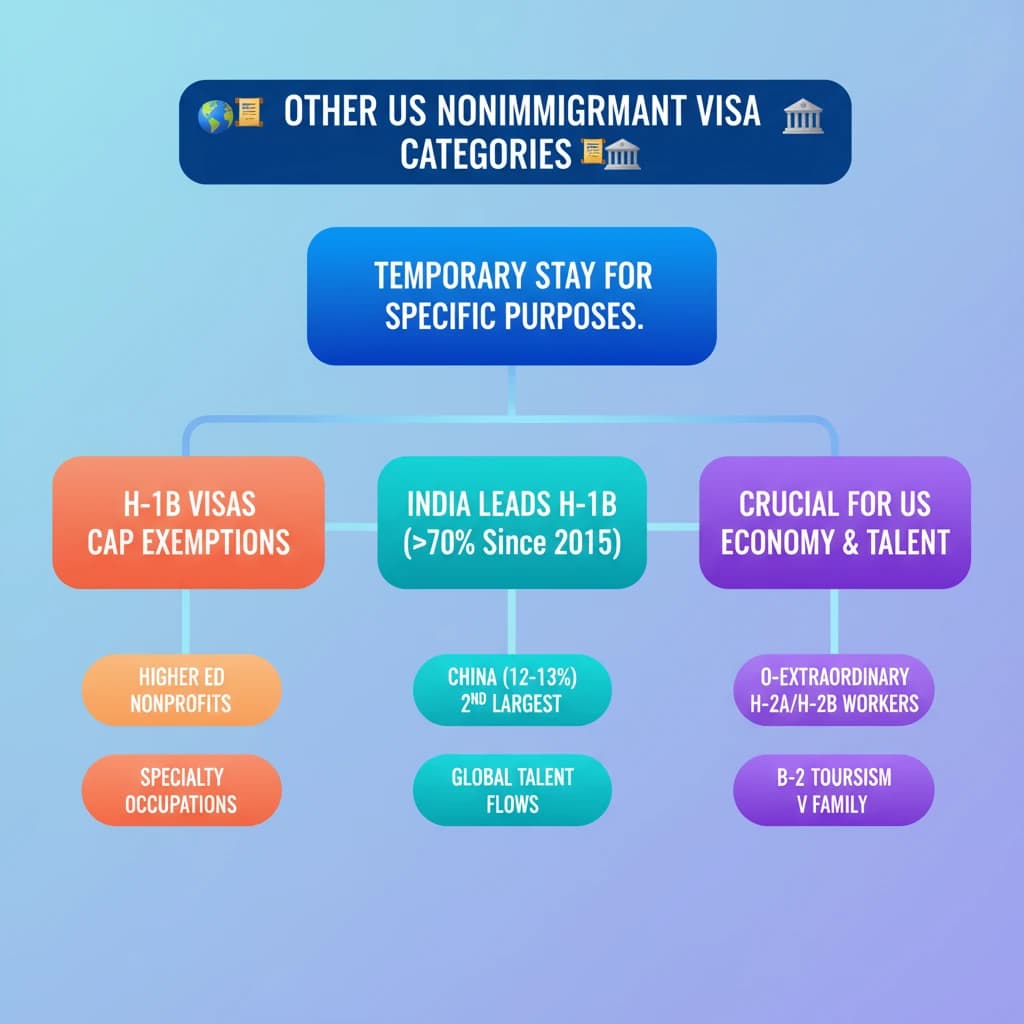
  • US nonimmigrant visas allow temporary stay for specific purposes.
  • H-1B visas have cap exemptions for certain employment types (e.g., higher education, nonprofits).
  • Indians are the largest beneficiaries of H-1B visas (over 70% since 2015), followed by Chinese (12-13%).
  • Other key nonimmigrant visas include O (extraordinary ability), H-2A/H-2B (temporary workers), B-2 (tourism), and V (family reunification).
  • These visas are crucial for U.S. economy, international relations, and global talent management.
Other US Nonimmigrant Visa Categories

Other US Nonimmigrant Visa Categories

Medium⏱️ 8 min read✓ 95% Verified
international relations

📖 Introduction

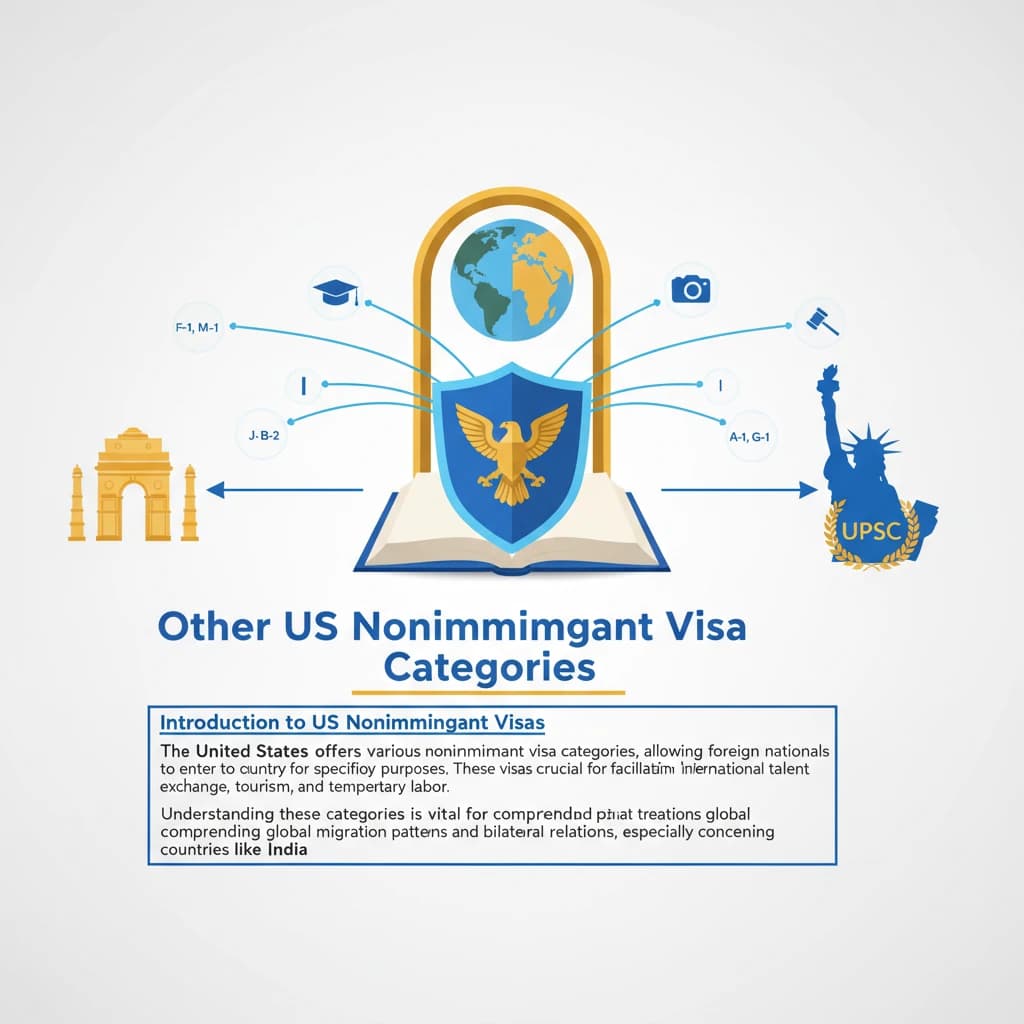
<h4>Introduction to US Nonimmigrant Visas</h4><p>The <strong>United States</strong> offers various <strong>nonimmigrant visa categories</strong>, allowing foreign nationals to enter the country for specific, temporary purposes. These visas are crucial for facilitating international talent exchange, tourism, and temporary labor.</p><p>Understanding these categories is vital for comprehending global migration patterns and bilateral relations, especially concerning countries like <strong>India</strong> and <strong>China</strong>.</p><h4>H-1B Visa Cap Exemptions</h4><p>The <strong>H-1B visa</strong> is a nonimmigrant visa that allows U.S. employers to temporarily employ foreign workers in specialty occupations. While generally subject to an annual cap, certain petitions are exempt from this limit.</p><div class="key-point-box"><p><strong>Cap exemption</strong> applies to petitions for <strong>H-1B visa holders</strong> seeking continued employment. This ensures continuity for existing skilled workers in the U.S. workforce.</p><p>Furthermore, employment at specific institutions also qualifies for exemption. This includes positions at <strong>higher education institutions</strong>, their <strong>affiliated nonprofit organizations</strong>, and <strong>government research organizations</strong>.</p></div><div class="exam-tip-box"><p>UPSC often asks about the nuances of <strong>international agreements</strong> and <strong>migration policies</strong>. Understanding H-1B cap exemptions can be crucial for answering questions on U.S. immigration policy and its impact on India.</p></div><h4>Demographic Trends in H-1B Visas</h4><p>The <strong>H-1B visa program</strong> has significant implications for skilled professionals globally, with specific countries dominating the beneficiary landscape.</p><div class="info-box"><p><strong>Dominance of Indian Beneficiaries:</strong> Since <strong>2015</strong>, individuals born in <strong>India</strong> have consistently been the largest beneficiaries of the <strong>H-1B visa program</strong>. They account for <strong>more than 70%</strong> of all approved H-1B petitions annually.</p><p><strong>China's Contribution:</strong> Individuals born in <strong>China</strong> consistently rank second. Since <strong>2018</strong>, they have made up approximately <strong>12-13%</strong> of all H-1B petitions.</p></div><p>These trends highlight the significant role of Indian and Chinese professionals in the U.S. technology and specialty occupation sectors, reflecting global talent flows.</p><h4>Overview of Other Key Nonimmigrant Visa Categories</h4><p>Beyond the H-1B, the U.S. offers a range of other nonimmigrant visas tailored for diverse purposes of travel and temporary stay.</p><table class="info-table"><tr><th>Visa Category</th><th>Purpose of Travel</th></tr><tr><td><strong>O Visa</strong></td><td>Foreign national with <strong>extraordinary ability</strong> in <strong>Sciences, Arts, Education, Business or Athletics</strong>.</td></tr><tr><td><strong>H-2A Visa</strong></td><td><strong>Temporary agricultural worker</strong>, addressing seasonal labor needs in the agricultural sector.</td></tr><tr><td><strong>H-2B Visa</strong></td><td><strong>Temporary worker</strong> performing other services or labor of a <strong>temporary or seasonal nature</strong>, outside of agriculture.</td></tr><tr><td><strong>B-2 Visa</strong></td><td>For <strong>Tourism, vacation, pleasure visitor</strong>. This is a common visa for short-term personal travel.</td></tr><tr><td><strong>V Visa</strong></td><td><strong>Nonimmigrant Visa</strong> for <strong>Spouse and Children</strong> of a <strong>Lawful Permanent Resident</strong>, allowing family reunification while awaiting immigrant visas.</td></tr></table><p>Each of these categories serves a distinct function in managing the flow of temporary visitors and workers into the United States.</p>
Concept Diagram

💡 Key Takeaways

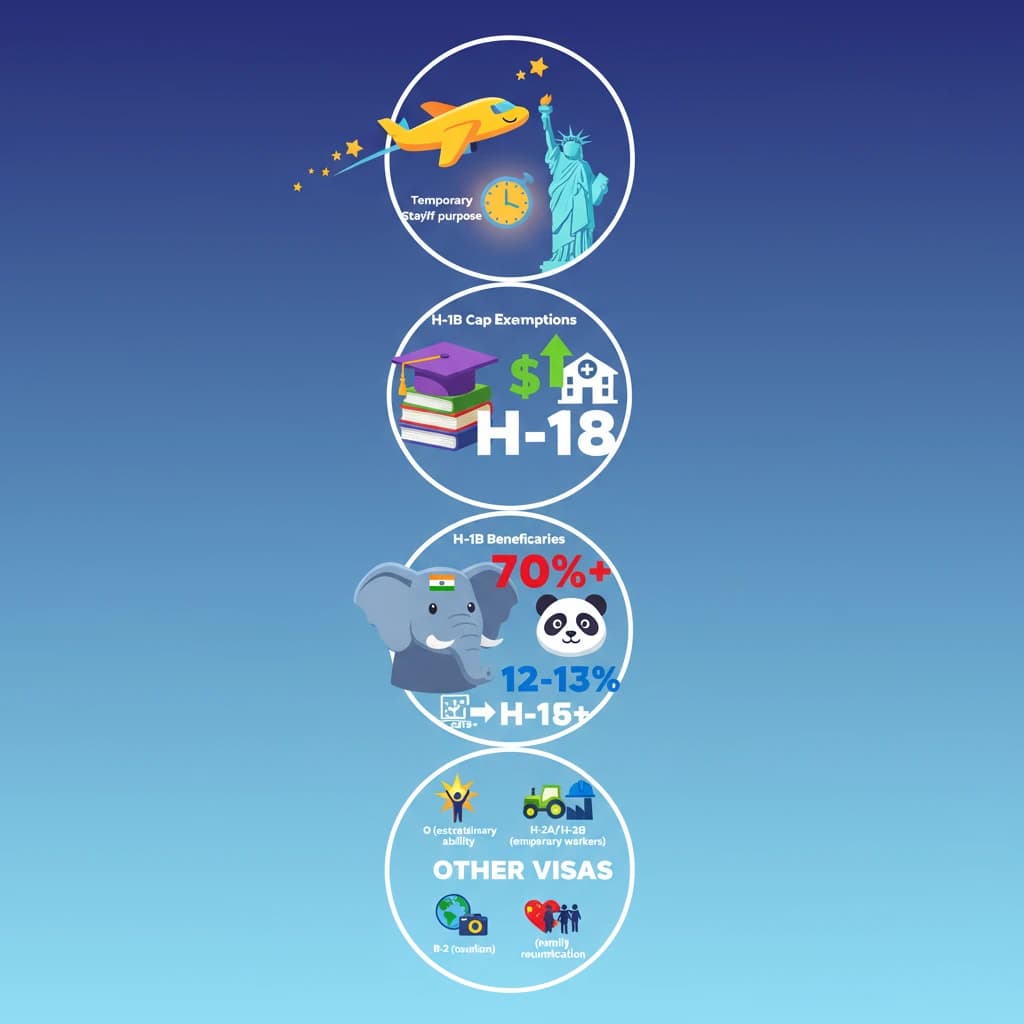
  • •US nonimmigrant visas allow temporary stay for specific purposes.
  • •H-1B visas have cap exemptions for certain employment types (e.g., higher education, nonprofits).
  • •Indians are the largest beneficiaries of H-1B visas (over 70% since 2015), followed by Chinese (12-13%).
  • •Other key nonimmigrant visas include O (extraordinary ability), H-2A/H-2B (temporary workers), B-2 (tourism), and V (family reunification).
  • •These visas are crucial for U.S. economy, international relations, and global talent management.

🧠 Memory Techniques
Memory Aid
95% Verified Content

📚 Reference Sources

•U.S. Citizenship and Immigration Services (USCIS) official website
•U.S. Department of State - Bureau of Consular Affairs website

Related Topics

Loading related topics...
Explore:International Relations Topics·All Subjects·Daily Current Affairs·Editorial Analysis·Previous Year Questions·UPSC GPT