Loading page, please wait…
Vaidra Logo
Vaidra

Top 4 items + smart groups

UPSC GPT
New
Current Affairs
Daily Solutions
Daily Puzzle
Mains Evaluator

Version 2.0.0 • Built with ❤️ for UPSC aspirants

Loading...
Loading...
Loading...
Loading...
Loading...
Loading...
Loading...
Loading...
Loading...
Loading...
Loading...
Loading...
Loading...
Back
All Subjects

Topics

0 topics • 0 completed

Loading topics...
Loading...
Loading...
Loading...
Loading...
Loading...
Overall Progress0%

India’s Neighbourhood First Policy - UPSC International Relations

What is India’s Neighbourhood First Policy in UPSC International Relations?

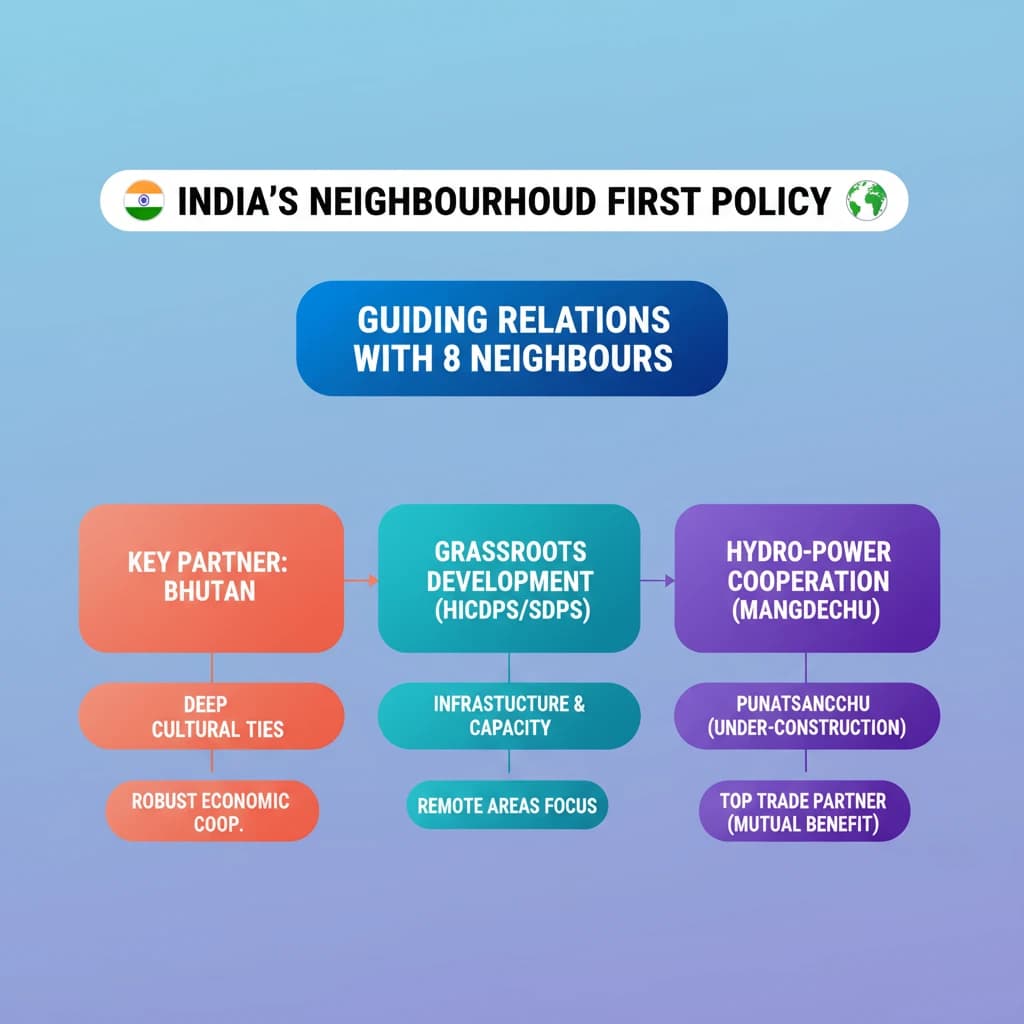
India’s Neighbourhood First Policy is a key topic under International Relations for UPSC Civil Services Examination. Key points include: Neighbourhood First Policy guides India's relations with its 8 immediate neighbours.. Bhutan is a key partner, with deep cultural ties and robust economic cooperation.. HICDPs/SDPs support grassroots development, building infrastructure and capacity in remote Bhutan.. Understanding this topic is essential for both UPSC Prelims and Mains preparation.

Why is India’s Neighbourhood First Policy important for UPSC exam?

India’s Neighbourhood First Policy is a Medium-level topic in UPSC International Relations. It is tested in both Prelims (factual MCQs) and Mains (analytical answer writing). Previous year UPSC questions have frequently covered aspects of India’s Neighbourhood First Policy, making it essential for comprehensive IAS preparation.

How to prepare India’s Neighbourhood First Policy for UPSC?

To prepare India’s Neighbourhood First Policy for UPSC: (1) Study the comprehensive notes covering all key concepts on Vaidra. (2) Practice previous year questions on this topic. (3) Connect it with current affairs using daily updates. (4) Revise using key takeaways and mind maps available for International Relations. (5) Write practice answers linking India’s Neighbourhood First Policy to related GS Paper topics.

Key takeaways of India’s Neighbourhood First Policy for UPSC

  • Neighbourhood First Policy guides India's relations with its 8 immediate neighbours.
  • Bhutan is a key partner, with deep cultural ties and robust economic cooperation.
  • HICDPs/SDPs support grassroots development, building infrastructure and capacity in remote Bhutan.
  • Hydro-power cooperation is a vital pillar, with operational (e.g., Mangdechhu), under-construction (Punatsangchhu), and joint venture (Kholongchhu) projects.
  • India is Bhutan's top trade partner, underscoring strong economic interdependence and mutual benefit.
India’s Neighbourhood First Policy

India’s Neighbourhood First Policy

Medium⏱️ 6 min read✓ 98% Verified
international relations

📖 Introduction

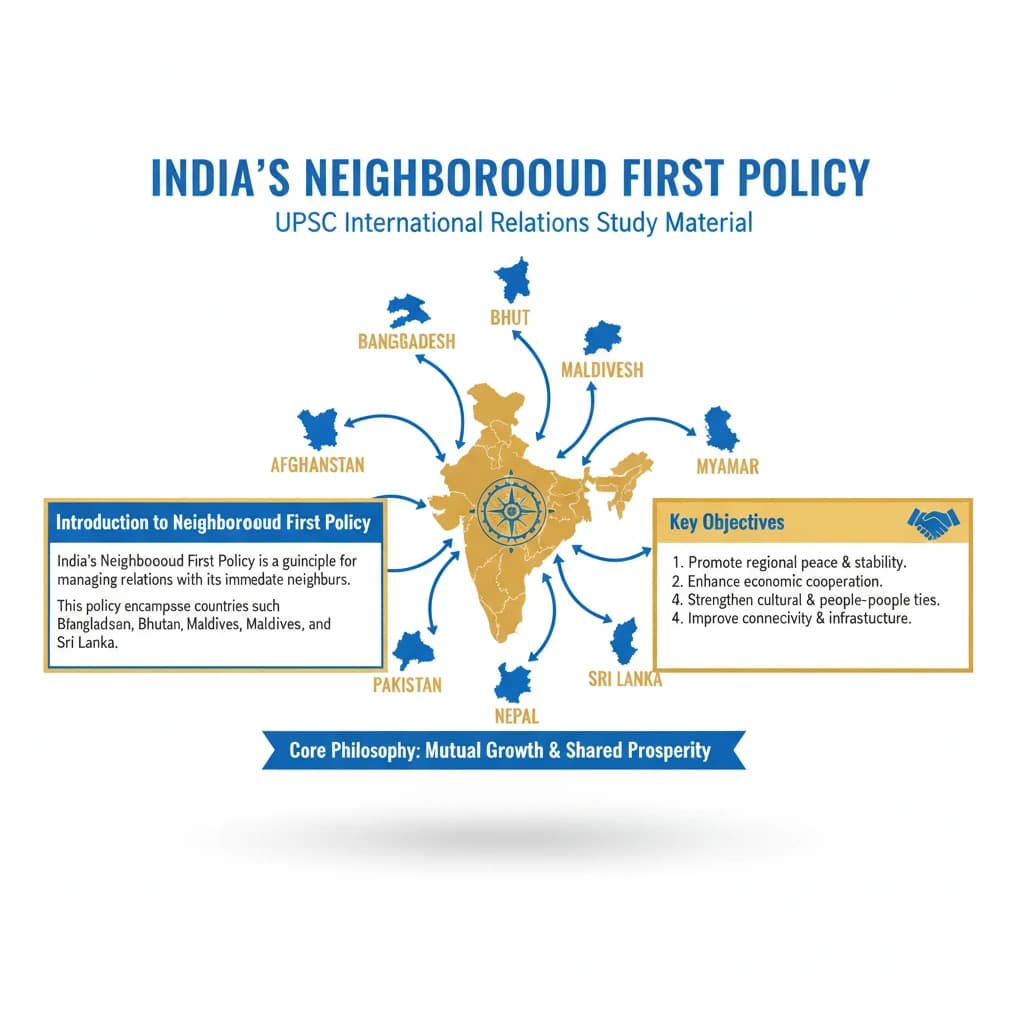
<h4>Introduction to Neighbourhood First Policy</h4><p>India's <strong>Neighbourhood First Policy</strong> is a guiding principle for managing relations with its immediate neighbours.</p><p>This policy encompasses countries such as <strong>Afghanistan</strong>, <strong>Bangladesh</strong>, <strong>Bhutan</strong>, <strong>Maldives</strong>, <strong>Myanmar</strong>, <strong>Nepal</strong>, <strong>Pakistan</strong>, and <strong>Sri Lanka</strong>.</p><div class='key-point-box'><p>The core objective is to foster mutually beneficial and proactive engagement with these nations.</p></div><h4>India-Bhutan Bilateral Relations: A Strong Pillar</h4><p><strong>Bhutan</strong> is a significant partner, characterized by deep civilisational and cultural ties spanning centuries.</p><p>The Bhutanese refer to India as <strong>Gyagar</strong>, meaning 'the holy land,' due to <strong>Buddhism's</strong> origin in India, which is the majority religion in Bhutan.</p><h4>High Impact Community Development Projects (HICDPs)</h4><p>India has committed to supporting grassroots development in Bhutan through <strong>High Impact Community Development Projects (HICDPs)</strong>, also known as <strong>Small Development Projects (SDPs)</strong>.</p><div class='info-box'><ul><li>These are <strong>short-gestation small projects</strong>.</li><li>They are primarily situated in <strong>remote parts of Bhutan</strong>.</li><li>Their aim is to create essential infrastructure and foster <strong>capacity development</strong> at the local level.</li></ul></div><p>Examples of infrastructure include <strong>Farm Roads</strong>, <strong>livestock centres</strong>, and <strong>water supply and irrigation systems</strong>.</p><h4>Hydro-power Cooperation: A Key Economic Pillar</h4><p><strong>Mutually beneficial hydro-power cooperation</strong> is a central element of the bilateral economic relationship between India and Bhutan.</p><p>For Bhutan, hydro-power development serves as a vital catalyst for its <strong>socio-economic development</strong>.</p><div class='info-box'><p>The framework for this cooperation is established under the <strong>2006 inter-governmental cooperation agreement</strong> and its <strong>Protocol signed in 2009</strong>.</p></div><h4>Operational and Under-Implementation Hydroelectric Projects (HEPs)</h4><p>Currently, <strong>four hydroelectric projects (HEPs)</strong> with a combined capacity of <strong>2136 MW</strong> are operational in Bhutan and supply electricity to India.</p><div class='info-box'><ul><li>The <strong>720 MW Mangdechhu project</strong> was commissioned in <strong>August 2019</strong> and formally handed over to Bhutan in <strong>December 2022</strong>.</li></ul></div><p>Two other HEPs, namely <strong>1200 MW Punatsangchhu-I</strong> and <strong>1020 MW Punatsangchhu-II</strong>, are under various stages of implementation in an <strong>Inter-Governmental mode</strong>.</p><h4>Joint Venture Hydro-Project: Kholongchhu</h4><p>India and Bhutan also commissioned their <strong>first-ever joint venture project</strong>, the <strong>500 MW Kholongchhu hydroproject</strong>.</p><div class='key-point-box'><p>This project aims to generate surplus hydroelectricity for Bhutan, which will then be <strong>exported to India</strong>, significantly aiding Bhutan's <strong>revenue generation</strong> and <strong>employment opportunities</strong>.</p></div><h4>Trade Partnership</h4><p>India holds the position of <strong>Bhutan's top trade partner</strong>, serving as both its primary import source and its largest export destination.</p>
Concept Diagram

💡 Key Takeaways

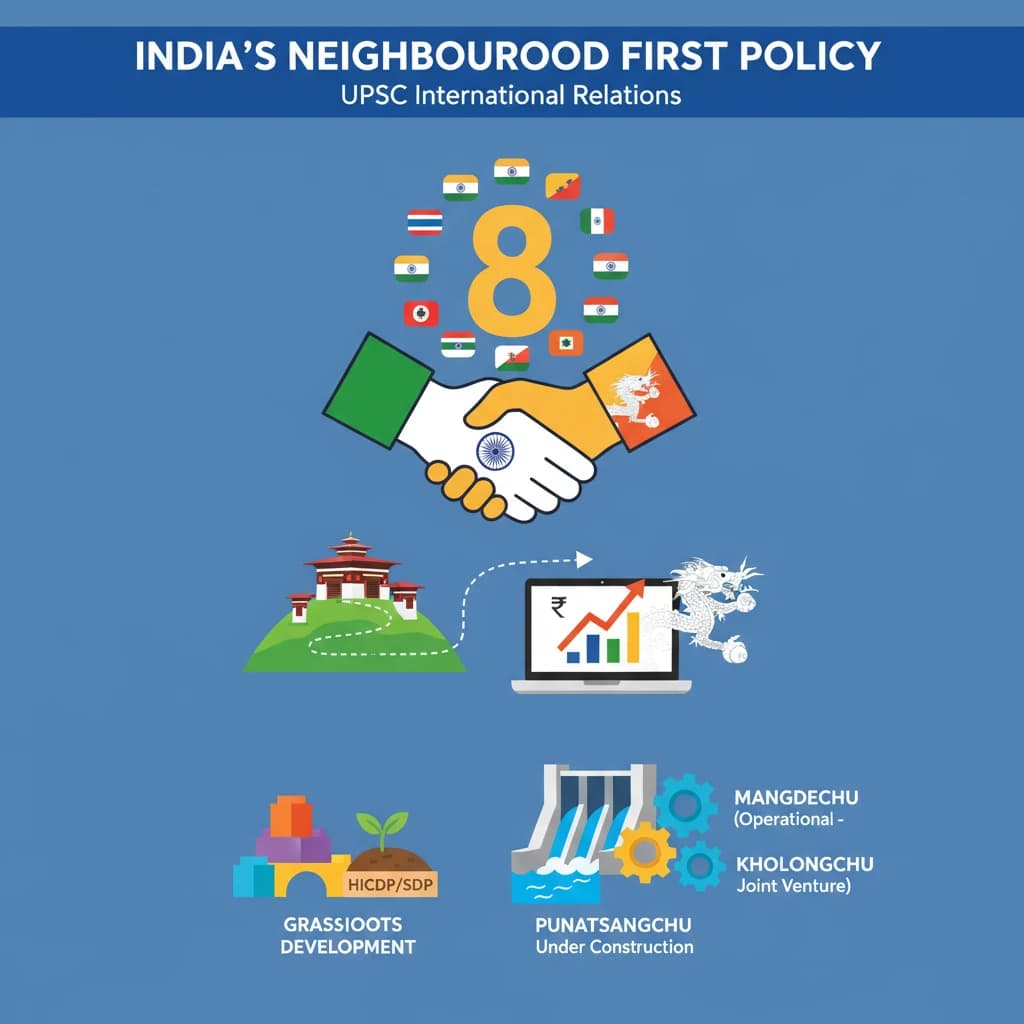
  • •Neighbourhood First Policy guides India's relations with its 8 immediate neighbours.
  • •Bhutan is a key partner, with deep cultural ties and robust economic cooperation.
  • •HICDPs/SDPs support grassroots development, building infrastructure and capacity in remote Bhutan.
  • •Hydro-power cooperation is a vital pillar, with operational (e.g., Mangdechhu), under-construction (Punatsangchhu), and joint venture (Kholongchhu) projects.
  • •India is Bhutan's top trade partner, underscoring strong economic interdependence and mutual benefit.

🧠 Memory Techniques
Memory Aid
98% Verified Content

Related Topics

Loading related topics...
Explore:International Relations Topics·All Subjects·Daily Current Affairs·Editorial Analysis·Previous Year Questions·UPSC GPT
India’s Neighbourhood First Policy - UPSC International Relations