📖 Introduction
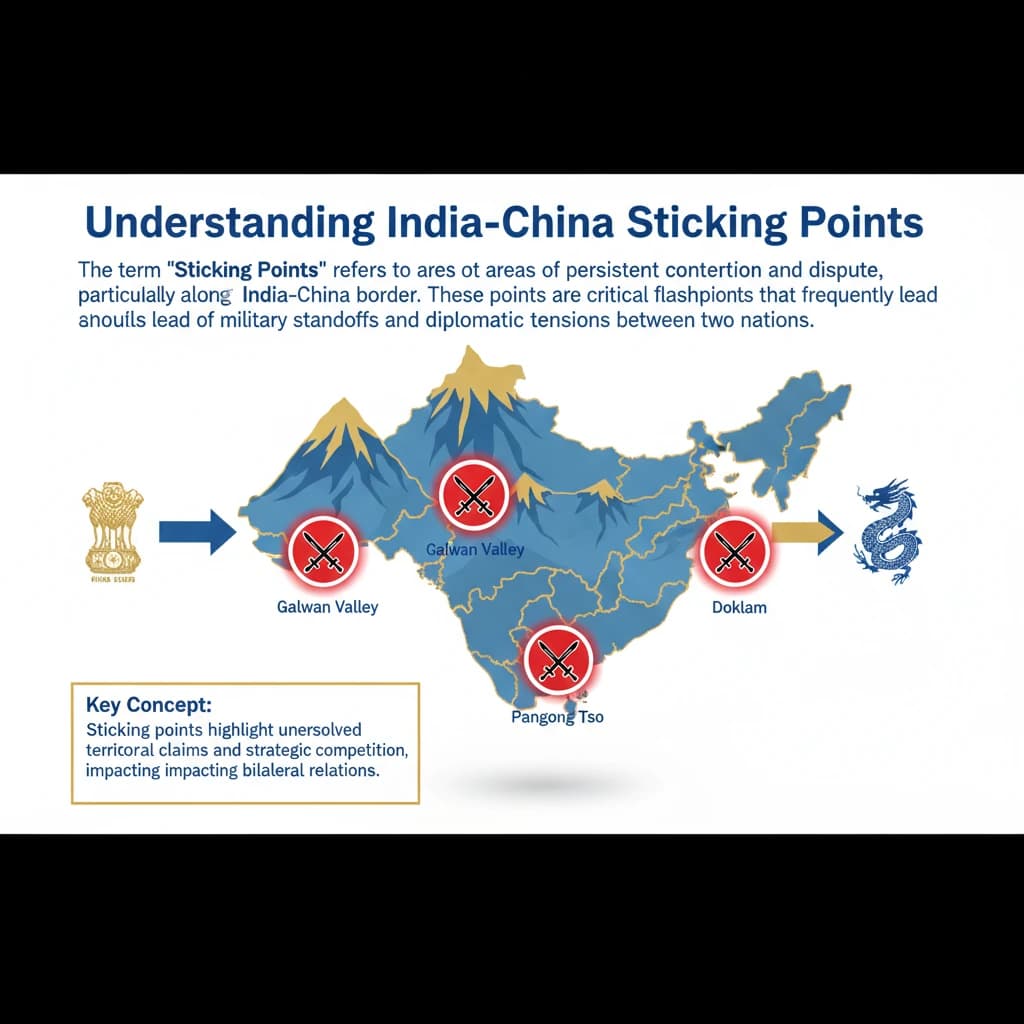
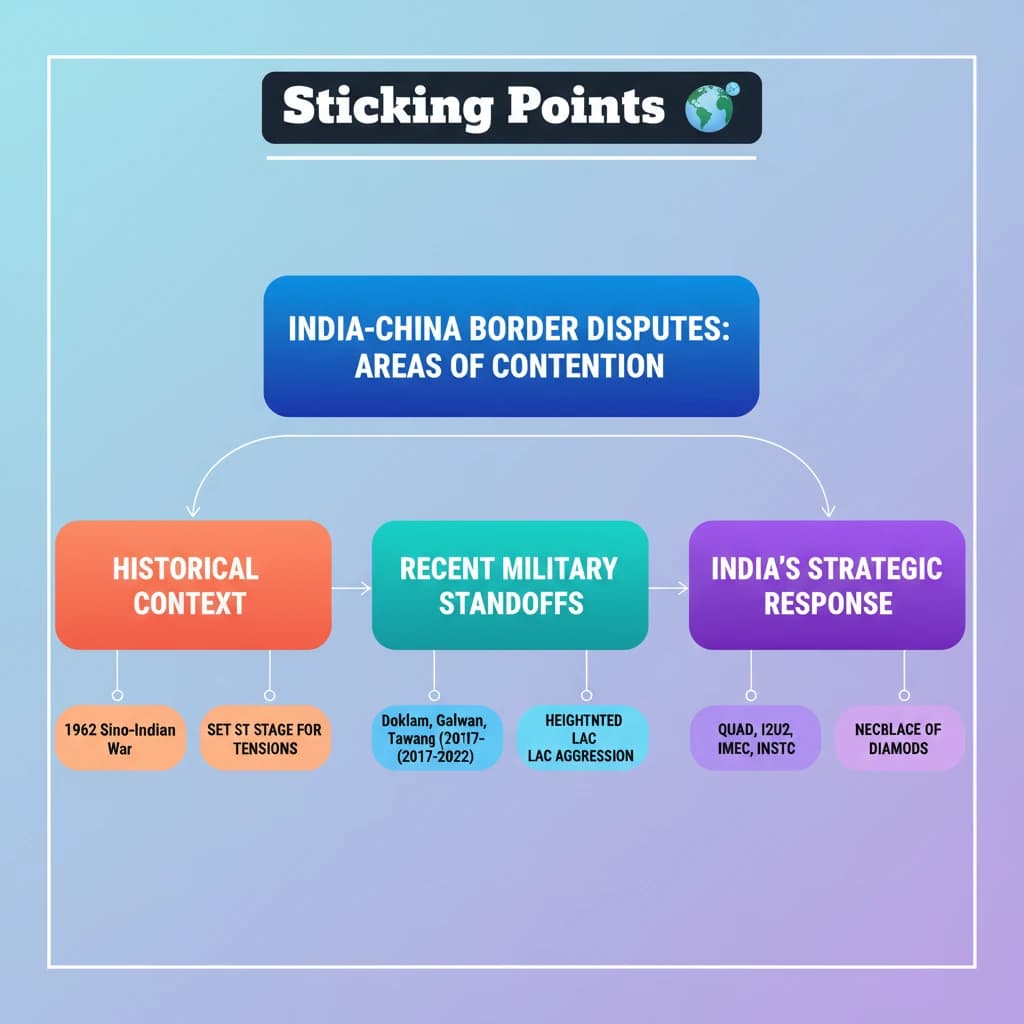
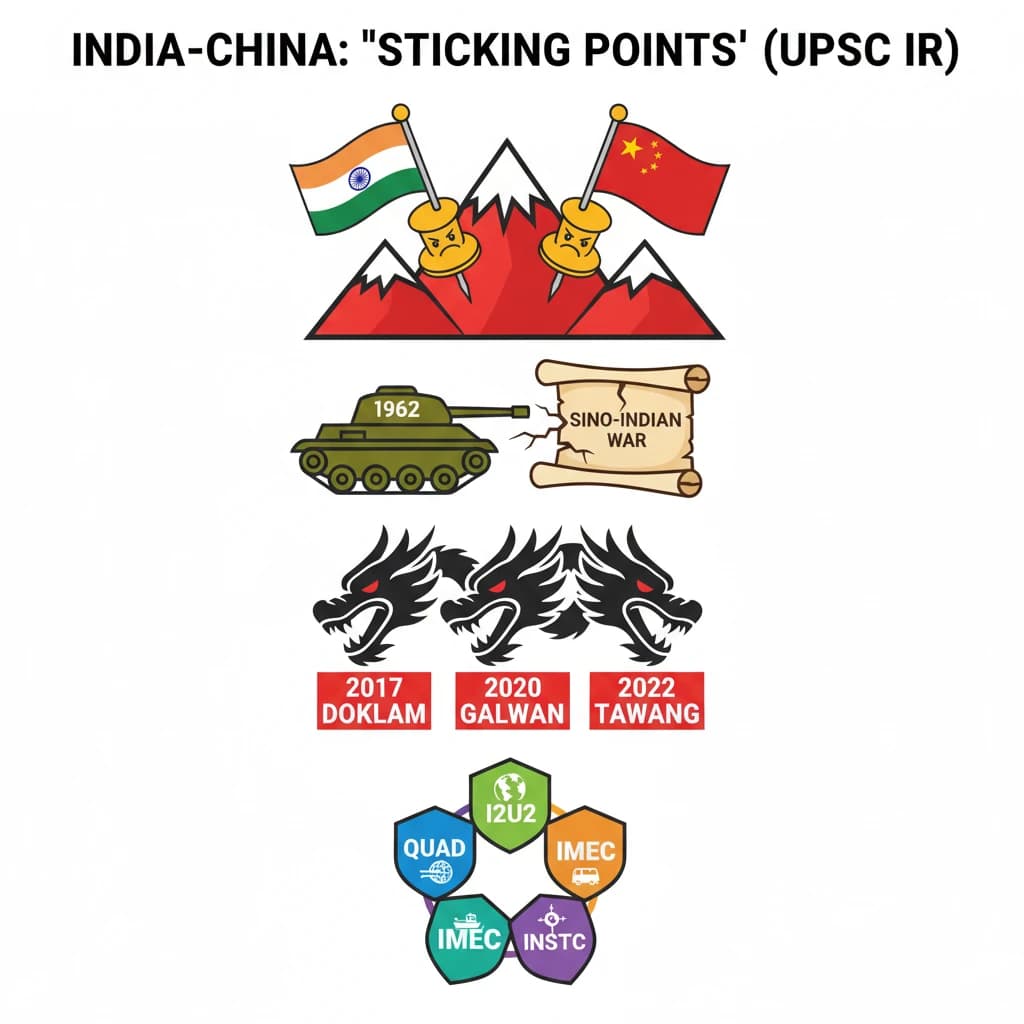
<h4>Understanding India-China Sticking Points</h4><p>The term <strong>'Sticking Points'</strong> refers to areas of persistent contention and dispute, particularly along the <strong>India-China border</strong>. These points are critical flashpoints that frequently lead to military standoffs and diplomatic tensions between the two nations.</p><div class='key-point-box'><p><strong>Key Concept:</strong> Sticking points highlight unresolved territorial claims and strategic competition, impacting bilateral relations and regional stability.</p></div><h4>Border Sectors of Concern</h4><p>The unresolved border dispute between India and China spans several sectors, each presenting unique challenges. These sectors are broadly categorized based on their geographical location.</p><ul><li><strong>Middle Sector:</strong> This sector primarily involves areas in <strong>Himachal Pradesh</strong> and <strong>Uttarakhand</strong>. While relatively calmer than other sectors, it still contains areas of differing perceptions regarding the <strong>Line of Actual Control (LAC)</strong>.</li><li><strong>Eastern Sector:</strong> This highly sensitive sector includes <strong>Arunachal Pradesh</strong> and <strong>Sikkim</strong>. China claims the entirety of Arunachal Pradesh as 'South Tibet', leading to significant disputes.</li></ul><h4>Historical Military Standoffs</h4><p>The border dispute has a long and complex history, marked by significant military confrontations that have shaped the current state of relations.</p><div class='info-box'><p><strong>Key Event:</strong> The <strong>1962 Sino-Indian War</strong> remains a pivotal moment, resulting from unresolved border issues and differing territorial claims. This conflict fundamentally altered the perception of the border.</p></div><p>Following the 1962 war, both countries have engaged in efforts to manage tensions. Various agreements and protocols have been established with the aim of maintaining peace and tranquility along the border, though their effectiveness is often tested.</p><h4>Recent Escalations and Faceoffs</h4><p>Since <strong>2013</strong>, there has been a noticeable and concerning increase in the frequency and seriousness of military confrontations between India and China along the <strong>Line of Actual Control (LAC)</strong>.</p><ul><li><strong>2017 Doklam Standoff:</strong> A significant confrontation occurred in the <strong>Doklam region</strong>, near the tri-junction of India, Bhutan, and China. This standoff lasted for 73 days and highlighted the strategic importance of the area.</li><li><strong>2020 Galwan Valley Clash:</strong> A particularly violent clash took place in the <strong>Galwan Valley in Ladakh</strong>, resulting in casualties on both sides. This incident marked a severe escalation in border tensions.</li><li><strong>2022 Tawang Incident:</strong> Another faceoff occurred in <strong>Tawang in Arunachal Pradesh</strong>, further underscoring the persistent nature of the border dispute in the Eastern Sector.</li></ul><div class='exam-tip-box'><p><strong>UPSC Insight:</strong> Understanding the chronology and specifics of these recent standoffs is crucial for Mains answers on India-China relations and regional security. Focus on the strategic implications of each event.</p></div><h4>India's Strategic Response to China's Aggression</h4><p>India has adopted a multi-faceted approach to counter China's aggressive measures along the border and its growing influence in the <strong>Indian Ocean Region</strong>.</p><h4>Global Strategic Alliances</h4><p>India actively engages with like-minded nations to collectively address China’s expanding influence. These alliances aim to create a balance of power and ensure a free and open Indo-Pacific.</p><ul><li><strong>QUAD (Quadrilateral Security Dialogue):</strong> Comprising <strong>India, the United States, Japan, and Australia</strong>, the QUAD focuses on maritime security, economic cooperation, and regional stability.</li><li><strong>I2U2 Grouping:</strong> This unique grouping includes <strong>India, Israel, the UAE, and the USA</strong>, focusing on joint investments and initiatives in water, energy, transportation, space, health, and food security.</li><li><strong>India-Middle East-Europe Economic Corridor (IMEC):</strong> A proposed economic corridor aiming to connect India with Europe via the Middle East, enhancing trade routes and regional connectivity.</li><li><strong>International North-South Transport Corridor (INSTC):</strong> A multi-modal network of ship, rail, and road routes for moving freight between India, Iran, Azerbaijan, Russia, Central Asia, and Europe.</li></ul><h4>India’s Necklace of Diamonds Strategy</h4><p>In direct response to China’s perceived <strong>'String of Pearls' strategy</strong> (a network of Chinese military and commercial facilities along its sea lines of communication), India has adopted its own counter-strategy.</p><div class='key-point-box'><p><strong>Concept:</strong> India's <strong>'Necklace of Diamonds' strategy</strong> involves strengthening its strategic assets and alliances around China's periphery and along critical maritime routes. This includes developing ports, airfields, and surveillance capabilities in friendly nations to ensure India's security and influence.</p></div>