Loading page, please wait…
Annual Exchange of Nuclear Installation Lists: India and Pakistan - UPSC International Relations
What is Annual Exchange of Nuclear Installation Lists: India and Pakistan in UPSC International Relations?
Annual Exchange of Nuclear Installation Lists: India and Pakistan is a key topic under International Relations for UPSC Civil Services Examination. Key points include: India and Pakistan annually exchange lists of their nuclear installations under a 1988 bilateral agreement.. The agreement, in force since 1991, prohibits attacks on each other's declared nuclear facilities.. It serves as a crucial Confidence-Building Measure (CBM) to reduce miscalculation and enhance transparency.. Understanding this topic is essential for both UPSC Prelims and Mains preparation.
Why is Annual Exchange of Nuclear Installation Lists: India and Pakistan important for UPSC exam?
Annual Exchange of Nuclear Installation Lists: India and Pakistan is a Medium-level topic in UPSC International Relations. It is tested in both Prelims (factual MCQs) and Mains (analytical answer writing). Previous year UPSC questions have frequently covered aspects of Annual Exchange of Nuclear Installation Lists: India and Pakistan, making it essential for comprehensive IAS preparation.
How to prepare Annual Exchange of Nuclear Installation Lists: India and Pakistan for UPSC?
To prepare Annual Exchange of Nuclear Installation Lists: India and Pakistan for UPSC: (1) Study the comprehensive notes covering all key concepts on Vaidra. (2) Practice previous year questions on this topic. (3) Connect it with current affairs using daily updates. (4) Revise using key takeaways and mind maps available for International Relations. (5) Write practice answers linking Annual Exchange of Nuclear Installation Lists: India and Pakistan to related GS Paper topics.
Key takeaways of Annual Exchange of Nuclear Installation Lists: India and Pakistan for UPSC
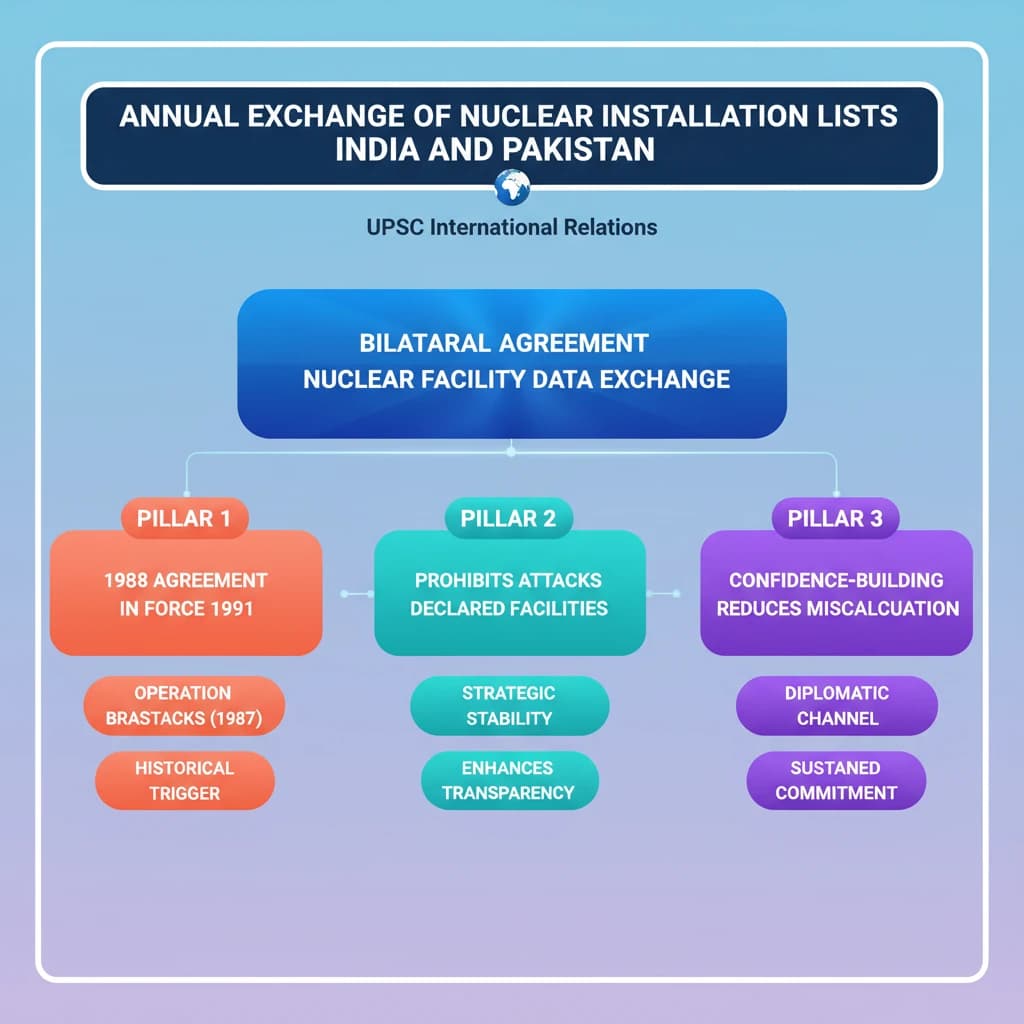
- India and Pakistan annually exchange lists of their nuclear installations under a 1988 bilateral agreement.
- The agreement, in force since 1991, prohibits attacks on each other's declared nuclear facilities.
- It serves as a crucial Confidence-Building Measure (CBM) to reduce miscalculation and enhance transparency.
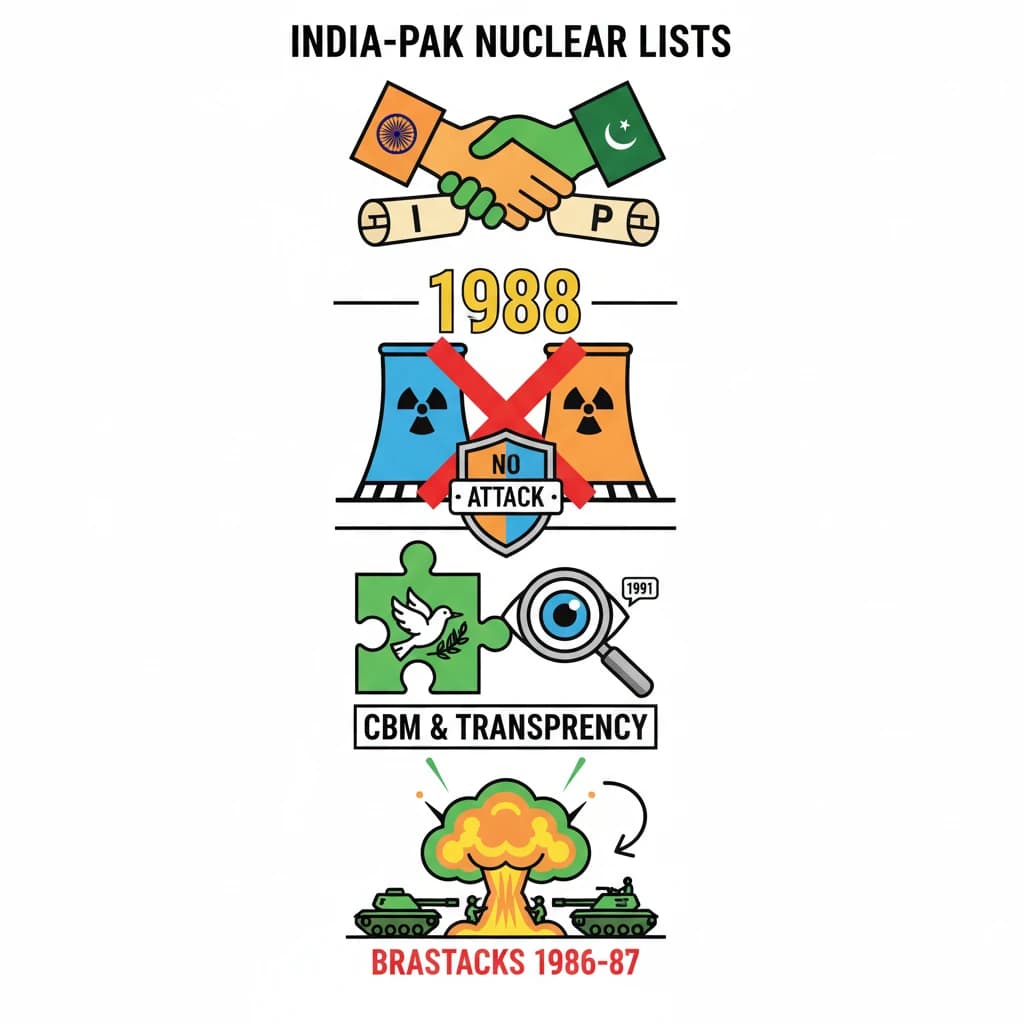
- The 1986-87 Operation Brasstacks crisis was a direct historical trigger for the agreement's negotiation.
- Despite broader bilateral disputes, this annual exchange represents a sustained diplomatic channel and commitment to strategic stability.

Annual Exchange of Nuclear Installation Lists: India and Pakistan
Medium⏱️ 8 min read
international relations
📖 Introduction
Why in News?
Recently, India and Pakistan exchanged lists of their nuclear installations and facilities.
This exchange occurred through diplomatic channels in New Delhi (India) and Islamabad (Pakistan).
It is mandated by the Agreement on the Prohibition of Attack against Nuclear Installations and Facilities between the two countries.
The Agreement: An Overview
The Agreement on the Prohibition of Attack against Nuclear Installations and Facilities was signed on December 31, 1988.
Signatories were then Pakistani Prime Minister Benazir Bhutto and Indian Prime Minister Rajiv Gandhi.
The treaty officially came into force on January 27, 1991.
The recent exchange marks the 33rd consecutive exchange of these lists between the two nations.
The first exchange took place on January 1, 1992.
Mandate and Scope of the Agreement
The agreement mandates both countries to inform each other about any nuclear installations and facilities to be covered.
This information exchange must occur annually on January 1st of every calendar year.
It provides a crucial confidence-building security measure (CBM) environment between India and Pakistan.
According to the agreement, the term ‘nuclear installation or facility’ includes:
- Nuclear power and research reactors
- Fuel fabrication facilities
- Uranium enrichment facilities
- Isotope separation facilities
- Reprocessing facilities
- Any other installations with fresh or irradiated nuclear fuel and materials in any form
- Establishments storing significant quantities of radioactive materials
Historical Context: Operation Brasstacks
While other factors played a role, the direct trigger for the negotiation and signing of the agreement was the tension generated by the 1986-87 Brasstacks exercise by the Indian Army.
Operation Brasstacks was a large-scale military exercise conducted in the Indian state of Rajasthan, near the Pakistan border.
Major Areas of Dispute Between India and Pakistan
Despite the nuclear CBM, several significant disputes persist between India and Pakistan, impacting bilateral relations.
Kashmir Dispute
- Line of Control (LoC) Violations: Frequent ceasefire violations along the LoC result in casualties and escalating tensions.
- Disagreements over Demilitarization: Calls for demilitarization on both sides of the LoC remain unaddressed, hindering progress towards peaceful resolution.
Terrorism
- Cross-border Infiltration: India accuses Pakistan-backed militants of infiltrating the LoC to carry out terrorist attacks.
- Designation of Terror Groups: Differences in designating militant groups as terrorist organizations create obstacles to counter-terrorism cooperation.
- Impact on Civilian Populations: Terrorist attacks claim innocent lives and foster further animosity between the two communities.
Water Sharing
- Construction of Dams: Dispute over construction of dams and hydroelectric projects on the Indus River and its tributaries, impacting water flow and usage rights.
- Implementation of Indus Water Treaty: Differences in interpreting and implementing clauses of the treaty regarding water allocation and dispute resolution mechanisms.
Trade and Economic Ties
- Trade Barriers: Restrictive trade policies and high tariffs imposed by both countries hinder cross-border trade and economic connectivity.
- In August 2019, Pakistan halted trade with India in response to constitutional amendments made in the Jammu and Kashmir region.
💡 Key Takeaways
- •India and Pakistan annually exchange lists of their nuclear installations under a 1988 bilateral agreement.
- •The agreement, in force since 1991, prohibits attacks on each other's declared nuclear facilities.
- •It serves as a crucial Confidence-Building Measure (CBM) to reduce miscalculation and enhance transparency.
- •The 1986-87 Operation Brasstacks crisis was a direct historical trigger for the agreement's negotiation.
- •Despite broader bilateral disputes, this annual exchange represents a sustained diplomatic channel and commitment to strategic stability.
🧠 Memory Techniques
95% Verified Content
📚 Reference Sources
•Ministry of External Affairs (India) press releases
•Pakistan Ministry of Foreign Affairs statements
•Academic papers on India-Pakistan Confidence-Building Measures