Loading page, please wait…
Vaidra Logo
Vaidra

Top 4 items + smart groups

UPSC GPT
New
Current Affairs
Daily Solutions
Daily Puzzle
Mains Evaluator

Version 2.0.0 • Built with ❤️ for UPSC aspirants

Loading...
Loading...
Loading...
Loading...
Loading...
Loading...
Loading...
Loading...
Loading...
Loading...
Loading...
Loading...
Loading...

Codex Alimentarius: Standards, Regional Variations, and India's Role - UPSC International Relations

What is Codex Alimentarius: Standards, Regional Variations, and India's Role in UPSC International Relations?

Codex Alimentarius: Standards, Regional Variations, and India's Role is a key topic under International Relations for UPSC Civil Services Examination. Key points include: Codex Standards are international benchmarks for food safety and quality, developed by FAO and WHO.. They are categorized into General, Commodity, and Regional standards, covering hygiene, labeling, contaminants, and specific products.. India, represented by FSSAI, actively participates in Codex meetings, advocating for standards in key export areas.. Understanding this topic is essential for both UPSC Prelims and Mains preparation.

Why is Codex Alimentarius: Standards, Regional Variations, and India's Role important for UPSC exam?

Codex Alimentarius: Standards, Regional Variations, and India's Role is a Medium-level topic in UPSC International Relations. It is tested in both Prelims (factual MCQs) and Mains (analytical answer writing). Previous year UPSC questions have frequently covered aspects of Codex Alimentarius: Standards, Regional Variations, and India's Role, making it essential for comprehensive IAS preparation.

How to prepare Codex Alimentarius: Standards, Regional Variations, and India's Role for UPSC?

To prepare Codex Alimentarius: Standards, Regional Variations, and India's Role for UPSC: (1) Study the comprehensive notes covering all key concepts on Vaidra. (2) Practice previous year questions on this topic. (3) Connect it with current affairs using daily updates. (4) Revise using key takeaways and mind maps available for International Relations. (5) Write practice answers linking Codex Alimentarius: Standards, Regional Variations, and India's Role to related GS Paper topics.

Key takeaways of Codex Alimentarius: Standards, Regional Variations, and India's Role for UPSC

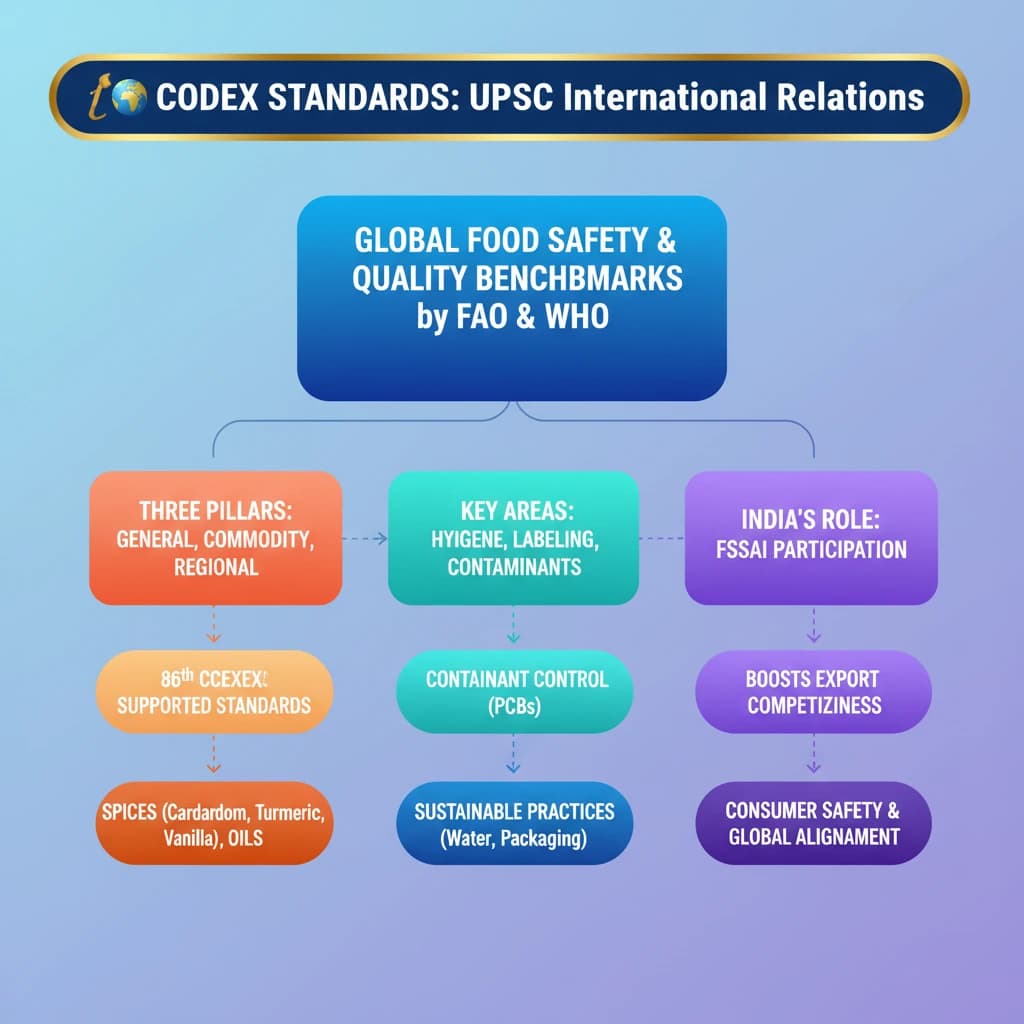
  • Codex Standards are international benchmarks for food safety and quality, developed by FAO and WHO.
  • They are categorized into General, Commodity, and Regional standards, covering hygiene, labeling, contaminants, and specific products.
  • India, represented by FSSAI, actively participates in Codex meetings, advocating for standards in key export areas.
  • At the 86th CCEXEC, India supported standards for spices (cardamom, turmeric, vanilla), vegetable oils, contaminant control (PCBs), and sustainable practices (water reuse, recycled packaging).
  • India's engagement boosts its export competitiveness, ensures consumer safety, and aligns national food regulations with global best practices.
Codex Alimentarius: Standards, Regional Variations, and India's Role

Codex Alimentarius: Standards, Regional Variations, and India's Role

Medium⏱️ 7 min read✓ 98% Verified
international relations

📖 Introduction

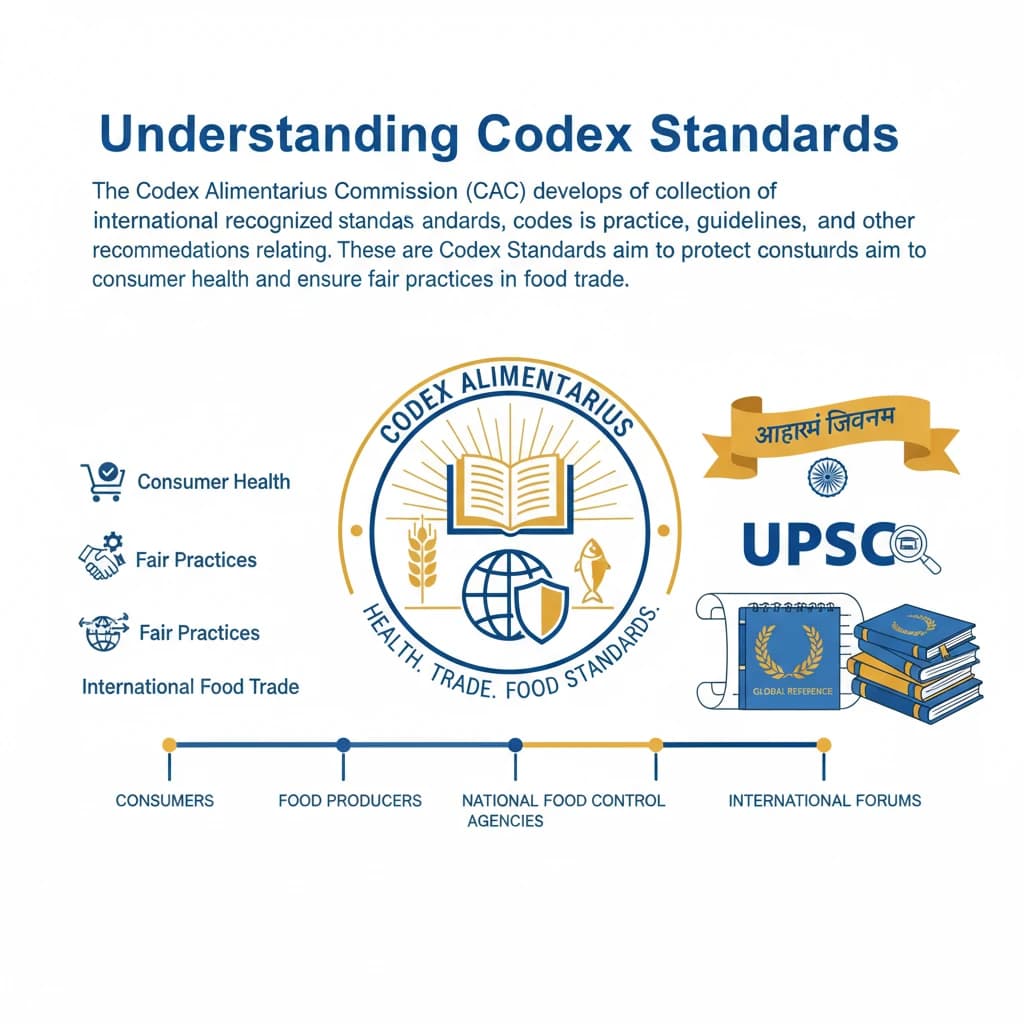
<h4>Understanding Codex Standards</h4><p>The <strong>Codex Alimentarius Commission (CAC)</strong> develops a collection of internationally recognized standards, codes of practice, guidelines, and other recommendations relating to food. These are known as <strong>Codex Standards</strong> and aim to protect consumer health and ensure fair practices in food trade.</p><p>These standards serve as a global reference for consumers, food producers, national food control agencies, and the international food trade. They are crucial for harmonizing food regulations worldwide.</p><h4>Types of Codex Standards</h4><p>Codex Standards are broadly categorized into three main types, each serving a distinct purpose in regulating the global food supply chain:</p><ul><li><p><strong>General Standards, Guidelines and Codes of Practice:</strong> These are foundational texts that apply across various products and categories. They cover critical aspects such as <strong>hygienic practice</strong>, <strong>labelling requirements</strong>, acceptable levels of <strong>contaminants</strong>, use of <strong>additives</strong>, and procedures for <strong>inspection & certification</strong>.</p><div class='info-box'><p>These general standards also address <strong>nutrition</strong>, and the permissible <strong>residues of veterinary drugs and pesticides</strong>, ensuring broad applicability and safety.</p></div></li><li><p><strong>Commodity Standards:</strong> These standards are developed for specific food products or, increasingly, for entire food groups. They define the essential composition, quality factors, and safety requirements for individual commodities, facilitating their trade.</p></li><li><p><strong>Regional Standards:</strong> These are developed by the respective <strong>Regional Coordinating Committees</strong> of the CAC. They are specifically applicable to the food products and trade practices within their designated geographical regions.</p></li></ul><h4>86th Session of the Executive Committee (CCEXEC) of CAC</h4><p>The <strong>86th Session of the Codex Alimentarius Commission’s Executive Committee (CCEXEC)</strong> was a significant event for global food standard setting. It took place at the <strong>FAO Headquarters in Rome</strong>, bringing together key stakeholders from around the world.</p><div class='info-box'><p>The <strong>CCEXEC</strong> plays a vital role in the <strong>CAC</strong>. Its responsibilities include reviewing proposals for new work and diligently monitoring the progress of existing standards development initiatives.</p></div><h4>India's Active Participation and Support</h4><p><strong>India</strong> demonstrated strong leadership and active participation at the <strong>86th CCEXEC session</strong>. The country was represented by the <strong>CEO of FSSAI</strong> (Food Safety and Standards Authority of India), highlighting its commitment to global food safety.</p><div class='key-point-box'><p>During the session, <strong>India</strong> strongly advocated for and supported the advancement of <strong>standards development for various spices</strong>. This initiative is particularly significant for India, given its status as a major global producer and exporter of these commodities.</p></div><p>Specific spices for which India championed standards development included <strong>small cardamom</strong>, <strong>turmeric</strong>, and <strong>vanilla</strong>. Establishing international standards for these products will greatly facilitate smoother and more efficient international trade.</p><p>Beyond spices, <strong>India</strong> also backed the progression of standards for <strong>vegetable oils</strong>. This demonstrates a comprehensive approach to ensuring safety and quality across diverse food categories.</p><p>Furthermore, <strong>India</strong> supported guidelines for the control of hazardous substances such as <strong>dioxin-dioxin-like polychlorinated biphenyls (PCBs)</strong>. This reflects a commitment to addressing chemical contaminants in the food chain.</p><p>Another key area of India's support was the safe use and reuse of <strong>water in food production and processing</strong>. This is crucial for sustainable and hygienic food manufacturing practices globally.</p><p>Finally, <strong>India</strong> championed a proposal for developing <strong>Codex guidance on food safety considerations related to the use of recycled materials in food packaging</strong>. This forward-thinking initiative addresses emerging challenges in food safety and environmental sustainability.</p><div class='exam-tip-box'><p><strong>UPSC Insight:</strong> India's proactive role in <strong>Codex Alimentarius Commission</strong> meetings, especially in advocating for standards for key export commodities like spices, is a significant point for <strong>GS Paper 2 (International Relations)</strong> and <strong>GS Paper 3 (Economy, Food Processing)</strong>. Be prepared to discuss its implications for trade and public health.</p></div>
Concept Diagram

💡 Key Takeaways

  • •Codex Standards are international benchmarks for food safety and quality, developed by FAO and WHO.
  • •They are categorized into General, Commodity, and Regional standards, covering hygiene, labeling, contaminants, and specific products.
  • •India, represented by FSSAI, actively participates in Codex meetings, advocating for standards in key export areas.
  • •At the 86th CCEXEC, India supported standards for spices (cardamom, turmeric, vanilla), vegetable oils, contaminant control (PCBs), and sustainable practices (water reuse, recycled packaging).
  • •India's engagement boosts its export competitiveness, ensures consumer safety, and aligns national food regulations with global best practices.

🧠 Memory Techniques

Memory Aid
98% Verified Content

📚 Reference Sources

•Food and Agriculture Organization (FAO) Official Website
•World Health Organization (WHO) Official Website
•Food Safety and Standards Authority of India (FSSAI) Official Website

Related Topics

Loading related topics...
Explore:International Relations Topics·All Subjects·Daily Current Affairs·Editorial Analysis·Previous Year Questions·UPSC GPT
Back
All Subjects

Topics

0 topics • 0 completed

Loading topics...
Loading...
Loading...
Loading...
Loading...
Loading...
Overall Progress0%
Codex Alimentarius: Standards, Regional Variations, and India's Role - UPSC International Relations