Loading page, please wait…
Vaidra Logo
Vaidra

Top 4 items + smart groups

UPSC GPT
New
Current Affairs
Daily Solutions
Daily Puzzle
Mains Evaluator

Version 2.0.0 • Built with ❤️ for UPSC aspirants

Loading...
Loading...
Loading...
Loading...
Loading...
Loading...
Loading...
Loading...
Loading...
Loading...
Loading...
Loading...
Loading...

Pravasi Bharatiya - UPSC International Relations

What is Pravasi Bharatiya in UPSC International Relations?

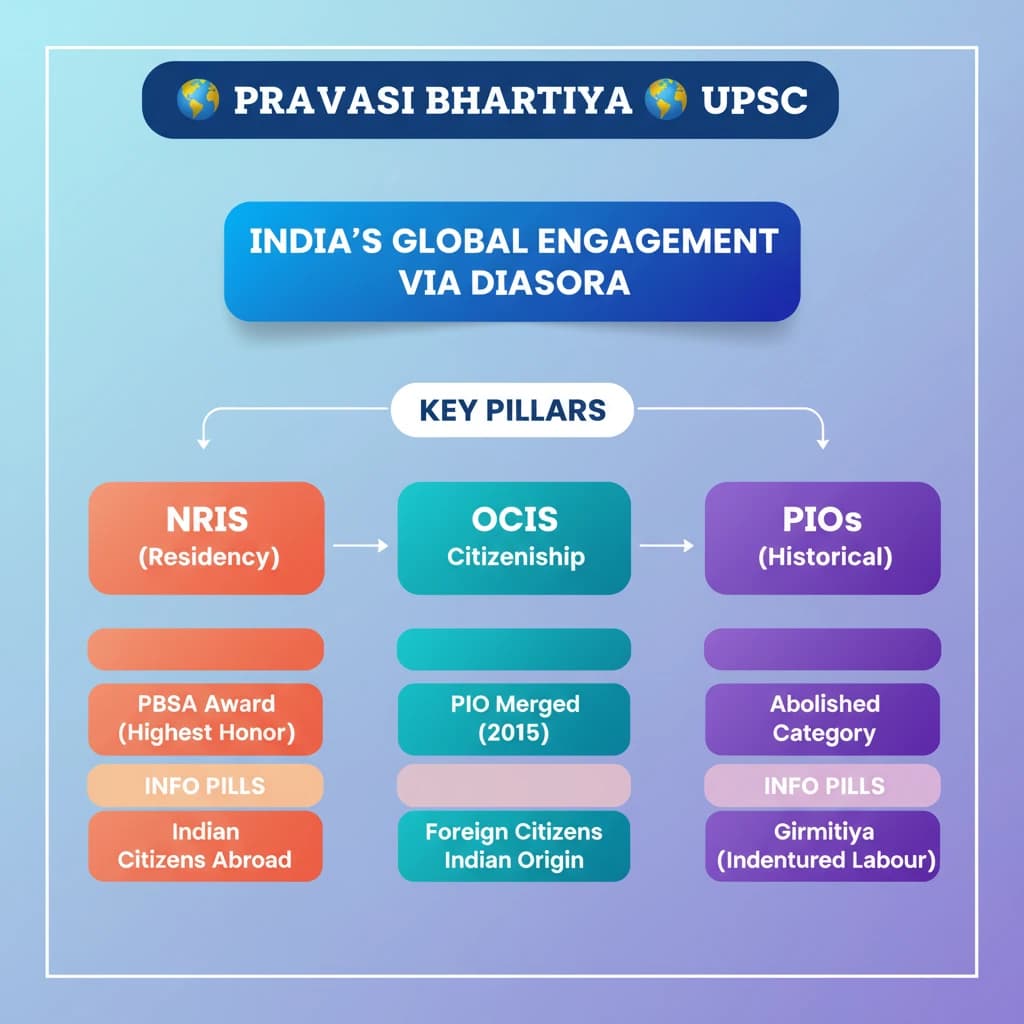
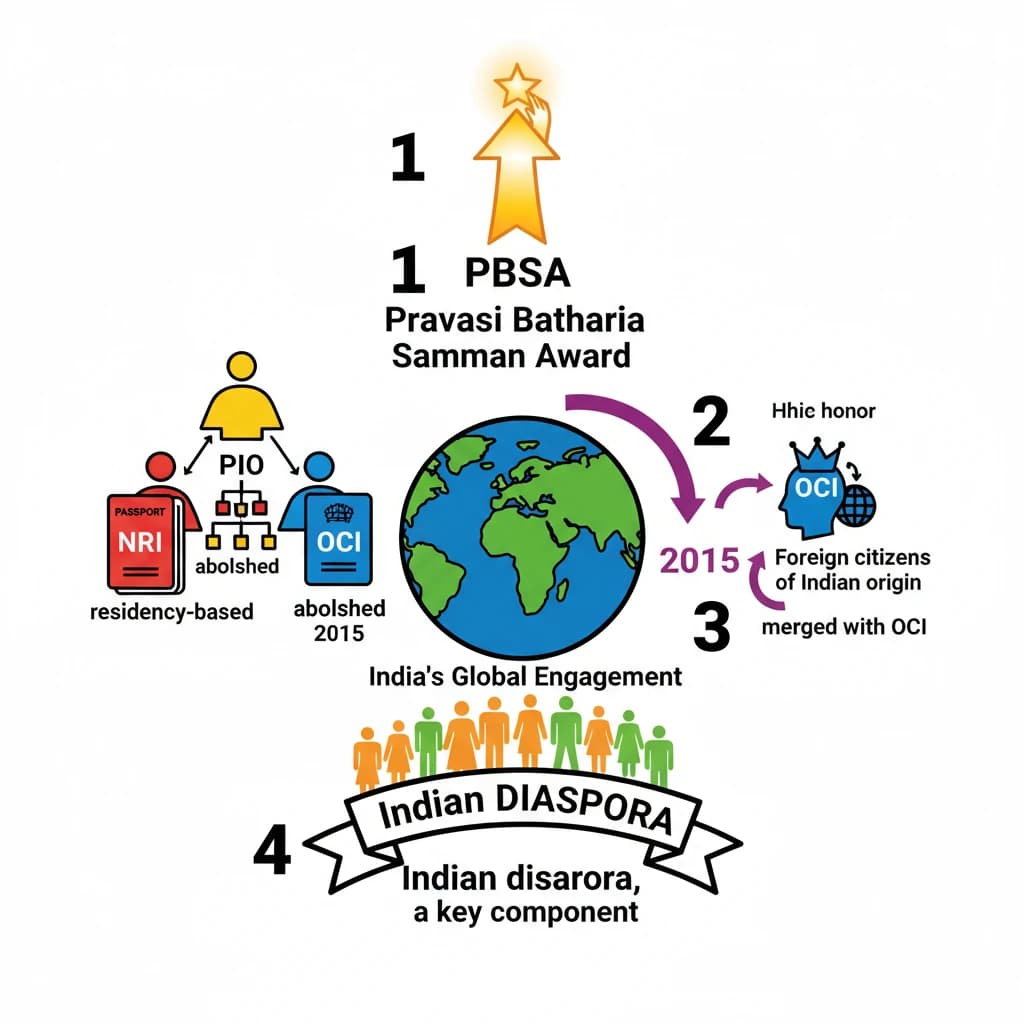
Pravasi Bharatiya is a key topic under International Relations for UPSC Civil Services Examination. Key points include: Pravasi Bharatiya refers to the Indian diaspora, a key component of India's global engagement.. Pravasi Bharatiya Samman Award (PBSA) is the highest honor for NRIs, PIOs, or diaspora organizations.. Indian diaspora is classified into NRIs (residency-based), PIOs (historical Indian connection, now merged), and OCIs (foreign citizens of Indian origin).. Understanding this topic is essential for both UPSC Prelims and Mains preparation.

Why is Pravasi Bharatiya important for UPSC exam?

Pravasi Bharatiya is a Medium-level topic in UPSC International Relations. It is tested in both Prelims (factual MCQs) and Mains (analytical answer writing). Previous year UPSC questions have frequently covered aspects of Pravasi Bharatiya, making it essential for comprehensive IAS preparation.

How to prepare Pravasi Bharatiya for UPSC?

To prepare Pravasi Bharatiya for UPSC: (1) Study the comprehensive notes covering all key concepts on Vaidra. (2) Practice previous year questions on this topic. (3) Connect it with current affairs using daily updates. (4) Revise using key takeaways and mind maps available for International Relations. (5) Write practice answers linking Pravasi Bharatiya to related GS Paper topics.

Key takeaways of Pravasi Bharatiya for UPSC

  • Pravasi Bharatiya refers to the Indian diaspora, a key component of India's global engagement.
  • Pravasi Bharatiya Samman Award (PBSA) is the highest honor for NRIs, PIOs, or diaspora organizations.
  • Indian diaspora is classified into NRIs (residency-based), PIOs (historical Indian connection, now merged), and OCIs (foreign citizens of Indian origin).
  • The PIO category was abolished in 2015 and merged with OCI to streamline status.
  • The 'Girmitiya' system represents the historical indentured labour migration that formed early diaspora communities.
  • A comprehensive database for Girmitiyas has been suggested to connect with descendants of early migrants.
Pravasi Bharatiya

Pravasi Bharatiya

Medium⏱️ 7 min read✓ 98% Verified
international relations

📖 Introduction

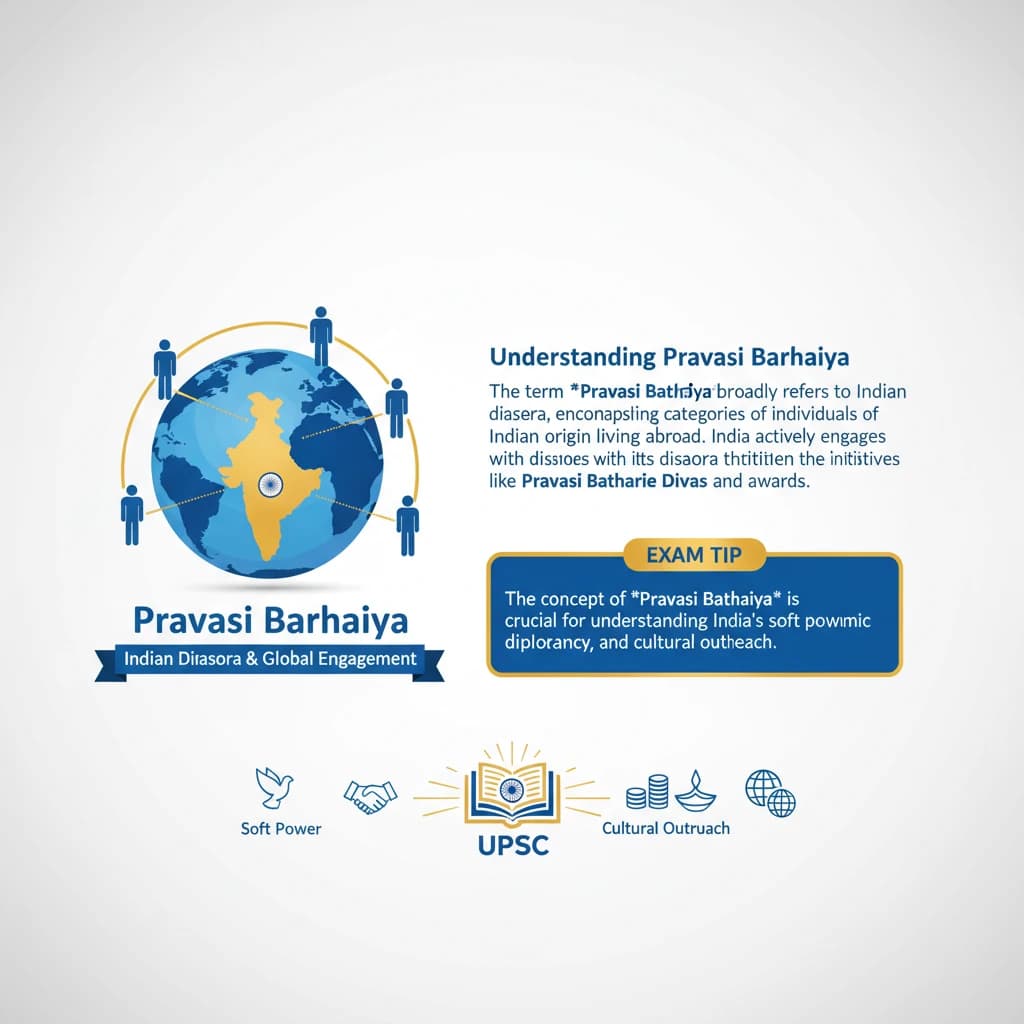
<h4>Understanding Pravasi Bharatiya</h4><p>The term <strong>Pravasi Bharatiya</strong> broadly refers to the Indian diaspora, encompassing various categories of individuals of Indian origin living abroad. India actively engages with its diaspora through initiatives like the <strong>Pravasi Bharatiya Divas</strong> and awards.</p><div class='exam-tip-box'><p>The concept of <strong>Pravasi Bharatiya</strong> is crucial for understanding India's soft power, economic diplomacy, and cultural outreach, often appearing in <strong>GS Paper II (International Relations)</strong>.</p></div><h4>Pravasi Bharatiya Samman Award (PBSA)</h4><p>The <strong>Pravasi Bharatiya Samman Award (PBSA)</strong> represents the highest honour bestowed by the President of India. It is presented as part of the <strong>Pravasi Bharatiya programme</strong>.</p><div class='info-box'><p><strong>Award Recipients:</strong> The PBSA is conferred upon a <strong>Non-Resident Indian (NRI)</strong>, a <strong>Person of Indian Origin (PIO)</strong>, or an organisation/institution established and managed by them.</p></div><p>This prestigious award serves to acknowledge and celebrate the significant contributions of the <strong>Indian diaspora</strong>. It highlights their efforts in enhancing India's image globally and supporting its various causes.</p><p>Furthermore, the award recognizes their dedication to the welfare and upliftment of the local Indian communities in their respective countries of residence.</p><h4>Classification of Indian Diaspora</h4><p>The Indian diaspora is categorized into distinct groups based on their residency and citizenship status. Understanding these classifications is essential for policy formulation and engagement.</p><div class='key-point-box'><p>The classification includes <strong>Non-Resident Indians (NRIs)</strong>, <strong>Persons of Indian Origin (PIOs)</strong>, and <strong>Overseas Citizens of India (OCIs)</strong>, each with specific legal definitions and implications.</p></div><h4>Non-Resident Indians (NRIs)</h4><p><strong>Non-Resident Indians (NRIs)</strong> are Indian citizens who reside outside India. Their status is primarily determined by the duration of their stay in India during a financial year.</p><div class='info-box'><p><strong>NRI Criteria:</strong> A person is considered an <strong>NRI</strong> if they are in India for:<br><ul><li>Less than <strong>182 days</strong> in a financial year, OR</li><li>Less than <strong>365 days</strong> in the preceding <strong>4 years</strong> AND less than <strong>60 days</strong> in the current year.</li></ul></p></div><h4>Persons of Indian Origin (PIOs)</h4><p>A <strong>Person of Indian Origin (PIO)</strong> referred to a foreign citizen who had a historical connection to India. This category was significant for many years.</p><div class='info-box'><p><strong>PIO Definition:</strong> A foreign citizen (excluding certain nationalities) who:<br><ul><li>Previously held an <strong>Indian passport</strong>, OR</li><li>Whose parents or grandparents were <strong>born in India</strong>, OR</li><li>Is a spouse of a <strong>citizen of India</strong> or a <strong>PIO</strong>.</li></ul></p></div><p>However, certain nationalities were explicitly excluded from applying for PIO status. These included citizens of <strong>Pakistan, Afghanistan, Bangladesh, China, Iran, Bhutan, Sri Lanka</strong>, and <strong>Nepal</strong>.</p><div class='key-point-box'><p><strong>Important Update:</strong> The <strong>PIO category</strong> was officially <strong>abolished in 2015</strong>. It was subsequently <strong>merged with the Overseas Citizen of India (OCI) category</strong> to streamline the process.</p></div><h4>Overseas Citizens of India (OCIs)</h4><p>The <strong>Overseas Citizen of India (OCI)</strong> category was introduced to provide a closer link for foreign nationals of Indian descent. This status offers certain benefits, though it is not full citizenship.</p><div class='info-box'><p><strong>OCI Card Eligibility:</strong> An <strong>OCI card</strong> is granted to a foreign national (excluding nationals of Pakistan and Bangladesh) who:<br><ul><li>Was eligible to become a <strong>citizen of India on January 26, 1950</strong>, OR</li><li>Belonged to a territory that became part of <strong>India after August 15, 1947</strong>.</li></ul></p></div><p>Additionally, <strong>minor children</strong> of such eligible individuals were also qualified to receive <strong>OCI Cards</strong>, further extending the reach of this important category.</p>
Concept Diagram

💡 Key Takeaways

  • •Pravasi Bharatiya refers to the Indian diaspora, a key component of India's global engagement.
  • •Pravasi Bharatiya Samman Award (PBSA) is the highest honor for NRIs, PIOs, or diaspora organizations.
  • •Indian diaspora is classified into NRIs (residency-based), PIOs (historical Indian connection, now merged), and OCIs (foreign citizens of Indian origin).
  • •The PIO category was abolished in 2015 and merged with OCI to streamline status.
  • •The 'Girmitiya' system represents the historical indentured labour migration that formed early diaspora communities.
  • •A comprehensive database for Girmitiyas has been suggested to connect with descendants of early migrants.

🧠 Memory Techniques
Memory Aid
98% Verified Content

📚 Reference Sources

•Ministry of External Affairs, Government of India - Overseas Indian Affairs Division
•Citizenship Act, 1955 and subsequent amendments

Related Topics

Loading related topics...
Explore:International Relations Topics·All Subjects·Daily Current Affairs·Editorial Analysis·Previous Year Questions·UPSC GPT
Back
All Subjects

Topics

0 topics • 0 completed

Loading topics...
Loading...
Loading...
Loading...
Loading...
Loading...
Overall Progress0%
Pravasi Bharatiya - UPSC International Relations