Loading page, please wait…
Vaidra Logo
Vaidra

Top 4 items + smart groups

UPSC GPT
New
Current Affairs
Daily Solutions
Daily Puzzle
Mains Evaluator

Version 2.0.0 • Built with ❤️ for UPSC aspirants

Loading...
Loading...
Loading...
Loading...
Loading...
Loading...
Loading...
Loading...
Loading...
Loading...
Loading...
Loading...
Loading...
LAC vs. LoC: India-China Border Disputes and Management - UPSC International Relations
Back
All Subjects

Topics

0 topics • 0 completed

Loading topics...
Loading...
Loading...
Loading...
Loading...
Loading...
Overall Progress0%

LAC vs. LoC: India-China Border Disputes and Management - UPSC International Relations

What is LAC vs. LoC: India-China Border Disputes and Management in UPSC International Relations?

LAC vs. LoC: India-China Border Disputes and Management is a key topic under International Relations for UPSC Civil Services Examination. Key points include: The LAC (India-China) is an undemarcated, mutually unagreed de facto border, leading to frequent confrontations.. The LoC (India-Pakistan) is a formally delineated, internationally recognized ceasefire line established in 1972.. Clarification of the LAC has stalled since 2002, especially in the Western sector.. Understanding this topic is essential for both UPSC Prelims and Mains preparation.

Why is LAC vs. LoC: India-China Border Disputes and Management important for UPSC exam?

LAC vs. LoC: India-China Border Disputes and Management is a Medium-level topic in UPSC International Relations. It is tested in both Prelims (factual MCQs) and Mains (analytical answer writing). Previous year UPSC questions have frequently covered aspects of LAC vs. LoC: India-China Border Disputes and Management, making it essential for comprehensive IAS preparation.

How to prepare LAC vs. LoC: India-China Border Disputes and Management for UPSC?

To prepare LAC vs. LoC: India-China Border Disputes and Management for UPSC: (1) Study the comprehensive notes covering all key concepts on Vaidra. (2) Practice previous year questions on this topic. (3) Connect it with current affairs using daily updates. (4) Revise using key takeaways and mind maps available for International Relations. (5) Write practice answers linking LAC vs. LoC: India-China Border Disputes and Management to related GS Paper topics.

Key takeaways of LAC vs. LoC: India-China Border Disputes and Management for UPSC

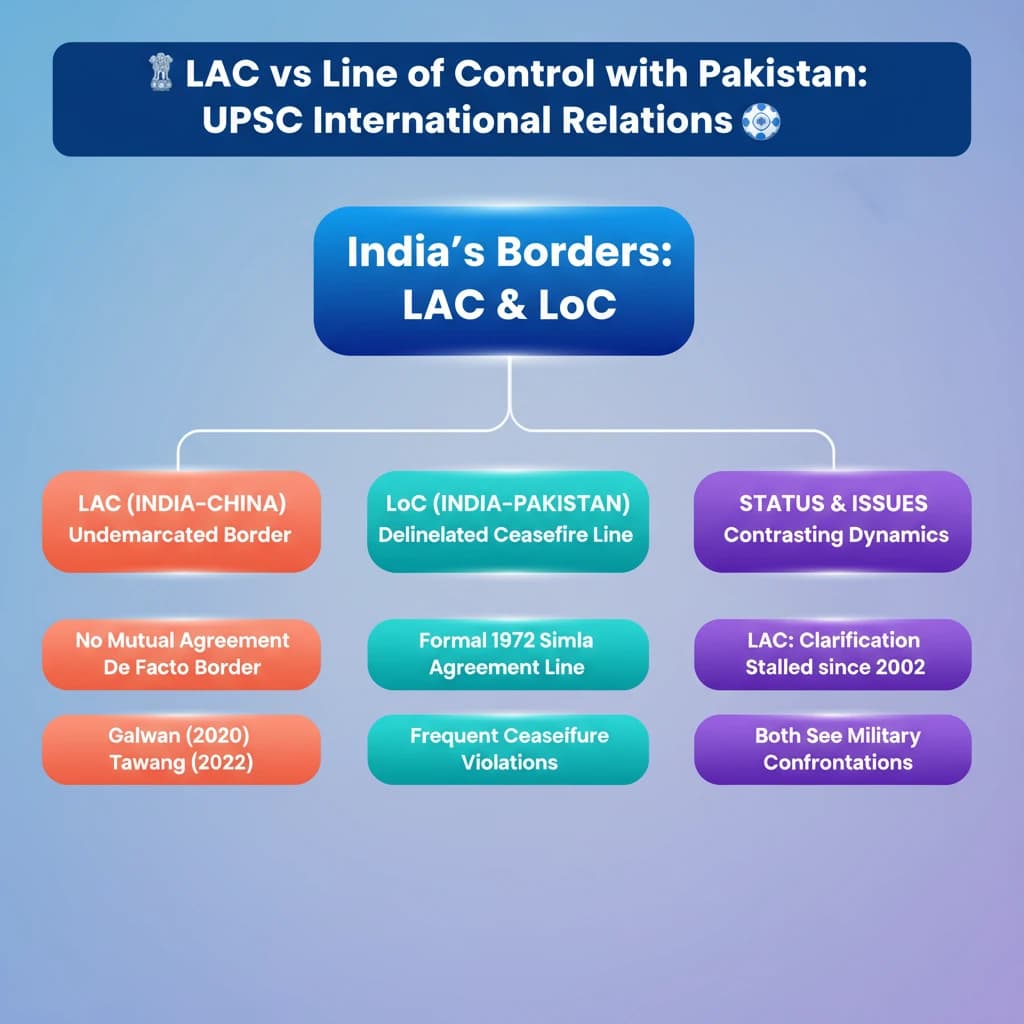
  • The LAC (India-China) is an undemarcated, mutually unagreed de facto border, leading to frequent confrontations.
  • The LoC (India-Pakistan) is a formally delineated, internationally recognized ceasefire line established in 1972.
  • Clarification of the LAC has stalled since 2002, especially in the Western sector.
  • Recent LAC conflicts include Galwan (2020) and Tawang (2022), indicating increased military confrontations since 2013.
  • The LoC, despite its formal status, sees frequent ceasefire violations and infiltration attempts.
  • Understanding the distinct legal and practical statuses of LAC and LoC is crucial for India's security and foreign policy.
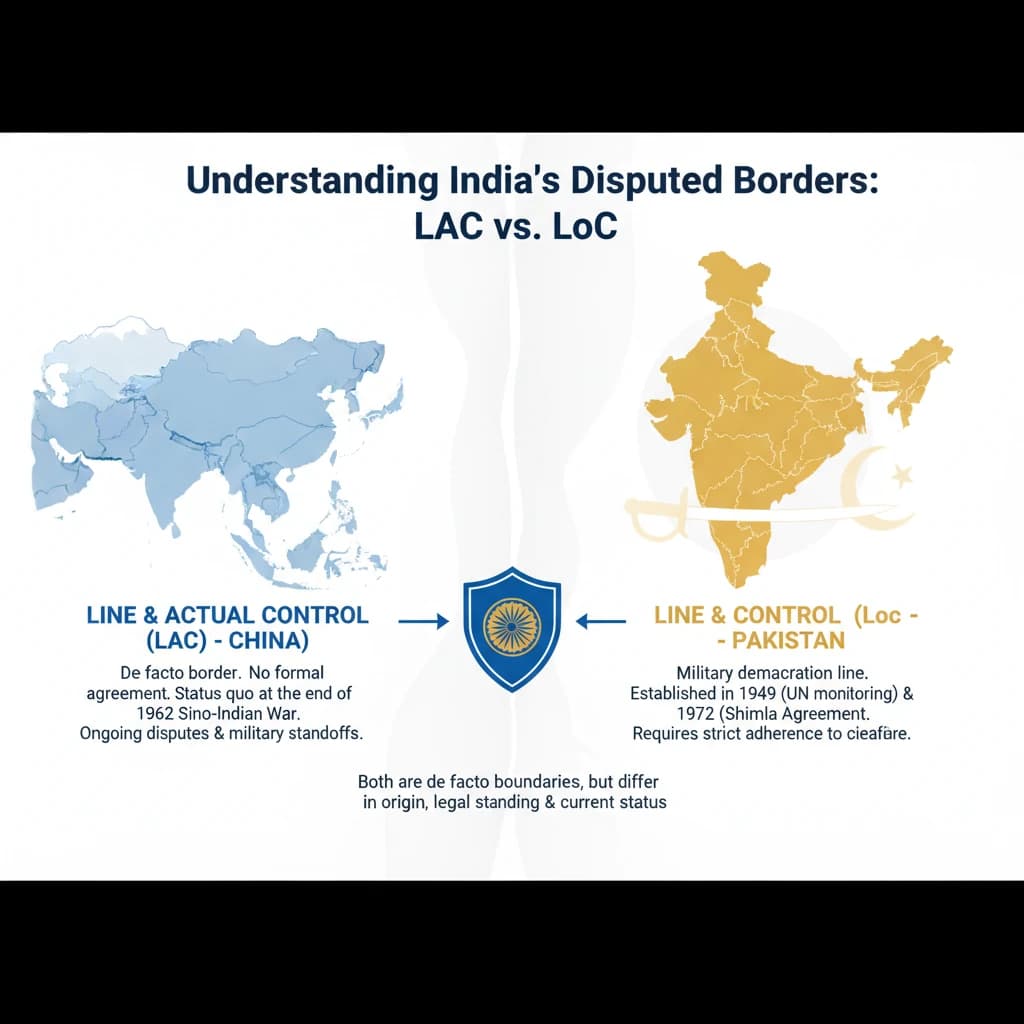
LAC vs. LoC: India-China Border Disputes and Management

LAC vs. LoC: India-China Border Disputes and Management

Medium⏱️ 8 min read✓ 98% Verified
international relations

📖 Introduction

<h4>Understanding India's Disputed Borders: LAC vs. LoC</h4><p>India shares complex and often contested borders with its neighbors, <strong>China</strong> and <strong>Pakistan</strong>. Two critical terms defining these borders are the <strong>Line of Actual Control (LAC)</strong> with China and the <strong>Line of Control (LoC)</strong> with Pakistan.</p><p>While both represent de facto boundaries, their origins, legal standing, and current status differ significantly, impacting India's foreign policy and security strategies.</p><h4>The Line of Actual Control (LAC) with China</h4><p>The <strong>Line of Actual Control (LAC)</strong> is the demarcation line that separates Indian-controlled territory from Chinese-controlled territory in the <strong>Sino-Indian border dispute</strong>. It is a largely undefined and undemarcated boundary.</p><div class="info-box"><p><strong>Formal Acceptance:</strong> India formally accepted the concept of the <strong>LAC</strong> in <strong>1993</strong>. Following this, both sides signed the <strong>Agreement to Maintain Peace and Tranquility at the LAC</strong>.</p></div><p>Despite this agreement, the precise alignment of the <strong>LAC</strong> remains a major point of contention. The two countries have only formally exchanged maps for the <strong>middle sector</strong> of the <strong>LAC</strong>.</p><p>For the more sensitive <strong>Western sector</strong>, maps were “shared” but never formally exchanged. The crucial process of clarifying and delineating the <strong>LAC</strong> has effectively stalled since <strong>2002</strong>.</p><div class="key-point-box"><p><strong>Key Point:</strong> The <strong>LAC</strong> is not agreed upon by both countries, is not delineated on a map signed by both, and is not demarcated on the ground. This ambiguity is a primary cause of frequent border standoffs.</p></div><p>Recent years have witnessed a concerning increase in serious military confrontations along the <strong>LAC</strong>. Observers from both sides agree that such incidents have risen significantly <strong>since 2013</strong>.</p><p>The most severe recent episodes of conflict include the <strong>Galwan Valley clash</strong> in <strong>Ladakh</strong> in <strong>2020</strong> and a skirmish in <strong>Tawang</strong>, <strong>Arunachal Pradesh</strong>, in <strong>2022</strong>. These events highlight the volatile nature of the undemarcated border.</p><h4>The Line of Control (LoC) with Pakistan</h4><p>The <strong>Line of Control (LoC)</strong> is the de facto military control line that divides the Indian-controlled part of <strong>Jammu and Kashmir</strong> from the Pakistan-controlled part of <strong>Gilgit-Baltistan</strong> and <strong>Azad Kashmir</strong>.</p><div class="info-box"><p><strong>Establishment:</strong> The <strong>LoC</strong> was established in <strong>1972</strong> following the <strong>Kashmir War</strong> (also known as the <strong>Indo-Pakistani War of 1971</strong>). It was based on the <strong>ceasefire line</strong> negotiated by the <strong>United Nations (UN)</strong> in <strong>1948</strong>.</p></div><p>Unlike the <strong>LAC</strong>, the <strong>LoC</strong> possesses a higher degree of international recognition and legal validity. It is clearly delineated on a map that has been officially signed by both <strong>India</strong> and <strong>Pakistan</strong>.</p><div class="key-point-box"><p><strong>Key Point:</strong> The <strong>LoC</strong> has international legal validity and is precisely delineated on a map signed by both countries. This formal recognition distinguishes it significantly from the <strong>LAC</strong>.</p></div><p>Despite its formal status, the <strong>LoC</strong> remains a highly militarized and volatile border, frequently witnessing cross-border firing, infiltration attempts, and heightened tensions between the two nuclear-armed nations.</p><h4>Comparative Analysis: LAC vs. LoC</h4><p>Understanding the fundamental differences between these two lines is crucial for comprehending India's strategic challenges. The ambiguity of the <strong>LAC</strong> contrasts sharply with the formal, albeit contested, nature of the <strong>LoC</strong>.</p><div class="highlight-box"><p><strong>LAC (India-China):</strong></p><ul><li><strong>Status:</strong> Not formally agreed upon or delineated on maps by both countries.</li><li><strong>Demarcation:</strong> Not demarcated on the ground.</li><li><strong>Legal Validity:</strong> Lacks international legal recognition as a formal border.</li><li><strong>Clarification Process:</strong> Stalled since <strong>2002</strong>.</li><li><strong>Recent Incidents:</strong> Increased military confrontations, e.g., <strong>Galwan (2020)</strong>, <strong>Tawang (2022)</strong>.</li></ul><p><strong>LoC (India-Pakistan):</strong></p><ul><li><strong>Status:</strong> Established in <strong>1972</strong>, based on <strong>1948 UN ceasefire line</strong>.</li><li><strong>Demarcation:</strong> Delineated on a map signed by both countries and generally understood on the ground.</li><li><strong>Legal Validity:</strong> Possesses international legal validity as a ceasefire line/de facto border.</li><li><strong>Clarification Process:</strong> Clearly defined post-<strong>1971 war</strong>.</li><li><strong>Recent Incidents:</strong> Frequent ceasefire violations, cross-border terrorism.</li></ul></div>
Concept Diagram

💡 Key Takeaways

  • •The LAC (India-China) is an undemarcated, mutually unagreed de facto border, leading to frequent confrontations.
  • •The LoC (India-Pakistan) is a formally delineated, internationally recognized ceasefire line established in 1972.
  • •Clarification of the LAC has stalled since 2002, especially in the Western sector.
  • •Recent LAC conflicts include Galwan (2020) and Tawang (2022), indicating increased military confrontations since 2013.
  • •The LoC, despite its formal status, sees frequent ceasefire violations and infiltration attempts.
  • •Understanding the distinct legal and practical statuses of LAC and LoC is crucial for India's security and foreign policy.

🧠 Memory Techniques
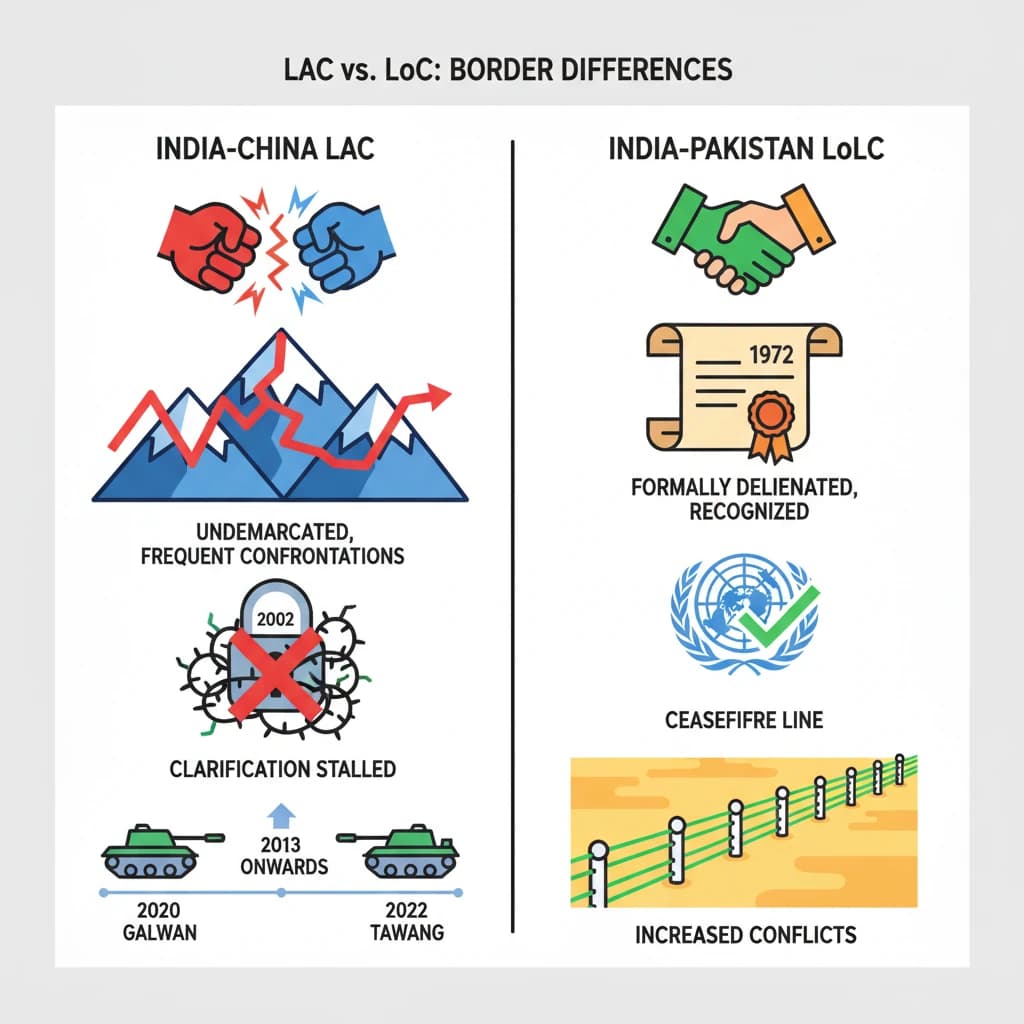
Memory Aid
98% Verified Content

📚 Reference Sources

•Ministry of External Affairs (MEA), Government of India statements
•Reports from reputable Indian think tanks on border security
•Academic analyses of India-China and India-Pakistan border disputes

Related Topics

Loading related topics...
Explore:International Relations Topics·All Subjects·Daily Current Affairs·Editorial Analysis·Previous Year Questions·UPSC GPT