Loading page, please wait…
Vaidra Logo
Vaidra

Top 4 items + smart groups

UPSC GPT
New
Current Affairs
Daily Solutions
Daily Puzzle
Mains Evaluator

Version 2.0.0 • Built with ❤️ for UPSC aspirants

Loading...
Loading...
Loading...
Loading...
Loading...
Loading...
Loading...
Loading...
Loading...
Loading...
Loading...
Loading...
Loading...
Back
All Subjects

Topics

0 topics • 0 completed

Loading topics...
Loading...
Loading...
Loading...
Loading...
Loading...
Overall Progress0%

India’s Act East Policy - UPSC International Relations

What is India’s Act East Policy in UPSC International Relations?

India’s Act East Policy is a key topic under International Relations for UPSC Civil Services Examination. Key points include: Act East Policy (2014) is an upgrade of Look East Policy (1992), expanding geographical and thematic scope.. Shift from primarily economic integration with ASEAN to comprehensive engagement including East Asia, Indo-Pacific, and security cooperation.. Inland Water Transport (IWT) is a key connectivity pillar, exemplified by trial cargo vessels to Bangladesh.. Understanding this topic is essential for both UPSC Prelims and Mains preparation.

Why is India’s Act East Policy important for UPSC exam?

India’s Act East Policy is a Medium-level topic in UPSC International Relations. It is tested in both Prelims (factual MCQs) and Mains (analytical answer writing). Previous year UPSC questions have frequently covered aspects of India’s Act East Policy, making it essential for comprehensive IAS preparation.

How to prepare India’s Act East Policy for UPSC?

To prepare India’s Act East Policy for UPSC: (1) Study the comprehensive notes covering all key concepts on Vaidra. (2) Practice previous year questions on this topic. (3) Connect it with current affairs using daily updates. (4) Revise using key takeaways and mind maps available for International Relations. (5) Write practice answers linking India’s Act East Policy to related GS Paper topics.

Key takeaways of India’s Act East Policy for UPSC

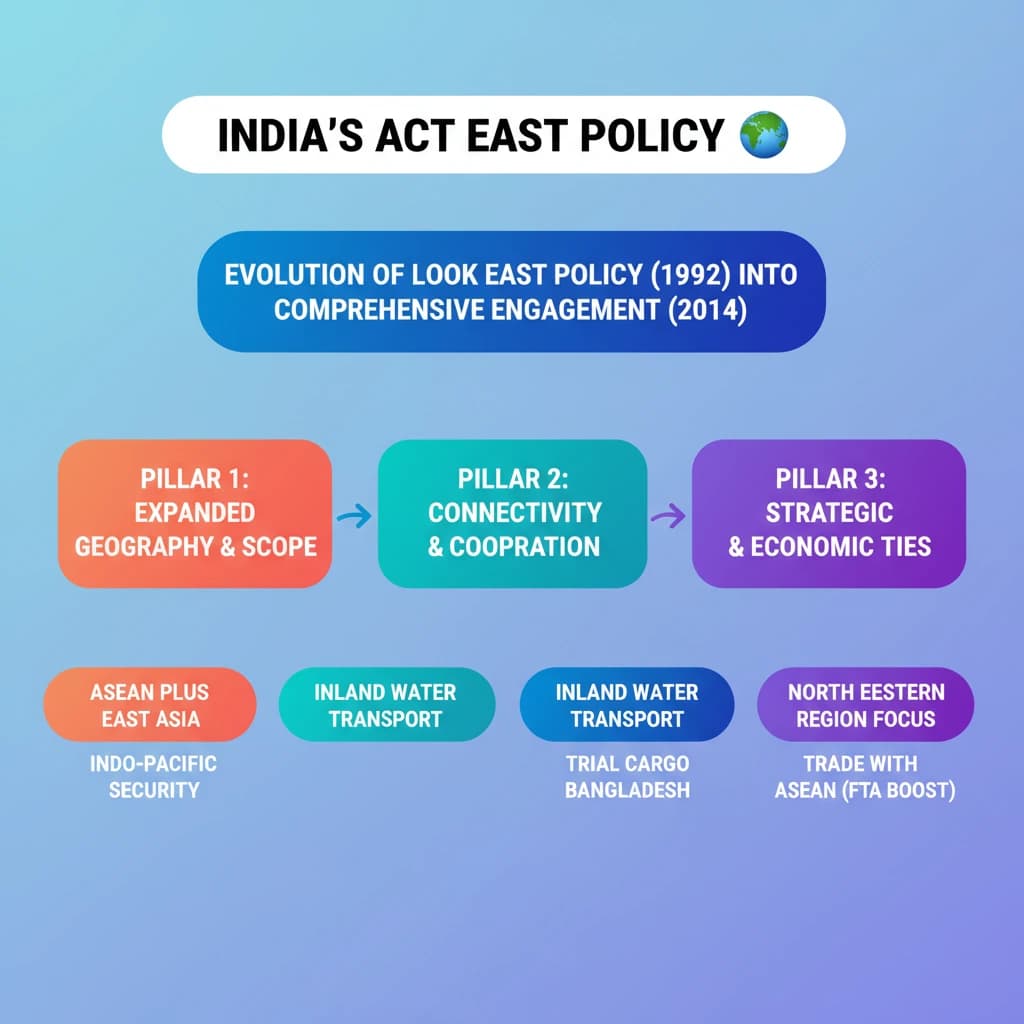
  • Act East Policy (2014) is an upgrade of Look East Policy (1992), expanding geographical and thematic scope.
  • Shift from primarily economic integration with ASEAN to comprehensive engagement including East Asia, Indo-Pacific, and security cooperation.
  • Inland Water Transport (IWT) is a key connectivity pillar, exemplified by trial cargo vessels to Bangladesh.
  • AEP aims to promote economic cooperation, cultural ties, strategic relations, and significantly develop India's North Eastern Region (NER).
  • India's trade with ASEAN grew substantially post-FTA, highlighting the economic success of the earlier policy and setting the stage for AEP's expansion.
India’s Act East Policy

India’s Act East Policy

Medium⏱️ 10 min read✓ 95% Verified
international relations

📖 Introduction

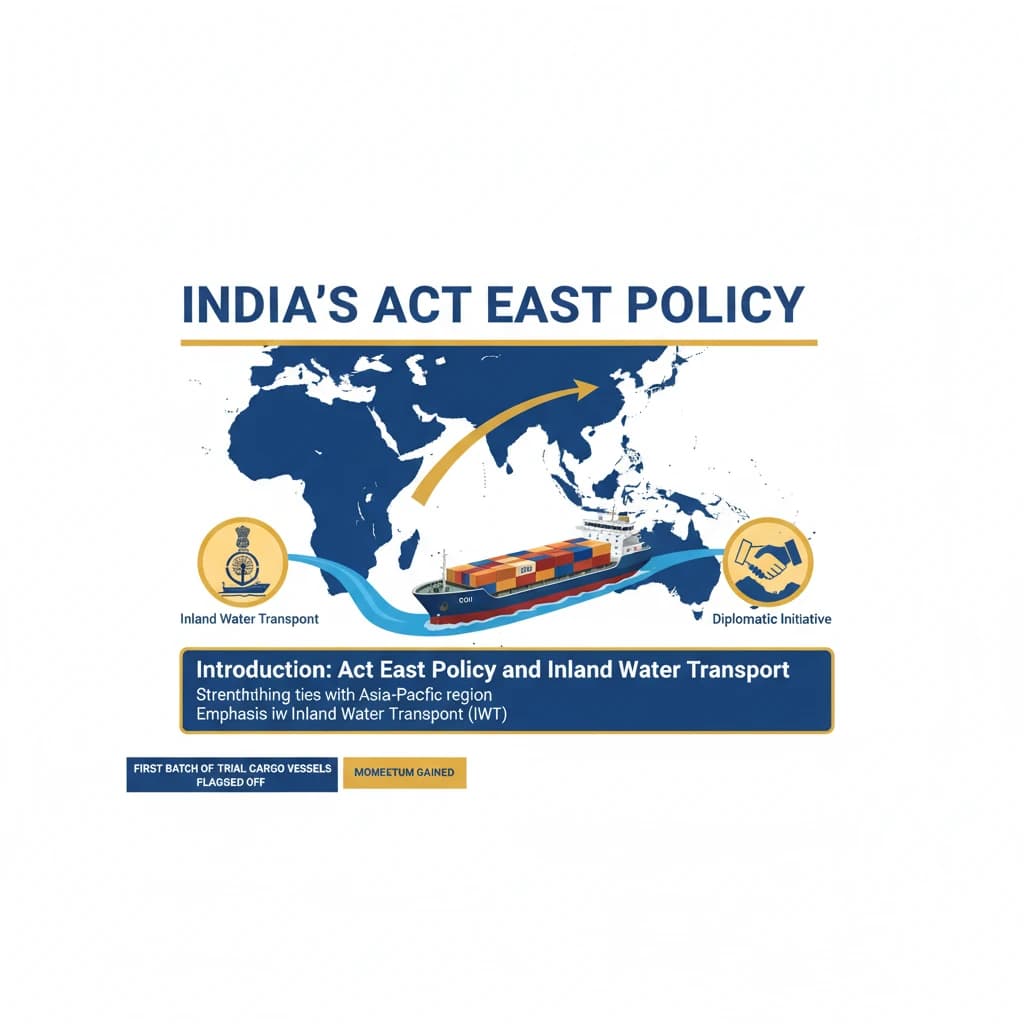
<h4>Introduction: Act East Policy and Inland Water Transport</h4><p>India's <strong>Act East Policy</strong> is a pivotal diplomatic initiative focused on strengthening ties with the vast <strong>Asia-Pacific region</strong>.</p><p>Recently, the policy gained significant momentum with the flagging off of <strong>trial cargo vessels</strong>, emphasizing the crucial role of <strong>Inland Water Transport (IWT)</strong>.</p><div class='info-box'><p>The <strong>first batch of trial Cargo Vessels</strong> was flagged off from <strong>Mala Inland Custom Port</strong> in West Bengal to <strong>Sultanganj Port</strong> in Bangladesh, marking a key step under the <strong>Act East Policy</strong>.</p></div><h4>Understanding Inland Water Transport (IWT)</h4><p><strong>Inland Water Transport (IWT)</strong> refers to the transportation of goods and passengers via navigable rivers, canals, lakes, and other inland waterways.</p><p>This mode utilizes various watercraft such as <strong>boats, barges, and ships</strong> to move cargo and people within a country's interior regions, connecting various ports and terminals.</p><div class='key-point-box'><p><strong>IWT Significance:</strong> It is a highly <strong>cost-effective</strong> mode of transportation, particularly beneficial for <strong>bulk cargo</strong>.</p></div><p>Common bulk cargoes include <strong>coal, iron ore, cement, food grains, and fertilizers</strong>, making IWT vital for industrial and agricultural logistics.</p><div class='info-box'><ul><li>Current share in India's modal mix: Only <strong>2%</strong>.</li><li>Government's target by <strong>2030</strong> (under <strong>Maritime India Vision (MIV)-2030</strong>): To increase this share to <strong>5%</strong>.</li><li>The <strong>Inland Waterways Authority of India (IWAI)</strong> has identified <strong>25 new National Waterways (NWs)</strong> through feasibility studies to make them navigable.</li></ul></div><h4>The Act East Policy: Overview</h4><p>The <strong>'Act East Policy'</strong>, officially announced in <strong>November 2014</strong>, serves as an upgraded and more proactive version of the earlier <strong>“Look East Policy”</strong>.</p><p>It is a comprehensive diplomatic initiative designed to promote robust <strong>economic, strategic, and cultural relations</strong> with the broader <strong>Asia-Pacific region</strong> at various levels.</p><div class='key-point-box'><p>The policy involves intensive and continuous engagement with <strong>Southeast Asian countries</strong> across multiple critical domains.</p></div><p>Key areas of engagement include <strong>connectivity, trade, culture, defence, and people-to-people contact</strong>, pursued at bilateral, regional, and multilateral platforms.</p><h4>Aims of the Act East Policy</h4><p>The <strong>Act East Policy</strong> adopts a <strong>proactive and pragmatic approach</strong> to achieve several crucial objectives:</p><ul><li>To promote enhanced <strong>economic cooperation</strong> and strengthen <strong>cultural ties</strong> with partner nations.</li><li>To develop deep and enduring <strong>strategic relationships</strong> with countries in the <strong>Indo-Pacific region</strong>.</li><li>To significantly improve the <strong>economic development of the North Eastern Region (NER)</strong>, recognizing its pivotal role as India's gateway to the Southeast Asia Region.</li></ul><h4>Look East vs. Act East Policy: A Comparison</h4><div class='key-point-box'><p>The <strong>Act East Policy</strong> represents an evolution and expansion of the <strong>Look East Policy</strong>, moving towards more comprehensive and dynamic engagement.</p></div><h5>Look East Policy (Launched 1992)</h5><p>The <strong>Look East Policy</strong> primarily focused on the <strong>Association of Southeast Asian Nations (ASEAN) countries</strong>.</p><p>Its main emphasis was on fostering greater <strong>economic integration</strong> with these rapidly growing economies.</p><div class='info-box'><ul><li><strong>1996:</strong> India became a <strong>dialogue partner of ASEAN</strong>.</li><li><strong>2002:</strong> India's relationship with ASEAN was upgraded to a <strong>summit-level partner</strong>.</li><li><strong>2012:</strong> The relationship was further elevated to a <strong>Strategic Partnership</strong>.</li><li><strong>Trade Growth:</strong> India's trade with ASEAN grew from <strong>USD 2 billion</strong> (1992) to <strong>USD 72 billion</strong> (2017-18) after the signing of the <strong>Free Trade Agreement (FTA) in 2010</strong>.</li></ul></div><p>India was also an active participant in several regional forums during this period, including the <strong>East Asia Summit (EAS)</strong> and the <strong>ASEAN Regional Forum (ARF)</strong>.</p><h5>Act East Policy (Launched 2014)</h5><p>The <strong>Act East Policy</strong> expands its geographical focus to include not only <strong>ASEAN countries</strong> but also the broader <strong>East Asian countries</strong> and the entire <strong>Indo-Pacific region</strong>.</p><p>Beyond economic integration, a key differentiator is its strong emphasis on <strong>security cooperation</strong> and strategic partnerships.</p><div class='exam-tip-box'><p><strong>UPSC Insight:</strong> The shift from 'Look' to 'Act' signifies a move from passive observation to a more <strong>proactive, multi-dimensional, and results-oriented strategy</strong>, encompassing defence, security, and strategic partnerships alongside economic and cultural ties.</p></div>
Concept Diagram

💡 Key Takeaways

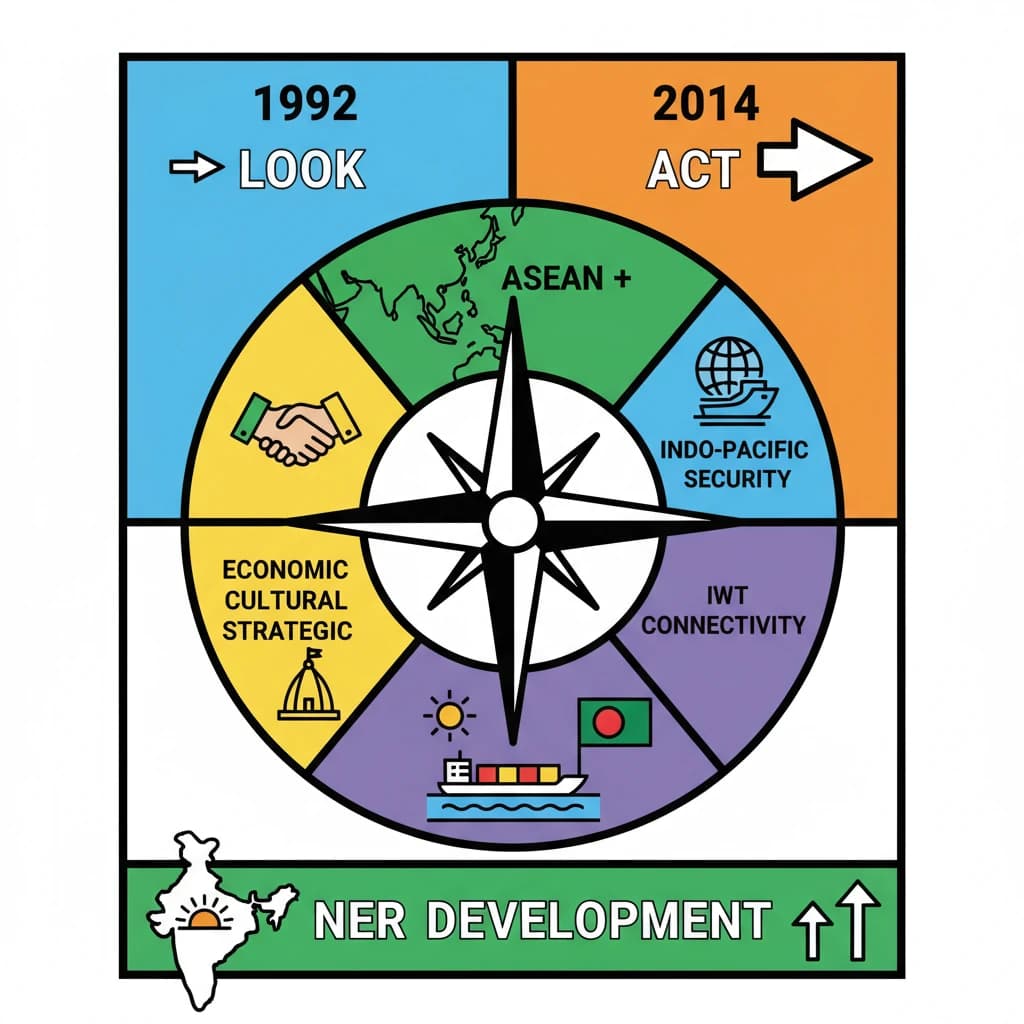
  • •Act East Policy (2014) is an upgrade of Look East Policy (1992), expanding geographical and thematic scope.
  • •Shift from primarily economic integration with ASEAN to comprehensive engagement including East Asia, Indo-Pacific, and security cooperation.
  • •Inland Water Transport (IWT) is a key connectivity pillar, exemplified by trial cargo vessels to Bangladesh.
  • •AEP aims to promote economic cooperation, cultural ties, strategic relations, and significantly develop India's North Eastern Region (NER).
  • •India's trade with ASEAN grew substantially post-FTA, highlighting the economic success of the earlier policy and setting the stage for AEP's expansion.

🧠 Memory Techniques
Memory Aid
95% Verified Content

Related Topics

Loading related topics...
Explore:International Relations Topics·All Subjects·Daily Current Affairs·Editorial Analysis·Previous Year Questions·UPSC GPT
India’s Act East Policy - UPSC International Relations