Loading page, please wait…
BRICS: Evolution, Expansion, and Significance for Emerging Economies - UPSC International Relations
What is BRICS: Evolution, Expansion, and Significance for Emerging Economies in UPSC International Relations?
BRICS: Evolution, Expansion, and Significance for Emerging Economies is a key topic under International Relations for UPSC Civil Services Examination. Key points include: BRICS started as BRIC (Brazil, Russia, India, China) in 2006, with South Africa joining in 2010.. It represents a grouping of leading emerging economies, advocating for a multipolar world.. The group expanded to 10 members, including Egypt, Ethiopia, Iran, UAE, and Indonesia.. Understanding this topic is essential for both UPSC Prelims and Mains preparation.
Why is BRICS: Evolution, Expansion, and Significance for Emerging Economies important for UPSC exam?
BRICS: Evolution, Expansion, and Significance for Emerging Economies is a Medium-level topic in UPSC International Relations. It is tested in both Prelims (factual MCQs) and Mains (analytical answer writing). Previous year UPSC questions have frequently covered aspects of BRICS: Evolution, Expansion, and Significance for Emerging Economies, making it essential for comprehensive IAS preparation.
How to prepare BRICS: Evolution, Expansion, and Significance for Emerging Economies for UPSC?
To prepare BRICS: Evolution, Expansion, and Significance for Emerging Economies for UPSC: (1) Study the comprehensive notes covering all key concepts on Vaidra. (2) Practice previous year questions on this topic. (3) Connect it with current affairs using daily updates. (4) Revise using key takeaways and mind maps available for International Relations. (5) Write practice answers linking BRICS: Evolution, Expansion, and Significance for Emerging Economies to related GS Paper topics.
Key takeaways of BRICS: Evolution, Expansion, and Significance for Emerging Economies for UPSC
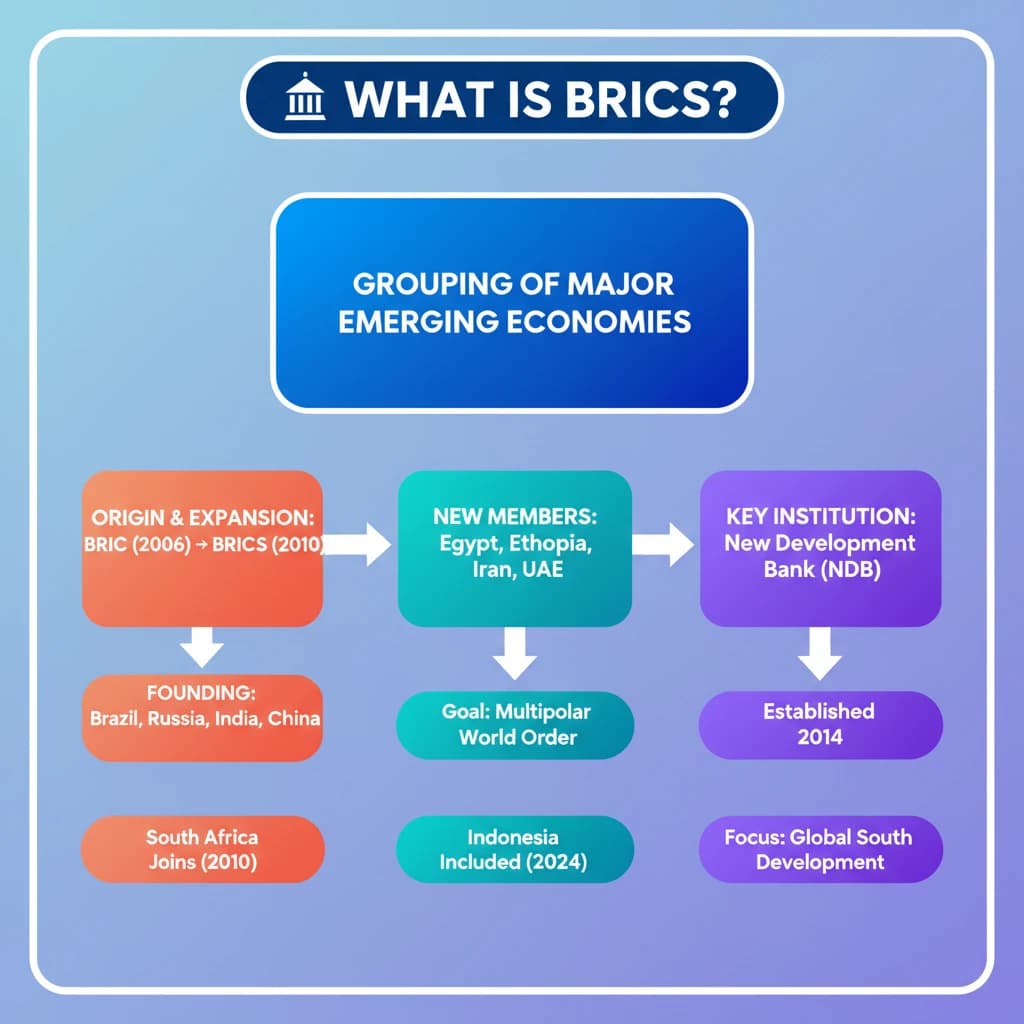
- BRICS started as BRIC (Brazil, Russia, India, China) in 2006, with South Africa joining in 2010.
- It represents a grouping of leading emerging economies, advocating for a multipolar world.
- The group expanded to 10 members, including Egypt, Ethiopia, Iran, UAE, and Indonesia.
- The New Development Bank (NDB), established in 2014, is a key institutional achievement.
- BRICS aims to foster economic cooperation, sustainable development, and a stronger voice for the Global South.

BRICS: Evolution, Expansion, and Significance for Emerging Economies
Medium⏱️ 5 min read
international relations
📖 Introduction
Formation of BRIC: The Genesis
The concept of BRIC (Brazil, Russia, India, and China) was first formally recognized in 2006.
Leaders of these four nations met informally on the sidelines of the G8 Outreach Summit, laying the groundwork for this significant grouping.
Initial Members: Brazil, Russia, India, China
Year of Informal Formation: 2006
Context: Sidelines of G8 (now G7) Outreach Summit
Expansion to BRICS: A Growing Influence
The group expanded in 2010 with the inclusion of South Africa.
This addition transformed the acronym from BRIC to BRICS, signifying its growing geographical and economic reach.
Key Expansion: South Africa joined in 2010, forming BRICS.
BRICS: A Bloc of Emerging Economies
BRICS represents a crucial grouping of the world’s leading emerging economies.
Its primary objective is to foster cooperation and address global challenges from the perspective of developing nations.
Current Membership: A Global Footprint
As of recent developments, the BRICS group has further expanded its membership.
It now comprises 10 countries, enhancing its collective influence on the global stage.
Current Members:
- Brazil
- China
- Egypt
- Ethiopia
- India
- Iran
- Russian Federation
- South Africa
- UAE
- Indonesia
Inaugural Summit and Key Milestones
The first official BRIC summit was held in Yekaterinburg, Russia, in 2009.
This event marked a significant step in formalizing the group's collaborative efforts and agenda.
A major achievement was the establishment of the New Development Bank (NDB).
The agreement for the NDB was signed during the 6th BRICS Summit in Fortaleza in 2014.
First BRIC Summit: Yekaterinburg, Russia (2009)
New Development Bank (NDB) Establishment: Signed at 6th BRICS Summit in Fortaleza (2014)
Broader Objectives and Collaboration
Beyond economic and political cooperation, BRICS countries are encouraged to collaborate on specific global issues.
This includes efforts towards conservation of vulnerable species, highlighting a commitment to environmental concerns.
UPSC Insight: Understanding the evolution of BRICS from BRIC, its membership changes, and key institutions like the NDB is crucial for International Relations (GS-II). Pay attention to the dates and locations of major summits.
💡 Key Takeaways
- •BRICS started as BRIC (Brazil, Russia, India, China) in 2006, with South Africa joining in 2010.
- •It represents a grouping of leading emerging economies, advocating for a multipolar world.
- •The group expanded to 10 members, including Egypt, Ethiopia, Iran, UAE, and Indonesia.
- •The New Development Bank (NDB), established in 2014, is a key institutional achievement.
- •BRICS aims to foster economic cooperation, sustainable development, and a stronger voice for the Global South.
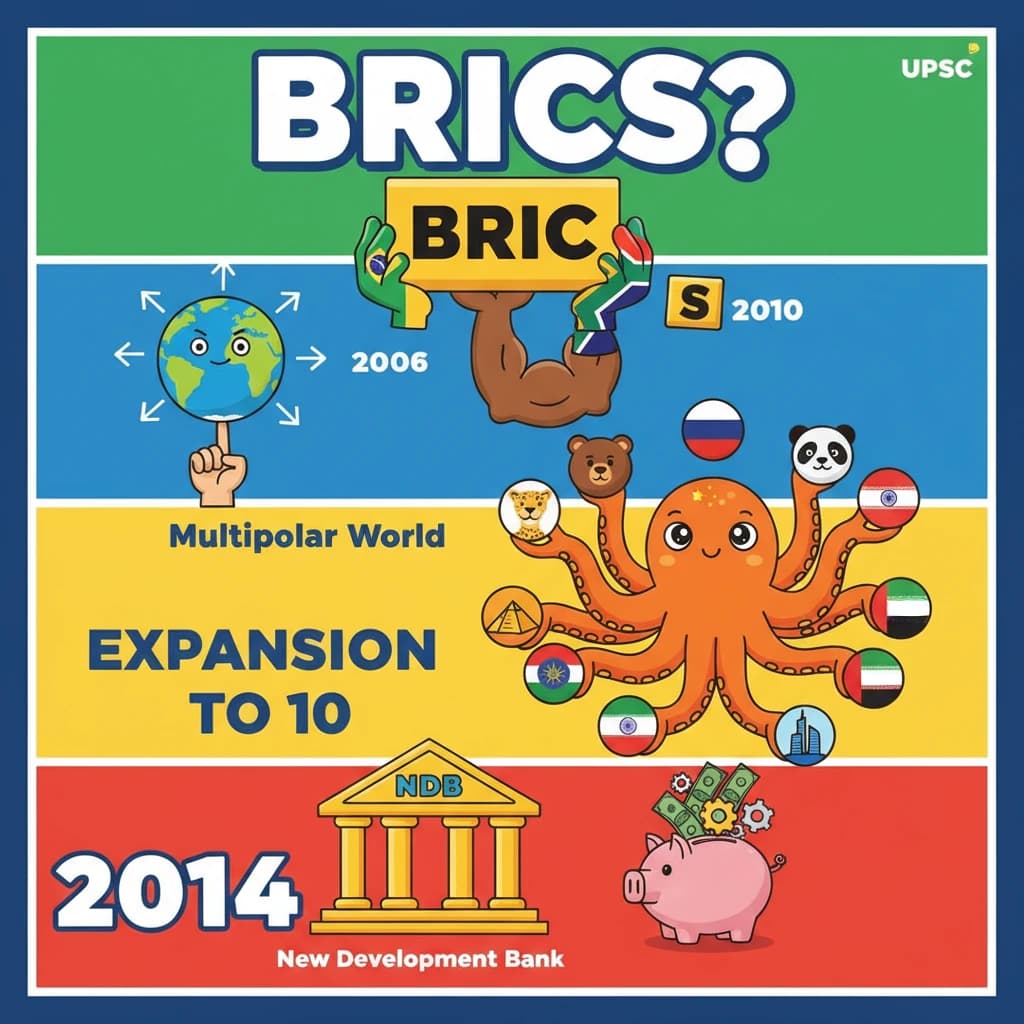
🧠 Memory Techniques
98% Verified Content
📚 Reference Sources
•Official BRICS website (general knowledge)
•New Development Bank (NDB) official website (general knowledge)