📖 Introduction
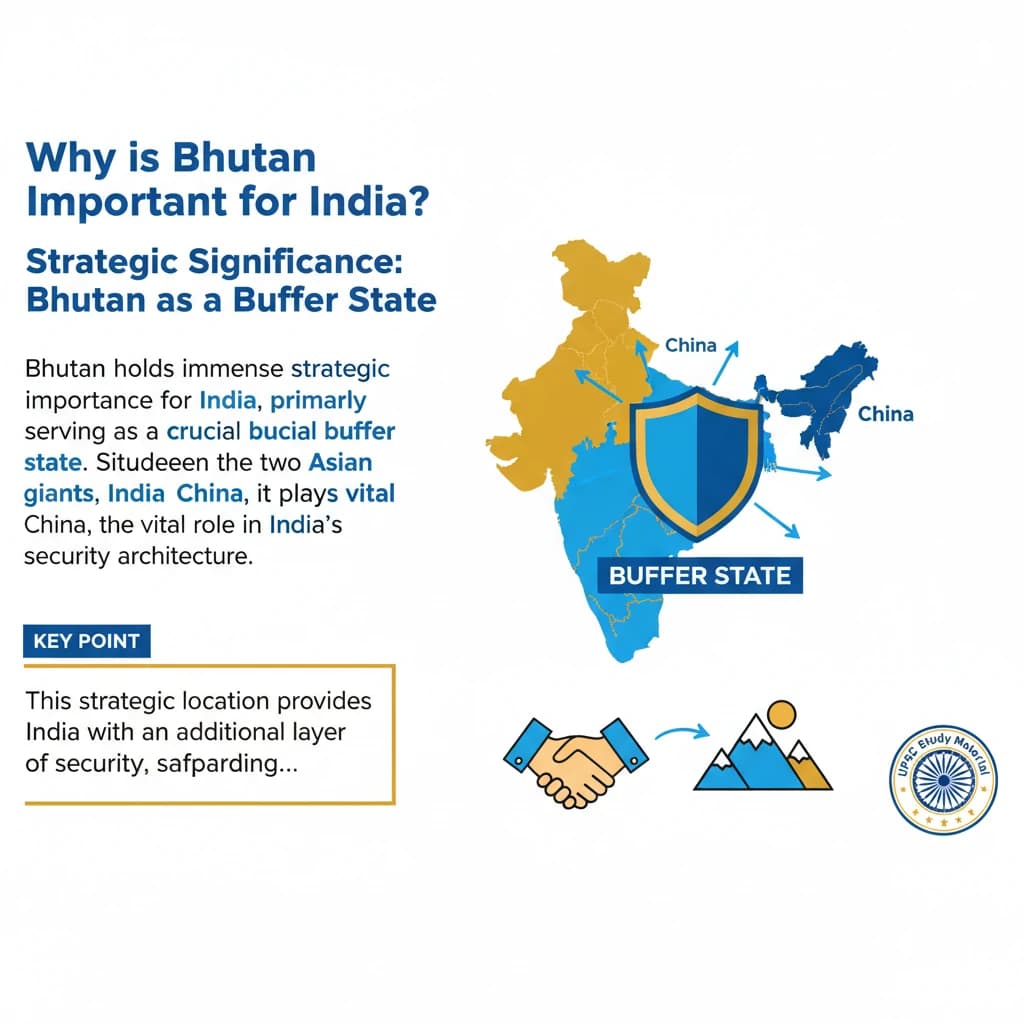
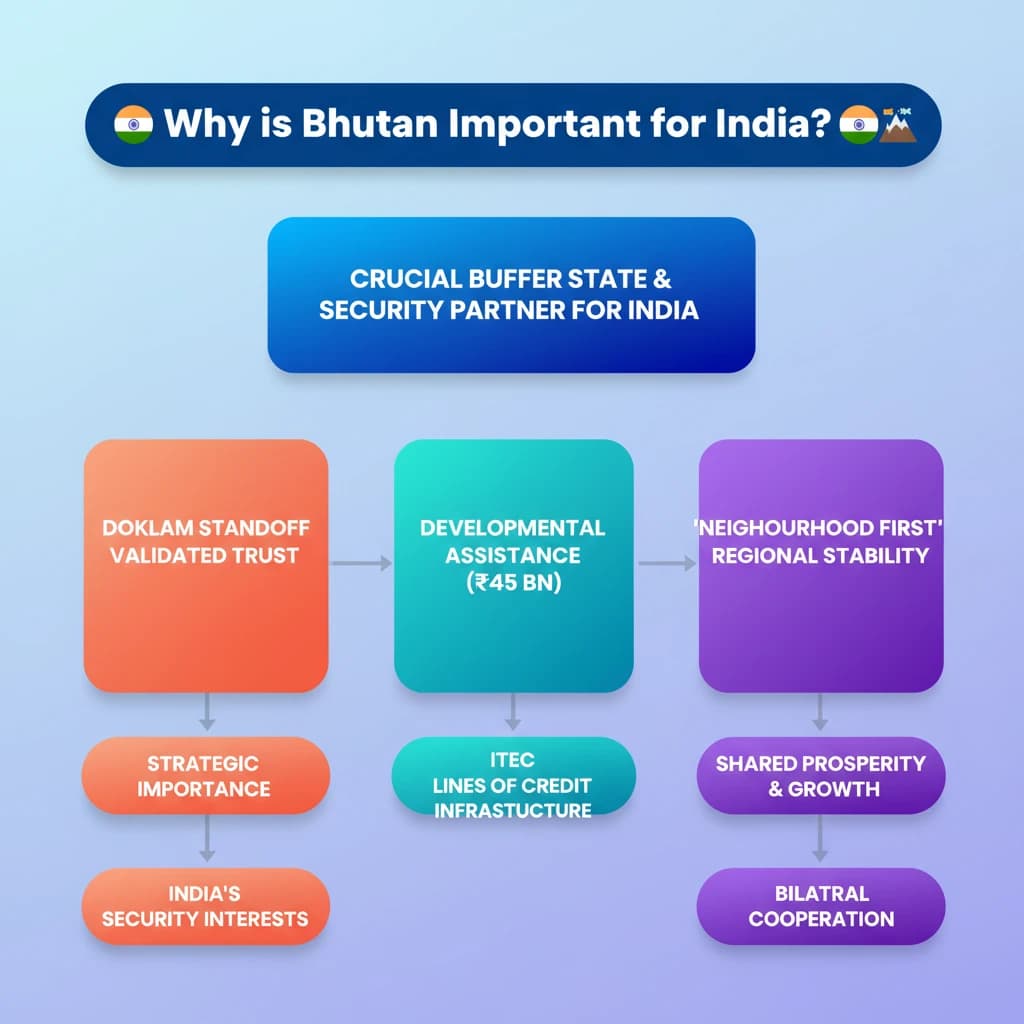
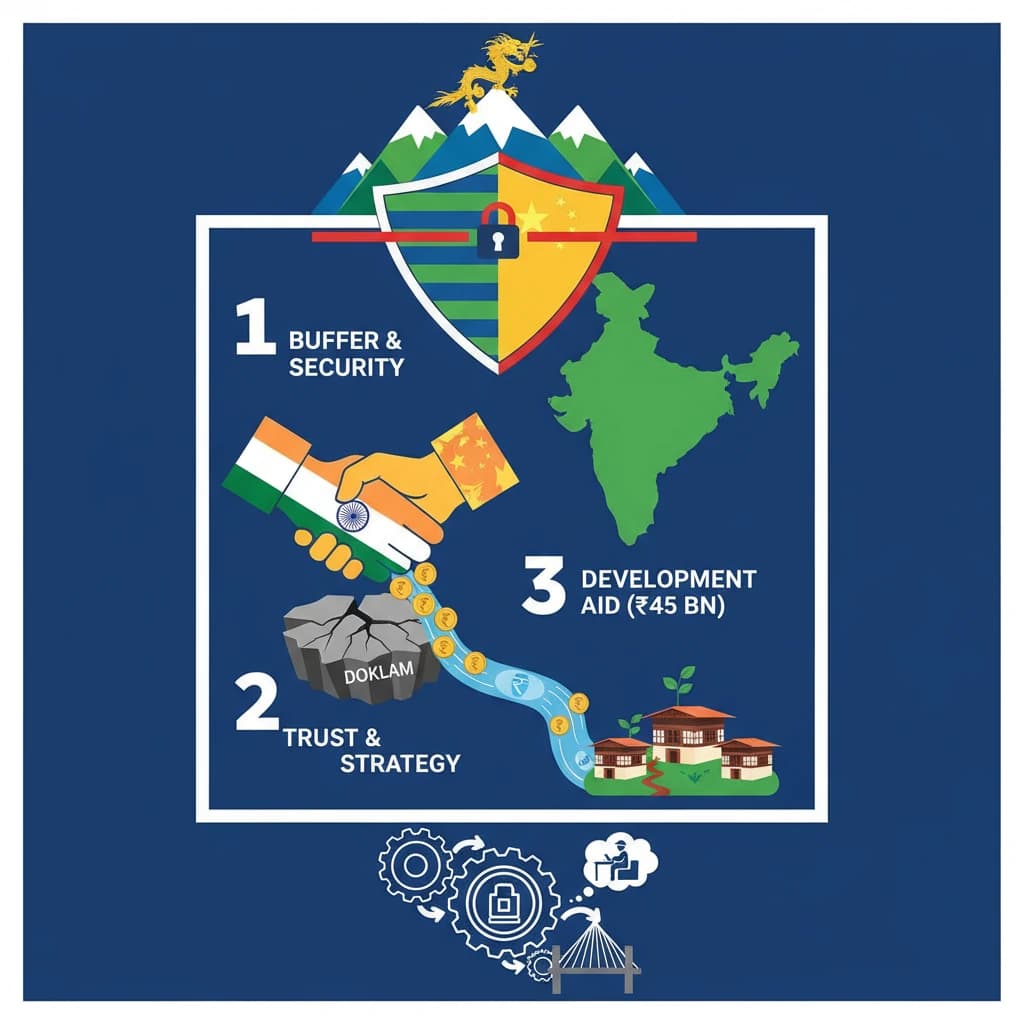
<h4>Strategic Significance: Bhutan as a Buffer State</h4><p><strong>Bhutan</strong> holds immense strategic importance for <strong>India</strong>, primarily serving as a crucial <strong>buffer state</strong>. Situated between the two Asian giants, <strong>India</strong> and <strong>China</strong>, it plays a vital role in India's security architecture.</p><div class='key-point-box'><p>This <strong>strategic location</strong> provides <strong>India</strong> with an additional layer of security, safeguarding against potential threats emanating from its northern borders, particularly concerning the contested <strong>India-China border</strong>.</p></div><h4>Role in Doklam Standoff (2017)</h4><p>The strategic importance of <strong>Bhutan</strong> was vividly demonstrated during the <strong>2017 Doklam standoff</strong>. This incident involved a military confrontation between <strong>India</strong> and <strong>China</strong> over a disputed plateau near the tri-junction.</p><p>During this critical period, <strong>Bhutan</strong> played a pivotal role by allowing <strong>Indian troops</strong> to enter its territory. This facilitated India's resistance against Chinese incursions, highlighting the deep trust and strategic alignment between the two nations.</p><h4>Economic Development and Bilateral Assistance</h4><p><strong>India's full support</strong> for the socio-economic development of <strong>Bhutan</strong> is a cornerstone of their bilateral relations. This partnership is driven by shared priorities to boost <strong>cross-border connectivity</strong> and expand ties in areas like <strong>trade</strong>, <strong>infrastructure</strong>, and <strong>energy</strong>.</p><div class='info-box'><p>The <strong>Government of India</strong> committed a substantial <strong>Rs. 45 billion</strong> to <strong>Bhutan's 12th Five Year Plan (2018-2023)</strong>. A significant portion of this, <strong>Rs. 28 billion</strong>, was allocated for <strong>Project Tied Assistance (PTA)</strong>.</p></div><p>The <strong>PTA program</strong> encompasses a wide array of projects. These initiatives span critical sectors aimed at improving the quality of life and fostering sustainable growth in <strong>Bhutan</strong>.</p><ul><li><strong>Health:</strong> Enhancing healthcare facilities and services.</li><li><strong>Education:</strong> Supporting educational infrastructure and programs.</li><li><strong>Culture:</strong> Preserving and promoting Bhutanese cultural heritage.</li><li><strong>Livestock Development:</strong> Boosting agricultural productivity and food security.</li><li><strong>Infrastructure:</strong> Developing essential physical infrastructure like roads and bridges.</li></ul><h4>Capacity Building and Technical Cooperation</h4><p><strong>India's development partnership</strong> with friendly nations, including <strong>Bhutan</strong>, prioritizes <strong>capacity building</strong>. This involves a multi-faceted approach to skill development and knowledge transfer.</p><p>Assistance includes offering <strong>civilian and military training</strong>, conducting <strong>on-site programs</strong>, and deputing <strong>expert personnel</strong>. These efforts aim to strengthen human resources and institutional capabilities in partner countries.</p><div class='info-box'><p>The <strong>Indian Technical and Economic Cooperation (ITEC) Program</strong>, launched in <strong>1964</strong>, is a flagship initiative. It extends to <strong>160 partner countries</strong>, providing short-term training across diverse disciplines. The program witnessed significant growth, from <strong>4,000 to 14,000 slots</strong> by <strong>2019-20</strong>.</p></div><p><strong>ITEC courses</strong> cover a broad spectrum of areas, contributing to holistic skill enhancement. These include <strong>Engineering</strong>, <strong>Climate Change</strong>, <strong>Health</strong>, and <strong>Women Empowerment</strong>, reflecting contemporary global needs.</p><h4>Lines of Credit for Development Projects</h4><p><strong>Development assistance</strong> is also extended through concessional <strong>Lines of Credit (LOCs)</strong>. These are provided by <strong>India</strong> under the <strong>Indian Development and Economic Assistance Scheme (IDEAS)</strong>, channeled through the <strong>Exim Bank of India</strong>.</p><div class='info-box'><p>Globally, <strong>India</strong> has extended a total of <strong>306 LOCs</strong> worth <strong>USD 30.59 billion</strong> to <strong>65 countries</strong>. These financial instruments support crucial infrastructure and development projects.</p></div><p>Projects funded under <strong>LOCs</strong> cover vital sectors. These include <strong>transport</strong>, <strong>power generation</strong>, <strong>agriculture</strong>, <strong>manufacturing industries</strong>, <strong>healthcare</strong>, <strong>education</strong>, and <strong>capacity building</strong>, contributing to broad-based economic growth.</p><div class='exam-tip-box'><p><strong>UPSC Insight:</strong> Understanding <strong>India's development assistance models</strong> like <strong>ITEC</strong> and <strong>LOCs</strong>, and their specific application in countries like <strong>Bhutan</strong>, is crucial for questions on <strong>India's foreign policy</strong> and <strong>regional diplomacy</strong> (<strong>GS Paper 2</strong>).</p></div>