Loading page, please wait…
Vaidra Logo
Vaidra

Top 4 items + smart groups

UPSC GPT
New
Current Affairs
Daily Solutions
Daily Puzzle
Mains Evaluator

Version 2.0.0 • Built with ❤️ for UPSC aspirants

Loading...
Loading...
Loading...
Loading...
Loading...
Loading...
Loading...
Loading...
Loading...
Loading...
Loading...
Loading...
Loading...
Back
All Subjects

Topics

0 topics • 0 completed

Loading topics...
Loading...
Loading...
Loading...
Loading...
Loading...
Overall Progress0%

Indo-Pacific Economic Framework (IPEF): Objectives, Members, and Pillars - UPSC International Relations

What is Indo-Pacific Economic Framework (IPEF): Objectives, Members, and Pillars in UPSC International Relations?

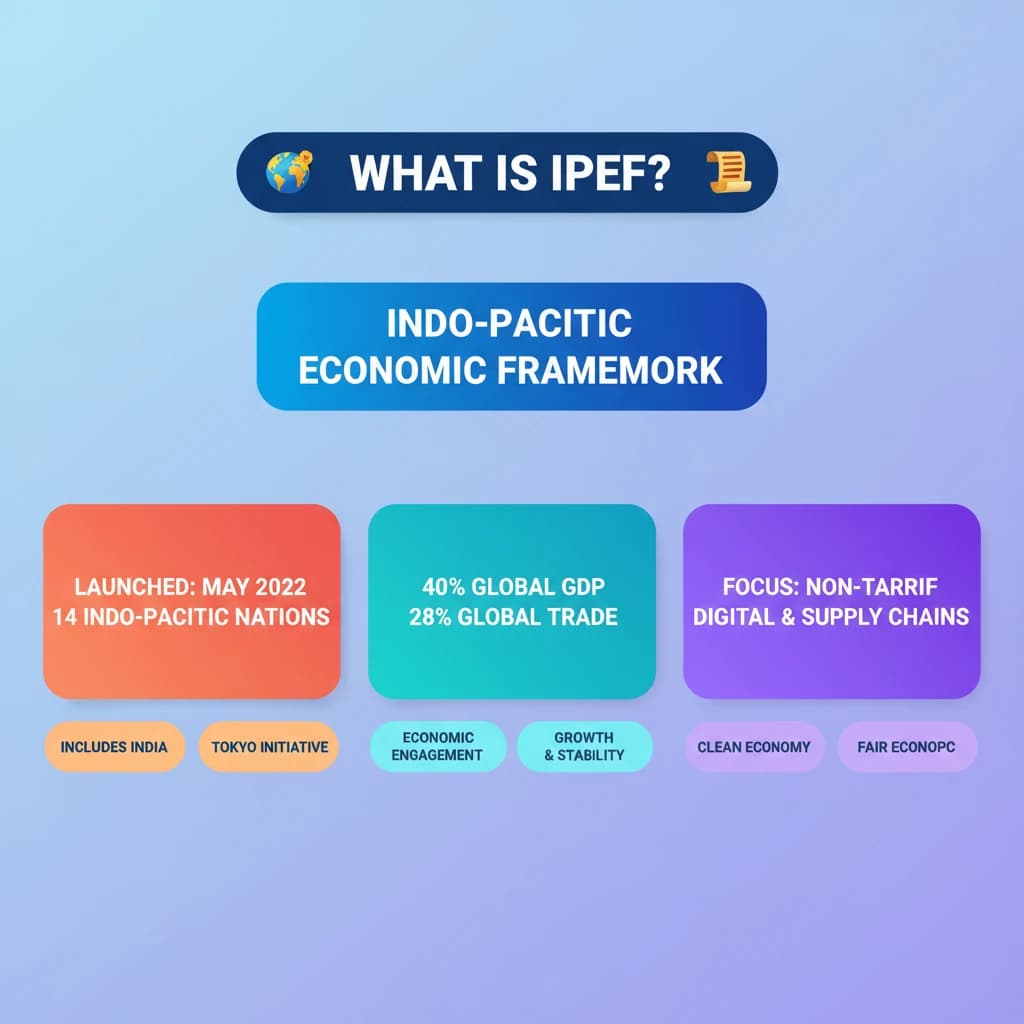
Indo-Pacific Economic Framework (IPEF): Objectives, Members, and Pillars is a key topic under International Relations for UPSC Civil Services Examination. Key points include: IPEF launched May 2022 in Tokyo with 14 Indo-Pacific nations, including India.. Aims to strengthen economic engagement, growth, stability, and prosperity in the region.. Members represent 40% of global GDP and 28% of global trade.. Understanding this topic is essential for both UPSC Prelims and Mains preparation.

Why is Indo-Pacific Economic Framework (IPEF): Objectives, Members, and Pillars important for UPSC exam?

Indo-Pacific Economic Framework (IPEF): Objectives, Members, and Pillars is a Medium-level topic in UPSC International Relations. It is tested in both Prelims (factual MCQs) and Mains (analytical answer writing). Previous year UPSC questions have frequently covered aspects of Indo-Pacific Economic Framework (IPEF): Objectives, Members, and Pillars, making it essential for comprehensive IAS preparation.

How to prepare Indo-Pacific Economic Framework (IPEF): Objectives, Members, and Pillars for UPSC?

To prepare Indo-Pacific Economic Framework (IPEF): Objectives, Members, and Pillars for UPSC: (1) Study the comprehensive notes covering all key concepts on Vaidra. (2) Practice previous year questions on this topic. (3) Connect it with current affairs using daily updates. (4) Revise using key takeaways and mind maps available for International Relations. (5) Write practice answers linking Indo-Pacific Economic Framework (IPEF): Objectives, Members, and Pillars to related GS Paper topics.

Key takeaways of Indo-Pacific Economic Framework (IPEF): Objectives, Members, and Pillars for UPSC

  • IPEF launched May 2022 in Tokyo with 14 Indo-Pacific nations, including India.
  • Aims to strengthen economic engagement, growth, stability, and prosperity in the region.
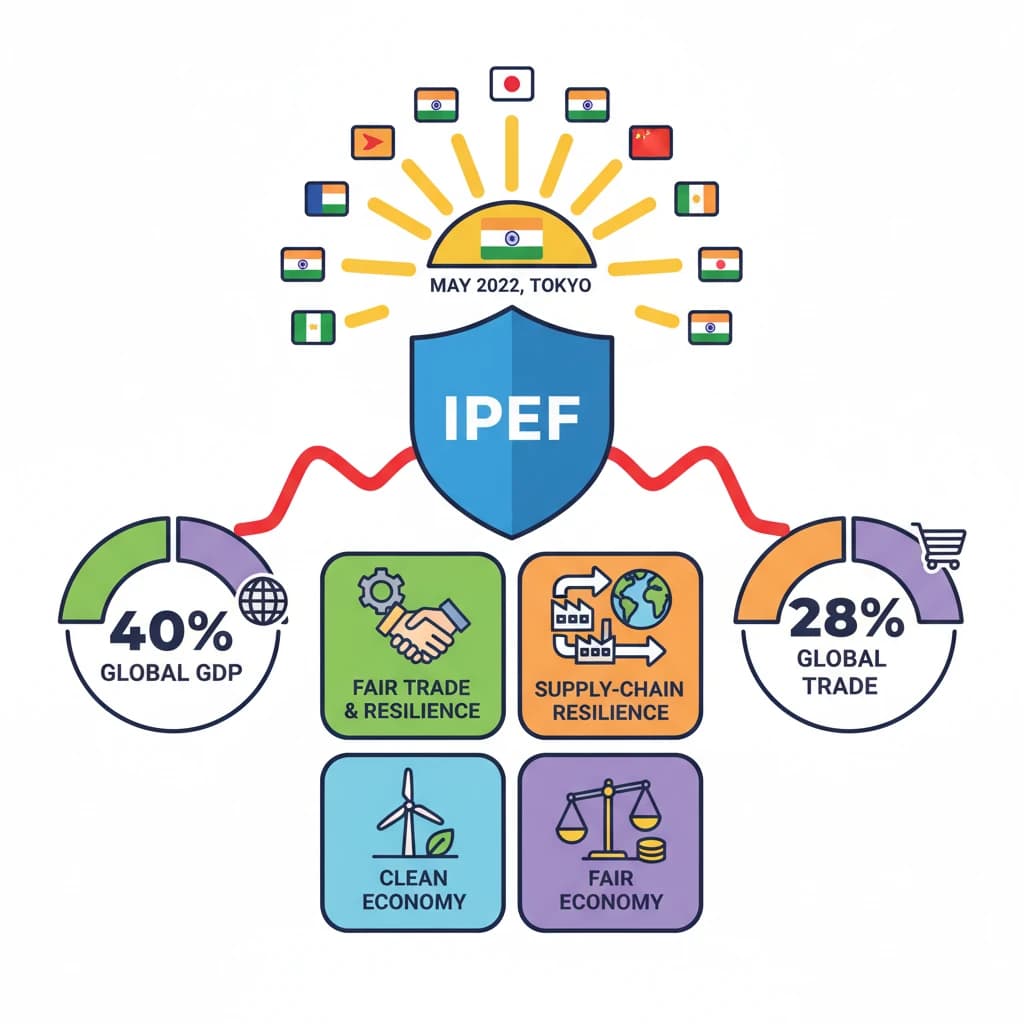
  • Members represent 40% of global GDP and 28% of global trade.
  • Built on 4 main pillars: Fair and Resilient Trade, Supply-Chain Resilience, and two others (Clean Economy, Fair Economy) not detailed in this summary.
  • Focuses on non-tariff aspects like supply chain resilience and digital economy, differing from traditional FTAs.
  • Offers a flexible framework where members can opt-in to specific pillars, not requiring full commitment to all.
Indo-Pacific Economic Framework (IPEF): Objectives, Members, and Pillars

Indo-Pacific Economic Framework (IPEF): Objectives, Members, and Pillars

Medium⏱️ 8 min read✓ 95% Verified
international relations

📖 Introduction

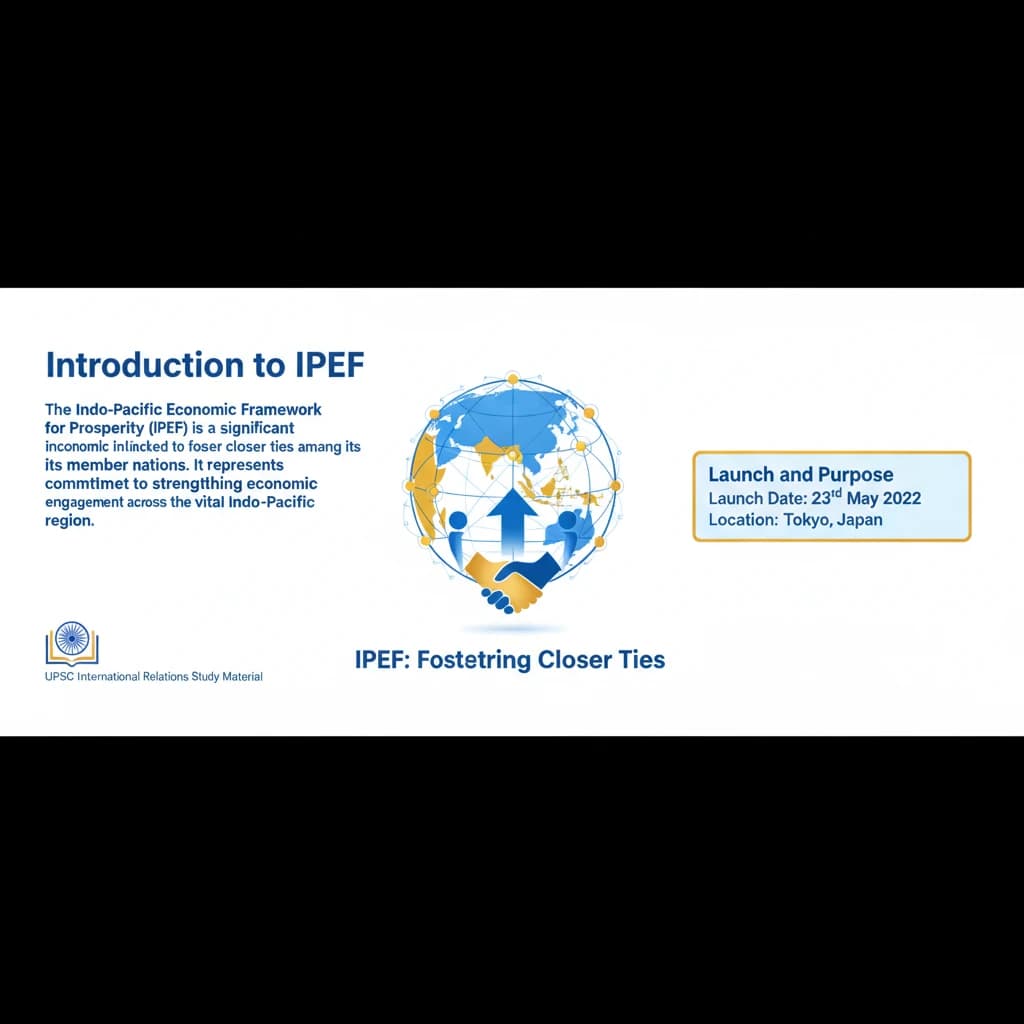
<h4>Introduction to IPEF</h4><p>The <strong>Indo-Pacific Economic Framework for Prosperity (IPEF)</strong> is a significant economic initiative launched to foster closer ties among its member nations. It represents a commitment to strengthening economic engagement across the vital <strong>Indo-Pacific region</strong>.</p><h4>Launch and Purpose</h4><div class='info-box'><p><strong>Launch Date:</strong> <strong>23rd May 2022</strong></p><p><strong>Location:</strong> <strong>Tokyo, Japan</strong></p><p><strong>Initial Members:</strong> <strong>14 countries</strong></p></div><p>The primary objective of <strong>IPEF</strong> is to enhance <strong>economic engagement and cooperation</strong> among its partner countries. This framework aims to drive sustainable <strong>growth</strong>, ensure <strong>economic stability</strong>, and promote overall <strong>prosperity</strong> within the region.</p><h4>Member Countries and Economic Clout</h4><p>The <strong>IPEF</strong> comprises a diverse group of <strong>14 nations</strong> spanning the Indo-Pacific. These members are crucial players in the global economy and represent a substantial portion of international trade and output.</p><div class='info-box'><p><strong>IPEF Partner Countries:</strong></p><ul><li><strong>Australia</strong></li><li><strong>Brunei</strong></li><li><strong>Fiji</strong></li><li><strong>India</strong></li><li><strong>Indonesia</strong></li><li><strong>Japan</strong></li><li><strong>South Korea</strong></li><li><strong>Malaysia</strong></li><li><strong>New Zealand</strong></li><li><strong>Philippines</strong></li><li><strong>Singapore</strong></li><li><strong>Thailand</strong></li><li><strong>United States</strong></li><li><strong>Vietnam</strong></li></ul></div><div class='key-point-box'><p>Collectively, these <strong>14 IPEF partners</strong> account for approximately <strong>40% of global GDP</strong> and <strong>28% of global goods and services trade</strong>, highlighting their significant economic influence.</p></div><h4>The Four Pillars of IPEF</h4><p>The <strong>IPEF</strong> is structured around <strong>four main pillars</strong>, each addressing critical aspects of economic cooperation and resilience. These pillars guide the framework's initiatives and negotiations.</p><h5>Pillar I: Fair and Resilient Trade</h5><p>This pillar focuses on establishing high-standard, inclusive, and transparent rules of engagement for trade among partner countries. It aims to foster an environment conducive to robust economic activity.</p><div class='info-box'><p><strong>Objective:</strong> To promote sustained <strong>economic growth</strong>, regional <strong>peace</strong>, and collective <strong>prosperity</strong> through fair and resilient trade practices.</p></div><h5>Pillar II: Supply-Chain Resilience</h5><p>Recognizing the vulnerabilities exposed by recent global events, this pillar is dedicated to strengthening supply chains. It seeks to prevent disruptions and ensure smooth economic functioning.</p><ul><li>It aims to make <strong>supply chains more resilient, robust, and well-integrated</strong> across the Indo-Pacific.</li><li>Key areas of focus include improving <strong>logistics</strong>, enhancing <strong>connectivity</strong>, and boosting <strong>investments in critical sectors</strong>.</li><li>The pillar also emphasizes improving the role of <strong>workers</strong> through targeted <strong>upskilling and reskilling initiatives</strong>.</li></ul><div class='exam-tip-box'><p>UPSC aspirants should note that <strong>supply chain resilience</strong> is a recurring theme in international relations and economics, often linked to geopolitical stability and economic security. Questions may arise on how <strong>IPEF</strong> contributes to this goal, especially for countries like <strong>India</strong>.</p></div>
Concept Diagram

💡 Key Takeaways

  • •IPEF launched May 2022 in Tokyo with 14 Indo-Pacific nations, including India.
  • •Aims to strengthen economic engagement, growth, stability, and prosperity in the region.
  • •Members represent 40% of global GDP and 28% of global trade.
  • •Built on 4 main pillars: Fair and Resilient Trade, Supply-Chain Resilience, and two others (Clean Economy, Fair Economy) not detailed in this summary.
  • •Focuses on non-tariff aspects like supply chain resilience and digital economy, differing from traditional FTAs.
  • •Offers a flexible framework where members can opt-in to specific pillars, not requiring full commitment to all.

🧠 Memory Techniques
Memory Aid
95% Verified Content

📚 Reference Sources

•Official White House Briefings on IPEF
•Reports from think tanks on Indo-Pacific economic strategy

Related Topics

Loading related topics...
Explore:International Relations Topics·All Subjects·Daily Current Affairs·Editorial Analysis·Previous Year Questions·UPSC GPT
Indo-Pacific Economic Framework (IPEF): Objectives, Members, and Pillars - UPSC International Relations