Loading page, please wait…
Vaidra Logo
Vaidra

Top 4 items + smart groups

UPSC GPT
New
Current Affairs
Daily Solutions
Daily Puzzle
Mains Evaluator

Version 2.0.0 • Built with ❤️ for UPSC aspirants

Loading...
Loading...
Loading...
Loading...
Loading...
Loading...
Loading...
Loading...
Loading...
Loading...
Loading...
Loading...
Loading...
Back
All Subjects

Topics

0 topics • 0 completed

Loading topics...
Loading...
Loading...
Loading...
Loading...
Loading...
Overall Progress0%

Modern Threat of Nuclear Weapons - UPSC International Relations

What is Modern Threat of Nuclear Weapons in UPSC International Relations?

Modern Threat of Nuclear Weapons is a key topic under International Relations for UPSC Civil Services Examination. Key points include: Nuclear weapons have evolved from 15 kt (Hiroshima) to 50 Mt (Tsar Bomba), an increase of over 3,800 times in destructive power.. This exponential increase in yield occurred primarily during the Cold War arms race.. Modern nuclear arsenals, while often using smaller warheads, employ advanced delivery systems like MIRVs for strategic impact.. Understanding this topic is essential for both UPSC Prelims and Mains preparation.

Why is Modern Threat of Nuclear Weapons important for UPSC exam?

Modern Threat of Nuclear Weapons is a Medium-level topic in UPSC International Relations. It is tested in both Prelims (factual MCQs) and Mains (analytical answer writing). Previous year UPSC questions have frequently covered aspects of Modern Threat of Nuclear Weapons, making it essential for comprehensive IAS preparation.

How to prepare Modern Threat of Nuclear Weapons for UPSC?

To prepare Modern Threat of Nuclear Weapons for UPSC: (1) Study the comprehensive notes covering all key concepts on Vaidra. (2) Practice previous year questions on this topic. (3) Connect it with current affairs using daily updates. (4) Revise using key takeaways and mind maps available for International Relations. (5) Write practice answers linking Modern Threat of Nuclear Weapons to related GS Paper topics.

Key takeaways of Modern Threat of Nuclear Weapons for UPSC

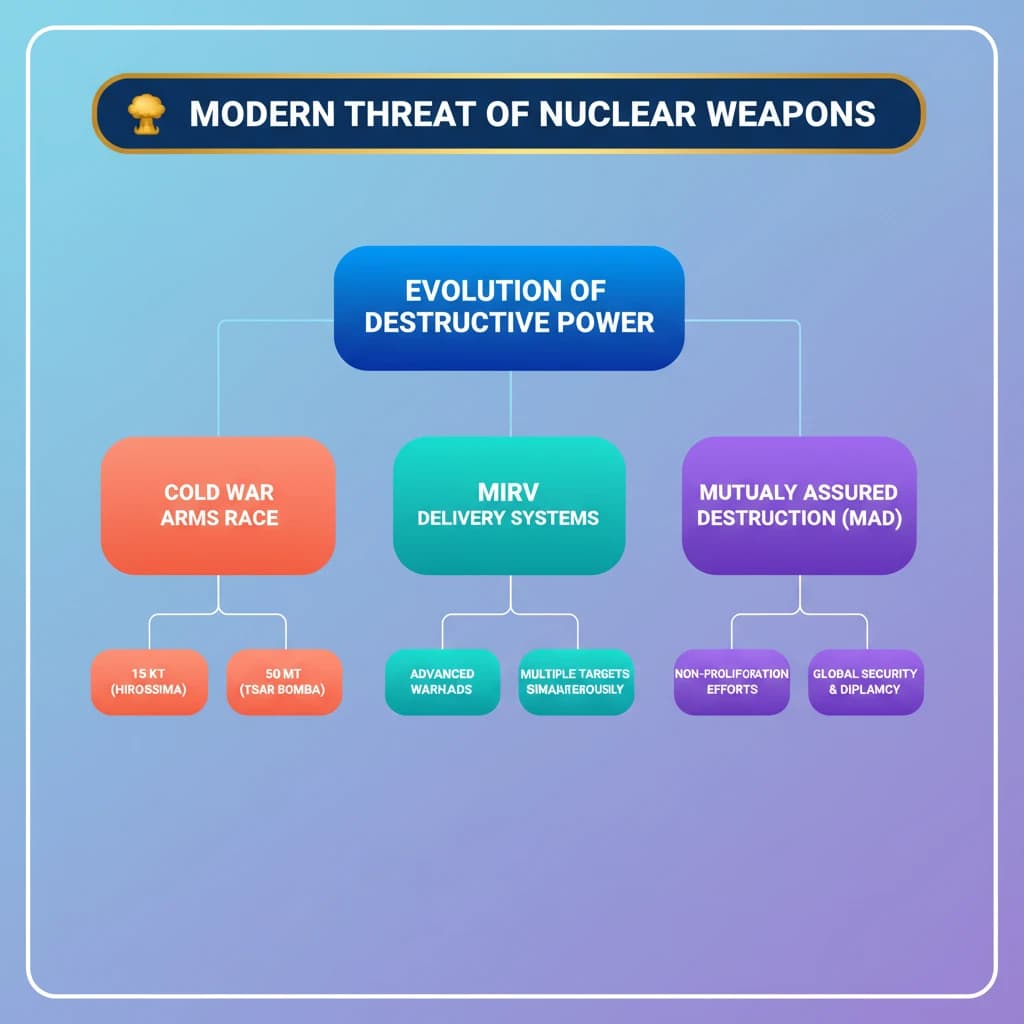
  • Nuclear weapons have evolved from 15 kt (Hiroshima) to 50 Mt (Tsar Bomba), an increase of over 3,800 times in destructive power.
  • This exponential increase in yield occurred primarily during the Cold War arms race.
  • Modern nuclear arsenals, while often using smaller warheads, employ advanced delivery systems like MIRVs for strategic impact.
  • The sheer destructive potential of nuclear weapons underscores the concept of mutually assured destruction (MAD) and the importance of non-proliferation.
  • The threat of nuclear weapons remains a critical factor in contemporary global security, driving arms control efforts and diplomatic engagement.
Modern Threat of Nuclear Weapons

Modern Threat of Nuclear Weapons

Medium⏱️ 7 min read✓ 98% Verified
international relations

📖 Introduction

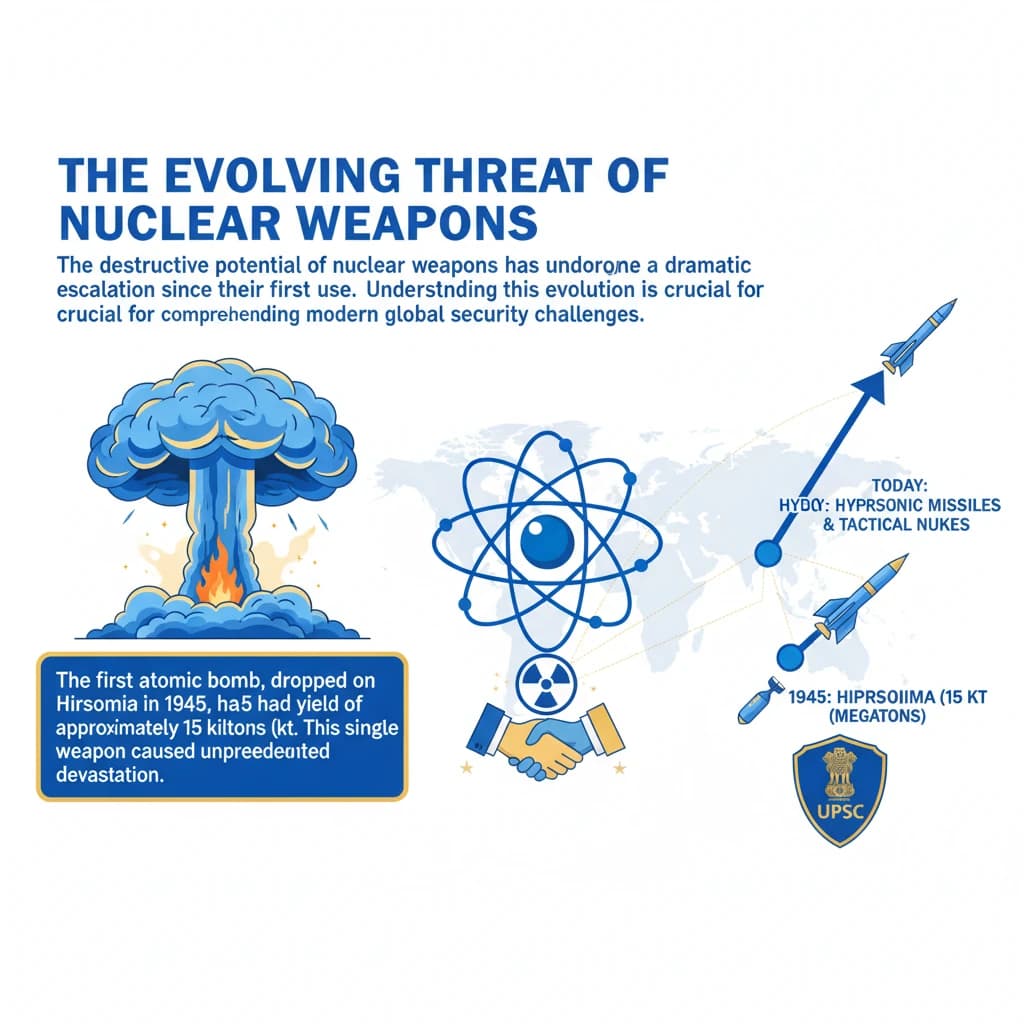
<h4>The Evolving Threat of Nuclear Weapons</h4><p>The destructive potential of <strong>nuclear weapons</strong> has undergone a dramatic escalation since their first use. Understanding this evolution is crucial for comprehending modern global security challenges.</p><div class='info-box'><p>The first atomic bomb, dropped on <strong>Hiroshima</strong> in <strong>1945</strong>, had a yield of approximately <strong>15 kilotons (kt)</strong>. This single weapon caused unprecedented devastation.</p></div><h4>Escalation in Destructive Power</h4><p>Modern nuclear arsenals possess capabilities far exceeding those of early atomic bombs. Technological advancements have led to the development of thermonuclear weapons, also known as hydrogen bombs, with significantly higher yields.</p><div class='info-box'><p>An example of this increased power is the <strong>Tsar Bomba</strong>, tested by <strong>Russia</strong> (then the Soviet Union) in <strong>1961</strong>. This weapon achieved an estimated yield of <strong>50 megatons (Mt)</strong>.</p></div><div class='key-point-box'><p>To put this in perspective, the <strong>Tsar Bomba</strong> was over <strong>3,800 times more powerful</strong> than the bomb dropped on <strong>Hiroshima</strong>. This stark difference highlights the exponential increase in destructive capacity.</p></div><h4>Implications for Global Security</h4><p>The existence of such powerful weapons necessitates robust international efforts for non-proliferation and disarmament. The potential for widespread destruction in a nuclear exchange remains a primary concern for policymakers worldwide.</p><div class='exam-tip-box'><p><strong>UPSC Mains GS-II:</strong> When discussing nuclear threats, always mention the qualitative leap in destructive power from early atomic bombs to modern thermonuclear weapons. This demonstrates a nuanced understanding of the subject.</p></div>
Concept Diagram

💡 Key Takeaways

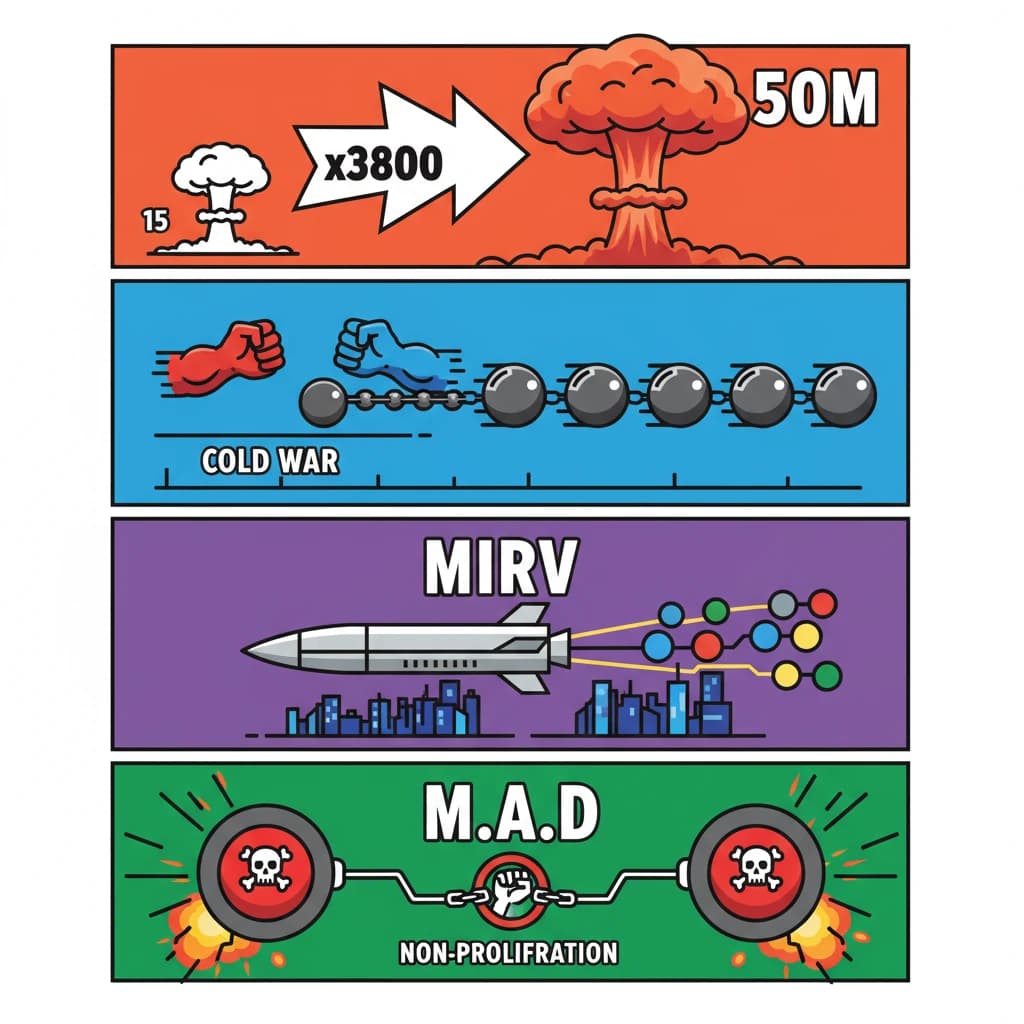
  • •Nuclear weapons have evolved from 15 kt (Hiroshima) to 50 Mt (Tsar Bomba), an increase of over 3,800 times in destructive power.
  • •This exponential increase in yield occurred primarily during the Cold War arms race.
  • •Modern nuclear arsenals, while often using smaller warheads, employ advanced delivery systems like MIRVs for strategic impact.
  • •The sheer destructive potential of nuclear weapons underscores the concept of mutually assured destruction (MAD) and the importance of non-proliferation.
  • •The threat of nuclear weapons remains a critical factor in contemporary global security, driving arms control efforts and diplomatic engagement.

🧠 Memory Techniques
Memory Aid
98% Verified Content

📚 Reference Sources

•Federation of American Scientists (FAS) - Nuclear Weapons Program
•Atomic Heritage Foundation - The Manhattan Project
•International Atomic Energy Agency (IAEA) - Nuclear Security
•United Nations Office for Disarmament Affairs (UNODA)

Related Topics

Loading related topics...
Explore:International Relations Topics·All Subjects·Daily Current Affairs·Editorial Analysis·Previous Year Questions·UPSC GPT
Modern Threat of Nuclear Weapons - UPSC International Relations