Loading page, please wait…
Vaidra Logo
Vaidra

Top 4 items + smart groups

UPSC GPT
New
Current Affairs
Daily Solutions
Daily Puzzle
Mains Evaluator

Version 2.0.0 • Built with ❤️ for UPSC aspirants

Loading...
Loading...
Loading...
Loading...
Loading...
Loading...
Loading...
Loading...
Loading...
Loading...
Loading...
Loading...
Loading...

What are the Key Facts About India and Bhutan? - UPSC International Relations

What is What are the Key Facts About India and Bhutan? in UPSC International Relations?

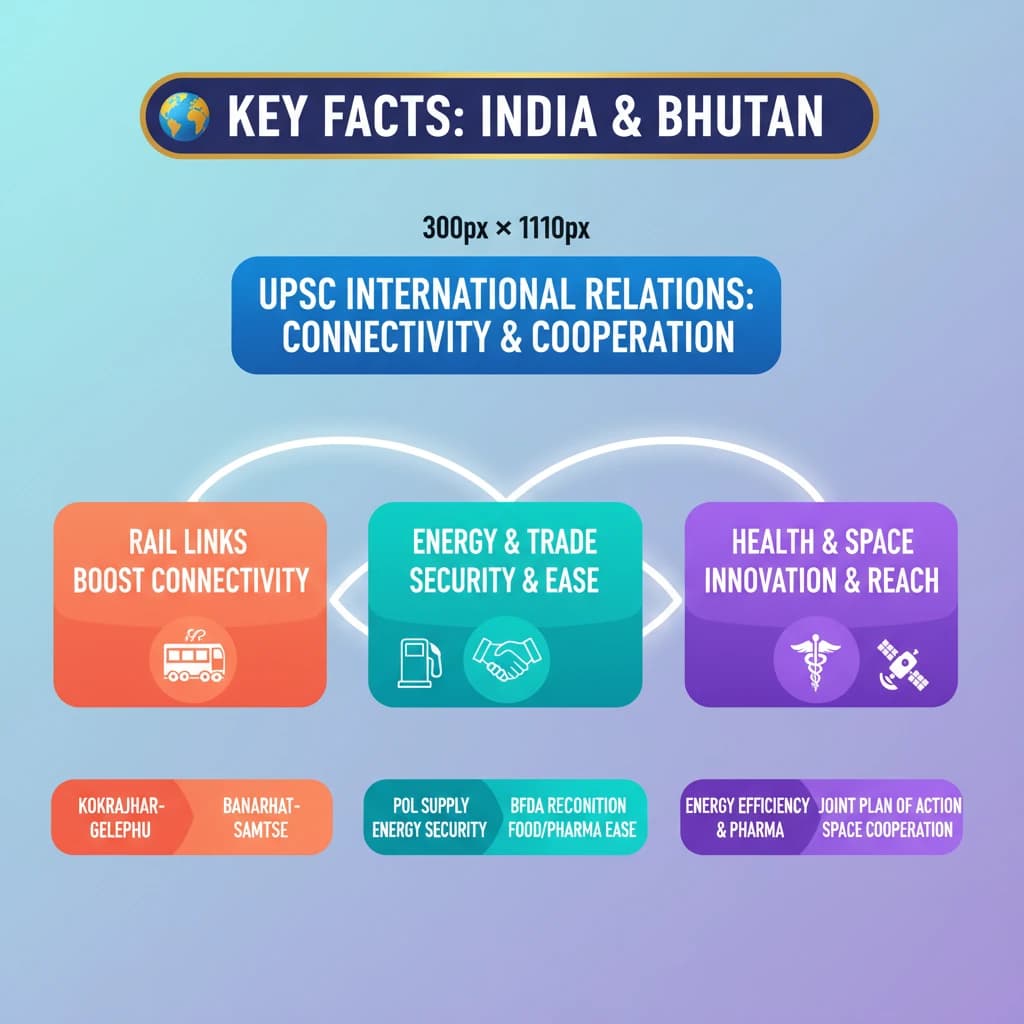
What are the Key Facts About India and Bhutan? is a key topic under International Relations for UPSC Civil Services Examination. Key points include: India and Bhutan have finalized agreements on rail links (Kokrajhar-Gelephu, Banarhat-Samtse) to boost connectivity.. A POL supply agreement ensures Bhutan's energy security through agreed entry/exit points.. BFDA recognition by FSSAI aims to ease business and reduce compliance costs in food/pharma trade.. Understanding this topic is essential for both UPSC Prelims and Mains preparation.

Why is What are the Key Facts About India and Bhutan? important for UPSC exam?

What are the Key Facts About India and Bhutan? is a Medium-level topic in UPSC International Relations. It is tested in both Prelims (factual MCQs) and Mains (analytical answer writing). Previous year UPSC questions have frequently covered aspects of What are the Key Facts About India and Bhutan?, making it essential for comprehensive IAS preparation.

How to prepare What are the Key Facts About India and Bhutan? for UPSC?

To prepare What are the Key Facts About India and Bhutan? for UPSC: (1) Study the comprehensive notes covering all key concepts on Vaidra. (2) Practice previous year questions on this topic. (3) Connect it with current affairs using daily updates. (4) Revise using key takeaways and mind maps available for International Relations. (5) Write practice answers linking What are the Key Facts About India and Bhutan? to related GS Paper topics.

Key takeaways of What are the Key Facts About India and Bhutan? for UPSC

  • India and Bhutan have finalized agreements on rail links (Kokrajhar-Gelephu, Banarhat-Samtse) to boost connectivity.
  • A POL supply agreement ensures Bhutan's energy security through agreed entry/exit points.
  • BFDA recognition by FSSAI aims to ease business and reduce compliance costs in food/pharma trade.
  • MoUs cover energy efficiency (star labelling, auditor training) and acceptance of Indian Pharmacopoeia for affordable generic medicines.
  • A Joint Plan of Action (JPOA) strengthens space cooperation through exchange programs and training.
  • These agreements exemplify India's 'Neighbourhood First' policy and commitment to Bhutan's development and strategic interests.
What are the Key Facts About India and Bhutan?

What are the Key Facts About India and Bhutan?

Medium⏱️ 8 min read✓ 98% Verified
international relations

📖 Introduction

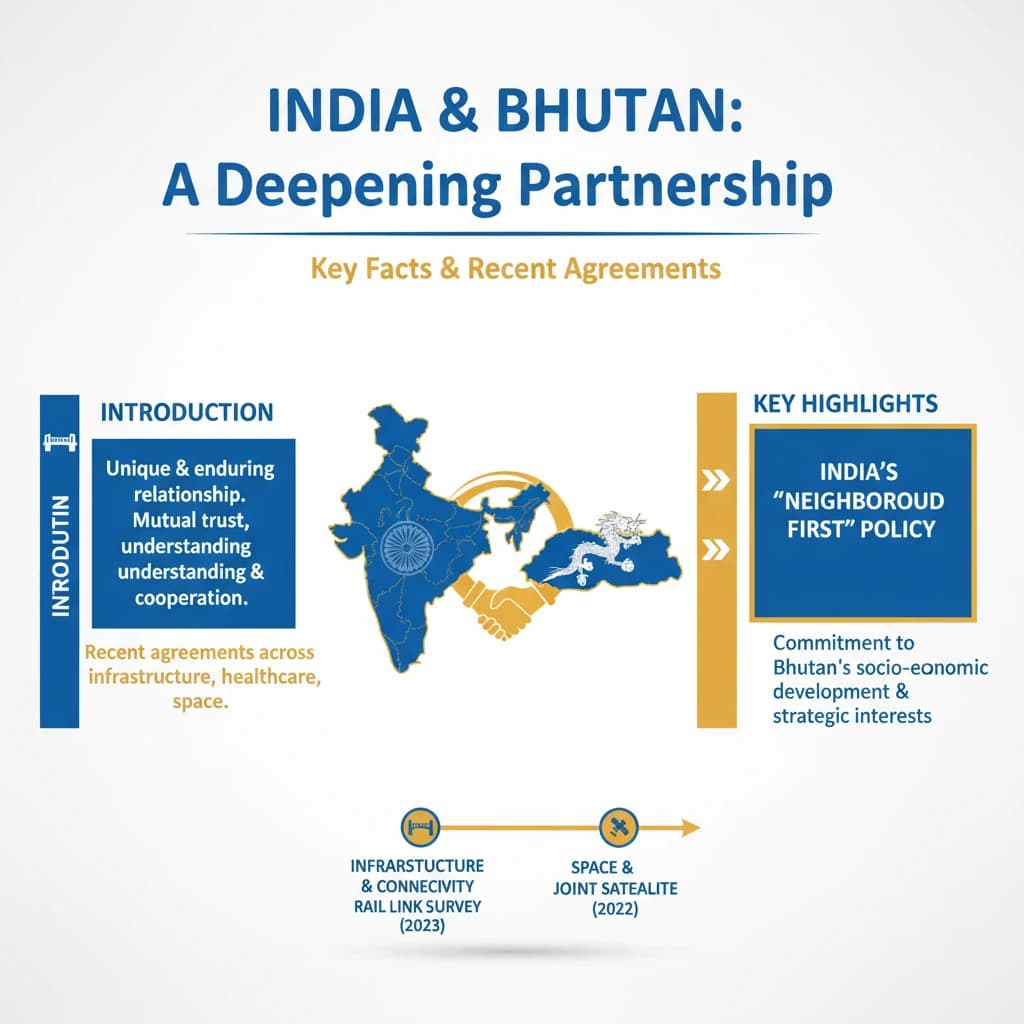
<h4>Introduction to India-Bhutan Relations</h4><p>India and Bhutan share a unique and enduring relationship, characterized by mutual trust, understanding, and cooperation. Recent agreements highlight the deepening of this bilateral partnership across various sectors, from infrastructure to healthcare and space.</p><div class='key-point-box'><p>The agreements underscore India's <strong>'Neighbourhood First' policy</strong> and its commitment to Bhutan's socio-economic development and strategic interests.</p></div><h4>Establishment of Rail Links</h4><p>A significant development is the finalization of a <strong>Memorandum of Understanding (MoU)</strong> for establishing crucial rail links between India and Bhutan. This initiative aims to enhance connectivity and facilitate trade and people-to-people contact.</p><div class='info-box'><p>Key rail links include the <strong>Kokrajhar-Gelephu rail link</strong> and the <strong>Banarhat-Samtse rail link</strong>. These projects are expected to boost economic activities in border regions.</p></div><h4>Petroleum, Oil, and Lubricants (POL) Supply</h4><p>An agreement has been reached for the general supply of <strong>Petroleum, Oil, and Lubricants (POL)</strong> and related products from India to Bhutan. This ensures a stable and reliable energy supply for Bhutan.</p><div class='info-box'><p>The agreement facilitates supply through mutually agreed <strong>entry/exit points</strong>, streamlining logistics and ensuring energy security for Bhutan.</p></div><h4>Recognition of Bhutan Food and Drug Authority (BFDA)</h4><p>A landmark agreement involves the recognition of official controls exercised by the <strong>Bhutan Food and Drug Authority (BFDA)</strong> by the <strong>Food Safety and Standards Authority Of India (FSSAI)</strong>. This promotes smoother trade in food and pharmaceutical products.</p><div class='info-box'><p>This recognition aims to promote <strong>ease of doing business</strong> and significantly reduce compliance costs for traders and manufacturers in both countries.</p></div><h4>Cooperation in Energy Efficiency and Energy Conservation</h4><p>An MoU has been finalized to assist Bhutan in enhancing <strong>energy efficiency</strong>, particularly within its household sector. This aligns with global efforts towards sustainable development.</p><div class='info-box'><p>Measures under this MoU include promoting a <strong>star labelling program</strong> for appliances and institutionalizing the training of <strong>energy auditors</strong> in Bhutan.</p></div><h4>Pharmacopoeia, Vigilance, and Testing of Medicinal Products</h4><p>This MoU focuses on enhancing cooperation and information exchange in the regulation of medicines. It is crucial for ensuring the quality and affordability of pharmaceutical products.</p><div class='info-box'><p>The agreement allows for the acceptance of <strong>Indian Pharmacopoeia</strong> by Bhutan and facilitates the supply of <strong>generic medicines</strong> at affordable prices, benefiting public health.</p></div><h4>Joint Plan of Action (JPOA) on Space Cooperation</h4><p>A concrete roadmap has been established for further developing <strong>space cooperation</strong> between India and Bhutan. This opens new avenues for technological advancement and research.</p><div class='info-box'><p>The JPOA includes provisions for exchange programs and training, fostering scientific collaboration and capacity building in the space sector.</p></div><div class='exam-tip-box'><p>These agreements are crucial for understanding India's evolving <strong>bilateral diplomacy</strong> and its role as a regional partner. They can be cited in answers related to <strong>GS Paper 2: International Relations</strong>, particularly on India's neighbourhood policy and economic diplomacy.</p></div>
Concept Diagram

💡 Key Takeaways

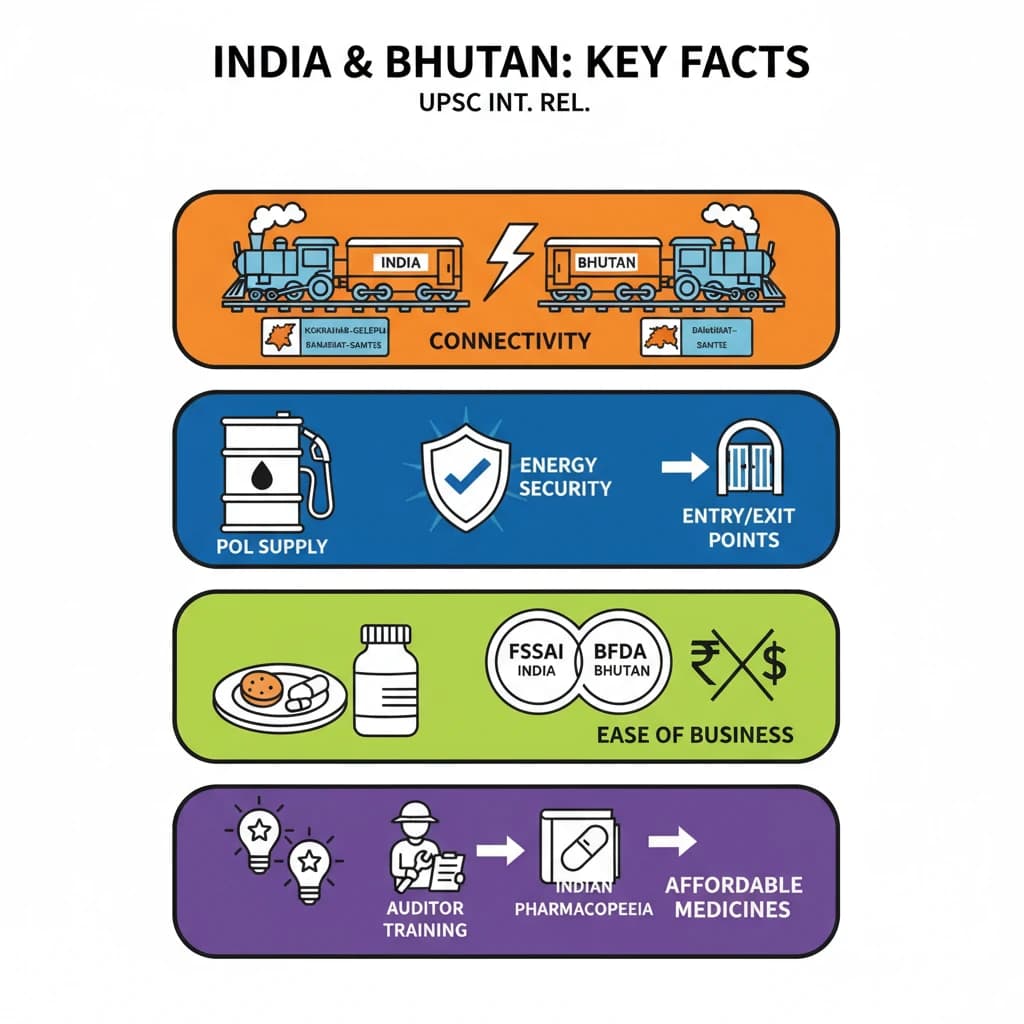
  • •India and Bhutan have finalized agreements on rail links (Kokrajhar-Gelephu, Banarhat-Samtse) to boost connectivity.
  • •A POL supply agreement ensures Bhutan's energy security through agreed entry/exit points.
  • •BFDA recognition by FSSAI aims to ease business and reduce compliance costs in food/pharma trade.
  • •MoUs cover energy efficiency (star labelling, auditor training) and acceptance of Indian Pharmacopoeia for affordable generic medicines.
  • •A Joint Plan of Action (JPOA) strengthens space cooperation through exchange programs and training.
  • •These agreements exemplify India's 'Neighbourhood First' policy and commitment to Bhutan's development and strategic interests.

🧠 Memory Techniques
Memory Aid
98% Verified Content

📚 Reference Sources

•General knowledge of India-Bhutan bilateral relations

Related Topics

Loading related topics...
Explore:International Relations Topics·All Subjects·Daily Current Affairs·Editorial Analysis·Previous Year Questions·UPSC GPT
Back
All Subjects

Topics

0 topics • 0 completed

Loading topics...
Loading...
Loading...
Loading...
Loading...
Loading...
Overall Progress0%
What are the Key Facts About India and Bhutan? - UPSC International Relations