Loading page, please wait…
Vaidra Logo
Vaidra

Top 4 items + smart groups

UPSC GPT
New
Current Affairs
Daily Solutions
Daily Puzzle
Mains Evaluator

Version 2.0.0 • Built with ❤️ for UPSC aspirants

Loading...
Loading...
Loading...
Loading...
Loading...
Loading...
Loading...
Loading...
Loading...
Loading...
Loading...
Loading...
Loading...
Back
All Subjects

Topics

0 topics • 0 completed

Loading topics...
Loading...
Loading...
Loading...
Loading...
Loading...
Overall Progress0%

Indian Diaspora - UPSC International Relations

What is Indian Diaspora in UPSC International Relations?

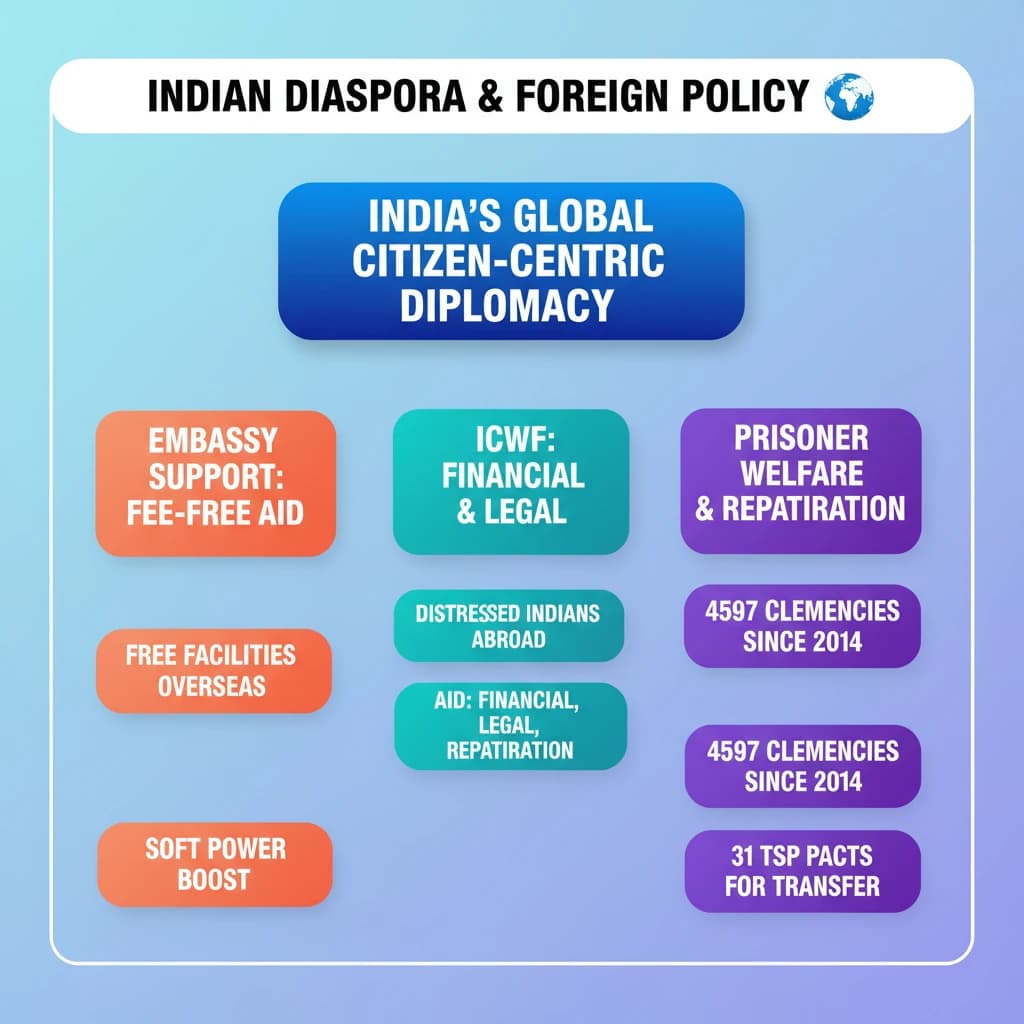
Indian Diaspora is a key topic under International Relations for UPSC Civil Services Examination. Key points include: Indian Embassies provide fee-free facilities to overseas nationals.. ICWF offers financial, legal, and repatriation aid to distressed Indians abroad.. Government actively pursues repatriation and sentence reduction for Indian prisoners, achieving 4,597 clemencies since 2014.. Understanding this topic is essential for both UPSC Prelims and Mains preparation.

Why is Indian Diaspora important for UPSC exam?

Indian Diaspora is a Medium-level topic in UPSC International Relations. It is tested in both Prelims (factual MCQs) and Mains (analytical answer writing). Previous year UPSC questions have frequently covered aspects of Indian Diaspora, making it essential for comprehensive IAS preparation.

How to prepare Indian Diaspora for UPSC?

To prepare Indian Diaspora for UPSC: (1) Study the comprehensive notes covering all key concepts on Vaidra. (2) Practice previous year questions on this topic. (3) Connect it with current affairs using daily updates. (4) Revise using key takeaways and mind maps available for International Relations. (5) Write practice answers linking Indian Diaspora to related GS Paper topics.

Key takeaways of Indian Diaspora for UPSC

  • Indian Embassies provide fee-free facilities to overseas nationals.
  • ICWF offers financial, legal, and repatriation aid to distressed Indians abroad.
  • Government actively pursues repatriation and sentence reduction for Indian prisoners, achieving 4,597 clemencies since 2014.
  • India has signed TSP agreements with 31 countries and two multilateral conventions for prisoner transfer.
  • These mechanisms are crucial for India's citizen-centric foreign policy and soft power.
Indian Diaspora

Indian Diaspora

Medium⏱️ 8 min read✓ 95% Verified
international relations

📖 Introduction

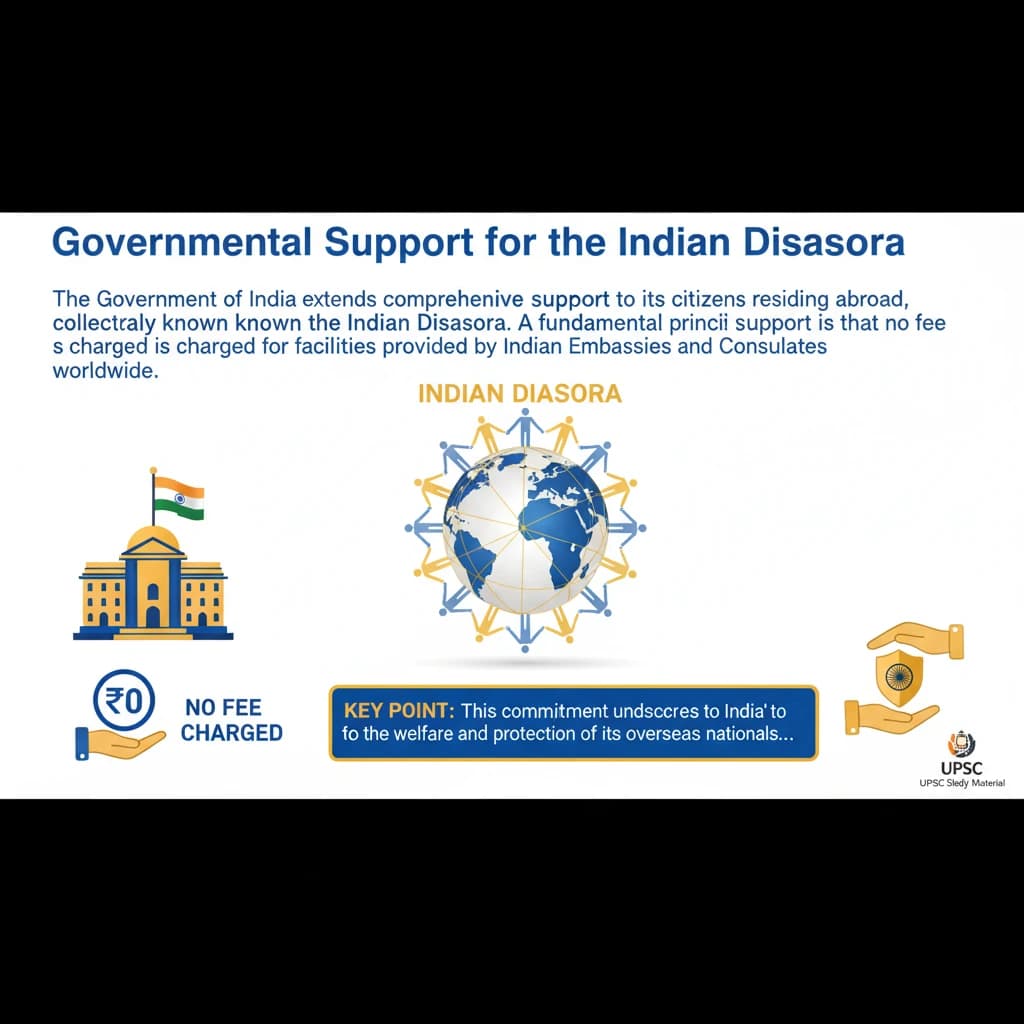
<h4>Governmental Support for the Indian Diaspora</h4><p>The Government of India extends comprehensive support to its citizens residing abroad, collectively known as the <strong>Indian Diaspora</strong>. A fundamental principle of this support is that <strong>no fee is charged</strong> for facilities provided by Indian Embassies and Consulates worldwide.</p><div class='key-point-box'><p>This commitment underscores India's dedication to the welfare and protection of its overseas nationals, reflecting a citizen-centric approach in its foreign policy.</p></div><h4>Indian Community Welfare Fund (ICWF)</h4><p>The <strong>Indian Community Welfare Fund (ICWF)</strong> is a vital mechanism established at Indian Missions and Posts abroad. Its primary objective is to provide assistance to <strong>overseas Indian nationals in distress situations</strong>.</p><div class='info-box'><p>The <strong>ICWF</strong> offers various forms of support, including:</p><ul><li><strong>Financial assistance</strong> for legal aid.</li><li>Provision of <strong>travel documents</strong>.</li><li>Arrangement of <strong>air tickets during repatriation</strong>.</li><li>Support in other deserving cases of hardship.</li></ul></div><h4>Repatriation of Indian Nationals</h4><p>The Indian government actively pursues the issue of <strong>release and repatriation</strong> of Indian nationals incarcerated in foreign prisons. This is a continuous process conducted through <strong>consular and other consultations</strong> with the concerned foreign governments.</p><p>These efforts aim to ensure due process and humanitarian treatment for Indian citizens detained abroad, facilitating their safe return home.</p><h4>Pardon and Reduction in Prison Sentences</h4><p>India consistently engages with foreign governments to seek <strong>pardon or reduction of sentences</strong> for Indian inmates. While some countries grant such relief to various nationalities, they often do not share specific data with the concerned countries.</p><div class='info-box'><p>Significant progress has been made: Since <strong>2014</strong>, a total of <strong>4,597 Indian nationals</strong> have received pardon or reduction of their sentences by foreign governments. This achievement is a direct result of sustained efforts by the Indian Government through multiple diplomatic channels.</p></div><h4>Agreement(s) on Transfer of Sentenced Persons (TSP)</h4><p>India has established a robust framework for the <strong>Transfer of Sentenced Persons (TSP)</strong>. These agreements allow Indian prisoners lodged in foreign countries to be transferred to India to serve the remainder of their sentences, and vice-versa for foreign nationals in Indian prisons.</p><div class='key-point-box'><p>The <strong>TSP agreements</strong> are crucial for humanitarian reasons, enabling prisoners to be closer to their families and cultural environment during their incarceration.</p></div><p>India has signed <strong>bilateral TSP agreements</strong> with <strong>31 countries</strong>. These include:</p><ul><li><strong>Australia</strong>, <strong>Bahrain</strong>, <strong>Bangladesh</strong>, <strong>Bosnia & Herzegovina</strong>, <strong>Brazil</strong>, <strong>Bulgaria</strong>, <strong>Cambodia</strong>, <strong>Egypt</strong>, <strong>Estonia</strong>, <strong>France</strong>, <strong>Hong Kong</strong>, <strong>Iran</strong>, <strong>Israel</strong>, <strong>Italy</strong>, <strong>Kazakhstan</strong>, <strong>Korea</strong>, <strong>Kuwait</strong>, <strong>Maldives</strong>, <strong>Mauritius</strong>, <strong>Mongolia</strong>, <strong>Qatar</strong>, <strong>Russia</strong>, <strong>Saudi Arabia</strong>, <strong>Somalia</strong>, <strong>Spain</strong>, <strong>Sri Lanka</strong>, <strong>Thailand</strong>, <strong>Turkey</strong>, <strong>United Arab Emirates (UAE)</strong>, <strong>United Kingdom</strong>, and <strong>Vietnam</strong>.</li></ul><p>Beyond bilateral pacts, India is also a signatory to <strong>two multilateral conventions</strong> on the transfer of sentenced persons:</p><ol><li>The <strong>Inter-American Convention on Serving Criminal Sentences Abroad</strong>.</li><li>The <strong>Council of Europe Convention on the Transfer of Sentenced Persons</strong>.
Concept Diagram

💡 Key Takeaways

  • •Indian Embassies provide fee-free facilities to overseas nationals.
  • •ICWF offers financial, legal, and repatriation aid to distressed Indians abroad.
  • •Government actively pursues repatriation and sentence reduction for Indian prisoners, achieving 4,597 clemencies since 2014.
  • •India has signed TSP agreements with 31 countries and two multilateral conventions for prisoner transfer.
  • •These mechanisms are crucial for India's citizen-centric foreign policy and soft power.

🧠 Memory Techniques

Memory Aid
95% Verified Content

Related Topics

Loading related topics...
Explore:International Relations Topics·All Subjects·Daily Current Affairs·Editorial Analysis·Previous Year Questions·UPSC GPT
Indian Diaspora - UPSC International Relations