Loading page, please wait…
Colombo Security Conclave - UPSC International Relations
What is Colombo Security Conclave in UPSC International Relations?
Colombo Security Conclave is a key topic under International Relations for UPSC Civil Services Examination. Key points include: CSC evolved from the 2011 NSA Trilateral, re-branded in 2020.. Current members: India, Sri Lanka, Maldives, Mauritius, Bangladesh; Seychelles is an observer.. Five pillars of cooperation: Maritime safety, counter-terrorism, anti-trafficking, cyber security, HADR.. Understanding this topic is essential for both UPSC Prelims and Mains preparation.
Why is Colombo Security Conclave important for UPSC exam?
Colombo Security Conclave is a Medium-level topic in UPSC International Relations. It is tested in both Prelims (factual MCQs) and Mains (analytical answer writing). Previous year UPSC questions have frequently covered aspects of Colombo Security Conclave, making it essential for comprehensive IAS preparation.
How to prepare Colombo Security Conclave for UPSC?
To prepare Colombo Security Conclave for UPSC: (1) Study the comprehensive notes covering all key concepts on Vaidra. (2) Practice previous year questions on this topic. (3) Connect it with current affairs using daily updates. (4) Revise using key takeaways and mind maps available for International Relations. (5) Write practice answers linking Colombo Security Conclave to related GS Paper topics.
Key takeaways of Colombo Security Conclave for UPSC
- CSC evolved from the 2011 NSA Trilateral, re-branded in 2020.
- Current members: India, Sri Lanka, Maldives, Mauritius, Bangladesh; Seychelles is an observer.
- Five pillars of cooperation: Maritime safety, counter-terrorism, anti-trafficking, cyber security, HADR.
- Recent milestone: Signing of CSC Charter and establishment of Secretariat in Colombo.
- Significance for India: Strengthens IOR outreach, counters China, aligns with SAGAR vision.
- Joint exercises like 'Dosti XV' enhance interoperability among member states.
Colombo Security Conclave
Medium⏱️ 10 min read
international relations
📖 Introduction
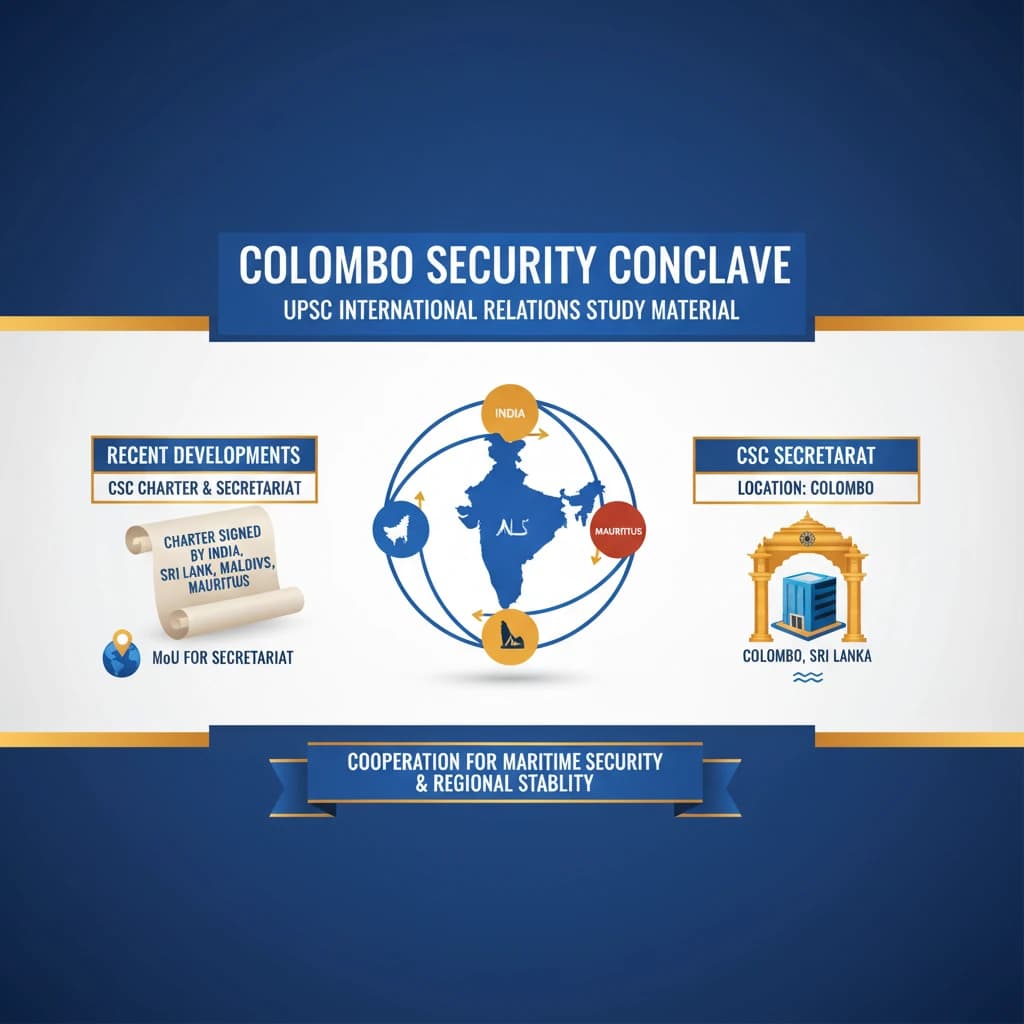
Recent Developments: CSC Charter and Secretariat
Recently, the member states of the Colombo Security Conclave (CSC) – India, Sri Lanka, the Maldives, and Mauritius – signed a crucial Charter. This significant event was accompanied by a Memorandum of Understanding (MoU) for the establishment of the CSC Secretariat, which will be located in Colombo.
During the signing, Bangladesh was notably absent, while Seychelles participated in the proceedings as an observer state.
Origins and Evolution of CSC
The Colombo Security Conclave has its roots in an earlier initiative known as the NSA Trilateral on Maritime Security. This trilateral framework was initially established in 2011 between India, Sri Lanka, and the Maldives.
The primary objective behind its formation was to enhance maritime security and cooperation within the strategically vital Indian Ocean Region (IOR). It was originally an initiative spearheaded by Sri Lanka.
Member States and Observers
The founding members of the conclave were India, Sri Lanka, and the Maldives. Over time, its membership has expanded to include other key regional players.
- Mauritius officially joined the conclave in 2022.
- Bangladesh became a member in 2024, further broadening the conclave's reach.
- Seychelles currently holds the status of an observer state, participating in discussions and activities.
Pillars of Cooperation
Cooperation within the Colombo Security Conclave is structured around five core pillars, addressing a comprehensive range of security challenges in the region.
- Maritime Safety and Security: Focusing on safeguarding sea lanes and preventing illicit activities.
- Countering Terrorism and Radicalisation: Joint efforts to combat extremist threats.
- Combatting Trafficking and Transnational Organised Crime: Addressing issues like drug and human trafficking.
- Cyber Security and Protection of Critical Infrastructure and Technology: Enhancing digital resilience.
- Humanitarian Assistance and Disaster Relief (HADR): Coordinated responses to natural calamities and crises.
Joint Defence Exercises
The member states actively engage in joint exercises to enhance interoperability and readiness in addressing shared security concerns. These exercises are crucial for practical cooperation.
- In November 2021, India, Sri Lanka, and the Maldives conducted Exercise Dosti XV in the Maldives, focusing on maritime security.
- Subsequently, these three nations also carried out their first joint exercise in the Arabian Sea, operating under the broader aegis of the CSC.
Timeline of Meetings and Revival
The initial dialogues among the original three countries commenced in 2011 in the Maldives. Subsequent meetings were held in Sri Lanka (2013) and India (2014).
However, the dialogue experienced a period of stagnation after 2014. This pause was primarily attributed to rising tensions between India and the Maldives, coupled with the increasing geopolitical influence of China in the Indian Ocean.
The initiative was successfully revived and subsequently re-branded as the Colombo Security Conclave in 2020, signaling renewed commitment to regional security cooperation.
Strategic Importance for India and the Region
The Colombo Security Conclave holds immense significance for India's Indian Ocean outreach and its broader strategic objectives in the region.
The CSC significantly strengthens India's position as a net security provider in the IOR. It serves as a crucial mechanism to counter China's growing influence in the region, particularly in the maritime domain.
It aligns seamlessly with India's SAGAR vision (Security and Growth for All in the Region), fostering sub-regionalism and collective security among Indian Ocean nations on a shared platform.
Related Regional Energy Infrastructure Projects
Beyond maritime security, regional dynamics also involve significant energy infrastructure projects that have geopolitical implications, though distinct from the direct mandate of CSC.
Turkmenistan-Afghanistan-Pakistan-India (TAPI) Pipeline
The TAPI pipeline is a major energy project envisioned to transport natural gas from Turkmenistan to Afghanistan, Pakistan, and India. It has several strategic and economic dimensions.
- Environmental Benefits: Potential to alleviate air pollution in major cities like Delhi, Mumbai, Karachi, and Islamabad by providing a cleaner energy alternative.
- Economic Growth: Offers opportunities for economic development in Afghanistan and Pakistan through transit fees and job creation. It could also stimulate investment in renewable energy.
- Strategic Influence: Seen as a key element in geopolitical competition for influence in Central Asia. The US views it as a counter to the Iran-Pakistan-India (IPI) pipeline, supported by Iran and Russia.
- Diversification for Turkmenistan: Provides Turkmenistan a chance to diversify its export markets and reduce dependency on existing routes to China and Russia.
- Counterweight to Chinese Influence: Could serve as a counterweight to Chinese influence, particularly in Pakistan, given China's investment in CPEC.
- Regional Cooperation: Enhances cooperation among Central and South Asian countries, potentially fostering collaborations in energy, communication, and transportation.
- India's Role: Positions Turkmenistan as a crucial energy partner for India, enhancing India’s connectivity with Central Asia and aligning with India’s broader strategy of regional connectivity and energy security.
India's Other Bilateral/Multilateral Energy Projects
India is involved in several other energy infrastructure projects to bolster its energy security and regional connectivity.
- India-Bangladesh Friendship Pipeline: Enhancing energy ties with Bangladesh.
- Mothari-Amlekhgunj Pipeline (India-Nepal): Strengthening energy cooperation with Nepal.
- Bay of Bengal Initiative for Multi-Sectoral Technical and Economic Cooperation (BIMSTEC): A platform for regional cooperation, including energy.
- International North-South Transport Corridor (INSTC): A multimodal network for freight transport, crucial for trade and energy routes.
💡 Key Takeaways
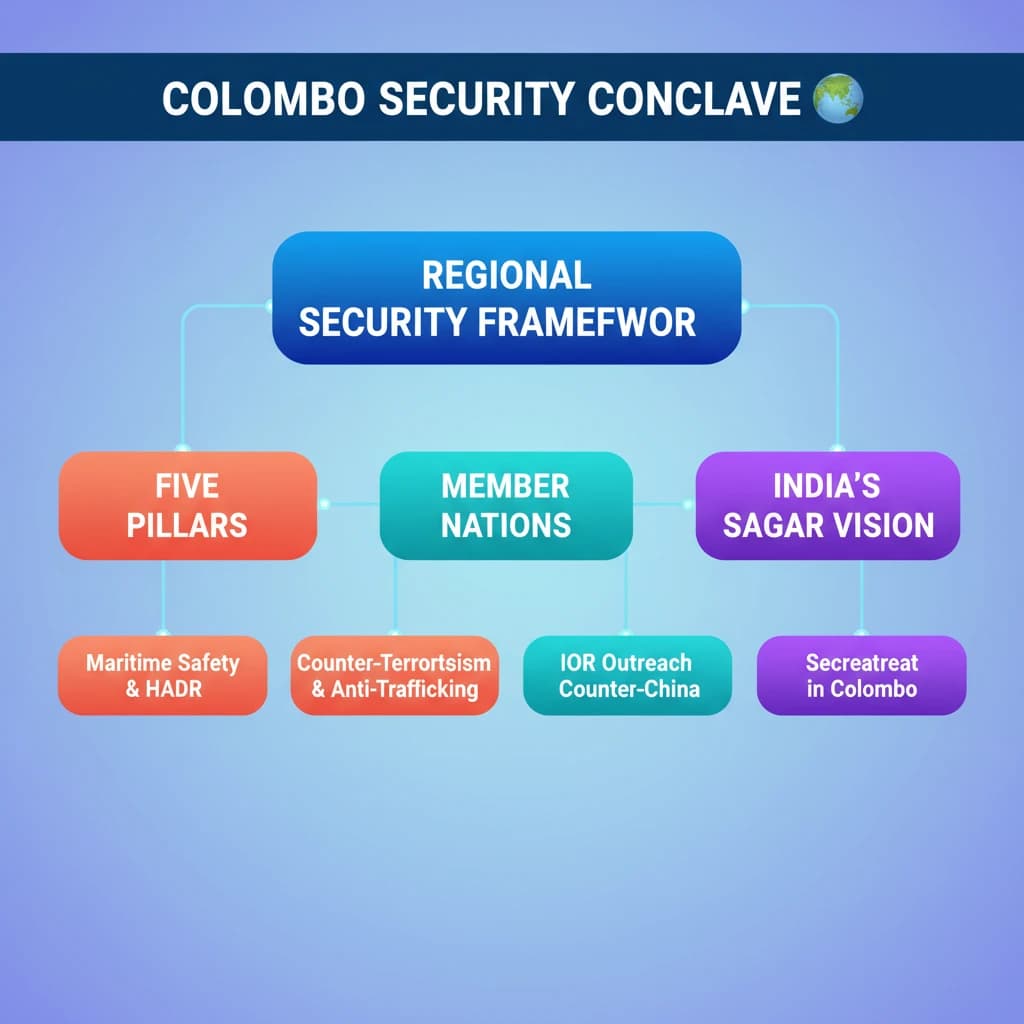
- •CSC evolved from the 2011 NSA Trilateral, re-branded in 2020.
- •Current members: India, Sri Lanka, Maldives, Mauritius, Bangladesh; Seychelles is an observer.
- •Five pillars of cooperation: Maritime safety, counter-terrorism, anti-trafficking, cyber security, HADR.
- •Recent milestone: Signing of CSC Charter and establishment of Secretariat in Colombo.
- •Significance for India: Strengthens IOR outreach, counters China, aligns with SAGAR vision.
- •Joint exercises like 'Dosti XV' enhance interoperability among member states.
🧠 Memory Techniques
95% Verified Content
📚 Reference Sources
•Ministry of External Affairs (MEA), Government of India
•Official websites of Colombo Security Conclave member states