Loading page, please wait…
Vaidra Logo
Vaidra

Top 4 items + smart groups

UPSC GPT
New
Current Affairs
Daily Solutions
Daily Puzzle
Mains Evaluator

Version 2.0.0 • Built with ❤️ for UPSC aspirants

Loading...
Loading...
Loading...
Loading...
Loading...
Loading...
Loading...
Loading...
Loading...
Loading...
Loading...
Loading...
Loading...
What are the Points of Tensions Between India and Bangladesh? - UPSC International Relations
Back
All Subjects

Topics

0 topics • 0 completed

Loading topics...
Loading...
Loading...
Loading...
Loading...
Loading...
Overall Progress0%

What are the Points of Tensions Between India and Bangladesh? - UPSC International Relations

What is What are the Points of Tensions Between India and Bangladesh? in UPSC International Relations?

What are the Points of Tensions Between India and Bangladesh? is a key topic under International Relations for UPSC Civil Services Examination. Key points include: India and Bangladesh share a 4096.7 km border, India's longest.. Cooperation areas include transport (BIMSTEC, Matarbari Port), energy (2000 MW import, Rooppur NPP), defence (Sampriti, Bongo Sagar), and multilateral forums.. Key tensions are transboundary river water sharing (54 rivers, only Ganga and Kushiyara treaties; Teesta, Feni pending) and illegal migration (refugees, economic migrants, Rohingya).. Understanding this topic is essential for both UPSC Prelims and Mains preparation.

Why is What are the Points of Tensions Between India and Bangladesh? important for UPSC exam?

What are the Points of Tensions Between India and Bangladesh? is a Medium-level topic in UPSC International Relations. It is tested in both Prelims (factual MCQs) and Mains (analytical answer writing). Previous year UPSC questions have frequently covered aspects of What are the Points of Tensions Between India and Bangladesh?, making it essential for comprehensive IAS preparation.

How to prepare What are the Points of Tensions Between India and Bangladesh? for UPSC?

To prepare What are the Points of Tensions Between India and Bangladesh? for UPSC: (1) Study the comprehensive notes covering all key concepts on Vaidra. (2) Practice previous year questions on this topic. (3) Connect it with current affairs using daily updates. (4) Revise using key takeaways and mind maps available for International Relations. (5) Write practice answers linking What are the Points of Tensions Between India and Bangladesh? to related GS Paper topics.

Key takeaways of What are the Points of Tensions Between India and Bangladesh? for UPSC

  • India and Bangladesh share a 4096.7 km border, India's longest.
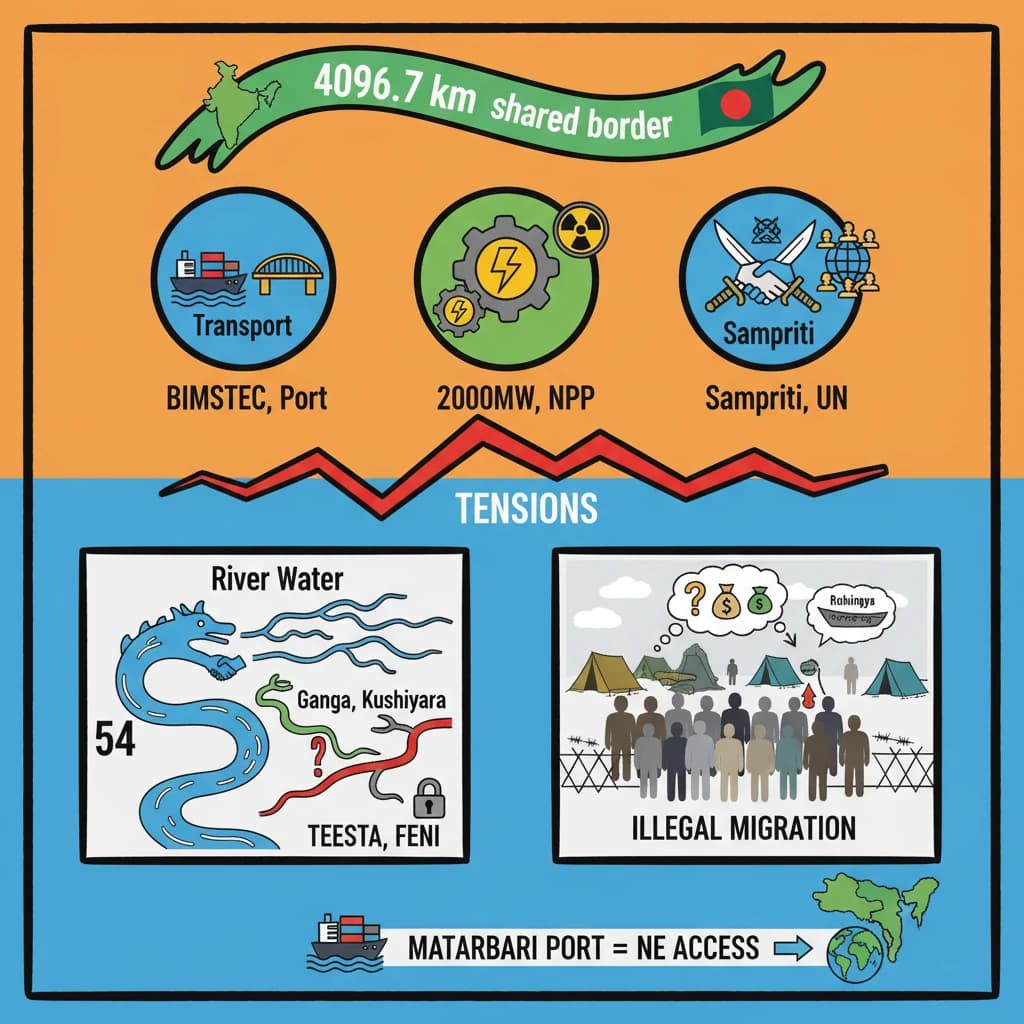
  • Cooperation areas include transport (BIMSTEC, Matarbari Port), energy (2000 MW import, Rooppur NPP), defence (Sampriti, Bongo Sagar), and multilateral forums.
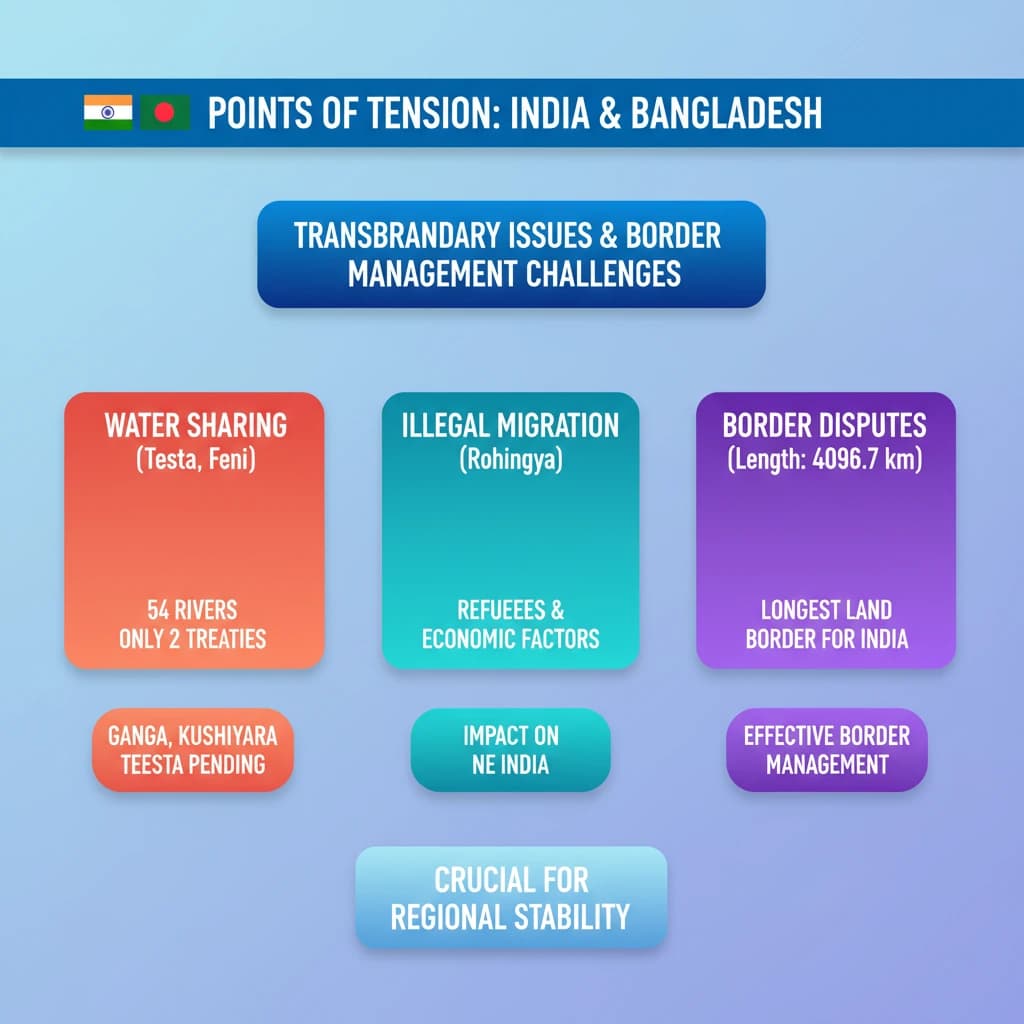
  • Key tensions are transboundary river water sharing (54 rivers, only Ganga and Kushiyara treaties; Teesta, Feni pending) and illegal migration (refugees, economic migrants, Rohingya).
  • Connectivity projects like Matarbari Port are vital for Northeast India's access to global markets.
  • Effective border management and water diplomacy are crucial for long-term bilateral stability.
What are the Points of Tensions Between India and Bangladesh?

What are the Points of Tensions Between India and Bangladesh?

Medium⏱️ 9 min read✓ 90% Verified
international relations

📖 Introduction

<h4>Introduction to India-Bangladesh Relations</h4><p>India and Bangladesh share a <strong>long-standing relationship</strong> marked by both cooperation and areas of tension. This dynamic partnership is crucial for regional stability and development in South Asia.</p><p>The shared <strong>border</strong> and common cultural ties underscore the importance of understanding the various facets of this bilateral engagement.</p><h4>Areas of Cooperation</h4><h4>Transport Connectivity Initiatives</h4><p>The <strong>BIMSTEC Master Plan for Transport Connectivity</strong> is a key initiative aiming to establish a robust shipping network across India, Bangladesh, Myanmar, and Thailand.</p><p>India is actively focusing on the <strong>Matarbari Port</strong>, which is being developed by Bangladesh. This port is strategically located approximately <strong>100 km from Tripura</strong>.</p><div class='info-box'><p>The <strong>Matarbari Port</strong> is envisioned to create a vital <strong>industrial corridor</strong> connecting <strong>Dhaka</strong> and <strong>Northeast India</strong>, significantly boosting trade and regional integration.</p></div><h4>Energy Sector Collaboration</h4><p>Bangladesh currently imports a substantial amount of electricity from India, highlighting significant energy cooperation.</p><div class='info-box'><p>Bangladesh imports nearly <strong>2,000 megawatts (MW) of electricity</strong> from India, demonstrating a strong energy interdependence.</p></div><p>A landmark agreement in <strong>2018</strong> saw <strong>Russia, Bangladesh, and India</strong> sign a memorandum for cooperation in the <strong>Rooppur Nuclear Power Plant project</strong>.</p><div class='key-point-box'><p>The <strong>Rooppur Nuclear Power Plant</strong> is significant as it represents <strong>Bangladesh’s first nuclear power reactor</strong>, with India playing a crucial supportive role.</p></div><h4>Defence and Border Management</h4><p>India and Bangladesh share the <strong>longest land boundary</strong> that India has with any of its neighbors, necessitating strong defence cooperation.</p><div class='info-box'><p>The shared border spans <strong>4096.7 km</strong>. Indian states bordering Bangladesh include <strong>Assam, West Bengal, Mizoram, Meghalaya, and Tripura</strong>.</p></div><p>Both nations regularly conduct joint military exercises to enhance interoperability and strengthen security ties.</p><ul><li><strong>Army Exercise:</strong> <strong>Exercise Sampriti</strong></li><li><strong>Navy Exercise:</strong> <strong>Exercise Bongo Sagar</strong></li></ul><h4>Multilateral Engagement</h4><p>India and Bangladesh actively participate in various regional forums, reinforcing their commitment to multilateral cooperation.</p><div class='key-point-box'><p>Key multilateral forums include <strong>SAARC</strong> (South Asian Association for Regional Cooperation), <strong>BIMSTEC</strong> (Bay of Bengal Multi-Sectoral Technical and Economic Cooperation), and <strong>IORA</strong> (Indian Ocean Rim Association).</p></div><h4>Points of Tension Between India and Bangladesh</h4><h4>Sharing of Transboundary River Waters</h4><p>A significant point of contention revolves around the equitable sharing of waters from numerous common rivers.</p><div class='info-box'><p>India and Bangladesh share <strong>54 common rivers</strong>. However, only two major treaties have been signed to date.</p></div><p>These treaties are the <strong>Ganga Waters Treaty</strong> and the more recent <strong>Kushiyara River Treaty</strong>.</p><div class='key-point-box'><p>Major rivers like the <strong>Teesta</strong> and <strong>Feni</strong> are still subjects of ongoing negotiations, posing a challenge to bilateral relations.</p></div><div class='exam-tip-box'><p>Understanding the <strong>water diplomacy challenges</strong> is crucial for Mains answers, especially regarding regional cooperation and environmental security.</p></div><h4>Illegal Migration Concerns</h4><p>The issue of <strong>illegal migration</strong> from Bangladesh into India remains a persistent and significant concern for India.</p><p>This influx includes both <strong>refugees</strong> and <strong>economic migrants</strong>, placing considerable strain on India's border states.</p><div class='key-point-box'><p>Illegal migration impacts local <strong>resources</strong>, creates demographic shifts, and raises serious <strong>security concerns</strong> in states like <strong>Assam</strong> and <strong>West Bengal</strong>.</p></div><p>The problem was further exacerbated by the entry of <strong>Rohingya refugees</strong> into India, often transiting through Bangladesh, adding another layer of complexity.</p><div class='exam-tip-box'><p>The topic of <strong>cross-border migration</strong> and its socio-economic and security implications is frequently tested in <strong>UPSC Mains GS-II and GS-III</strong>.</p></div>
Concept Diagram

💡 Key Takeaways

  • •India and Bangladesh share a 4096.7 km border, India's longest.
  • •Cooperation areas include transport (BIMSTEC, Matarbari Port), energy (2000 MW import, Rooppur NPP), defence (Sampriti, Bongo Sagar), and multilateral forums.
  • •Key tensions are transboundary river water sharing (54 rivers, only Ganga and Kushiyara treaties; Teesta, Feni pending) and illegal migration (refugees, economic migrants, Rohingya).
  • •Connectivity projects like Matarbari Port are vital for Northeast India's access to global markets.
  • •Effective border management and water diplomacy are crucial for long-term bilateral stability.

🧠 Memory Techniques
Memory Aid
90% Verified Content

Related Topics

Loading related topics...
Explore:International Relations Topics·All Subjects·Daily Current Affairs·Editorial Analysis·Previous Year Questions·UPSC GPT