Loading page, please wait…
Vaidra Logo
Vaidra

Top 4 items + smart groups

UPSC GPT
New
Current Affairs
Daily Solutions
Daily Puzzle
Mains Evaluator

Version 2.0.0 • Built with ❤️ for UPSC aspirants

Loading...
Loading...
Loading...
Loading...
Loading...
Loading...
Loading...
Loading...
Loading...
Loading...
Loading...
Loading...
Loading...
Back
All Subjects

Topics

0 topics • 0 completed

Loading topics...
Loading...
Loading...
Loading...
Loading...
Loading...
Overall Progress0%

How India-Indonesia Ties Evolved Overtime? - UPSC International Relations

What is How India-Indonesia Ties Evolved Overtime? in UPSC International Relations?

How India-Indonesia Ties Evolved Overtime? is a key topic under International Relations for UPSC Civil Services Examination. Key points include: Early ties (1940s-50s) were strong, built on anti-colonialism, non-alignment, and resulted in the 1951 Treaty of Friendship, Bandung Conference, and NAM.. The 1960s saw strained relations due to India-China conflict and Indonesia's support for Pakistan in 1965.. Under President Suharto (1966-1980s), ties improved, marked by the 1977 maritime pact and Suharto's 1980 visit.. Understanding this topic is essential for both UPSC Prelims and Mains preparation.

Why is How India-Indonesia Ties Evolved Overtime? important for UPSC exam?

How India-Indonesia Ties Evolved Overtime? is a Medium-level topic in UPSC International Relations. It is tested in both Prelims (factual MCQs) and Mains (analytical answer writing). Previous year UPSC questions have frequently covered aspects of How India-Indonesia Ties Evolved Overtime?, making it essential for comprehensive IAS preparation.

How to prepare How India-Indonesia Ties Evolved Overtime? for UPSC?

To prepare How India-Indonesia Ties Evolved Overtime? for UPSC: (1) Study the comprehensive notes covering all key concepts on Vaidra. (2) Practice previous year questions on this topic. (3) Connect it with current affairs using daily updates. (4) Revise using key takeaways and mind maps available for International Relations. (5) Write practice answers linking How India-Indonesia Ties Evolved Overtime? to related GS Paper topics.

Key takeaways of How India-Indonesia Ties Evolved Overtime? for UPSC

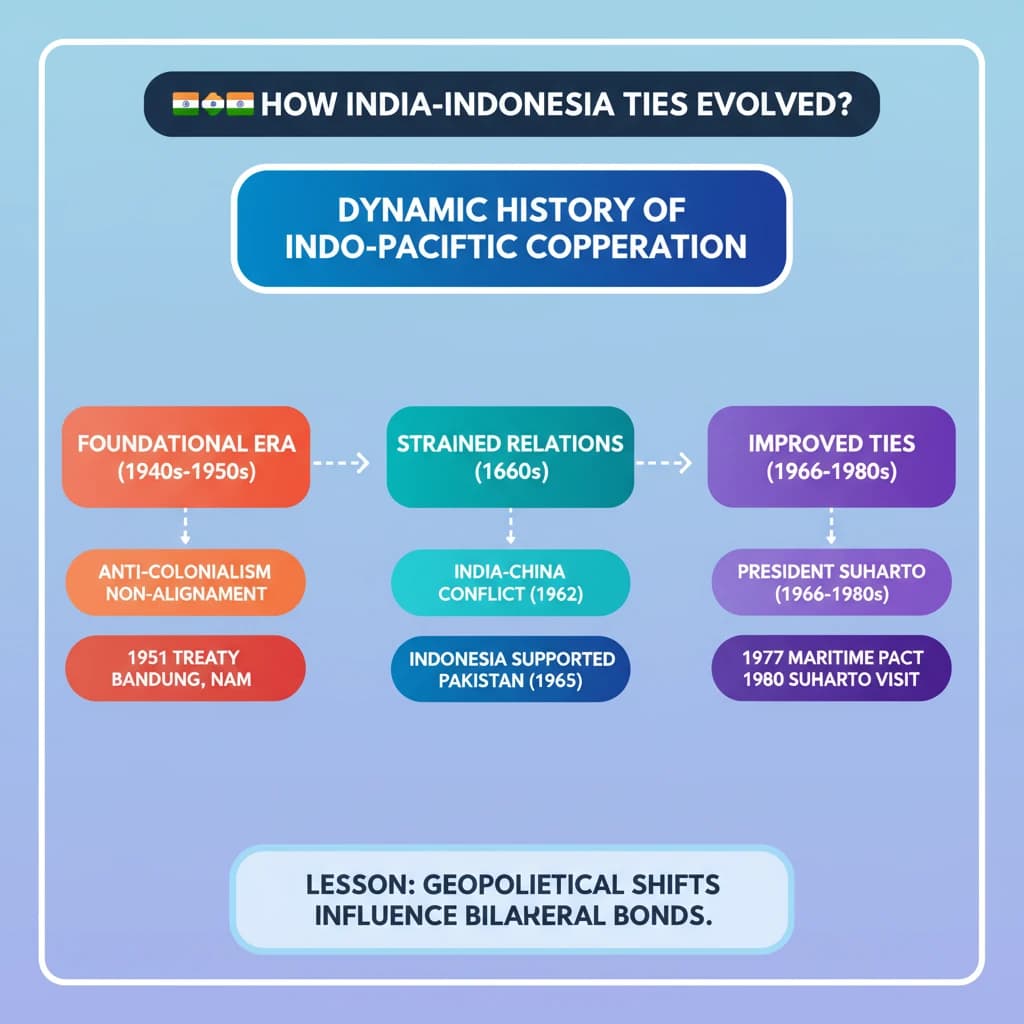
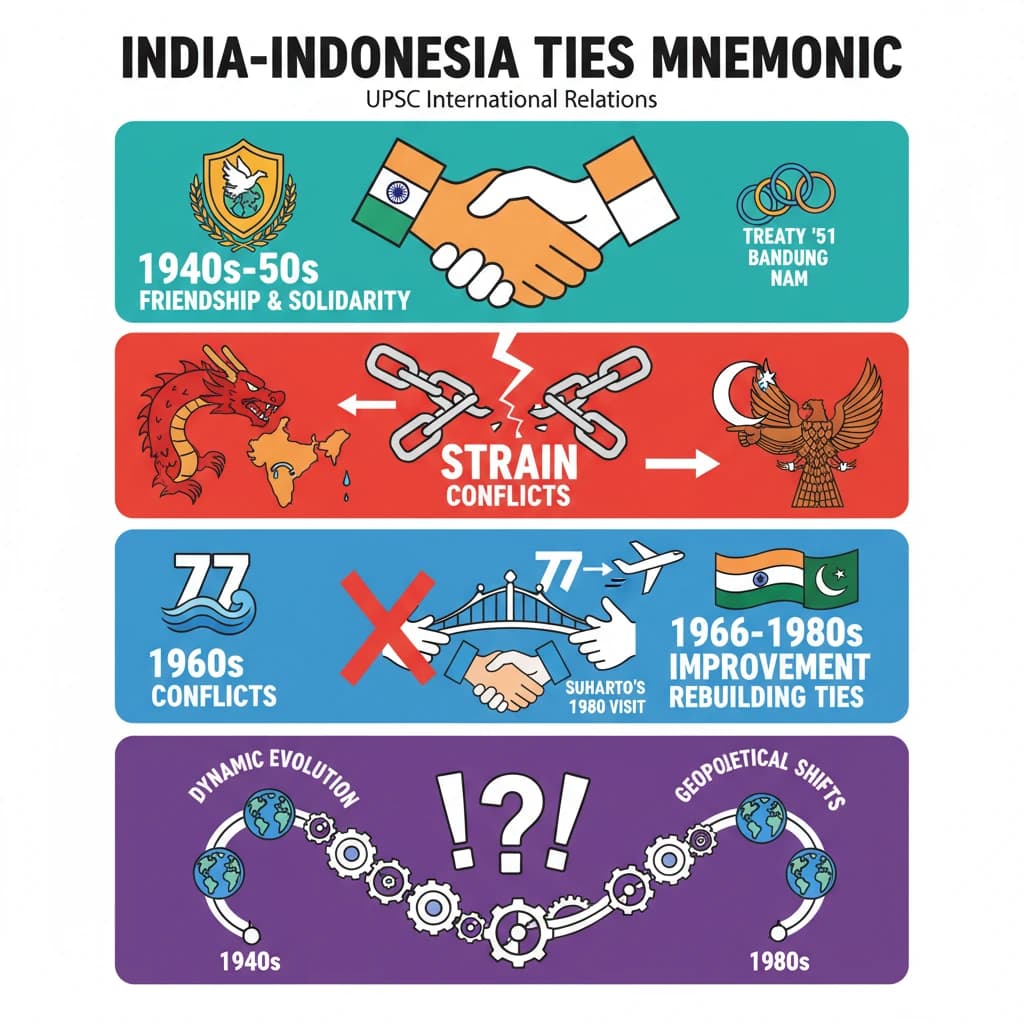
  • Early ties (1940s-50s) were strong, built on anti-colonialism, non-alignment, and resulted in the 1951 Treaty of Friendship, Bandung Conference, and NAM.
  • The 1960s saw strained relations due to India-China conflict and Indonesia's support for Pakistan in 1965.
  • Under President Suharto (1966-1980s), ties improved, marked by the 1977 maritime pact and Suharto's 1980 visit.
  • Historical evolution highlights the dynamic nature of international relations and the influence of geopolitical shifts.
  • Understanding this past is crucial for comprehending current Indo-Pacific cooperation.
How India-Indonesia Ties Evolved Overtime?

How India-Indonesia Ties Evolved Overtime?

Medium⏱️ 6 min read✓ 95% Verified
international relations

📖 Introduction

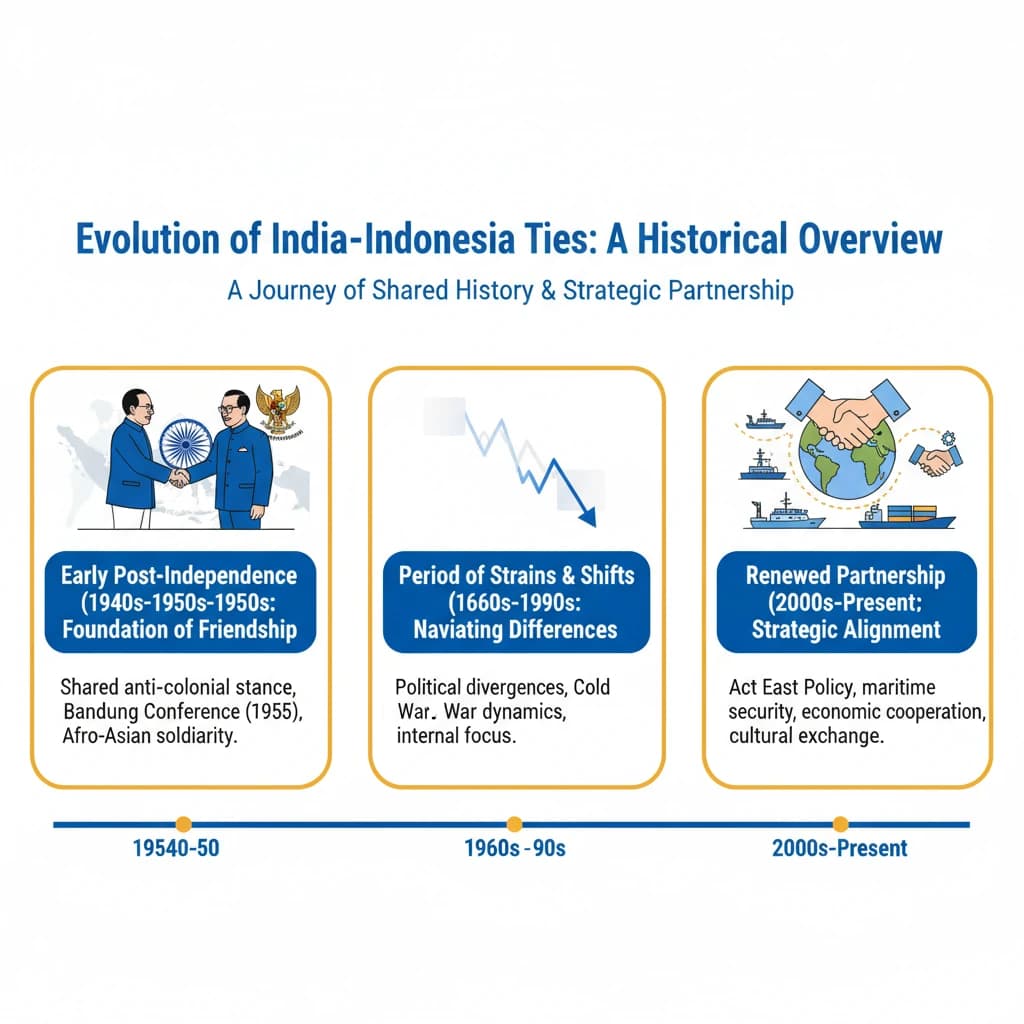
<h4>Evolution of India-Indonesia Ties: A Historical Overview</h4><p>The relationship between <strong>India</strong> and <strong>Indonesia</strong> has traversed through various phases, marked by periods of strong camaraderie and occasional strains. Understanding this evolution is crucial for grasping their current strategic partnership.</p><h4>Early Post-Independence Period (1940s-1950s): Foundation of Friendship</h4><p>During the immediate post-independence era, <strong>India</strong>, under Prime Minister <strong>Jawaharlal Nehru</strong>, extended unequivocal support to <strong>Indonesia's</strong> struggle for independence from <strong>Dutch colonial rule</strong>.</p><div class='info-box'><p>A significant milestone was the signing of a <strong>Treaty of Friendship</strong> in <strong>1951</strong>, formalizing their burgeoning bilateral relations.</p></div><p>This period witnessed flourishing cooperation across various sectors, including <strong>trade</strong>, <strong>culture</strong>, and <strong>military matters</strong>.</p><div class='key-point-box'><p>Both nations shared common ideological ground, aligning strongly on principles such as <strong>non-alignment</strong>, <strong>anti-colonialism</strong>, and <strong>peaceful coexistence</strong>.</p></div><p>Their shared vision led to active participation in the landmark <strong>1955 Bandung Conference</strong> and subsequently, the formation of the <strong>Non-Aligned Movement (NAM)</strong> in <strong>1961</strong>.</p><h4>Detente Ties (1960s): Period of Strain</h4><p>The <strong>1960s</strong> marked a period of strain in <strong>India-Indonesia</strong> relations. This was primarily due to shifts in geopolitical alignments and regional conflicts.</p><p><strong>India's</strong> ties with <strong>China</strong> deteriorated significantly following the <strong>1959 Tibetan uprising</strong> and the devastating <strong>Sino-Indian War of 1962</strong>.</p><p>Concurrently, <strong>Indonesia</strong> maintained cordial relations with <strong>China</strong>, creating a divergence in foreign policy priorities between Delhi and Jakarta.</p><div class='info-box'><p>A notable point of friction occurred during the <strong>1965 India-Pakistan conflict</strong>, when <strong>Indonesia</strong> sided with <strong>Pakistan</strong>, offering solidarity and military aid.</p></div><h4>Cold War Era (1966-1980s): Rebuilding Bridges</h4><p>Following the tumultuous 1960s, a period of rapprochement began. Under President <strong>Suharto</strong>, <strong>Indonesia</strong> strategically moved away from its earlier alignment with <strong>China</strong>.</p><p>This shift paved the way for efforts to rebuild and strengthen ties with <strong>India</strong>.</p><div class='info-box'><p>Key agreements facilitated this improvement, including the signing of a <strong>maritime boundary pact</strong> in <strong>1977</strong>.</p></div><p>The visit of President <strong>Suharto</strong> to <strong>India</strong> in <strong>1980</strong> further cemented the renewed diplomatic efforts and signaled a positive trajectory for bilateral relations.</p>
Concept Diagram

💡 Key Takeaways

  • •Early ties (1940s-50s) were strong, built on anti-colonialism, non-alignment, and resulted in the 1951 Treaty of Friendship, Bandung Conference, and NAM.
  • •The 1960s saw strained relations due to India-China conflict and Indonesia's support for Pakistan in 1965.
  • •Under President Suharto (1966-1980s), ties improved, marked by the 1977 maritime pact and Suharto's 1980 visit.
  • •Historical evolution highlights the dynamic nature of international relations and the influence of geopolitical shifts.
  • •Understanding this past is crucial for comprehending current Indo-Pacific cooperation.

🧠 Memory Techniques
Memory Aid
95% Verified Content

Related Topics

Loading related topics...
Explore:International Relations Topics·All Subjects·Daily Current Affairs·Editorial Analysis·Previous Year Questions·UPSC GPT
How India-Indonesia Ties Evolved Overtime? - UPSC International Relations