Loading page, please wait…
Vaidra Logo
Vaidra

Top 4 items + smart groups

UPSC GPT
New
Current Affairs
Daily Solutions
Daily Puzzle
Mains Evaluator

Version 2.0.0 • Built with ❤️ for UPSC aspirants

Loading...
Loading...
Loading...
Loading...
Loading...
Loading...
Loading...
Loading...
Loading...
Loading...
Loading...
Loading...
Loading...
India Sugarcane Subsidy under WTO Scrutiny - UPSC International Relations
Back
All Subjects

Topics

0 topics • 0 completed

Loading topics...
Loading...
Loading...
Loading...
Loading...
Loading...
Overall Progress0%

India Sugarcane Subsidy under WTO Scrutiny - UPSC International Relations

What is India Sugarcane Subsidy under WTO Scrutiny in UPSC International Relations?

India Sugarcane Subsidy under WTO Scrutiny is a key topic under International Relations for UPSC Civil Services Examination. Key points include: India's sugarcane subsidies are under WTO scrutiny by the US and Australia.. The contention is that India's subsidies exceed WTO Agreement on Agriculture (AoA) limits, distorting global trade.. The AoA, established in 1995 during the Uruguay Round, aims to liberalize agricultural trade.. Understanding this topic is essential for both UPSC Prelims and Mains preparation.

Why is India Sugarcane Subsidy under WTO Scrutiny important for UPSC exam?

India Sugarcane Subsidy under WTO Scrutiny is a Medium-level topic in UPSC International Relations. It is tested in both Prelims (factual MCQs) and Mains (analytical answer writing). Previous year UPSC questions have frequently covered aspects of India Sugarcane Subsidy under WTO Scrutiny, making it essential for comprehensive IAS preparation.

How to prepare India Sugarcane Subsidy under WTO Scrutiny for UPSC?

To prepare India Sugarcane Subsidy under WTO Scrutiny for UPSC: (1) Study the comprehensive notes covering all key concepts on Vaidra. (2) Practice previous year questions on this topic. (3) Connect it with current affairs using daily updates. (4) Revise using key takeaways and mind maps available for International Relations. (5) Write practice answers linking India Sugarcane Subsidy under WTO Scrutiny to related GS Paper topics.

Key takeaways of India Sugarcane Subsidy under WTO Scrutiny for UPSC

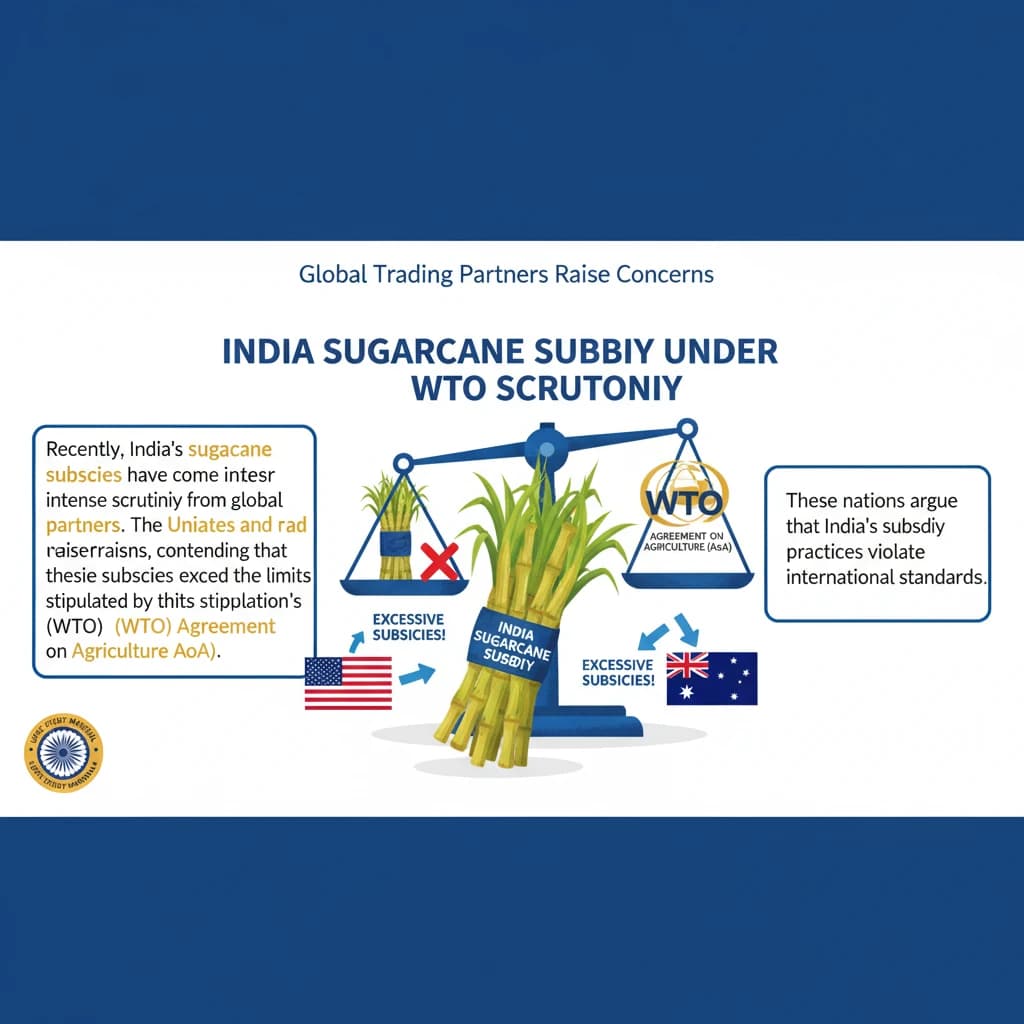
  • India's sugarcane subsidies are under WTO scrutiny by the US and Australia.
  • The contention is that India's subsidies exceed WTO Agreement on Agriculture (AoA) limits, distorting global trade.
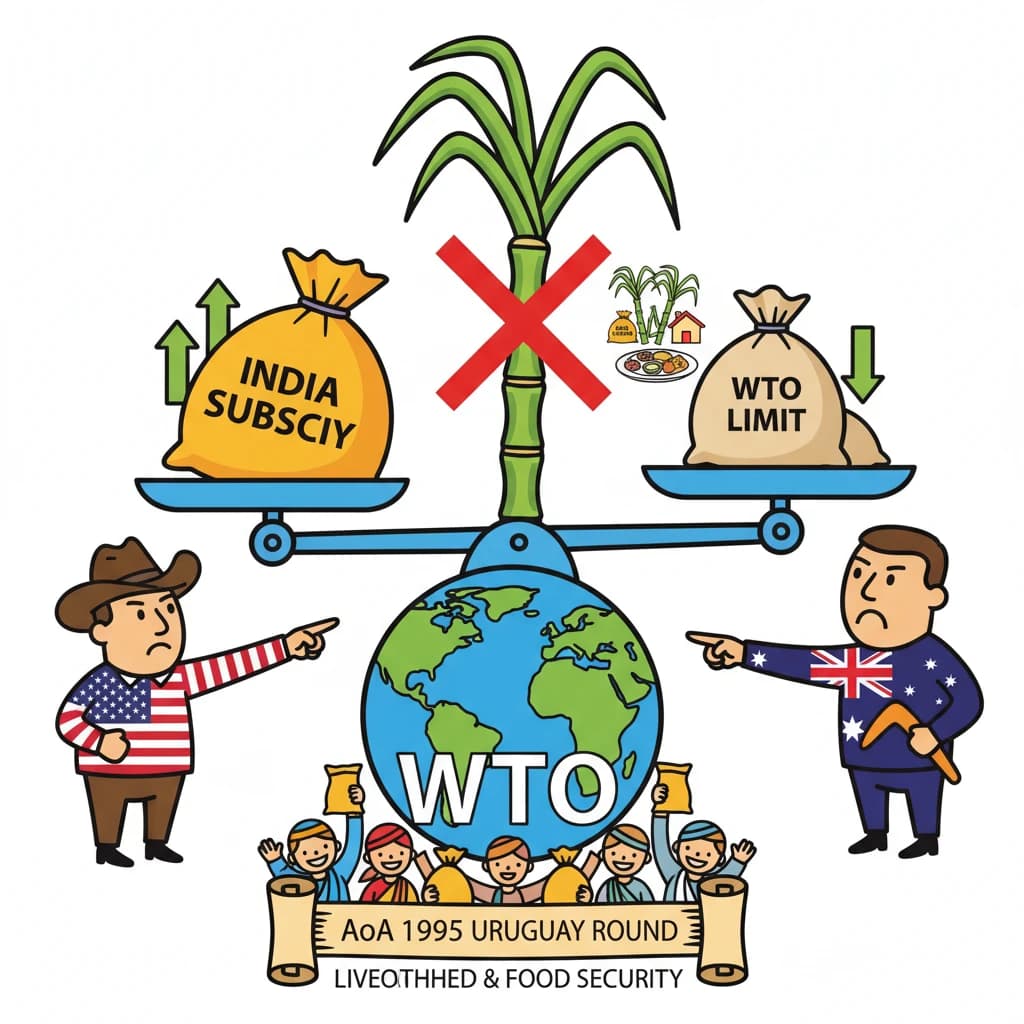
  • The AoA, established in 1995 during the Uruguay Round, aims to liberalize agricultural trade.
  • India argues subsidies are vital for farmer livelihoods and food security, a common stance for developing nations.
  • The issue highlights the tension between national agricultural support and international trade obligations.
  • The Group of Friends (GoF) on peacekeeper accountability is a separate, unrelated detail mentioned in the source.
India Sugarcane Subsidy under WTO Scrutiny

India Sugarcane Subsidy under WTO Scrutiny

Medium⏱️ 8 min read✓ 92% Verified
international relations

📖 Introduction

<h4>India Sugarcane Subsidy Under WTO Scrutiny</h4><p>Recently, <strong>India's sugarcane subsidies</strong> have come under intense scrutiny from global trading partners. The <strong>United States</strong> and <strong>Australia</strong> have raised concerns, contending that these subsidies exceed the limits stipulated by the <strong>World Trade Organization's (WTO) Agreement on Agriculture (AoA)</strong>.</p><p>These nations argue that India's subsidy practices violate international standards. Such actions, they claim, have the potential to significantly <strong>distort global trade</strong> in agricultural commodities, particularly sugar.</p><div class='exam-tip-box'><p><strong>UPSC Relevance:</strong> This issue is crucial for <strong>GS Paper 2 (International Relations)</strong> and <strong>GS Paper 3 (Economy)</strong>, highlighting India's trade policy challenges and its obligations under multilateral agreements.</p></div><h4>WTO's Agreement on Agriculture (AoA)</h4><p>The <strong>Agreement on Agriculture (AoA)</strong> is a landmark international treaty. It was established under the aegis of the <strong>World Trade Organization (WTO)</strong> to regulate agricultural trade globally.</p><div class='info-box'><p><strong>Negotiation & Entry:</strong> The AoA was a key outcome of the <strong>Uruguay Round</strong> of multilateral trade negotiations under the <strong>General Agreement on Tariffs and Trade (GATT)</strong>. It officially came into force on <strong>January 1, 1995</strong>, coinciding with the establishment of the WTO itself.</p></div><p>The primary objective of the AoA is to foster a more open and equitable global agricultural trading system. It seeks to achieve this by addressing various forms of trade barriers and promoting market integration.</p><div class='key-point-box'><p><strong>Core Aim:</strong> The AoA aims to remove <strong>trade barriers</strong> and promote <strong>transparent market access</strong>. It strives to establish a fair and <strong>market-oriented agricultural trading system</strong>, reducing distortions caused by domestic support and export subsidies.</p></div><h4>Contextual Note: Group of Friends (GoF) and Peacekeepers</h4><p>The provided source material also includes information regarding the <strong>Group of Friends (GoF)</strong> and accountability for crimes against <strong>peacekeepers (Blue Helmets)</strong>. While seemingly unrelated to sugarcane subsidies, this information is included as per the instruction to retain 100% of the source content.</p><p>The GoF calls on member states to investigate, arrest, and prosecute perpetrators of crimes against peacekeepers. This aligns with international obligations and promotes accountability within and outside the <strong>UN Security Council (UNSC)</strong>.</p><div class='info-box'><p><strong>India's Contribution:</strong> <strong>India</strong> has suffered the largest number of casualties among troop-contributing countries, losing <strong>177 peacekeepers</strong> in the line of duty. This underscores India's significant commitment to global peacekeeping efforts.</p></div><p>The <strong>Co-chairs</strong> of this Group of Friends include <strong>India, Bangladesh, Egypt, France, Morocco, and Nepal</strong>. The GoF commits to convening two meetings annually and organizing one event each year. These activities aim to inform and galvanize support for promoting accountability for crimes against peacekeepers.</p>
Concept Diagram

💡 Key Takeaways

  • •India's sugarcane subsidies are under WTO scrutiny by the US and Australia.
  • •The contention is that India's subsidies exceed WTO Agreement on Agriculture (AoA) limits, distorting global trade.
  • •The AoA, established in 1995 during the Uruguay Round, aims to liberalize agricultural trade.
  • •India argues subsidies are vital for farmer livelihoods and food security, a common stance for developing nations.
  • •The issue highlights the tension between national agricultural support and international trade obligations.
  • •The Group of Friends (GoF) on peacekeeper accountability is a separate, unrelated detail mentioned in the source.

🧠 Memory Techniques
Memory Aid
92% Verified Content

📚 Reference Sources

•World Trade Organization (WTO) Official Website - Agreement on Agriculture
•Ministry of Commerce & Industry, Government of India - Trade Policy Documents

Related Topics

Loading related topics...
Explore:International Relations Topics·All Subjects·Daily Current Affairs·Editorial Analysis·Previous Year Questions·UPSC GPT