📖 Introduction
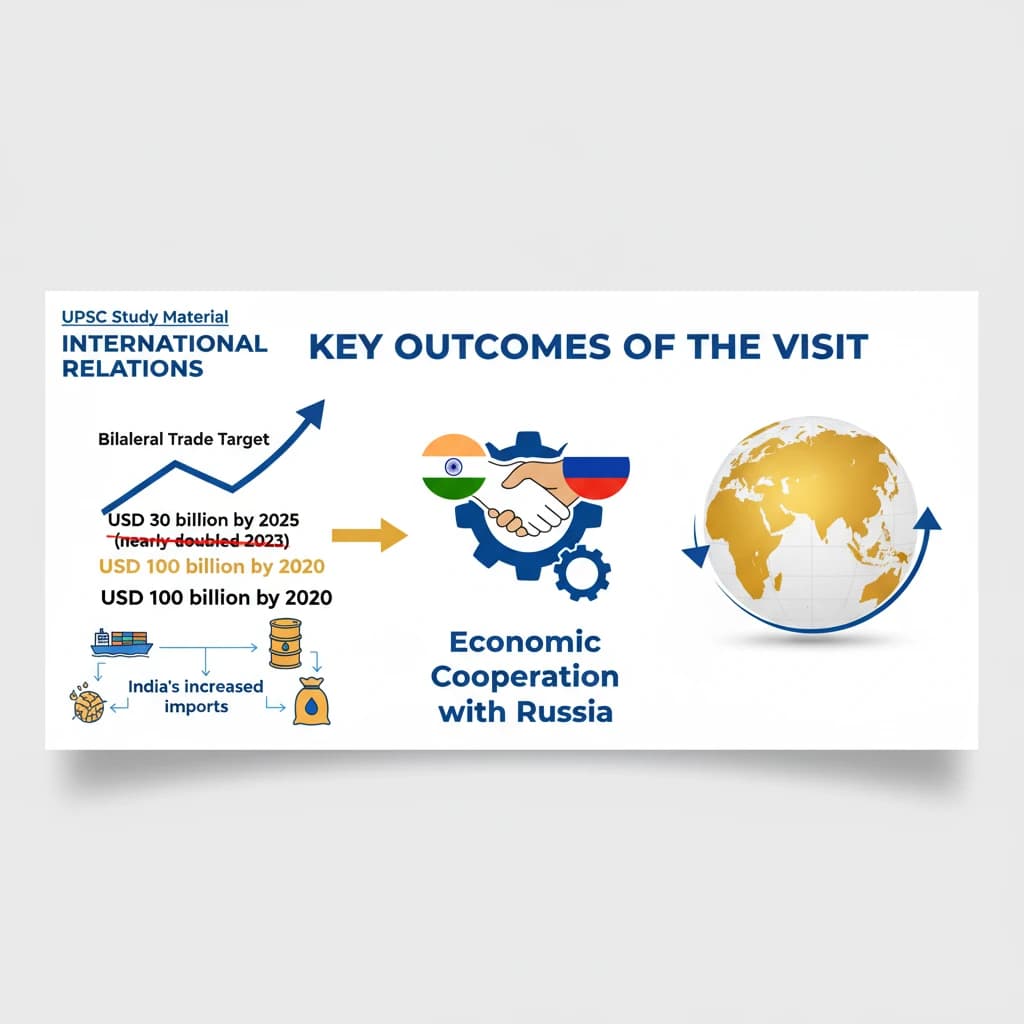
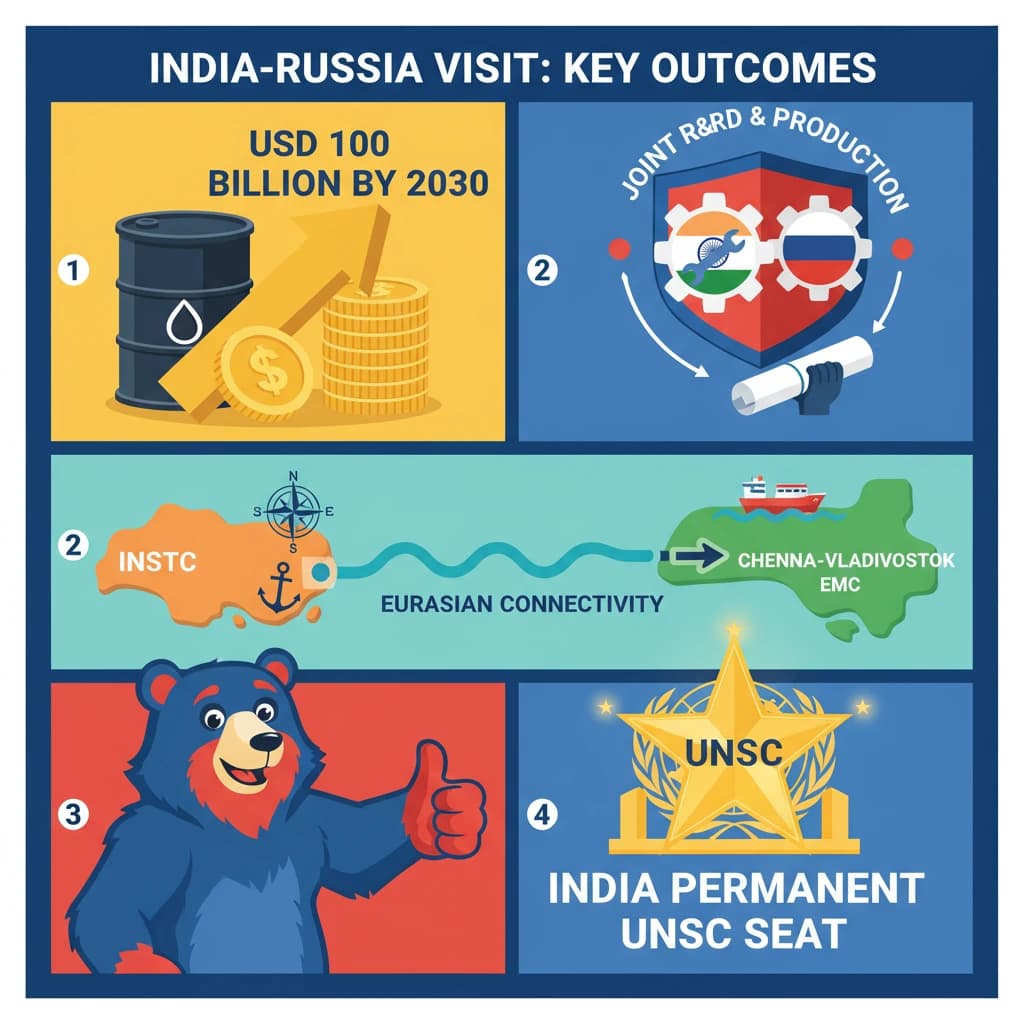
<h4>Economic Cooperation with Russia</h4><p><strong>Bilateral Trade Target</strong>: India and Russia have set an ambitious new bilateral trade target, significantly increasing their economic aspirations.</p><p>The new target aims for <strong>USD 100 billion by 2030</strong>. This is a substantial leap from the previous goal of <strong>USD 30 billion by 2025</strong>, which was nearly doubled in 2023.</p><p>This surge in trade volume is primarily attributed to <strong>India’s increased imports of Russian crude oil</strong>.</p><p>These imports rose significantly after the <strong>US and European Union imposed oil sanctions on Russia</strong> following its <strong>invasion of Ukraine</strong>.</p><div class='info-box'><p><strong>Programme-2030</strong>: An agreement was reached to prepare a comprehensive <strong>“Programme-2030”</strong>. This program is designed to develop promising areas of economic cooperation between the two nations.</p></div><p>The coordination of this program will be handled by the <strong>India-Russia Intergovernmental Commission on Trade, Economic, Scientific, Technical and Cultural Cooperation (IRIGC-TEC)</strong>.</p><div class='info-box'><p><strong>IRIGC-TEC</strong> serves as the apex <strong>Government-to-Government (G2G) forum</strong> for bilateral economic cooperation. It is co-chaired by the <strong>External Affairs Minister of India</strong> and the <strong>Deputy Prime Minister of Russia</strong>.</p></div><p><strong>Free Trade Agreement (FTA)</strong>: India and the <strong>Eurasian Economic Union (EEU)</strong> have commenced negotiations for a <strong>Free Trade Agreement (FTA) on goods</strong>.</p><p>Additionally, both sides plan to explore a bilateral <strong>free trade agreement in services and investments</strong>.</p><p><strong>“Make in India” & “Atmanirbhar Bharat”</strong>: Leaders agreed to facilitate the participation of <strong>Russian businesses</strong> in India’s <strong>“Make in India”</strong> and <strong>“Atmanirbhar Bharat”</strong> programs.</p><p>Conversely, <strong>Indian companies</strong> will be encouraged to participate in investment projects within Russia.</p><h4>Defence and Technology Cooperation</h4><p><strong>Shift in Relationship</strong>: The defence cooperation is undergoing a significant transition from a traditional <strong>buyer-seller relationship</strong>.</p><p>The new emphasis is on <strong>joint research, development, co-development, and joint production</strong> of advanced defence technology and systems.</p><p><strong>Joint Manufacturing</strong>: Both countries aim to encourage the joint manufacturing of <strong>spare parts and components</strong> for Russian-origin arms and defence equipment in India.</p><p>This initiative is a crucial component of the broader <strong>Make-in-India program</strong>.</p><p>It includes setting up <strong>joint ventures</strong> to meet the needs of the <strong>Indian Armed Forces</strong> and for subsequent export to friendly third countries.</p><p><strong>Working Group on Technological Cooperation</strong>: A new <strong>Working Group on Technological Cooperation</strong> is slated for establishment.</p><p>This group will discuss its provisions during the next meeting of the <strong>Intergovernmental Commission on Military and Military Technical Cooperation (IRIGC-M&MTC)</strong>.</p><p><strong>Indian Military Recruits in Russia</strong>: Russian President <strong>Vladimir Putin</strong> accepted the Prime Minister of India’s request regarding Indian military personnel.</p><p>The request sought the discharge of <strong>Indian military recruits serving in the Russian military</strong> on the <strong>Ukrainian war front</strong> who wish to return to India.</p><div class='info-box'><p><strong>Russian law</strong> permits the recruitment of foreign soldiers after thorough screening, which includes mental and physical checks.</p></div><p><strong>Reciprocal Exchange of Logistics Agreement (RELOS)</strong>: The summit concluded without the signing of the long-awaited <strong>RELOS agreement</strong>.</p><p>This agreement would have provided essential <strong>logistical support for military operations</strong> between Russia and India.</p><p>The <strong>Indian Navy</strong> would have particularly benefited from RELOS, gaining access to <strong>Russian military facilities in the Arctic</strong>.</p><h4>Transport and Connectivity Initiatives</h4><p><strong>Eurasian Transport Corridors</strong>: Both sides are focused on developing stable and efficient transport corridors across Eurasia.</p><p>Key initiatives include the <strong>Chennai-Vladivostok Eastern Maritime Corridor (EMC)</strong> and the <strong>International North-South Transport Corridor (INSTC)</strong>.</p><p><strong>Chennai-Vladivostok EMC</strong>: This is a vital sea link connecting ports on India's east coast with ports in Russia's far-east region.</p><div class='info-box'><p>The <strong>Chennai-Vladivostok EMC</strong> was initially proposed in <strong>2019</strong>. Its objective is to transport various types of cargo and reduce the transportation time to Russia by <strong>40%</strong>.</p></div><p><strong>International North-South Transport Corridor (INSTC)</strong>: The INSTC represents a crucial multi-modal transportation route.</p><div class='info-box'><p>Established in <strong>2000</strong> in <strong>St. Petersburg</strong> by <strong>Iran, Russia, and India</strong>, the INSTC aims to promote transportation cooperation among its member states.</p></div><p>The corridor connects the <strong>Indian Ocean and the Persian Gulf</strong> to the <strong>Caspian Sea via Iran</strong>.</p><p>From the Caspian Sea, it further connects to <strong>St. Petersburg and Northern Europe</strong> via the <strong>Russian Federation</strong>.</p><p><strong>Northern Sea Route & Connectivity</strong>: The leaders aim to increase infrastructure capacity and utilize the potential of the <strong>Northern Sea Route</strong>.</p><p>Both nations will collaborate to reduce the time and cost of cargo transportation, thereby enhancing connectivity in the broader <strong>Eurasian space</strong>.</p><h4>International Cooperation</h4><p><strong>UN Security Council (UNSC)</strong>: Russia expressed appreciation for India’s non-permanent membership in the <strong>UN Security Council (2021-22)</strong>.</p><p>Russia also supported India’s ongoing efforts in <strong>peacekeeping and counter-terrorism</strong> initiatives.</p><p><strong>Permanent UNSC Membership</strong>: Russia reiterated its strong support for <strong>India’s permanent membership</strong> in a reformed and expanded <strong>UN Security Council</strong>.</p><h4>India-Maldives Bilateral Outcomes</h4><p><strong>Water and Sewerage Network Project</strong>: Indian and Maldivian Foreign Ministers jointly inaugurated an India-assisted project.</p><p>This project, supported by India's <strong>Line of Credit (LoC)</strong>, provides water and sewerage networks across <strong>28 islands of Maldives</strong>.</p><p><strong>Capacity Building</strong>: A <strong>Memorandum of Understanding (MoU)</strong> was signed focused on capacity building.</p><p>This MoU will facilitate the training of an additional <strong>1,000 Maldivian civil servants in India</strong>.</p><p><strong>Launch of UPI</strong>: Both countries reached an agreement for the introduction of <strong>Unified Payments Interface (UPI)</strong> in <strong>Maldives</strong>.</p><p><strong>Community Development Projects</strong>: Six <strong>High Impact Community Development Projects (HICDPs)</strong> were jointly inaugurated.</p><p>These projects, funded by India's grant assistance, cover vital areas such as <strong>mental health, special education, speech therapy, and street lighting</strong>.</p><p><strong>'Ek Ped Maa Ke Naam' Initiative</strong>: India's EAM planted a sapling at the <strong>Rashtrapatiy Park</strong> as part of a significant environmental initiative.</p><p>This was in support of Prime Minister <strong>Muizzu’s ‘Ek Ped Maa Ke Naam’ initiative</strong> and President <strong>Muizzu’s 5 Million Tree Project</strong>.</p><p><strong>Greener Male’ Connectivity Project (GMCP)</strong>: The EAM visited the India-assisted <strong>GMCP site</strong>.</p><p>India reaffirmed its commitment to the progress of this flagship development project, which will connect <strong>Male</strong> with the adjoining islands of <strong>Villigili, Gulhifalhu, and Thilafushi</strong>.</p><p><strong>Addu Reclamation and Shore Protection Project</strong>: The EAM inaugurated the <strong>Addu Reclamation and Shore Protection Project</strong>.</p><p>Additionally, the <strong>Addu Detour Link Bridge Project</strong> was also inaugurated during the visit.</p>