Loading page, please wait…
Vaidra Logo
Vaidra

Top 4 items + smart groups

UPSC GPT
New
Current Affairs
Daily Solutions
Daily Puzzle
Mains Evaluator

Version 2.0.0 • Built with ❤️ for UPSC aspirants

Loading...
Loading...
Loading...
Loading...
Loading...
Loading...
Loading...
Loading...
Loading...
Loading...
Loading...
Loading...
Loading...
Back
All Subjects

Topics

0 topics • 0 completed

Loading topics...
Loading...
Loading...
Loading...
Loading...
Loading...
Overall Progress0%
What are the Different Organs of the UN? - UPSC International Relations

What are the Different Organs of the UN? - UPSC International Relations

What is What are the Different Organs of the UN? in UPSC International Relations?

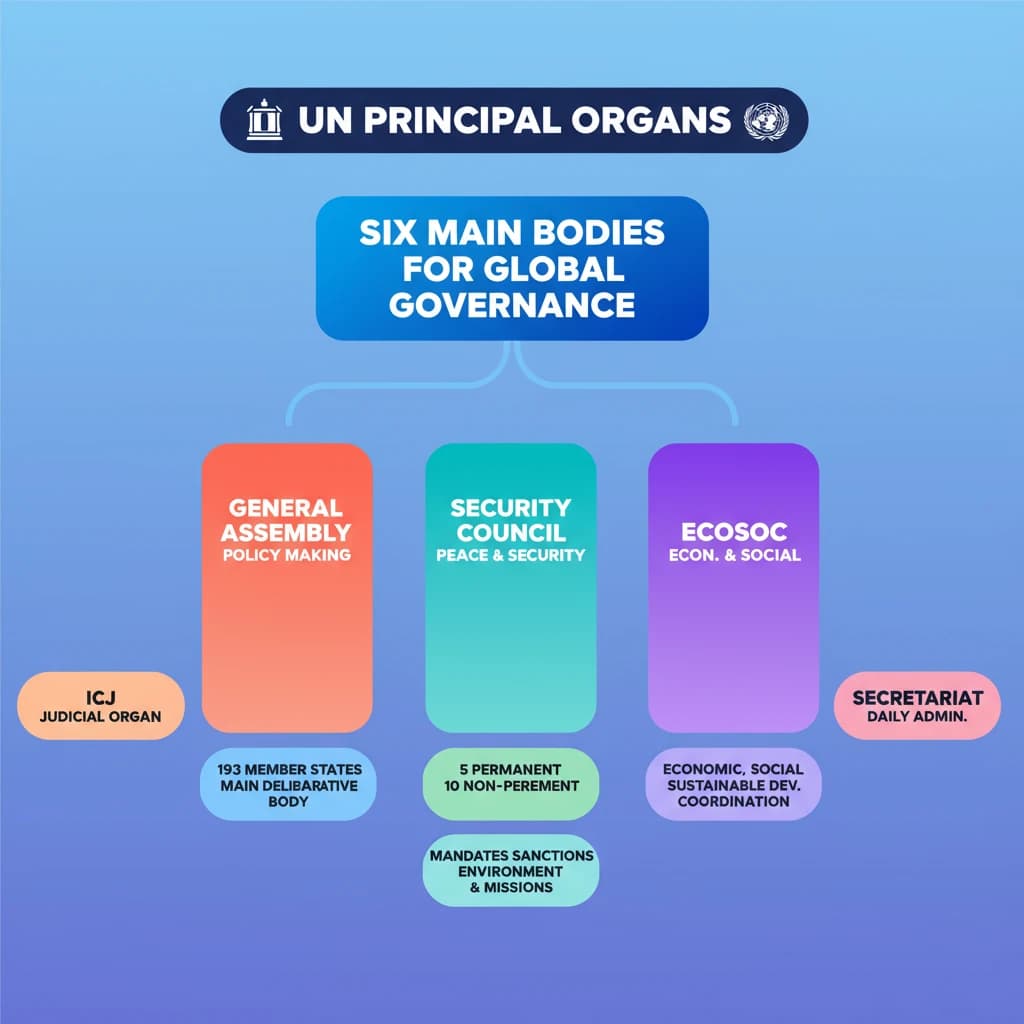
What are the Different Organs of the UN? is a key topic under International Relations for UPSC Civil Services Examination. Key points include: The UN has six principal organs, each with distinct functions for global governance.. The General Assembly is the main policy-making body, representing all 193 member states with equal vote.. The Security Council maintains international peace and security, comprising 5 permanent and 10 non-permanent members.. Understanding this topic is essential for both UPSC Prelims and Mains preparation.

Why is What are the Different Organs of the UN? important for UPSC exam?

What are the Different Organs of the UN? is a Medium-level topic in UPSC International Relations. It is tested in both Prelims (factual MCQs) and Mains (analytical answer writing). Previous year UPSC questions have frequently covered aspects of What are the Different Organs of the UN?, making it essential for comprehensive IAS preparation.

How to prepare What are the Different Organs of the UN? for UPSC?

To prepare What are the Different Organs of the UN? for UPSC: (1) Study the comprehensive notes covering all key concepts on Vaidra. (2) Practice previous year questions on this topic. (3) Connect it with current affairs using daily updates. (4) Revise using key takeaways and mind maps available for International Relations. (5) Write practice answers linking What are the Different Organs of the UN? to related GS Paper topics.

Key takeaways of What are the Different Organs of the UN? for UPSC

  • The UN has six principal organs, each with distinct functions for global governance.
  • The General Assembly is the main policy-making body, representing all 193 member states with equal vote.
  • The Security Council maintains international peace and security, comprising 5 permanent and 10 non-permanent members.
  • ECOSOC coordinates economic, social, and environmental issues, vital for sustainable development.
  • The ICJ is the primary judicial organ, settling disputes between states.
  • The Trusteeship Council fulfilled its mandate of overseeing territories to independence.
What are the Different Organs of the UN?

What are the Different Organs of the UN?

Medium⏱️ 8 min read✓ 95% Verified
international relations

📖 Introduction

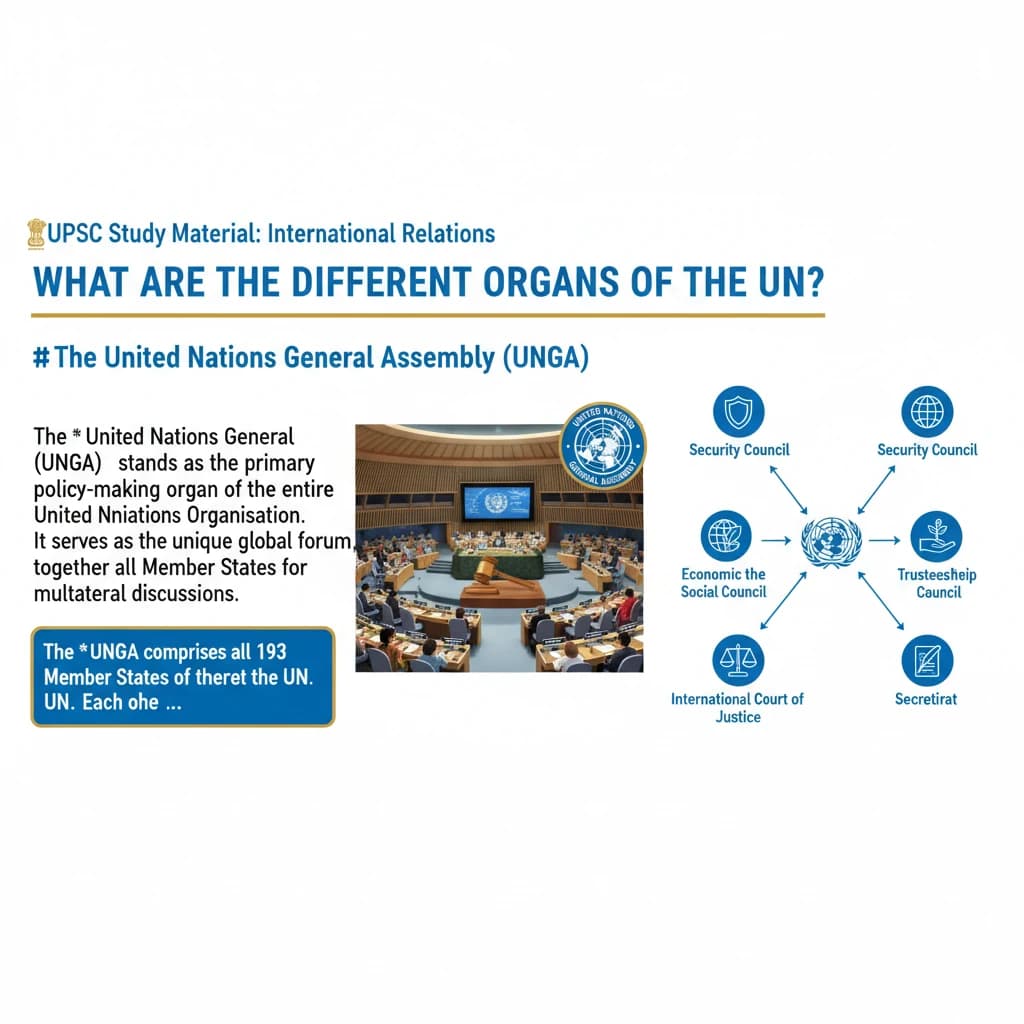
<h4>The United Nations General Assembly (UNGA)</h4><p>The <strong>United Nations General Assembly (UNGA)</strong> stands as the primary <strong>policy-making organ</strong> of the entire <strong>United Nations Organisation</strong>.</p><p>It serves as a unique global forum, bringing together all <strong>Member States</strong> for multilateral discussions.</p><div class='info-box'><p>The <strong>UNGA</strong> comprises <strong>all 193 Member States</strong> of the <strong>UN</strong>. Each of these nations holds an <strong>equal vote</strong>, ensuring democratic representation in its deliberations.</p></div><p>Its mandate covers the full spectrum of international issues as outlined in the <strong>Charter of the UN</strong>.</p><h4>The United Nations Security Council (UNSC)</h4><p>The <strong>United Nations Security Council (UNSC)</strong> is entrusted with the primary responsibility for the maintenance of <strong>international peace and security</strong>.</p><div class='info-box'><p>The <strong>UNSC</strong> is composed of <strong>15 members</strong>. This includes <strong>five permanent members</strong> and <strong>ten non-permanent members</strong>.</p></div><p>The <strong>five permanent members</strong> hold veto power and are <strong>China</strong>, <strong>France</strong>, the <strong>Russian Federation</strong>, the <strong>United Kingdom</strong>, and the <strong>United States</strong>.</p><p>The <strong>ten non-permanent members</strong> are elected by the <strong>General Assembly</strong> for a term of <strong>two years</strong>.</p><div class='exam-tip-box'><p><strong>India's</strong> significant role in global affairs is highlighted by its election as a <strong>non-permanent member</strong> of the <strong>UNSC</strong> for <strong>eight terms</strong>, a crucial fact for <strong>UPSC Mains GS-II</strong>.</p></div><h4>The United Nations Economic and Social Council (ECOSOC)</h4><p>The <strong>United Nations Economic and Social Council (ECOSOC)</strong> is a central platform for debate and innovative thinking on sustainable development.</p><div class='info-box'><p><strong>ECOSOC</strong> consists of <strong>54 Members</strong> of the <strong>UN</strong>, who are elected by the <strong>UN General Assembly</strong>.</p></div><p>It is the principal body for <strong>coordination</strong>, <strong>policy review</strong>, <strong>policy dialogue</strong>, and making <strong>recommendations</strong> on crucial <strong>economic</strong>, <strong>social</strong>, and <strong>environmental issues</strong>.</p><h4>The United Nations Trusteeship Council</h4><p>The <strong>Trusteeship Council</strong> was established as one of the main organs of the <strong>UN</strong> with a specific, historical mandate.</p><p>Its primary role was to <strong>supervise the administration of Trust Territories</strong>.</p><div class='key-point-box'><p>The Council's objective was to ensure these territories were prepared for <strong>self-governance</strong> or <strong>independence</strong>, transitioning them from <strong>colonies</strong> to <strong>sovereign nations</strong>.</p></div><h4>The International Court of Justice (ICJ)</h4><p>The <strong>International Court of Justice (ICJ)</strong>, often referred to as the <strong>World Court</strong>, is the principal judicial organ of the <strong>United Nations</strong>.</p><div class='info-box'><p>The <strong>ICJ</strong> is the <strong>only international court</strong> that settles legal disputes between the <strong>193 UN Member States</strong>.</p></div><p>The Court has the authority to rule on two distinct types of cases.</p><ul><li><strong>Contentious cases:</strong> These involve <strong>legal disputes between states</strong> that have agreed to submit to the Court's jurisdiction.</li><li><strong>Advisory proceedings:</strong> These are requests for <strong>advisory opinions</strong> on legal questions, referred to the <strong>ICJ</strong> by <strong>UN organs</strong> and certain <strong>specialized agencies</strong>.</li></ul>
Concept Diagram

💡 Key Takeaways

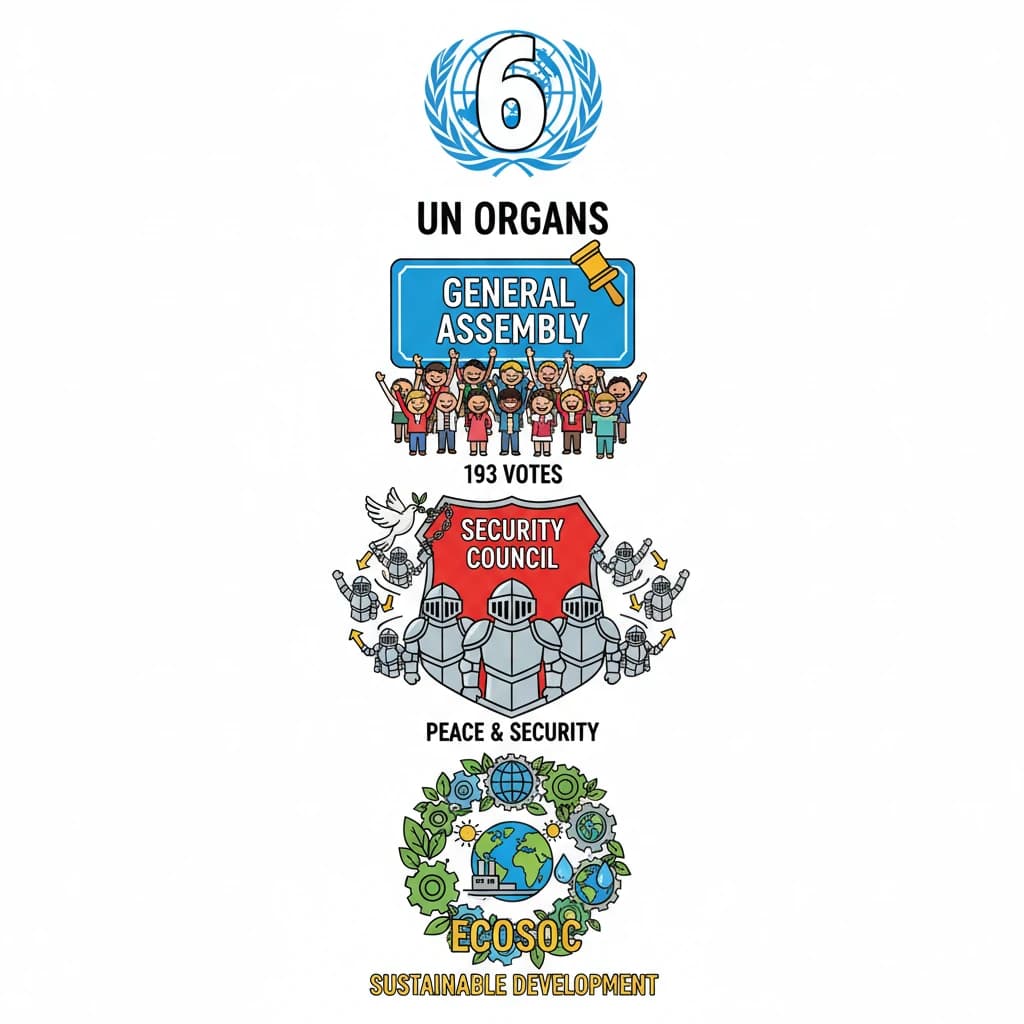
  • •The UN has six principal organs, each with distinct functions for global governance.
  • •The General Assembly is the main policy-making body, representing all 193 member states with equal vote.
  • •The Security Council maintains international peace and security, comprising 5 permanent and 10 non-permanent members.
  • •ECOSOC coordinates economic, social, and environmental issues, vital for sustainable development.
  • •The ICJ is the primary judicial organ, settling disputes between states.
  • •The Trusteeship Council fulfilled its mandate of overseeing territories to independence.

🧠 Memory Techniques
Memory Aid
95% Verified Content

📚 Reference Sources

•Official UN Website (for general structure and functions)

Related Topics

Loading related topics...
Explore:International Relations Topics·All Subjects·Daily Current Affairs·Editorial Analysis·Previous Year Questions·UPSC GPT