Loading page, please wait…
G20 Rio de Janeiro Leaders’ Declaration - UPSC International Relations
What is G20 Rio de Janeiro Leaders’ Declaration in UPSC International Relations?
G20 Rio de Janeiro Leaders’ Declaration is a key topic under International Relations for UPSC Civil Services Examination. Key points include: The 19th G20 Summit in Rio de Janeiro focused on 'Building a Just World and a Sustainable Planet.'. Digital Public Infrastructure (DPI) was a central theme, recognized for enabling economic opportunities and social services.. DPI is built on three pillars: digital ID (people), real-time payments (money), and consent-based data sharing (data).. Understanding this topic is essential for both UPSC Prelims and Mains preparation.
Why is G20 Rio de Janeiro Leaders’ Declaration important for UPSC exam?
G20 Rio de Janeiro Leaders’ Declaration is a Medium-level topic in UPSC International Relations. It is tested in both Prelims (factual MCQs) and Mains (analytical answer writing). Previous year UPSC questions have frequently covered aspects of G20 Rio de Janeiro Leaders’ Declaration, making it essential for comprehensive IAS preparation.
How to prepare G20 Rio de Janeiro Leaders’ Declaration for UPSC?
To prepare G20 Rio de Janeiro Leaders’ Declaration for UPSC: (1) Study the comprehensive notes covering all key concepts on Vaidra. (2) Practice previous year questions on this topic. (3) Connect it with current affairs using daily updates. (4) Revise using key takeaways and mind maps available for International Relations. (5) Write practice answers linking G20 Rio de Janeiro Leaders’ Declaration to related GS Paper topics.
Key takeaways of G20 Rio de Janeiro Leaders’ Declaration for UPSC
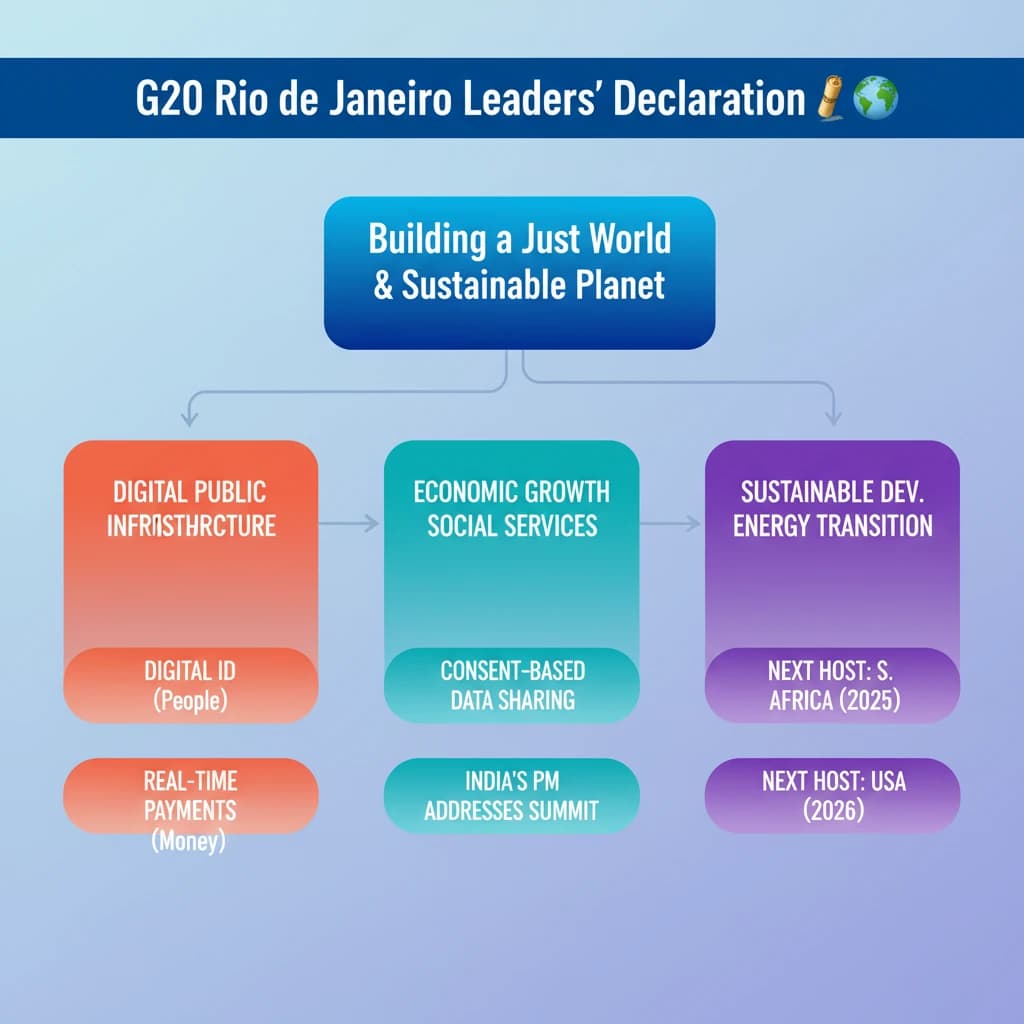
- The 19th G20 Summit in Rio de Janeiro focused on 'Building a Just World and a Sustainable Planet.'
- Digital Public Infrastructure (DPI) was a central theme, recognized for enabling economic opportunities and social services.
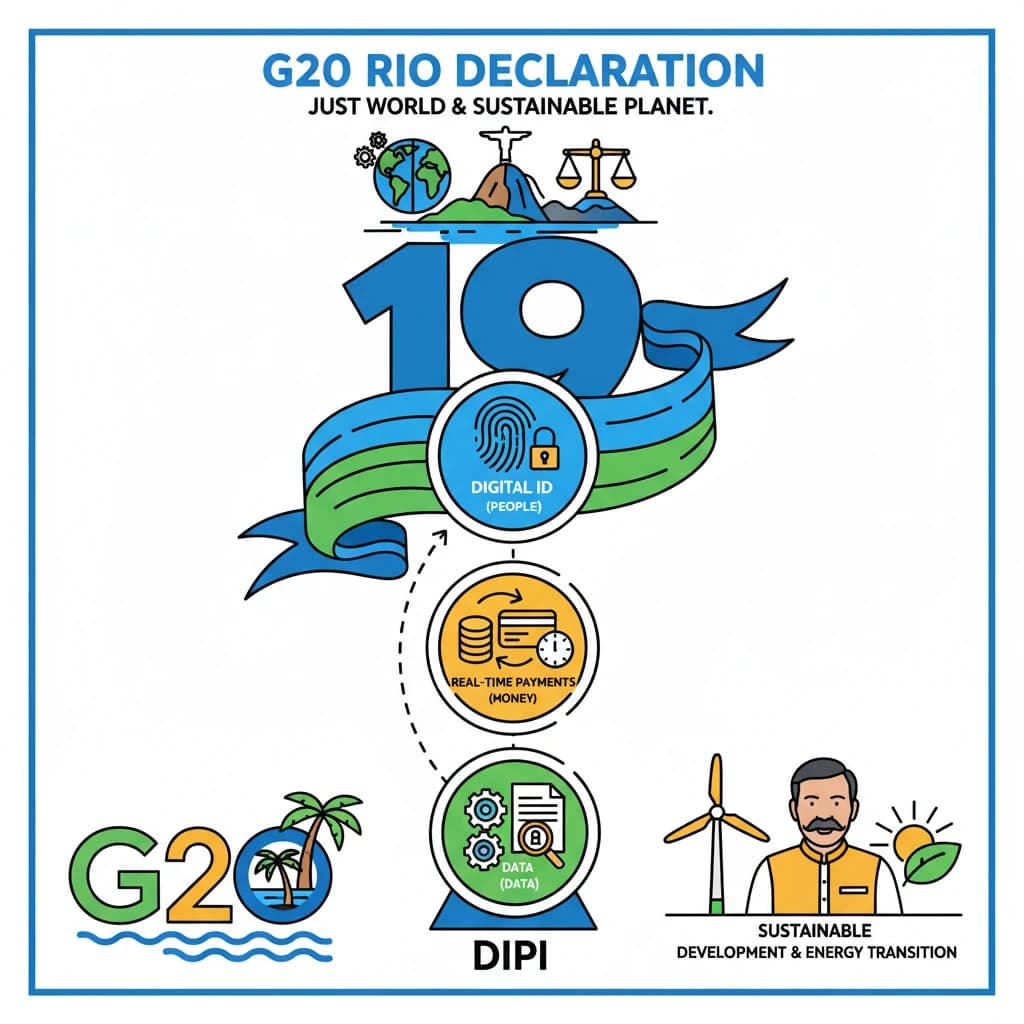
- DPI is built on three pillars: digital ID (people), real-time payments (money), and consent-based data sharing (data).
- India's PM addressed sustainable development and energy transition at the summit.
- South Africa (2025) and USA (2026) are the next G20 hosts.
- DPI is crucial for achieving Sustainable Development Goals and fostering inclusive growth.

G20 Rio de Janeiro Leaders’ Declaration
Medium⏱️ 5 min read
international relations
📖 Introduction
G20 Rio de Janeiro Leaders’ Declaration: Overview
The 19th G20 Summit recently convened in Rio de Janeiro, Brazil. This crucial gathering reaffirmed the G20’s unwavering commitment to fostering a sustainable and inclusive world.
The overarching theme for the Rio de Janeiro Summit was “Building a Just World and a Sustainable Planet.” This theme underscored the global challenges and shared responsibilities facing member nations.
Key Event: India’s Prime Minister addressed the G20 session specifically on Sustainable Development and Energy Transition, highlighting India's contributions and vision.
Future Hosts: The G20 Presidency will transition to South Africa in 2025, followed by the United States of America in 2026, ensuring continuity in global leadership discussions.
Understanding Digital Public Infrastructure (DPI)
Digital Public Infrastructure (DPI) represents a foundational set of digital systems. These systems are designed to empower countries to deliver economic opportunities and provide social services both safely and efficiently.
Definition: DPI is a robust framework of digital technologies that connects people, data, and money, much like traditional physical infrastructure such as roads and railways connect people and goods.
Its influence extends across the entire economy, creating interconnected pathways for various interactions. This broad coverage facilitates seamless operations and access to services for citizens.
The Core Pillars of a DPI Ecosystem
An effective DPI ecosystem is built upon three fundamental flows: people, money, and data. Each component is critical for realizing the full potential of digital transformation.
- Flow of People: Enabled by a robust digital ID system, ensuring unique and verifiable identification for individuals.
- Flow of Money: Facilitated by a real-time fast payment system, allowing for instant and secure financial transactions.
- Flow of Personal Information: Managed through consent-based data sharing systems, empowering citizens with control over their data and enabling personalized service delivery.
These interconnected flows are essential for actualizing the benefits of DPIs, ensuring that citizens have a real ability to control their personal information and access services effectively.
💡 Key Takeaways
- •The 19th G20 Summit in Rio de Janeiro focused on 'Building a Just World and a Sustainable Planet.'
- •Digital Public Infrastructure (DPI) was a central theme, recognized for enabling economic opportunities and social services.
- •DPI is built on three pillars: digital ID (people), real-time payments (money), and consent-based data sharing (data).
- •India's PM addressed sustainable development and energy transition at the summit.
- •South Africa (2025) and USA (2026) are the next G20 hosts.
- •DPI is crucial for achieving Sustainable Development Goals and fostering inclusive growth.
🧠 Memory Techniques
95% Verified Content