Loading page, please wait…
H-1B Visa Program - UPSC International Relations
What is H-1B Visa Program in UPSC International Relations?
H-1B Visa Program is a key topic under International Relations for UPSC Civil Services Examination. Key points include: The H-1B is a non-immigrant visa allowing US companies to hire foreign workers for specialty (STEM/IT) jobs.. It was introduced in 1990 to address skill shortages when qualified US workers are unavailable.. Visa duration is a maximum of six years, after which a Green Card application or departure is required.. Understanding this topic is essential for both UPSC Prelims and Mains preparation.
Why is H-1B Visa Program important for UPSC exam?
H-1B Visa Program is a Medium-level topic in UPSC International Relations. It is tested in both Prelims (factual MCQs) and Mains (analytical answer writing). Previous year UPSC questions have frequently covered aspects of H-1B Visa Program, making it essential for comprehensive IAS preparation.
How to prepare H-1B Visa Program for UPSC?
To prepare H-1B Visa Program for UPSC: (1) Study the comprehensive notes covering all key concepts on Vaidra. (2) Practice previous year questions on this topic. (3) Connect it with current affairs using daily updates. (4) Revise using key takeaways and mind maps available for International Relations. (5) Write practice answers linking H-1B Visa Program to related GS Paper topics.
Key takeaways of H-1B Visa Program for UPSC
- The H-1B is a non-immigrant visa allowing US companies to hire foreign workers for specialty (STEM/IT) jobs.
- It was introduced in 1990 to address skill shortages when qualified US workers are unavailable.
- Visa duration is a maximum of six years, after which a Green Card application or departure is required.
- There is an annual cap of 65,000 visas, with an additional 20,000 for US Master's degree holders.
- The program is a key point in US political debates regarding STEM talent and immigration policy.
H-1B Visa Program
Medium⏱️ 8 min read
international relations
📖 Introduction
Introduction to the H-1B Visa Program
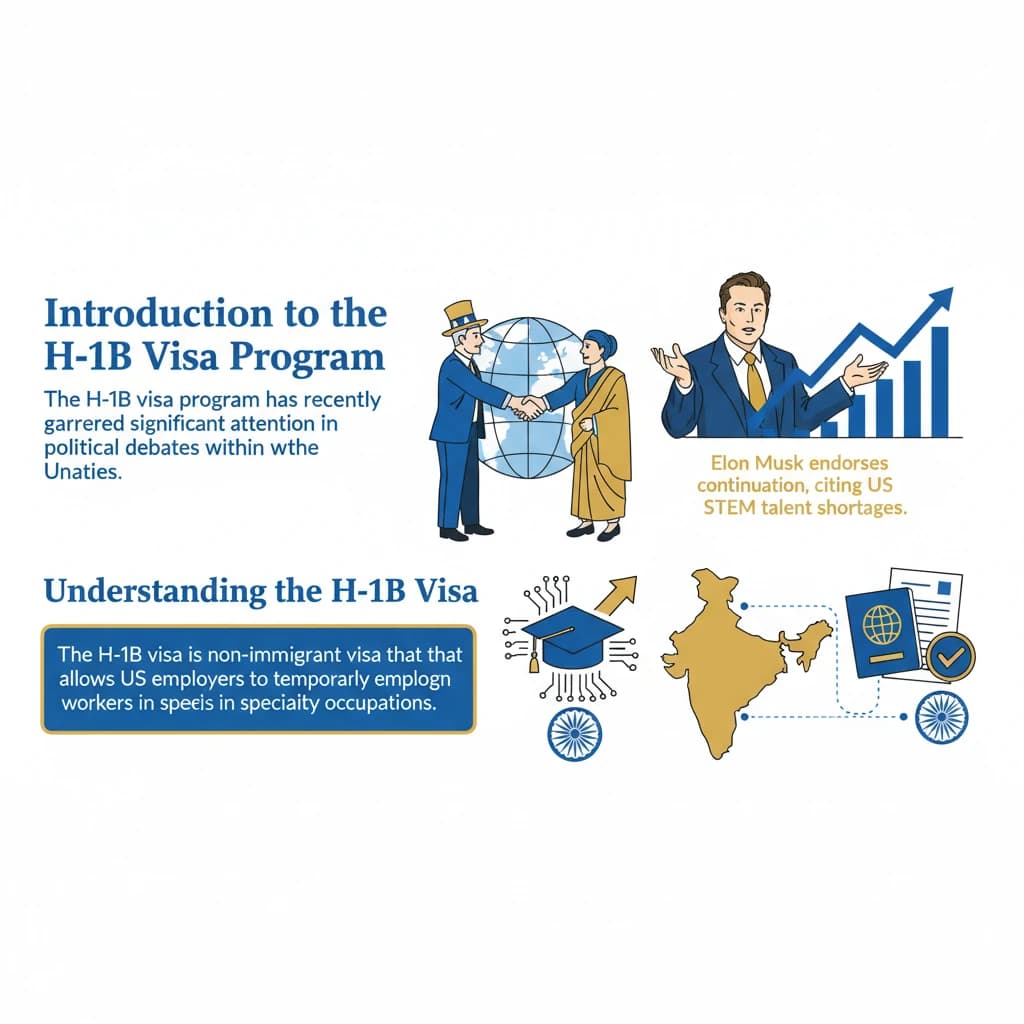
The H-1B visa program has recently garnered significant attention in political debates within the United States.
Prominent figures, including Elon Musk, have publicly voiced their support for its continuation. They emphasize its crucial role in addressing the US’s STEM talent shortages.
Understanding the H-1B Visa
The H-1B visa is a non-immigrant visa category. It permits US-based companies to temporarily employ foreign workers in specific specialty occupations.
These specialty jobs typically require a high level of skill and often a minimum of a bachelor’s degree. Key fields include Science, Technology, Engineering, and Mathematics (STEM), as well as Information Technology (IT).
The program was originally introduced in 1990. Its primary aim was to assist US employers in filling skill gaps when qualified American workers were not available.
What is a Non-Immigrant Visa?
A non-immigrant visa grants individuals temporary entry into the United States. It is distinct from an immigrant visa, which leads to permanent residency.
Such visas are issued for various specific purposes, including tourism, business, work, study, or medical treatment, for a defined period.
Visa Duration and Renewal
An H-1B visa can be initially issued for a maximum period of six years. This duration is typically split into two three-year increments.
Upon the completion of this six-year period, the visa holder has two main options. They must either depart the US for at least 12 months before being eligible to reapply for another H-1B visa, or they can apply for permanent residence (a Green Card).
Annual Cap and Exemptions
The H-1B visa program operates under an annual numerical limit, commonly known as the annual cap. This cap restricts the number of new visas issued each fiscal year.
- Regular Annual Cap: Currently set at 65,000 new H-1B visas per fiscal year.
- Master’s Exemption: An additional 20,000 visas are reserved. These are specifically for applicants who hold a master’s degree or higher from a US university.
UPSC Insight: Understanding the distinction between immigrant and non-immigrant visas is crucial. Also, note the specific annual cap and exemptions as these are frequently debated policy points relevant to GS-II: International Relations.
💡 Key Takeaways
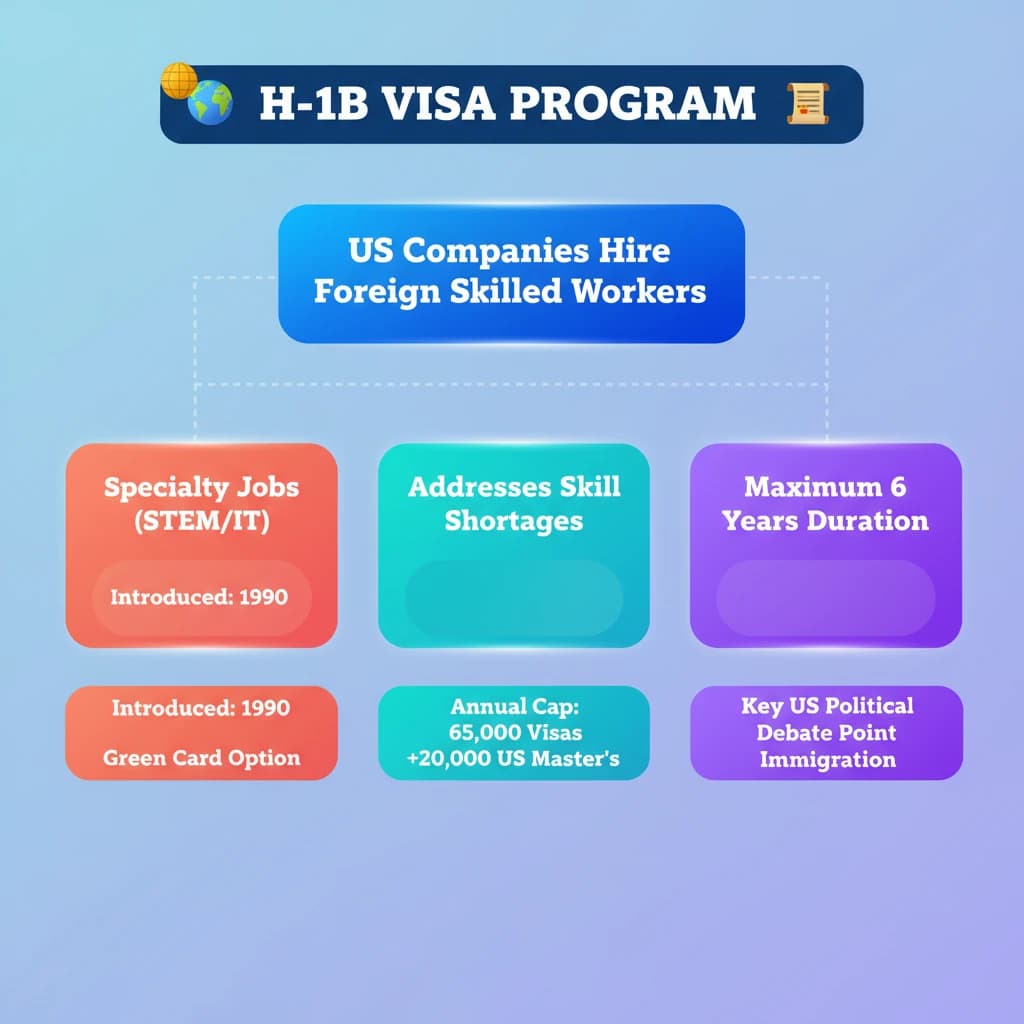
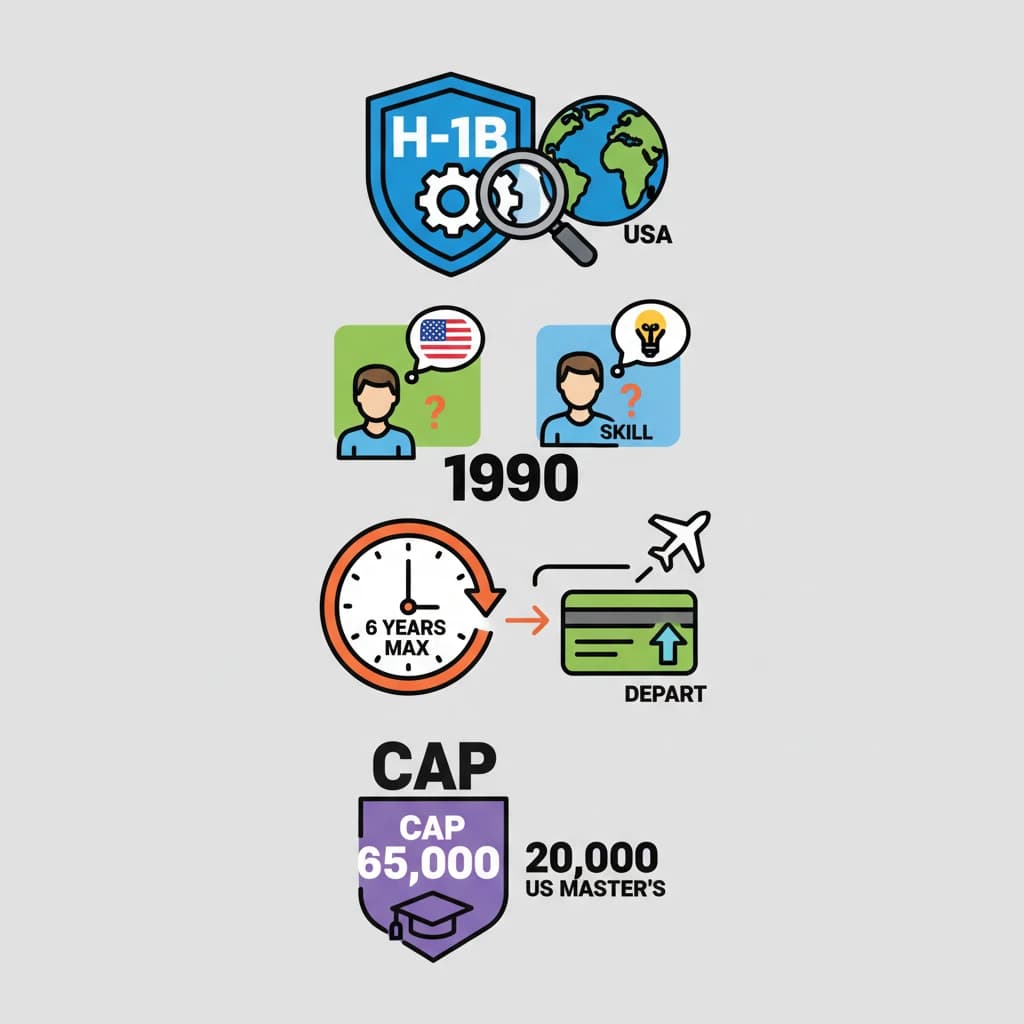
- •The H-1B is a non-immigrant visa allowing US companies to hire foreign workers for specialty (STEM/IT) jobs.
- •It was introduced in 1990 to address skill shortages when qualified US workers are unavailable.
- •Visa duration is a maximum of six years, after which a Green Card application or departure is required.
- •There is an annual cap of 65,000 visas, with an additional 20,000 for US Master's degree holders.
- •The program is a key point in US political debates regarding STEM talent and immigration policy.
🧠 Memory Techniques
95% Verified Content
📚 Reference Sources
•US Citizenship and Immigration Services (USCIS) official website
•Department of Homeland Security (DHS) reports
•Congressional Research Service (CRS) reports on H-1B visas