Loading page, please wait…
India and Uzbekistan Signed BIT - UPSC International Relations
What is India and Uzbekistan Signed BIT in UPSC International Relations?
India and Uzbekistan Signed BIT is a key topic under International Relations for UPSC Civil Services Examination. Key points include: India and Uzbekistan signed a Bilateral Investment Treaty (BIT) for investor protection.. BITs ensure minimum treatment, non-discrimination, and independent arbitration for investors.. India engages in various trade agreements: FTAs, EHS, CECAs/CEPAs, PTAs, and Regional FTAs.. Understanding this topic is essential for both UPSC Prelims and Mains preparation.
Why is India and Uzbekistan Signed BIT important for UPSC exam?
India and Uzbekistan Signed BIT is a Medium-level topic in UPSC International Relations. It is tested in both Prelims (factual MCQs) and Mains (analytical answer writing). Previous year UPSC questions have frequently covered aspects of India and Uzbekistan Signed BIT, making it essential for comprehensive IAS preparation.
How to prepare India and Uzbekistan Signed BIT for UPSC?
To prepare India and Uzbekistan Signed BIT for UPSC: (1) Study the comprehensive notes covering all key concepts on Vaidra. (2) Practice previous year questions on this topic. (3) Connect it with current affairs using daily updates. (4) Revise using key takeaways and mind maps available for International Relations. (5) Write practice answers linking India and Uzbekistan Signed BIT to related GS Paper topics.
Key takeaways of India and Uzbekistan Signed BIT for UPSC
- India and Uzbekistan signed a Bilateral Investment Treaty (BIT) for investor protection.
- BITs ensure minimum treatment, non-discrimination, and independent arbitration for investors.
- India engages in various trade agreements: FTAs, EHS, CECAs/CEPAs, PTAs, and Regional FTAs.
- FTAs offer preferential trade; EHS are precursors to broader deals.
- CECAs/CEPAs are comprehensive, covering goods, services, and investment, with CEPA having the widest scope.
- PTAs grant preferential access on a 'positive list' of products.
- These agreements are crucial for India's economic diplomacy, FDI attraction, and market access.
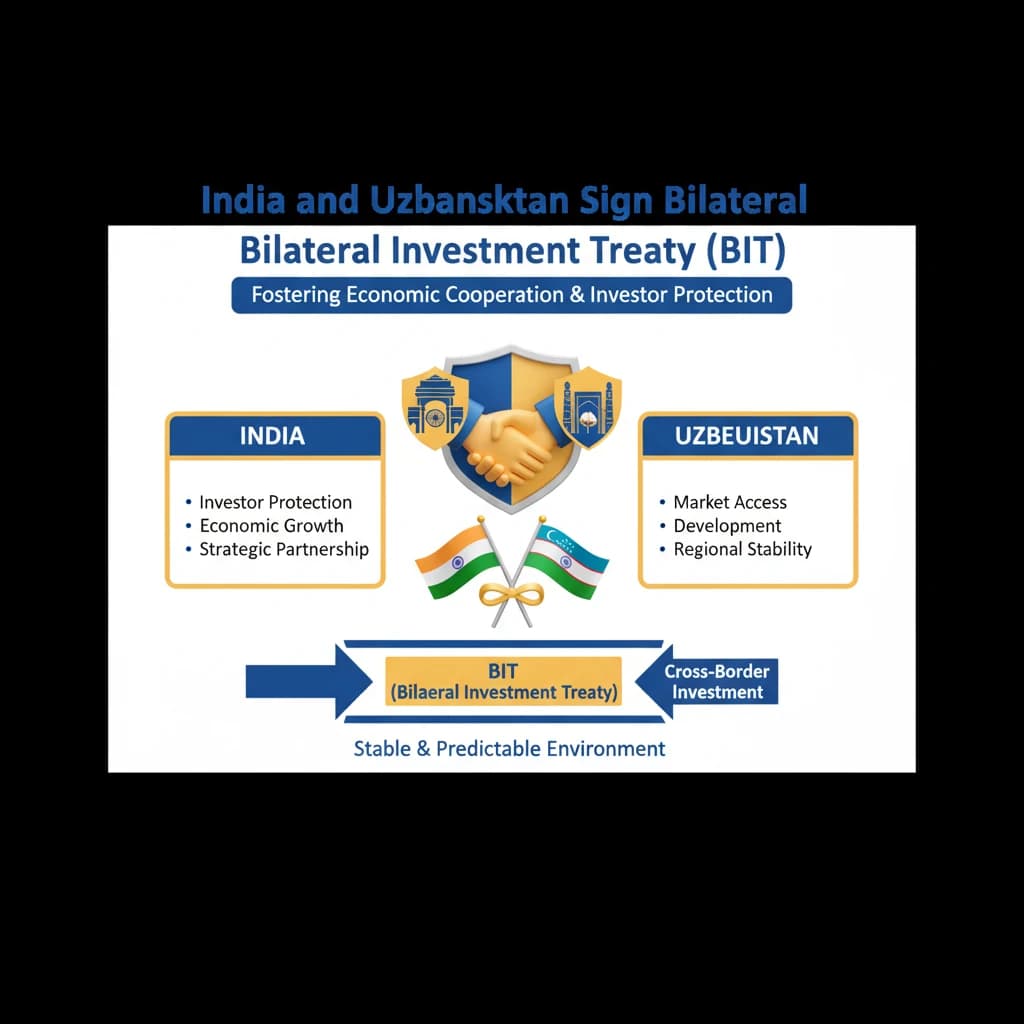
India and Uzbekistan Signed BIT
Medium⏱️ 8 min read
international relations
📖 Introduction
India and Uzbekistan Sign Bilateral Investment Treaty (BIT)
India and Uzbekistan have signed a Bilateral Investment Treaty (BIT). This significant agreement aims to foster greater economic cooperation between the two nations.
The primary objective of this BIT is to assure appropriate protection for investors from both countries. It creates a stable and predictable environment for cross-border investments.
A Bilateral Investment Treaty (BIT) typically assures a minimum standard of treatment and non-discrimination for investors. It also offers mechanisms for independent arbitration for dispute resolution, enhancing investor confidence.
However, the treaty also acknowledges the right of both countries to regulate. It provides adequate policy space for public interest regulation, without compromising the fundamental principles of investor protection.
Major Trade Agreements of India
India engages in various types of trade and investment agreements to boost its economic ties globally. These agreements range from bilateral to regional and multilateral frameworks.
Free Trade Agreements (FTAs)
An FTA is a comprehensive deal between countries offering preferential trade terms and tariff concessions. It typically includes a negative list of products and services that are excluded from these concessions.
India's FTAs with Neighbouring Countries:
- India-Sri Lanka FTA
- India-Nepal Treaty of Trade
- India-Bhutan Agreement on Trade, Commerce, and Transit
Early Harvest Schemes (EHS)
An EHS is a precursor to a broader agreement like an FTA, CECA, or CEPA. Negotiating countries select specific products for tariff liberalisation in the initial phase.
The purpose of an EHS is to pave the way for more comprehensive trade agreements and to build confidence between the negotiating parties.
Example:
- India-Thailand Early Harvest Scheme (EHS)
Comprehensive Economic Cooperation Agreements (CECAs) & Partnership Agreements (CEPAs)
CECA/CEPA agreements are broader in scope than traditional FTAs. They address a wider range of regulatory, trade, and economic aspects.
The key difference is that a CEPA has the widest scope, often including services, investment, and other areas. A CECA primarily focuses on tariff and Tariff Rate Quota (TQR) rates negotiation.
India's CECAs and CEPAs:
- CEPA with UAE, South Korea, Japan
- CECA with Singapore, Malaysia
- India-Mauritius Comprehensive Economic Cooperation and Partnership Agreement (CECPA)
Preferential Trade Agreements (PTAs)
In a PTA, partners grant preferential access to specified products by lowering duties on agreed tariff lines. These agreements maintain a positive list of products eligible for reduced or zero tariffs.
India's PTAs:
- Asia Pacific Trade Agreement (APTA): Involves Bangladesh, China, India, S. Korea, Lao PDR, Sri Lanka, and Mongolia.
- SAARC Preferential Trading Agreement (SAPTA): Predecessor to SAFTA, involved SAARC member countries.
- India-MERCOSUR PTA: Involves Brazil, Argentina, Uruguay, Paraguay and India.
- India's PTA with Chile, Afghanistan
Regional FTAs of India
India is also part of several regional free trade agreements, strengthening its economic integration within specific geographical blocs.
Key Regional FTAs:
- India-ASEAN Trade in Goods Agreement: Involves 10 ASEAN countries + India.
- South Asia Free Trade Agreement (SAFTA): Involves India, Pakistan, Nepal, Sri Lanka, Bangladesh, Bhutan, and the Maldives.
Global System of Trade Preferences (GSTP)
The GSTP is a framework for promoting trade among developing countries. India is a participant in this broader global initiative.
The GSTP involves 43 countries + India, aiming to facilitate trade through preferential tariff arrangements among its members.
UPSC Insight: Understanding the nuances between FTA, EHS, CECA, CEPA, and PTA is crucial for both Prelims (definitions, examples) and Mains (implications for India's trade policy, economic diplomacy). Pay attention to the scope and depth of each agreement type.
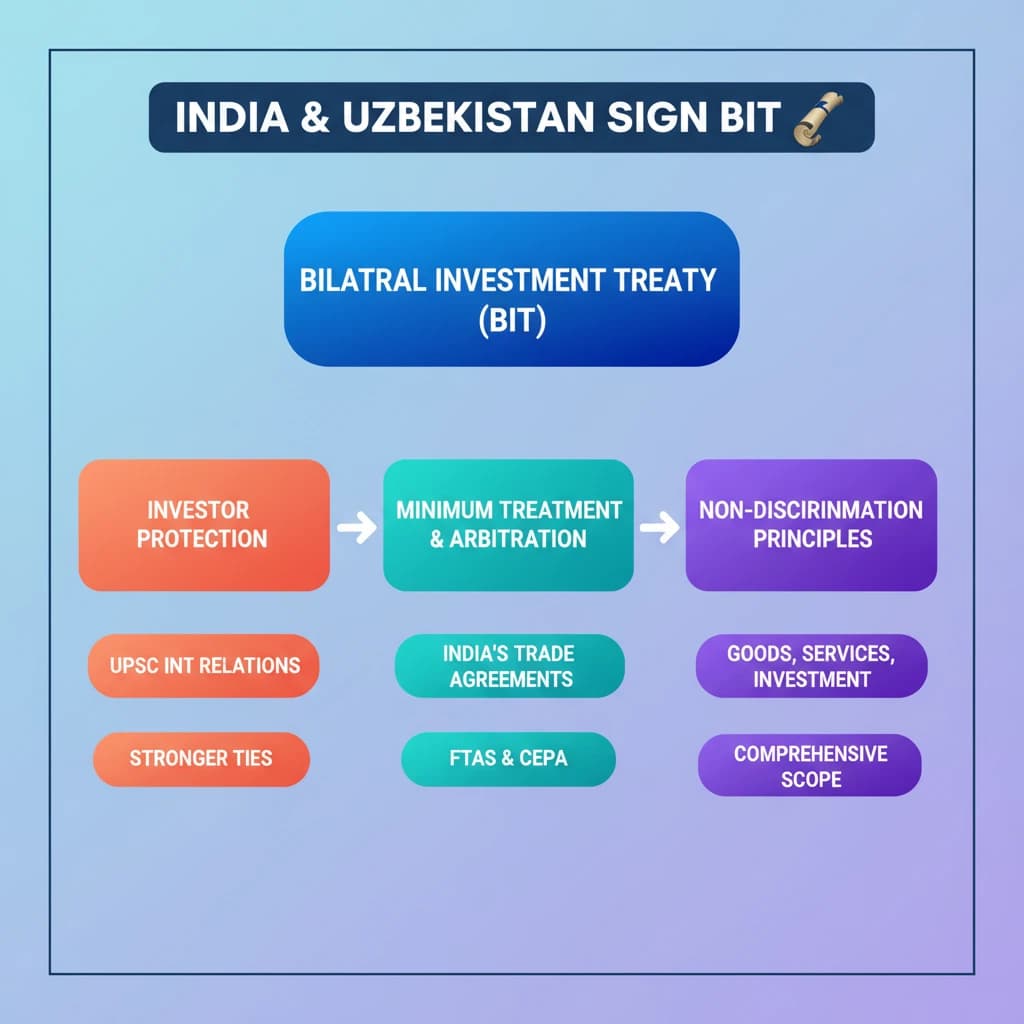
💡 Key Takeaways
- •India and Uzbekistan signed a Bilateral Investment Treaty (BIT) for investor protection.
- •BITs ensure minimum treatment, non-discrimination, and independent arbitration for investors.
- •India engages in various trade agreements: FTAs, EHS, CECAs/CEPAs, PTAs, and Regional FTAs.
- •FTAs offer preferential trade; EHS are precursors to broader deals.
- •CECAs/CEPAs are comprehensive, covering goods, services, and investment, with CEPA having the widest scope.
- •PTAs grant preferential access on a 'positive list' of products.
- •These agreements are crucial for India's economic diplomacy, FDI attraction, and market access.
🧠 Memory Techniques
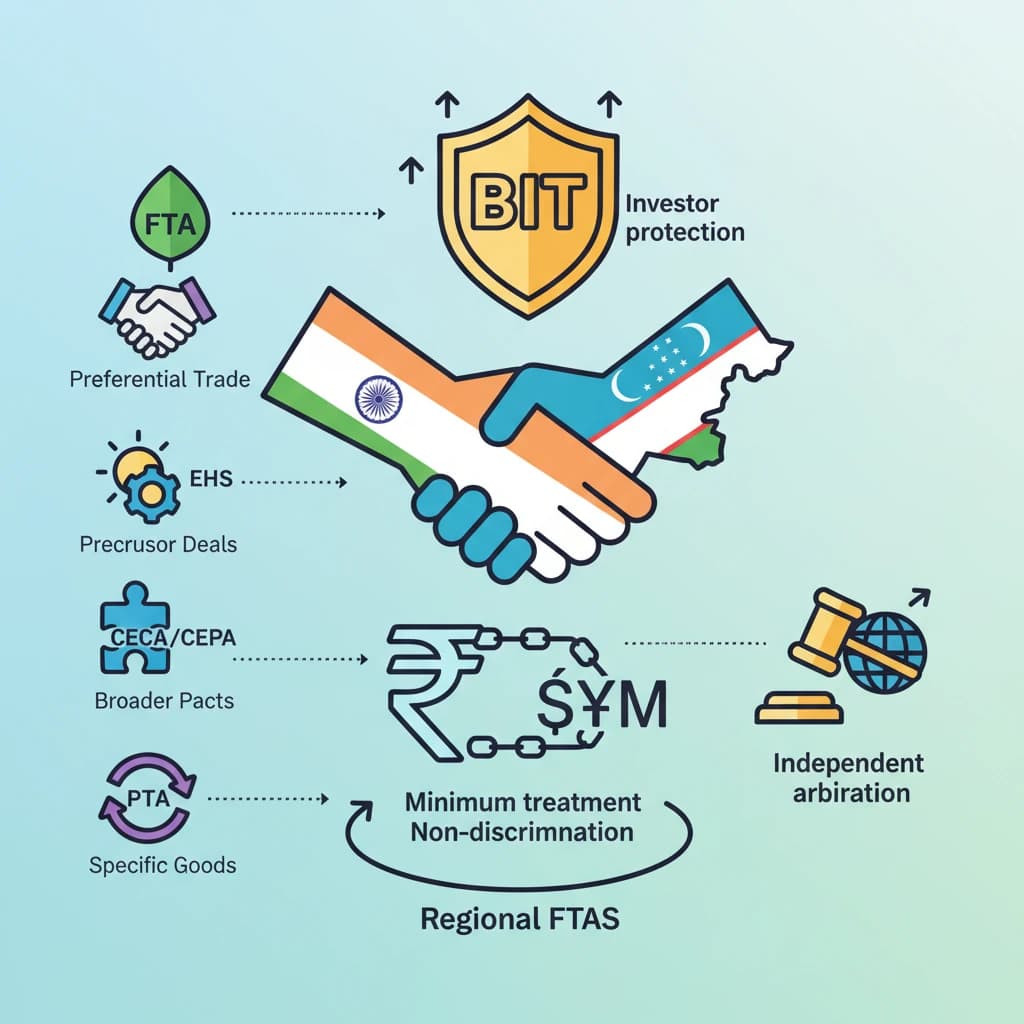
95% Verified Content
📚 Reference Sources
•Ministry of Commerce and Industry, Government of India (general knowledge on trade agreements)
•Press Information Bureau (PIB) releases (for specific agreement details like India-UAE CEPA)