Loading page, please wait…
India Japan 2+2 Foreign and Defence Ministerial Meeting - UPSC International Relations
What is India Japan 2+2 Foreign and Defence Ministerial Meeting in UPSC International Relations?
India Japan 2+2 Foreign and Defence Ministerial Meeting is a key topic under International Relations for UPSC Civil Services Examination. Key points include: The third India-Japan 2+2 meeting focused on deepening bilateral cooperation amidst Indo-Pacific geopolitical tensions.. Both nations reaffirmed commitment to a free, open, and rules-based Indo-Pacific, driven by concerns over China's assertiveness.. Strong support was expressed for ASEAN's unity, centrality, and the ASEAN Outlook on the Indo-Pacific (AOIP).. Understanding this topic is essential for both UPSC Prelims and Mains preparation.
Why is India Japan 2+2 Foreign and Defence Ministerial Meeting important for UPSC exam?
India Japan 2+2 Foreign and Defence Ministerial Meeting is a Medium-level topic in UPSC International Relations. It is tested in both Prelims (factual MCQs) and Mains (analytical answer writing). Previous year UPSC questions have frequently covered aspects of India Japan 2+2 Foreign and Defence Ministerial Meeting, making it essential for comprehensive IAS preparation.
How to prepare India Japan 2+2 Foreign and Defence Ministerial Meeting for UPSC?
To prepare India Japan 2+2 Foreign and Defence Ministerial Meeting for UPSC: (1) Study the comprehensive notes covering all key concepts on Vaidra. (2) Practice previous year questions on this topic. (3) Connect it with current affairs using daily updates. (4) Revise using key takeaways and mind maps available for International Relations. (5) Write practice answers linking India Japan 2+2 Foreign and Defence Ministerial Meeting to related GS Paper topics.
Key takeaways of India Japan 2+2 Foreign and Defence Ministerial Meeting for UPSC
- The third India-Japan 2+2 meeting focused on deepening bilateral cooperation amidst Indo-Pacific geopolitical tensions.
- Both nations reaffirmed commitment to a free, open, and rules-based Indo-Pacific, driven by concerns over China's assertiveness.
- Strong support was expressed for ASEAN's unity, centrality, and the ASEAN Outlook on the Indo-Pacific (AOIP).
- Cooperation within the Quadrilateral Security Dialogue (QUAD) was reaffirmed.
- Defence cooperation is a pillar of their Special Strategic and Global Partnership, reinforced by Japan's 2022 National Security Strategy.
India Japan 2+2 Foreign and Defence Ministerial Meeting
Medium⏱️ 7 min read
international relations
📖 Introduction
Introduction to India-Japan 2+2 Meeting
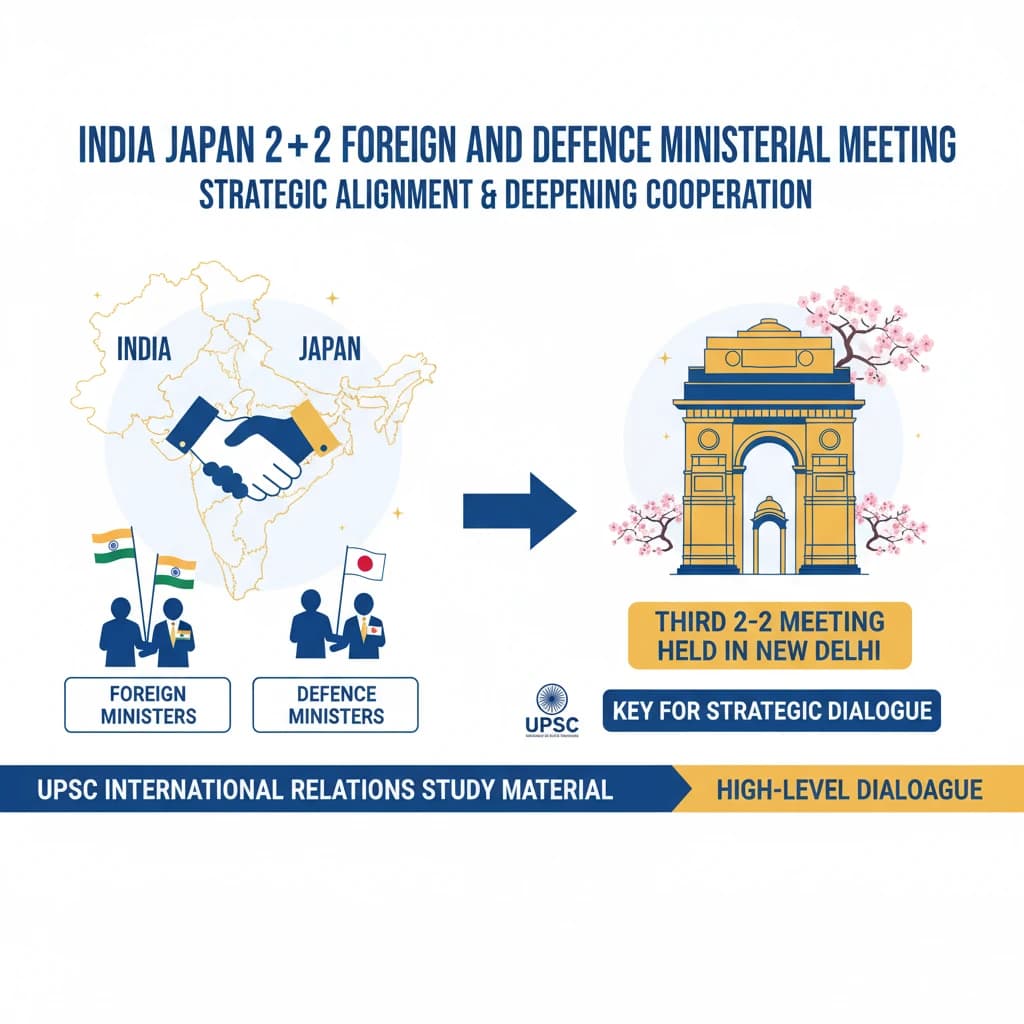
The India-Japan 2+2 Foreign and Defence Ministerial Meeting is a crucial bilateral dialogue mechanism. It involves the Foreign Ministers and Defence Ministers of both nations. These meetings are vital for strategic alignment and deepening cooperation.
The third 2+2 meeting between India and Japan recently took place in New Delhi. This high-level dialogue underscores the growing strategic importance of their partnership.
What is a 2+2 Dialogue?
A 2+2 dialogue involves a meeting between the foreign and defence ministers of two countries. It is considered the highest-level institutional mechanism to review and strategize on security and foreign policy issues.
The discussions were held amidst increasing geopolitical tensions and China’s assertiveness in the Indo-Pacific region. Both countries aimed to deepen bilateral cooperation across various critical sectors.
Commitment to a Free and Open Indo-Pacific (FOIP)
Both India and Japan strongly reiterated their commitment to a free, open, and rules-based Indo-Pacific. This shared vision is a cornerstone of their strategic partnership.
The emphasis on a rules-based Indo-Pacific is primarily driven by China’s growing military presence and activities in the region. It seeks to ensure adherence to international law.
ASEAN's Centrality and AOIP
The ministers expressed strong support for ASEAN’s unity and centrality. They underscored the significance of the ASEAN Outlook on the Indo-Pacific (AOIP).
The AOIP highlights ASEAN’s central role in fostering cooperation, stability, and peace across the Asia-Pacific and Indian Ocean regions. It promotes a rules-based regional order based on the United Nations Charter.
Quadrilateral Security Dialogue (QUAD) Cooperation
Both nations reaffirmed their commitment to advancing cooperation within the Quadrilateral Security Dialogue (QUAD). This follows discussions held at the Quad Foreign Ministers’ Meeting in July 2024.
The QUAD (India, Japan, Australia, US) is a key mechanism for coordinating strategies on Indo-Pacific security and development. Understanding its evolution is crucial for UPSC Mains GS-2.
Security Assistance to Third Countries
Japan and India articulated their intentions to collaborate on providing security assistance to third countries. This initiative aims to contribute to regional peace and stability.
Defence and Security Cooperation as a Pillar
The ministers acknowledged defence cooperation as a fundamental pillar of their Special Strategic and Global Partnership. This highlights the deep trust and shared security interests between the two nations.
Japan's National Security Strategy (2022)
Japan’s National Security Strategy, issued in 2022, has further strengthened the bilateral defence relationship. This strategy reflects Japan's proactive approach to regional security challenges.
💡 Key Takeaways
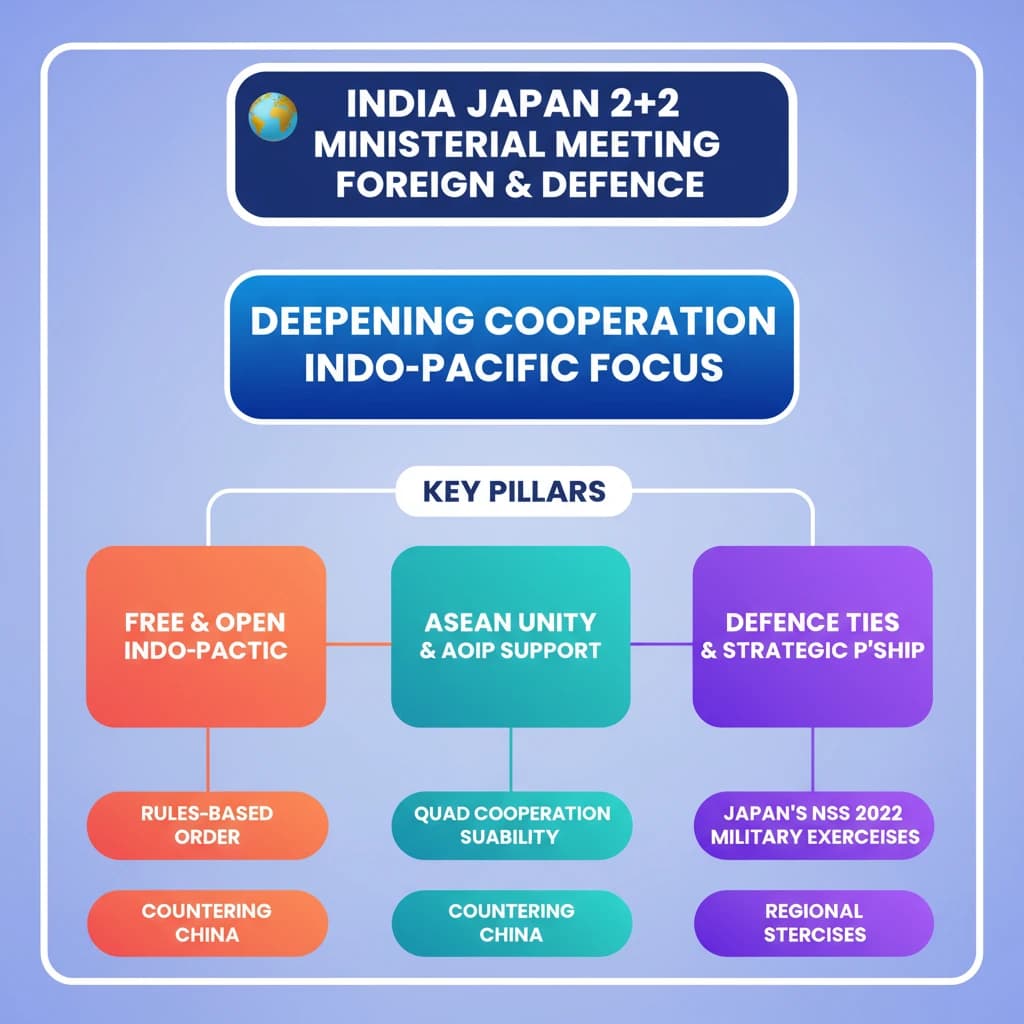
- •The third India-Japan 2+2 meeting focused on deepening bilateral cooperation amidst Indo-Pacific geopolitical tensions.
- •Both nations reaffirmed commitment to a free, open, and rules-based Indo-Pacific, driven by concerns over China's assertiveness.
- •Strong support was expressed for ASEAN's unity, centrality, and the ASEAN Outlook on the Indo-Pacific (AOIP).
- •Cooperation within the Quadrilateral Security Dialogue (QUAD) was reaffirmed.
- •Defence cooperation is a pillar of their Special Strategic and Global Partnership, reinforced by Japan's 2022 National Security Strategy.
🧠 Memory Techniques
95% Verified Content
📚 Reference Sources
•Ministry of External Affairs (MEA), Government of India press releases
•Ministry of Foreign Affairs (MOFA), Japan official statements