Loading page, please wait…
India-Middle-East-Europe Corridor (IMEC) - UPSC International Relations
What is India-Middle-East-Europe Corridor (IMEC) in UPSC International Relations?
India-Middle-East-Europe Corridor (IMEC) is a key topic under International Relations for UPSC Civil Services Examination. Key points include: IMEC was announced at the G20 Summit in September 2023.. It aims to connect India, the Middle East, and Europe through multi-modal transport (railways, roads, ship-to-rail links).. Comprises two corridors: East Corridor (India to Arabian Gulf) and Northern Corridor (Arabian Gulf to Europe).. Understanding this topic is essential for both UPSC Prelims and Mains preparation.
Why is India-Middle-East-Europe Corridor (IMEC) important for UPSC exam?
India-Middle-East-Europe Corridor (IMEC) is a Medium-level topic in UPSC International Relations. It is tested in both Prelims (factual MCQs) and Mains (analytical answer writing). Previous year UPSC questions have frequently covered aspects of India-Middle-East-Europe Corridor (IMEC), making it essential for comprehensive IAS preparation.
How to prepare India-Middle-East-Europe Corridor (IMEC) for UPSC?
To prepare India-Middle-East-Europe Corridor (IMEC) for UPSC: (1) Study the comprehensive notes covering all key concepts on Vaidra. (2) Practice previous year questions on this topic. (3) Connect it with current affairs using daily updates. (4) Revise using key takeaways and mind maps available for International Relations. (5) Write practice answers linking India-Middle-East-Europe Corridor (IMEC) to related GS Paper topics.
Key takeaways of India-Middle-East-Europe Corridor (IMEC) for UPSC
- IMEC was announced at the G20 Summit in September 2023.
- It aims to connect India, the Middle East, and Europe through multi-modal transport (railways, roads, ship-to-rail links).
- Comprises two corridors: East Corridor (India to Arabian Gulf) and Northern Corridor (Arabian Gulf to Europe).
- Includes additional infrastructure like electricity cable, hydrogen pipeline, and high-speed data cable.
- The project seeks to foster regional integration, enhance trade efficiency, and strengthen strategic partnerships.
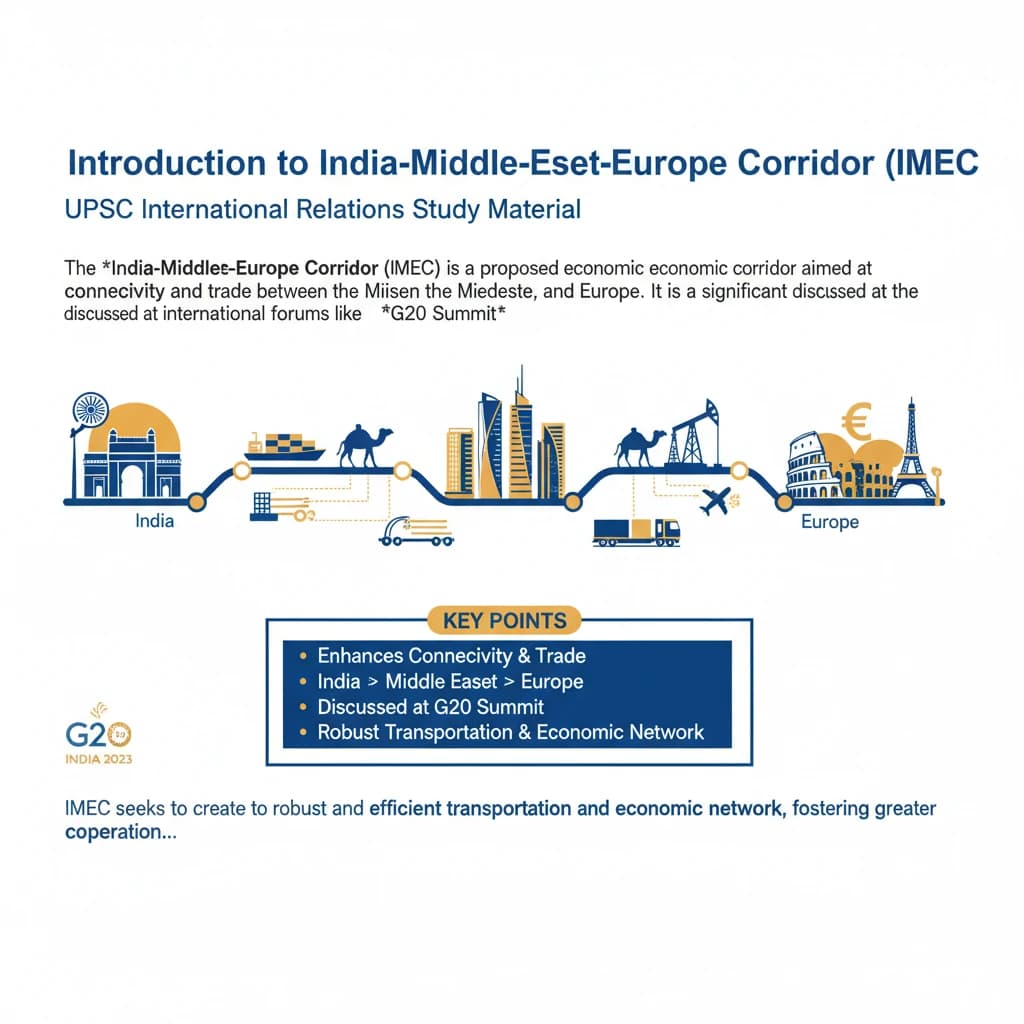
India-Middle-East-Europe Corridor (IMEC)
Medium⏱️ 7 min read
international relations
📖 Introduction
Introduction to the India-Middle-East-Europe Corridor (IMEC)
The India-Middle-East-Europe Economic Corridor (IMEC) project was a landmark initiative announced at the G20 Summit in September 2023. This ambitious corridor aims to significantly enhance connectivity across three major regions.
It is designed to link India, the Middle East, and Europe through a robust network of infrastructure, fostering economic cooperation and regional integration.
Core Objective of IMEC
The primary objective of IMEC is to create a seamless trade and economic pathway. This will facilitate faster movement of goods, services, and energy, ultimately promoting greater prosperity among participating nations.
Key Goal: To foster deep regional integration across Asia, Europe, and the Middle East, serving as a vital economic and strategic bridge.
Components of the Corridor
The IMEC project is envisioned as a multi-modal transport corridor. It will integrate various modes of transport to ensure efficient and effective connectivity.
The network will primarily consist of interconnected railways, roads, and crucial ship-to-rail links, ensuring a comprehensive logistics chain.
The Two Main Corridors
The IMEC is structured around two distinct yet interconnected corridors, each serving a critical geographical segment.
- East Corridor: This segment is designed to link India directly to the Arabian Gulf. It forms the initial leg of the journey from the Indian subcontinent.
- Northern Corridor: This segment connects the Arabian Gulf to Europe. It extends the corridor's reach into the European continent, completing the trans-regional link.
Additional Infrastructure for Enhanced Integration
Beyond traditional transport links, IMEC incorporates advanced infrastructure to support modern economic and energy needs.
The project will feature an electricity cable, a dedicated hydrogen pipeline, and a high-capacity high-speed data cable. These elements underscore a holistic approach to connectivity.
Infrastructure Details: The inclusion of an electricity cable aims to enhance energy grid connectivity, while the hydrogen pipeline supports future clean energy ambitions. The high-speed data cable is critical for digital trade and communication.
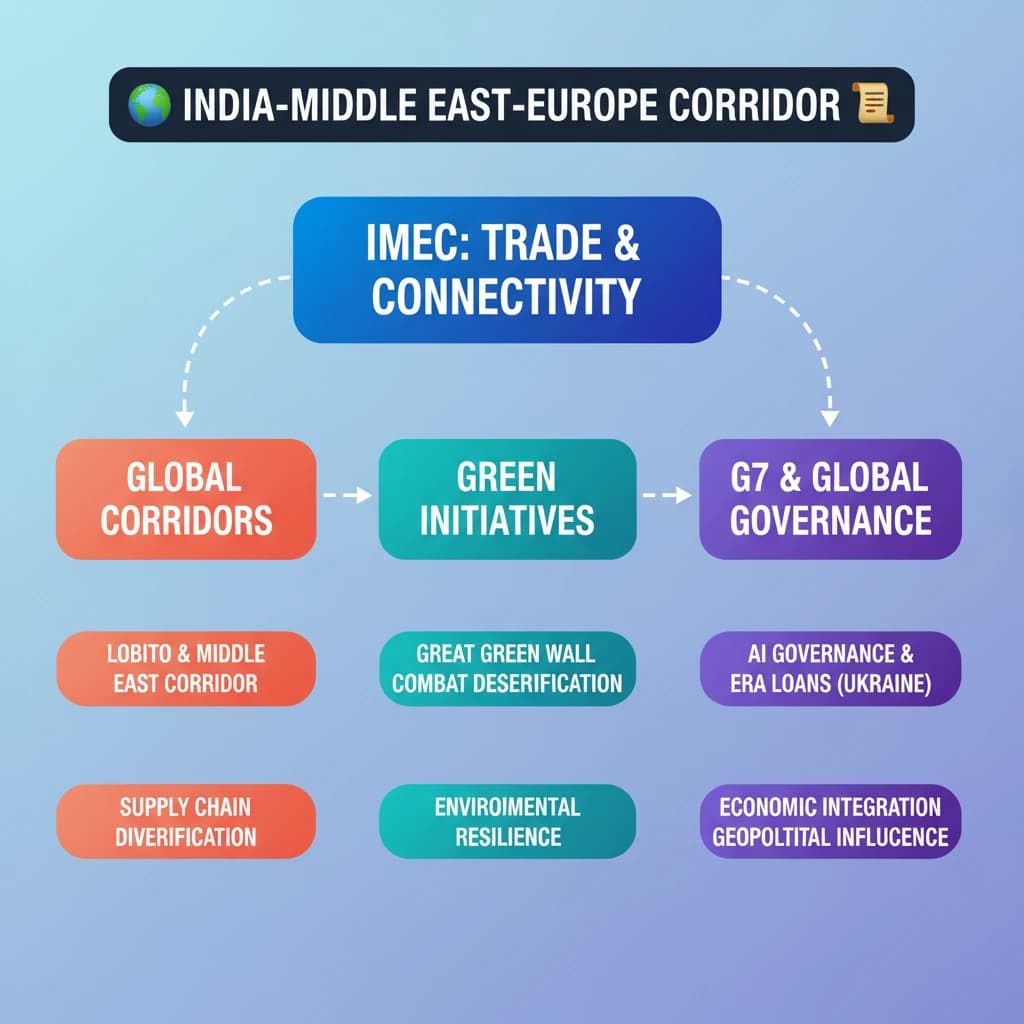
💡 Key Takeaways
- •IMEC was announced at the G20 Summit in September 2023.
- •It aims to connect India, the Middle East, and Europe through multi-modal transport (railways, roads, ship-to-rail links).
- •Comprises two corridors: East Corridor (India to Arabian Gulf) and Northern Corridor (Arabian Gulf to Europe).
- •Includes additional infrastructure like electricity cable, hydrogen pipeline, and high-speed data cable.
- •The project seeks to foster regional integration, enhance trade efficiency, and strengthen strategic partnerships.
🧠 Memory Techniques
95% Verified Content
📚 Reference Sources
•G20 Summit 2023 official statements (e.g., White House, European Commission)
•Ministry of External Affairs (MEA) reports and press releases