Loading page, please wait…
Indian Expatriate - UPSC International Relations
What is Indian Expatriate in UPSC International Relations?
Indian Expatriate is a key topic under International Relations for UPSC Civil Services Examination. Key points include: Approximately 8.9 million Indians reside in Gulf countries, constituting a major part of India's overseas population.. NRIs are Indian citizens living abroad; OCIs are foreign citizens of Indian origin with specific privileges.. Gulf countries contribute 28.6% of India's total inward remittances and one-sixth of its total trade.. Understanding this topic is essential for both UPSC Prelims and Mains preparation.
Why is Indian Expatriate important for UPSC exam?
Indian Expatriate is a Medium-level topic in UPSC International Relations. It is tested in both Prelims (factual MCQs) and Mains (analytical answer writing). Previous year UPSC questions have frequently covered aspects of Indian Expatriate, making it essential for comprehensive IAS preparation.
How to prepare Indian Expatriate for UPSC?
To prepare Indian Expatriate for UPSC: (1) Study the comprehensive notes covering all key concepts on Vaidra. (2) Practice previous year questions on this topic. (3) Connect it with current affairs using daily updates. (4) Revise using key takeaways and mind maps available for International Relations. (5) Write practice answers linking Indian Expatriate to related GS Paper topics.
Key takeaways of Indian Expatriate for UPSC
- Approximately 8.9 million Indians reside in Gulf countries, constituting a major part of India's overseas population.
- NRIs are Indian citizens living abroad; OCIs are foreign citizens of Indian origin with specific privileges.
- Gulf countries contribute 28.6% of India's total inward remittances and one-sixth of its total trade.
- India seeks comprehensive energy cooperation with GCC, including strategic petroleum reserves and long-term gas deals.
- The 1991 Kuwait liberation and subsequent Indian evacuation highlighted the vulnerability and importance of the diaspora.
- Strong India-Gulf ties are crucial for India's energy security, economic growth, and diaspora welfare.
Indian Expatriate
Medium⏱️ 7 min read
international relations
📖 Introduction
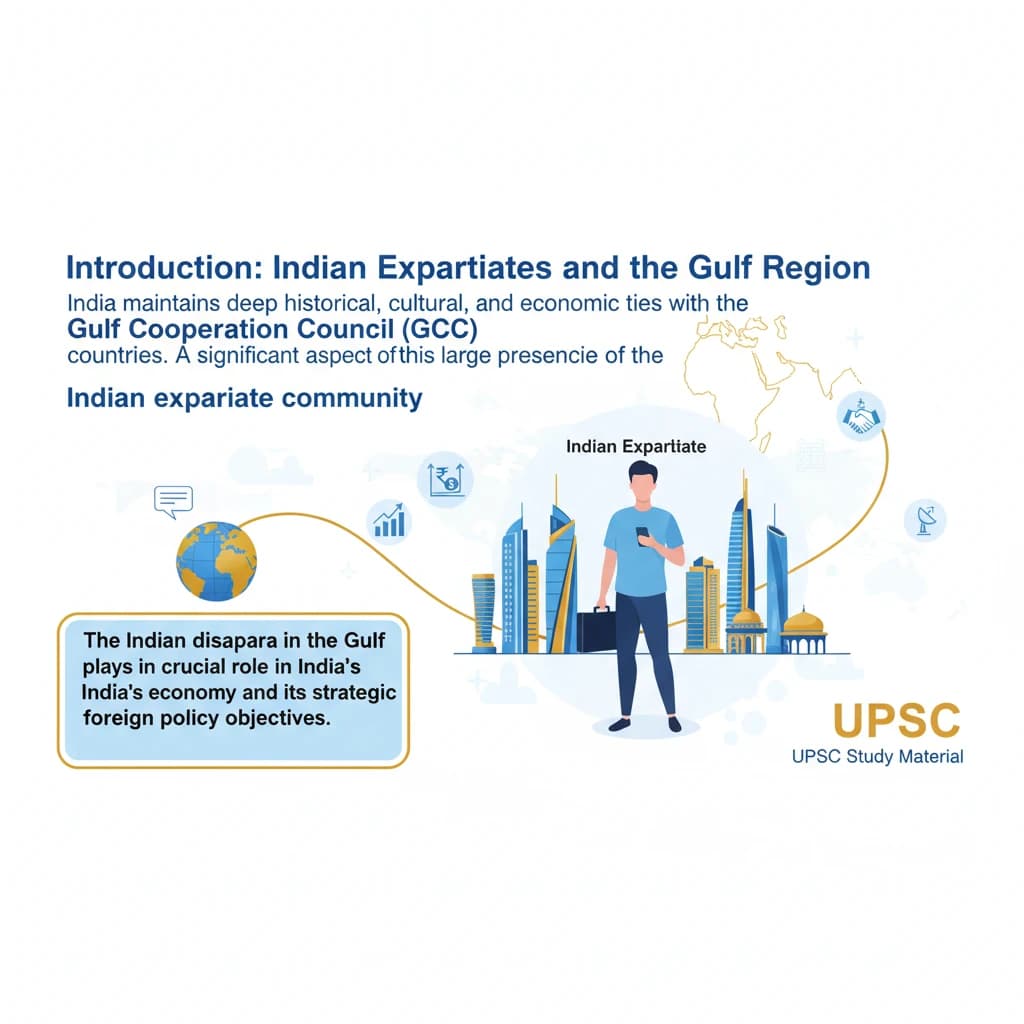
Introduction: Indian Expatriates and the Gulf Region
India maintains deep historical, cultural, and economic ties with the Gulf Cooperation Council (GCC) countries. A significant aspect of this relationship is the large presence of the Indian expatriate community in the region.
The Indian diaspora in the Gulf plays a crucial role in India's economy and its strategic foreign policy objectives.
Context: Kuwait's Liberation (1991)
The term "Kuwait’s liberation" refers to the military operations undertaken in 1991. These operations successfully led to the expulsion of Iraqi forces from Kuwait.
This pivotal event marked the conclusion of the Gulf War. A coalition, spearheaded by the United States, launched a military campaign to free Kuwait from its occupation by Iraq.
The successful liberation of Kuwait was instrumental in restoring the country’s sovereignty and independence, a significant geopolitical event with implications for the region and the Indian diaspora.
Indian Population in Gulf Countries
The Gulf countries host a substantial portion of India's overseas population. This presence underscores the strong socio-economic linkages between India and the region.
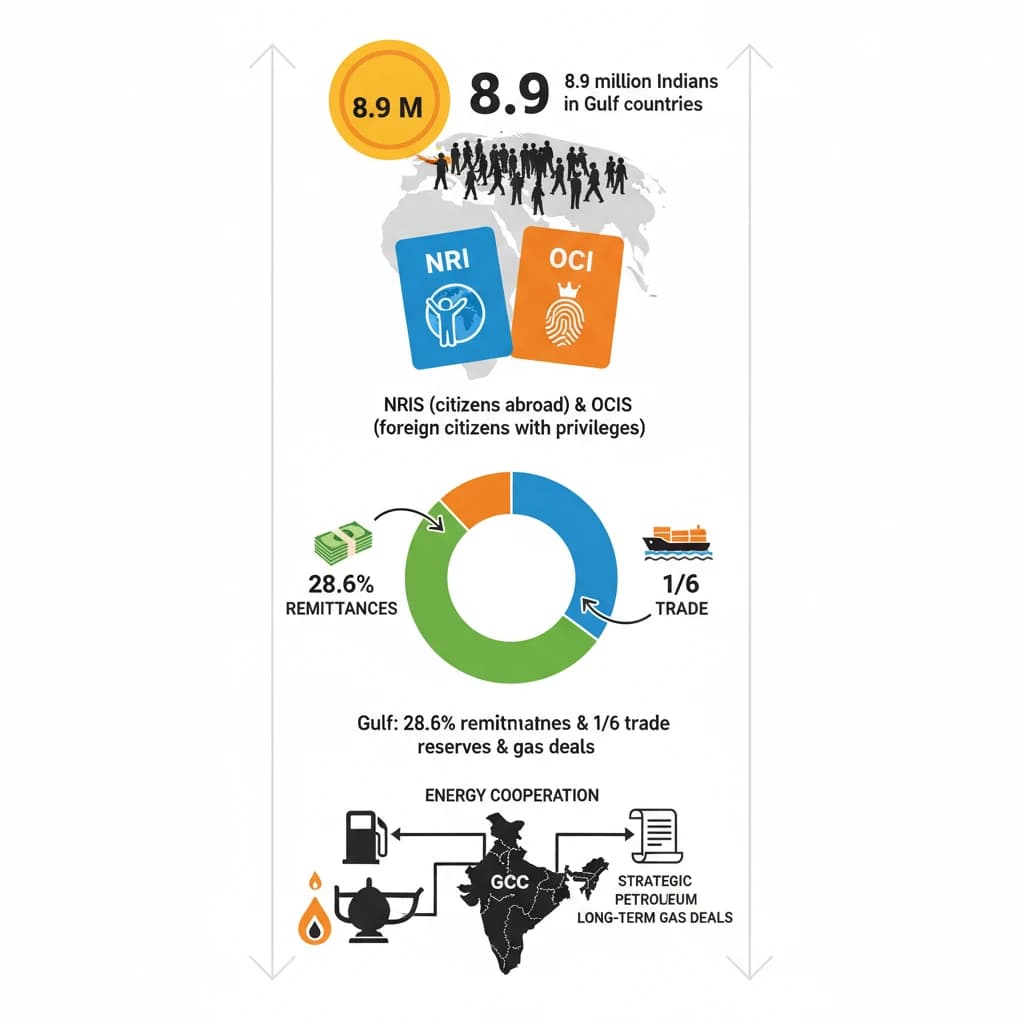
- As of 2021, data from the Government of India indicated approximately 8.9 million Indian migrants residing in the Gulf countries.
- Specifically, 25% of all overseas Indians and 56% of Non-Resident Indians (NRIs) are concentrated in six key Gulf countries.
- These six nations are the UAE, Saudi Arabia, Kuwait, Qatar, Oman, and Bahrain.
Understanding Key Terms: NRI vs. OCI
It is crucial to differentiate between various categories of Indians living abroad to understand their legal status and privileges.
Non-Resident Indians (NRIs): These are individuals who hold Indian citizenship but reside outside of India for a specified period, typically for employment, business, or vocation.
Overseas Citizens of India (OCIs) / Overseas Indians: These individuals originate from foreign countries but possess ancestral ties to India. They are not considered Indian citizens.
However, OCIs are granted specific privileges that are akin to those enjoyed by permanent residents in India, excluding certain political and property rights.
Economic Impact: Inward Remittances
The Indian diaspora, particularly those in the Gulf region, are a significant source of foreign inward remittances, contributing substantially to India's economy.
- Of the total foreign inward remittances received by India, a considerable 28.6% originated from the Gulf countries.
- Among these, Kuwait alone accounted for a notable 2.4% of the total remittances, highlighting its specific contribution.
Bilateral Relations: Trade with Gulf Countries
The Gulf region is a vital trading partner for India, contributing significantly to its overall international trade volume.
- The region accounts for approximately one-sixth of India’s total trade, indicating a strong economic interdependence.
- In the Financial Year 2022-23, India’s trade with the GCC countries reached approximately USD 184 billion.
- This figure represented a substantial 20% increase compared to the Financial Year 2021-22, showcasing growing trade relations.
Strategic Partnership: Energy Cooperation
Energy security is a cornerstone of India's foreign policy, and cooperation with GCC countries is paramount in this regard.
The Government of India has articulated plans to develop a comprehensive relationship with the GCC countries, specifically focusing on energy cooperation.
This strategic approach involves several key initiatives:
- Encouraging GCC participation in India’s strategic petroleum reserves.
- Negotiating long-term gas supply agreements to ensure stable energy imports.
- Seeking concessions in oilfields to enhance India's upstream presence.
- Collaborating on emerging renewable energy projects, aligning with global climate goals.
💡 Key Takeaways
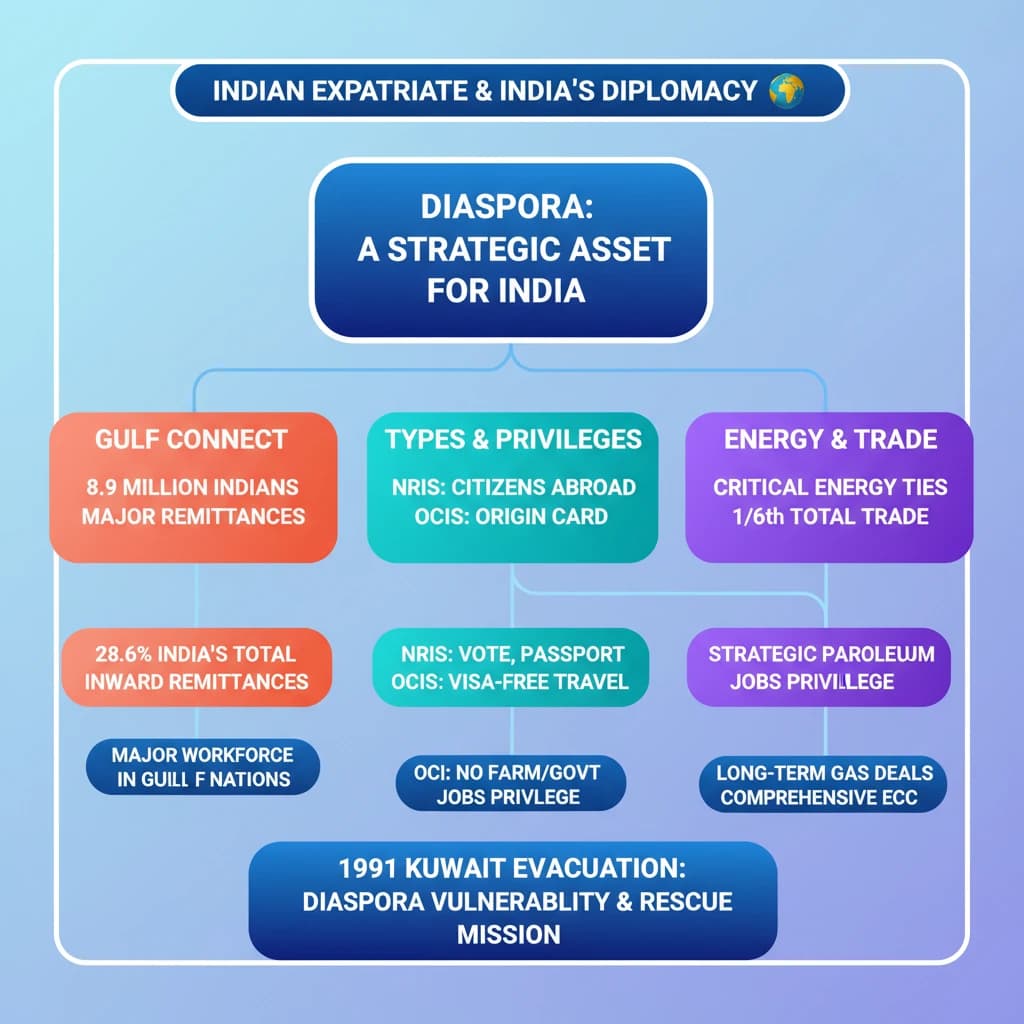
- •Approximately 8.9 million Indians reside in Gulf countries, constituting a major part of India's overseas population.
- •NRIs are Indian citizens living abroad; OCIs are foreign citizens of Indian origin with specific privileges.
- •Gulf countries contribute 28.6% of India's total inward remittances and one-sixth of its total trade.
- •India seeks comprehensive energy cooperation with GCC, including strategic petroleum reserves and long-term gas deals.
- •The 1991 Kuwait liberation and subsequent Indian evacuation highlighted the vulnerability and importance of the diaspora.
- •Strong India-Gulf ties are crucial for India's energy security, economic growth, and diaspora welfare.
🧠 Memory Techniques
95% Verified Content