Loading page, please wait…
Indian Expatriate Community in Gulf Region - UPSC International Relations
What is Indian Expatriate Community in Gulf Region in UPSC International Relations?
Indian Expatriate Community in Gulf Region is a key topic under International Relations for UPSC Civil Services Examination. Key points include: The Indian expatriate community in the Gulf is substantial, contributing significantly to both host economies and India's remittances.. Tragic incidents like the Kuwait fire highlight critical vulnerabilities faced by Indian migrant workers, including safety and living conditions.. The Transfer of Sentenced Persons (TSP) agreement is a key humanitarian mechanism for repatriating Indian prisoners.. Understanding this topic is essential for both UPSC Prelims and Mains preparation.
Why is Indian Expatriate Community in Gulf Region important for UPSC exam?
Indian Expatriate Community in Gulf Region is a Medium-level topic in UPSC International Relations. It is tested in both Prelims (factual MCQs) and Mains (analytical answer writing). Previous year UPSC questions have frequently covered aspects of Indian Expatriate Community in Gulf Region, making it essential for comprehensive IAS preparation.
How to prepare Indian Expatriate Community in Gulf Region for UPSC?
To prepare Indian Expatriate Community in Gulf Region for UPSC: (1) Study the comprehensive notes covering all key concepts on Vaidra. (2) Practice previous year questions on this topic. (3) Connect it with current affairs using daily updates. (4) Revise using key takeaways and mind maps available for International Relations. (5) Write practice answers linking Indian Expatriate Community in Gulf Region to related GS Paper topics.
Key takeaways of Indian Expatriate Community in Gulf Region for UPSC
- The Indian expatriate community in the Gulf is substantial, contributing significantly to both host economies and India's remittances.
- Tragic incidents like the Kuwait fire highlight critical vulnerabilities faced by Indian migrant workers, including safety and living conditions.
- The Transfer of Sentenced Persons (TSP) agreement is a key humanitarian mechanism for repatriating Indian prisoners.
- The 1990-91 Gulf War significantly impacted the Indian community in Kuwait, leading to a mass exodus and subsequent return as the largest expatriate group.
- India actively pursues bilateral agreements and welfare schemes (e.g., e-Migrate, ICWF) to protect its diaspora in the Gulf.
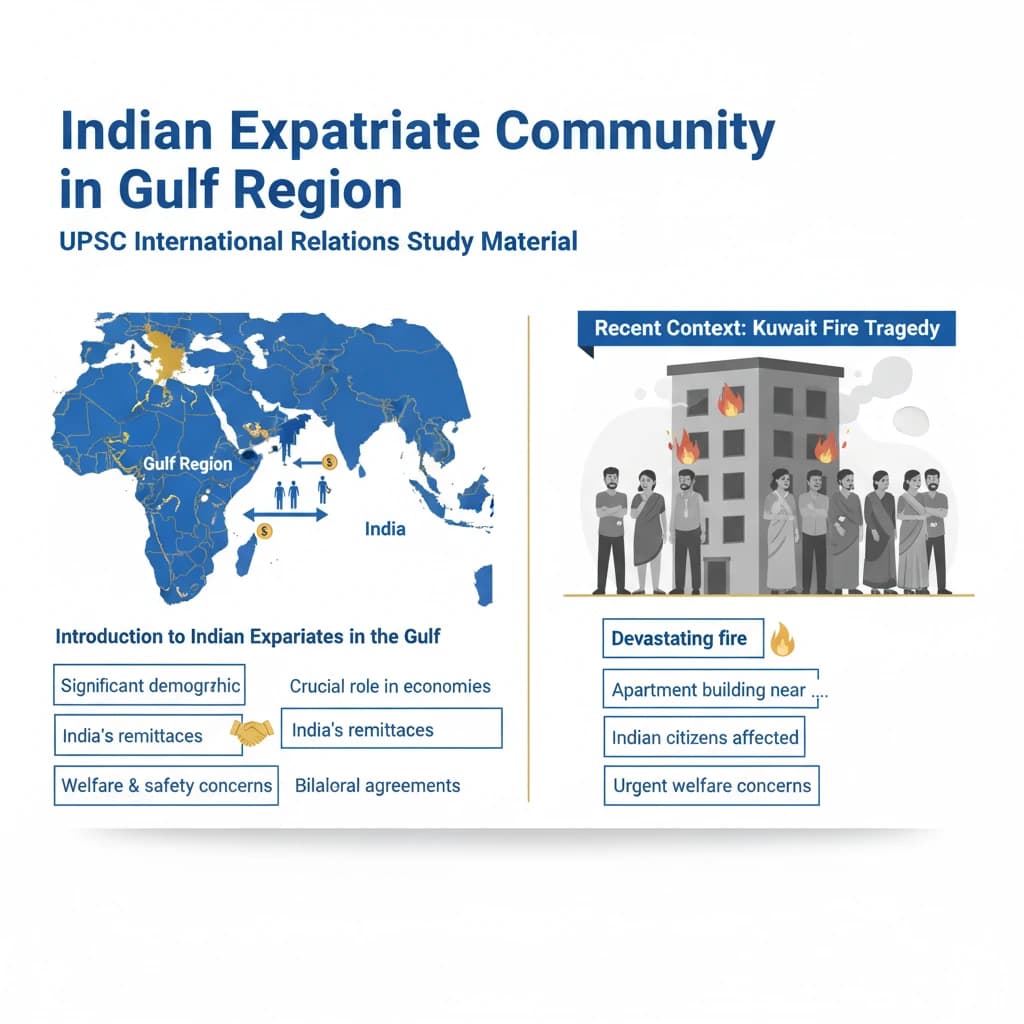
Indian Expatriate Community in Gulf Region
Medium⏱️ 8 min read
international relations
📖 Introduction
Introduction to Indian Expatriates in the Gulf
The Indian expatriate community in the Gulf Region is a significant demographic, playing a crucial role in both the host countries' economies and India's remittances.
Their welfare and safety are paramount concerns, often highlighted by various incidents and bilateral agreements.
Recent Context: Kuwait Fire Tragedy
A devastating fire recently erupted in an apartment building near Kuwait City, leading to a tragic loss of life.
At least 49 individuals perished in the incident, with approximately 40 victims identified as Indian nationals.
- The apartment building housed over 195 workers.
- The majority of these workers were Indian nationals.
- Victims hailed primarily from Kerala, Tamil Nadu, and various parts of northern India.
This incident underscores the vulnerabilities faced by migrant workers in the Gulf and the importance of worker safety regulations and bilateral agreements.
Understanding 'Expatriate'
An expatriate is defined as an individual who lives and/or works in a country different from their country of citizenship.
This arrangement is typically temporary and often driven by work-related reasons.
An expatriate can also refer to an individual who has formally renounced citizenship in their home country to become a citizen of another nation.
The Transfer of Sentenced Persons (TSP) Framework
The Transfer of Sentenced Persons (TSP) agreement is a crucial mechanism enabling the transfer of prisoners between member states and other acceding countries.
Under this framework, sentenced individuals can seek to serve the remainder of their sentences in their home country.
- From 2004 to January 2022, a total of 86 prisoners were transferred under the TSP.
- This included 75 imprisoned Indian nationals who were transferred to India.
- Additionally, 11 foreign prisoners were transferred to their respective countries.
The TSP mechanism is vital for humanitarian reasons, allowing prisoners to be closer to their families and cultural environment, facilitating rehabilitation.
Current State of Indian Workers in the Gulf Region
The Gulf Region hosts a significant number of Indian workers, who are primarily engaged in various sectors, contributing substantially to the economies of these nations.
Despite their contributions, these workers often face challenges related to working conditions, legal protections, and social integration.
Evolution of the Indian Community in Kuwait
The history of the Indian community in Kuwait has seen significant shifts, particularly influenced by regional conflicts.
The 1990-1991 Gulf War triggered a mass exodus of Indian nationals from Kuwait.
Following Kuwait's liberation, a majority of the Indian community gradually returned, re-establishing their presence.
Subsequently, Indians became the largest expatriate community in Kuwait.
Prior to the liberation war, the Palestinians constituted the largest expatriate community in Kuwait.
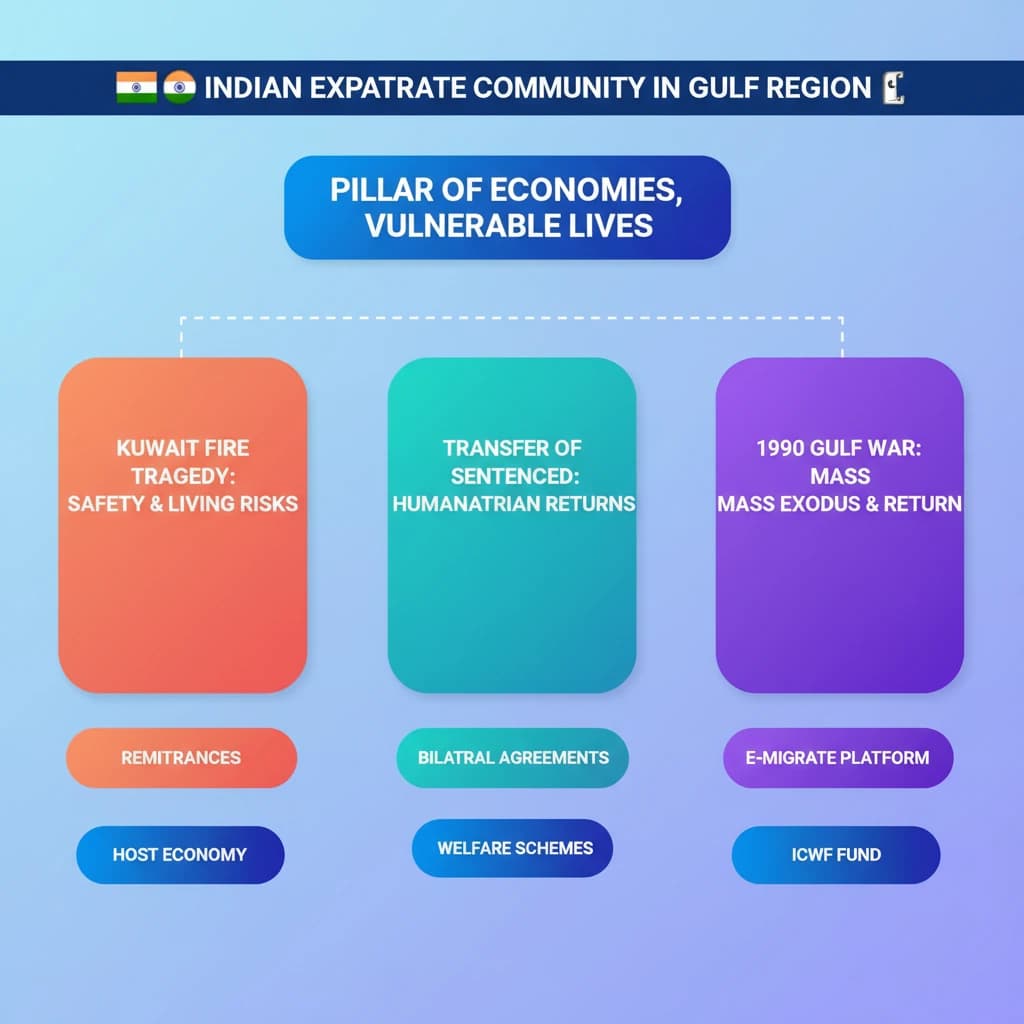
💡 Key Takeaways
- •The Indian expatriate community in the Gulf is substantial, contributing significantly to both host economies and India's remittances.
- •Tragic incidents like the Kuwait fire highlight critical vulnerabilities faced by Indian migrant workers, including safety and living conditions.
- •The Transfer of Sentenced Persons (TSP) agreement is a key humanitarian mechanism for repatriating Indian prisoners.
- •The 1990-91 Gulf War significantly impacted the Indian community in Kuwait, leading to a mass exodus and subsequent return as the largest expatriate group.
- •India actively pursues bilateral agreements and welfare schemes (e.g., e-Migrate, ICWF) to protect its diaspora in the Gulf.
🧠 Memory Techniques

95% Verified Content